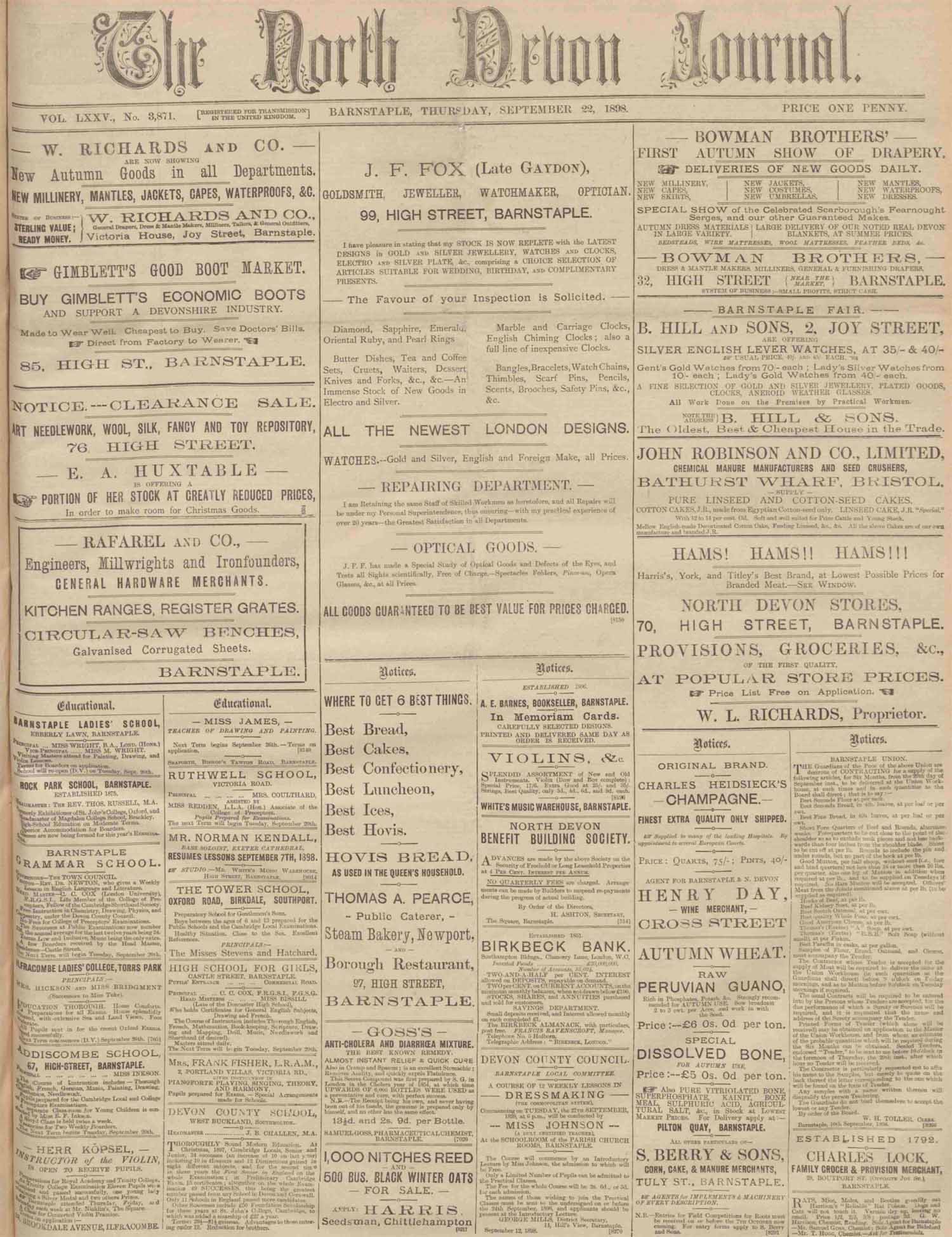
Exeter Flying Post – Wednesday 18 April 1883
SCENE IN DARTMOOR PRISON.
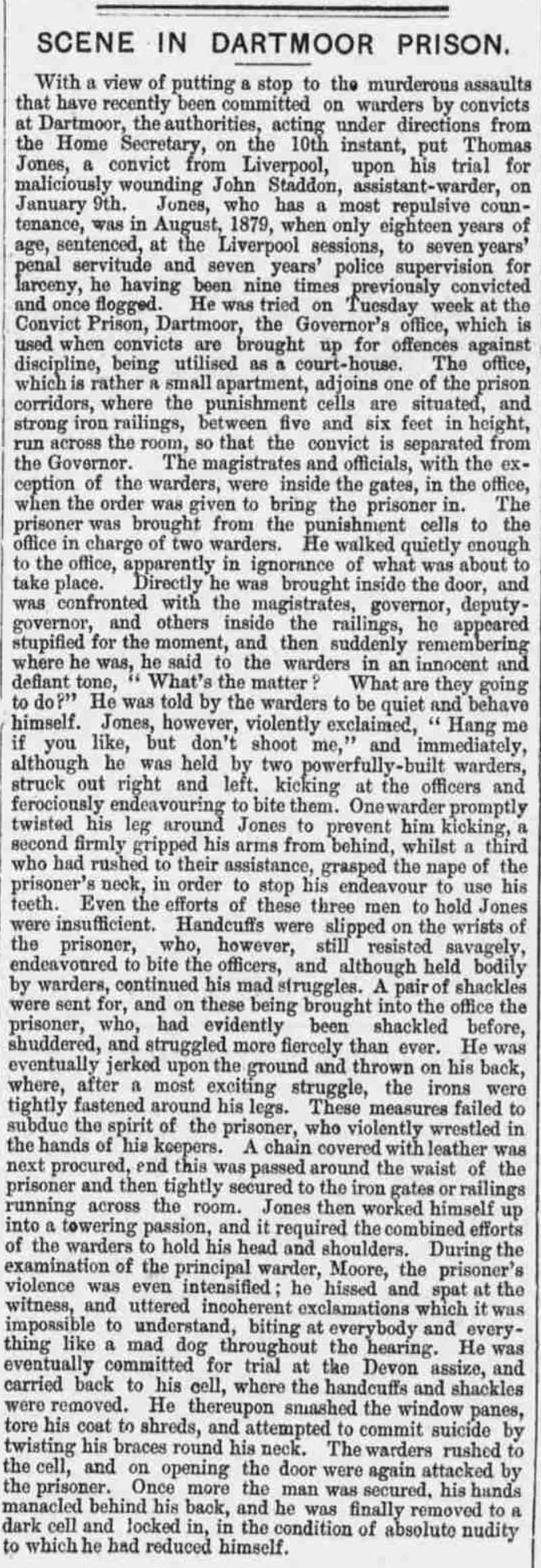
With a view of putting a stop to the murderous assaults that have recently been committed on warders by convicts at Dartmoor, the authorities, acting under directions from the Home Secretary, on the 10th instant, put Thomas Jones, a convict from Liverpool, upon his trial for maliciously wounding John Staddon, assistant-warder, on January 9th. Jones, who has a most repulsive countenance, was in August, 1879, when only eighteen years of age, sentenced at the Liverpool sessions, to seven years’ penal servitude and seven years’ police supervision for larceny, he having been nine times previously convicted and once flogged. He was tried on Tuesday week at the Convict Prison, Dartmoor, the Governor’s office, which is used when convicts are brought up for offences against discipline, being utilised as a court-house. The office, which is rather a small apartment, adjoins one of the prison corridors, where the punishment cells are situated, and strong iron railings, between five and six feet in height, run across the room, so that the convict is separated from the Governor. The magistrates and officials, with the exception of the warders, were inside the gates, in the office, when the order was given to bring the prisoner in. The prisoner was brought from the punishment cells to the office in charge of two warders. He walked quietly enough to the office, apparently in ignorance of what was about to take place. Directly he was brought inside the door, and was confronted with the magistrates, governor, deputy-governor, and others inside the railings, he appeared stupified for the moment, and then suddenly remembering where he was, he said to the warders in an innocent and defiant tone, “What’s the matter? What are they going to do?” He was told by the warders to be quiet and behave himself. Jones, however, violently exclaimed, “Hang me if you like, but don’t shoot me,” and immediately, although he was held by two powerfully-built warders, struck out right and left, kicking at the officers and ferociously endeavouring to bite them. One warder promptly twisted his leg around Jones to prevent him kicking, a second firmly gripped his arms from behind, whilst a third who had rushed to their assistance, grasped the nape of the prisoner’s neck, in order to stop his endeavour to use his teeth. Even the efforts of these three men to hold Jones were insufficient. Handcuffs were slipped on the wrists of the prisoner, who, however, still resisted savagely, endeavoured to bite the officers, and although held bodily by warders, continued his mad struggles. A pair of shackles were sent for, and on these being brought into the office the prisoner, who, had evidently been shackled before, shuddered, and struggled more fiercely than ever. He was eventually jerked upon the ground and thrown on his back, where, after a most exciting struggle, the irons were tightly fastened around his legs. These measures failed to subdue the spirit of the prisoner, who violently wrestled in the hands of his keepers. A chain covered with leather was next procured, and this was passed around the waist of the prisoner and then tightly secured to the iron gates or railings running across the room. Jones then worked himself up into a towering passion, and it required the combined efforts of the warders to hold his head and shoulders. During the examination of the principal warder, Moore, the prisoner’s violence was even intensified; he hissed and spat at the witness, and uttered incoherent exclamations which it was impossible to understand, biting at everybody and everything like a mad dog throughout the hearing. He was eventually committed for trial at the Devon assize, and carried back to his cell, where the handcuffs and shackles were removed. He thereupon smashed the window panes, tore his coat to shreds, and attempted to commit suicide by twisting his braces round his neck. The warders rushed to the cell, and on opening the door were again attacked by the prisoner. Once more the man was secured, his hands manacled behind his back, and he was finally removed to a dark cell and locked in, in the condition of absolute nudity to which he had reduced himself.
Historical and Legal Analysis (1883)
📜 The Legal Context
-
Malicious Wounding: At the time, malicious wounding was a serious offence under the Offences Against the Person Act 1861, which categorised such acts as felonies with punishments including penal servitude.
-
Penal Servitude: Jones was sentenced to seven years penal servitude, a harsh form of imprisonment that included hard labour, poor rations, and isolation.
-
Police Supervision: This referred to a form of post-prison surveillance under the Prevention of Crimes Act 1871, where released convicts had to report regularly to authorities.
⚖️ Prison Law and Discipline
-
Dartmoor was a convict prison, meaning it held men serving penal servitude sentences. It was known for extreme isolation, harsh physical punishment, and often brutal discipline.
-
The use of handcuffs, leg-irons, chains, and confinement in a dark cell in a state of nudity reflects the era’s approach to physical restraint and control.
-
The Home Secretary’s intervention signals the gravity of repeated assaults on warders—a clear crisis in prison discipline.
People, Occupations, Institutions
-
Thomas Jones: Young, repeatedly convicted thief from Liverpool. Described as “repulsive” and violent.
-
John Staddon: Assistant-warder at Dartmoor Prison, the victim of the assault.
-
Moore: Principal warder, likely in charge of internal prison discipline.
-
Governor and Deputy-Governor: Senior prison officials tasked with order and administration.
-
Magistrates: Presided over internal prison hearings, though this article highlights how precarious and violent such hearings could become.
Dartmoor Prison Life in 1883
Life was brutal and dehumanising:
-
Prisoners were punished with floggings, irons, and isolation.
-
Mental health concerns were misunderstood and treated with physical punishment.
-
Staff worked in daily danger, often relying on force and collective action for safety.
-
The article portrays Dartmoor as a place of extreme discipline but also crumbling under the weight of convict violence and systemic issues.
Usefulness to Historians & Genealogists
This article offers:
-
A named convict (Thomas Jones), with location (Liverpool), crime (larceny), and trial date (1879).
-
Information on prison staff, such as John Staddon and Moore.
-
Detailed descriptions of prison layout, daily operations, and judicial procedures.
-
Valuable for tracing criminal ancestors, especially those imprisoned at Dartmoor.
-
Insight into prison discipline practices, making it vital for social historians and legal researchers.
History of The Exeter Flying Post

Established in 1763, The Exeter Flying Post was one of the earliest and most influential regional newspapers in England. It served Exeter, Devon, and the wider West Country with news, commentary, public notices, and advertisements for over 150 years. Its development reflects the evolution of the British press and the changing landscape of public information in Georgian, Victorian, and Edwardian society.
Founding and Early Years
The paper was founded by Andrew Brice, a noted Exeter printer, author, and radical thinker. Brice had previously produced a paper known as The Exeter Post-Man, but in 1763, he launched The Exeter Flying Post, or Plymouth and Cornish Advertiser as a more robust and independent news sheet. From the outset, it was liberal in tone, locally focused, and nationally aware.
Brice’s mission was to provide news not only to the landed gentry and urban elite but also to the middle and mercantile classes of Exeter and surrounding counties. At a time when literacy was spreading and the appetite for printed news growing, the Flying Post emerged as a vital link between regional affairs and national currents.
Content and Reach
Throughout the 18th and early 19th centuries, The Exeter Flying Post:
-
Reported on Parliamentary debates, especially those affecting trade, taxation, and regional economies.
-
Covered local assizes and petty sessions, making it invaluable for those researching crime, legal history, or family genealogy.
-
Printed shipping news, agricultural prices, theatre listings, and local events, offering insights into the social and economic rhythms of Devon life.
-
Carried birth, marriage, and death notices, often being the sole record of such events for non-churchgoers or non-conformists.
It circulated not only in Exeter but throughout East and Mid Devon, parts of Somerset, Dorset, and Cornwall.
Printing and Publishing
In its early years, the newspaper was produced using wooden hand presses and printed in Brice’s own shop in Exeter’s Fore Street. Issues were typically four pages long, filled with dense columns of tightly packed type. As printing technology advanced, the Flying Post kept pace with mechanised presses, allowing for greater distribution and quicker turnarounds.
By the mid-19th century, the paper had expanded to 8 or even 12 pages, incorporating illustrations, line drawings, and letterpress advertisements, and was printed on steam-powered presses.
Political Leanings and Editorial Stance
In its early days under Brice, the Flying Post had a Whiggish orientation, advocating civil liberties, opposing arbitrary government power, and supporting reforms. In the 19th century, it became firmly Liberal, in contrast to the rival Western Times, which often leaned more conservative.
It supported key Liberal causes such as:
-
The Great Reform Act of 1832
-
Abolition of slavery
-
Expansion of the franchise
-
Disestablishment of the Church of Ireland
However, the Flying Post remained editorially independent and retained a strong local voice, criticising politicians and institutions of all stripes when local interests were affected.
Role in Society and Public Life
The Exeter Flying Post played a key role in:
-
Informing electors and political societies during campaigns and elections
-
Announcing market days, fairs, and social functions
-
Publishing lists of bankruptcies, land sales, and criminal trials
-
Circulating poetry, moral essays, and editorial sermons
For working-class readers, it became a window into national discourse; for the middle class, a forum for commerce and debate.
The paper also supported public campaigns, including better working conditions, improvements to Exeter’s sanitation and water systems, and expanded access to education.
Decline and Merger
Like many regional papers, the Flying Post struggled in the early 20th century, faced with rising costs, declining readership, and growing competition from London-based dailies and illustrated weeklies.
In 1917, after 154 years in print, the paper ceased independent publication. It was merged with the Devon and Exeter Gazette, and its title was gradually retired. The archives of the Exeter Flying Post, however, survive in libraries and historical collections, providing a unique and invaluable record of West Country life.
Importance for Historians and Genealogists
The Exeter Flying Post is a treasure trove for researchers, offering:
-
First-hand reports of court cases, often listing names, ages, occupations, and places of origin
-
Notices of births, deaths, marriages, bankruptcies, and property transfers
-
Insight into social conditions, especially regarding the poor, convicts, and working classes
-
Advertisements revealing trade, business ownership, and migration
-
Political coverage shedding light on local reactions to national events
It is especially useful for:
-
Tracing criminal ancestors or those imprisoned in Dartmoor or Exeter Gaol
-
Understanding regional economic trends, e.g., agricultural prices and industrial shifts
-
Reconstructing family and community histories in Devon and neighbouring counties.
Summary
| Year Founded | 1763 by Andrew Brice |
|---|---|
| Political Leaning | Liberal / Whig |
| Coverage Area | Exeter, Devon, West Country |
| Final Year of Publication | 1917 (merged with Devon and Exeter Gazette) |
| Value to Historians | Court records, local affairs, genealogical data, social history |
In Brief
Victorian prison horror at Dartmoor, 1883: Convict Thomas Jones violently assaults officers during trial in Governor’s office. Mental decline, restraint, and a dark cell follow. #PrisonHistory #Dartmoor #VictorianCrime #Genealogy #ExeterFlyingPost #HistoryMatters #LiverpoolHistory