Monmouthshire Beacon – Friday 23 November 1900
Monmouth, Monmouthshire Borough
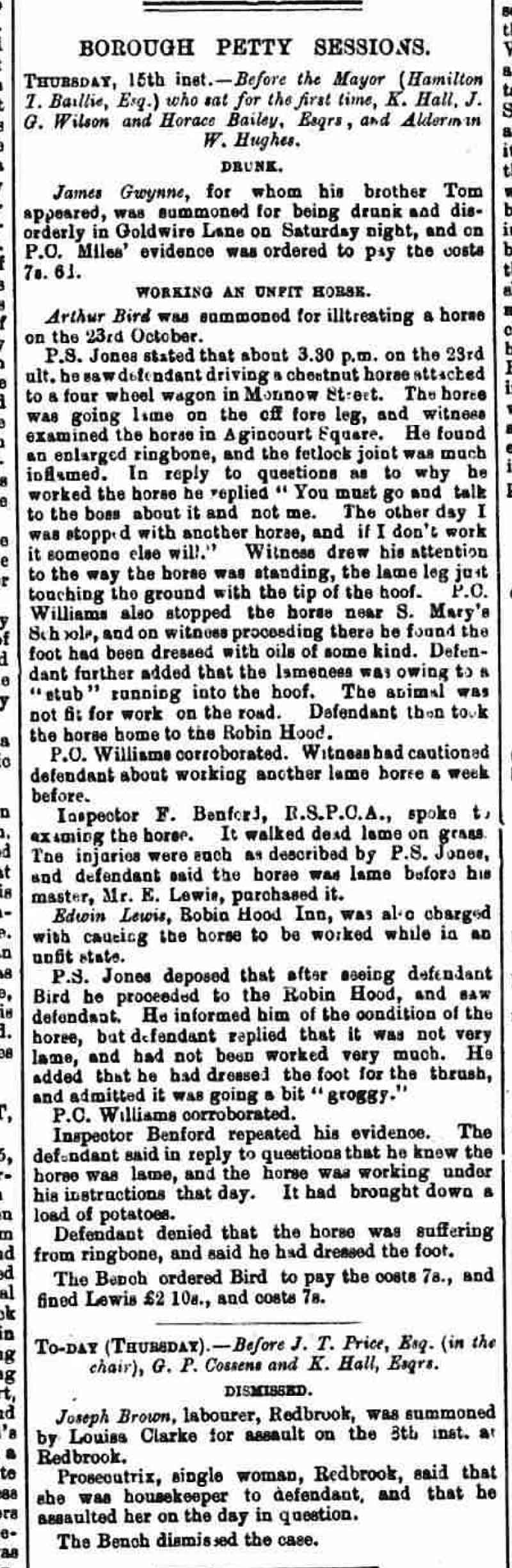
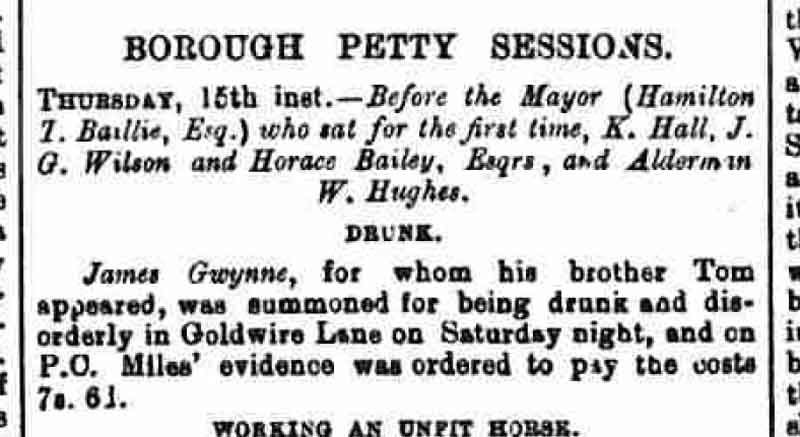
Thursday, 15th inst.—Before the Mayor (Hamilton T. Baillie, Esq.) who sat for the first time, K. Hall, J. G. Wilson and Horace Bailey, Esqs., and Alderman W. Hughes.
DRUNK.
James Gwynne, for whom his brother Tom appeared, was summoned for being drunk and disorderly in Goldwire Lane on Saturday night, and on P.C. Miles’ evidence was ordered to pay the costs 7s. 6d.
WORKING AN UNFIT HORSE.
Arthur Bird was summoned for ill-treating a horse on the 23rd October.
P.S. Jones stated that about 3.30 p.m. on the 23rd ult., he saw defendant driving a chestnut horse attached to a four-wheel wagon in Monnow Street. The horse was going lame on the off fore leg, and witness examined the horse in Agincourt Square. He found an enlarged ringbone, and the fetlock joint was much inflamed. In reply to questions as to why he worked the horse he replied: “You must go and talk to the boss about it and not me. The other day I was stopped with another horse, and if I don’t work it someone else will.”
Witness drew his attention to the way the horse was standing, the lame leg just touching the ground with the tip of the hoof. P.C. Williams also stopped the horse near St. Mary’s Schools, and on witness proceeding there he found the foot had been dressed with oils of some kind. Defendant further added that the lameness was owing to a “stub” running into the hoof. The animal was not fit for work on the road. Defendant then took the horse home to the Robin Hood.
P.C. Williams corroborated. Witness had cautioned defendant about working another lame horse a week before.
Inspector F. Benford, R.S.P.C.A., spoke to examining the horse. It walked dead lame on grass. The injuries were such as described by P.S. Jones, and defendant said the horse was lame before his master, Mr. E. Lewis, purchased it.
Edwin Lewis, Robin Hood Inn, was also charged with causing the horse to be worked while in an unfit state.
P.S. Jones deposed that after seeing defendant Bird he proceeded to the Robin Hood, and saw defendant. He informed him of the condition of the horse, but defendant replied that it was not very lame, and had not been worked very much. He added that he had dressed the foot for the thrush, and admitted it was going a bit “groggy.”
P.C. Williams corroborated.
Inspector Benford repeated his evidence. The defendant said in reply to questions that he knew the horse was lame, and the horse was working under his instructions that day. It had brought down a load of potatoes.
Defendant denied that the horse was suffering from ringbone, and said he had dressed the foot.
The Bench ordered Bird to pay the costs 7s., and fined Lewis £2 10s., and costs 7s.
TO-DAY (THURSDAY).—Before J. T. Price, Esq. (in the chair), G. P. Cossens and K. Hall, Esqs.
DISMISSED.
Joseph Brown, labourer, Redbrook, was summoned by Louisa Clarke for assault on the 5th inst. at Redbrook.
Prosecutrix, single woman, Redbrook, said that she was housekeeper to defendant, and that he assaulted her on the day in question.
The Bench dismissed the case.
Historical and Legal Analysis
Legal Framework & Social Implications (c. 1900):
-
Drunkenness (James Gwynne):
-
Public order offences such as drunkenness were minor yet common offences.
-
A 7s. 6d. fine was a modest sum but significant for a working-class person (equivalent to a labourer’s few days’ wages).
-
Indicates community enforcement of moral and social order.
-
-
Animal Welfare (Arthur Bird & Edwin Lewis):
-
Early use of animal cruelty legislation, especially after the foundation of the RSPCA (1824).
-
Demonstrates evolving public conscience and formal law around animal treatment.
-
Ringbone and thrush were known equine conditions; the case underscores early vet knowledge and its use in law.
-
-
Liability of Employers (Lewis):
-
Lewis, as innkeeper and employer, was fined more heavily than Bird, suggesting employer responsibility.
-
Reflects early employer liability laws and societal expectations.
-
-
Dismissed Assault Case (Louisa Clarke vs Joseph Brown):
-
Reflects how hard it was for women, especially single women or servants, to get justice in male-dominated courts.
-
May reflect societal bias or lack of corroborative evidence.
-
People, Occupations, and Institutions:
-
Hamilton T. Baillie: New mayor presiding for the first time. Likely from local gentry or mercantile elite.
-
Edwin Lewis: Publican of the Robin Hood Inn, employer of labourers like Bird.
-
Arthur Bird: Possibly a stable-hand, carter or driver.
-
Joseph Brown: Labourer — a broad term for unskilled or semi-skilled working-class man.
-
Louisa Clarke: Housekeeper — an important domestic position, though vulnerable.
-
P.S. Jones / P.C. Williams: Police officers; their testimony was central to prosecutions.
-
Inspector Benford: RSPCA representative; early advocate for animal welfare.
Life in Monmouth in 1900: A Historical Portrait
An Edwardian Border Town on the Cusp of Change
In 1900, Monmouth was a market town of considerable antiquity and quiet charm, nestled in the Wye Valley on the border between England and Wales. Although small in scale, with a population estimated at just over 5,000, it was a town of civic importance, being the county town of Monmouthshire. Its rhythms were those of a society still deeply rooted in the traditions of the 19th century, yet beginning to encounter the modern world.
Built Environment and Appearance
Monmouth in 1900 was picturesque and modest, characterised by its narrow streets, Georgian and Victorian townhouses, stone bridges, and church towers. The most iconic landmarks included:
-
The Shire Hall, built in 1724, dominating Agincourt Square and serving as a courthouse and civic centre.
-
Monnow Bridge, the only surviving medieval fortified river bridge in Britain with a gatehouse still on top.
-
St Mary’s Church, whose tower defined the town skyline.
The streets bustled on market days, but were quiet by modern standards. Gas lighting illuminated the streets, though electric lighting was beginning to appear in some commercial premises. Horse-drawn vehicles were the dominant form of transport, and the railway station, located south of the town centre, provided connection to larger towns like Newport and Gloucester.
Society and Class Structure
Monmouth society was distinctly hierarchical, with divisions between landowners, professionals, tradesmen, and labourers clearly drawn.
-
Gentry and landowners – They lived in larger houses on the outskirts or in nearby country estates. They typically served as magistrates or sat on the town council.
-
Professionals – Solicitors, doctors, schoolmasters, and clergy were respected and often involved in local governance.
-
Tradespeople – Shopkeepers, innkeepers, blacksmiths, and other craftsmen lived and worked on the high street and nearby lanes.
-
Working class – Labourers, domestic servants, washerwomen, and agricultural workers formed the majority. Many lived in modest cottages with outdoor privies and few amenities.
Despite the class distinctions, there was a strong sense of community and participation in civic affairs, often rooted in church attendance and membership of fraternal societies, such as the Oddfellows or Foresters.
Commerce and Occupations
Monmouth was a market centre for the surrounding countryside. Key occupations included:
-
Farmers bringing in produce, livestock, and dairy for market.
-
Butchers, bakers, grocers, tailors, ironmongers and cobblers serving local needs.
-
Innkeepers and publicans running establishments like the Robin Hood, King’s Head, and others, offering lodging and ale.
-
Carters, waggoners and stable-hands transporting goods and passengers.
-
Servants and domestic workers, often female, working in larger homes or local businesses.
-
A small number of craft industries, such as coopers and saddlers, persisted.
Markets were held in Agincourt Square, and there were monthly livestock fairs. The railway, opened in the mid-19th century, enabled some goods to be imported and exported with greater efficiency.
Law, Order and Justice
Monmouth was a centre of justice, home to petty sessions, quarter sessions, and assizes, often held at the Shire Hall. Court reports were frequently published in the Monmouthshire Beacon.
-
Petty sessions dealt with minor crimes: drunkenness, animal cruelty, vagrancy, and assaults.
-
The local police force was small but visible, and constables often walked regular beats.
-
Cases involving women and the poor were frequent, and sentences varied from fines and cautions to imprisonment or hard labour.
There was also a growing awareness of animal welfare, with the RSPCA active in monitoring cases of cruelty, particularly to working horses.
Housing and Living Conditions
Most housing in Monmouth was terraced or semi-detached, made of stone or brick, with slate roofs. The homes of wealthier residents had gardens and multiple rooms, while workers often lived in small two-up-two-down cottages with shared yards.
-
Sanitation was basic. Many homes lacked indoor plumbing.
-
Water was drawn from public pumps or wells, though a piped supply was expanding.
-
Toilets were outdoor privies, often shared.
-
Heating came from open coal fires.
While not slum-like, working-class housing was often cold, cramped and smoky, particularly during harsh winters.
Education and Children’s Lives
The Elementary Education Act 1870 made schooling compulsory, and by 1900 there were state-funded elementary schools in Monmouth. Attendance was high, though many children still left by the age of 12 or 13 to work.
-
Children of tradesmen might attend grammar school or boarding school.
-
Girls were often trained in domestic skills.
-
Boys from poorer families might become apprentices, errand boys, or enter service.
Outside school, children played in fields, along the River Wye, or in the lanes. Toys were simple—wooden carts, skipping ropes, or marbles.
Religion and Morality
Monmouth was a morally conservative town. The Church of England held sway, but Nonconformist chapels—Methodist, Baptist, and Congregational—were increasingly popular.
-
Sunday observance was strict: most shops closed, and church attendance was expected.
-
Religion guided public morality and education.
-
The Temperance movement had influence, particularly among Nonconformists.
Churches also ran charitable societies, Sunday schools, and moral improvement lectures.
Leisure, News and Entertainment
In 1900, Monmouth’s leisure pursuits were modest but growing:
-
Reading: Newspapers like the Monmouthshire Beacon, books from circulating libraries.
-
Theatre and music halls: Occasional touring shows came to local venues.
-
Pubs and inns: Centres of male social life, games, conversation and drink.
-
Fairs and fêtes: Held in the square or local fields, often tied to religious festivals.
-
Sport: Cricket and football were played, and angling was popular along the Wye.
News was primarily local, with national events filtering in via the press. The Boer War was ongoing in 1900, and many young men from Monmouthshire had enlisted or were soon to.
What Defined Life in Monmouth in 1900?
-
A sense of stability, yet tinged with change.
-
Respect for authority and traditional roles.
-
Rural identity, yet connected by rail to urban centres.
-
Work-centred lives, with leisure shaped by class, religion, and season.
-
A town on the edge of modernity—soon to see telephones, motor cars, suffragism, and war.
In Summary
Monmouth in 1900 was a genteel but working town steeped in routine and ritual, a place where tradition met quiet progress. Its citizens lived modest but connected lives, influenced by family, church, trade, and justice. For the family historian, it provides a rich social tapestry through which to explore real lives and everyday history.
The Monmouthshire Beacon: A Full History
Introduction
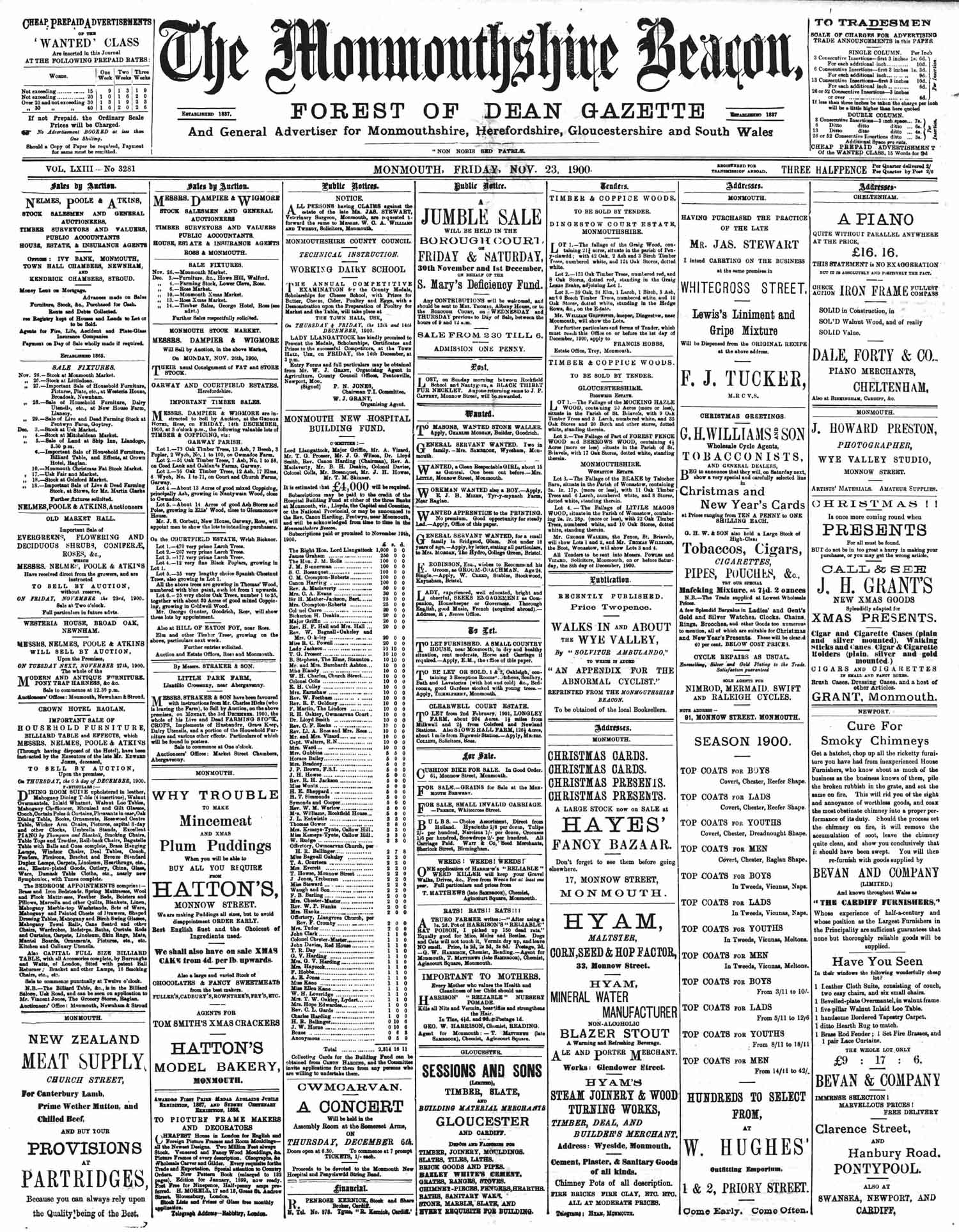
The Monmouthshire Beacon is one of the oldest surviving local newspapers in Wales, serving the town of Monmouth and its surrounding rural communities since the early Victorian era. Over the course of nearly two centuries, it has documented everyday life, civic changes, local government, crime, trade, and the social affairs of Monmouthshire. It remains an invaluable source for historians, genealogists, and those interested in the social history of south-east Wales and the borderlands.
Founding and Early Years (1837–1850s)
The newspaper was founded in 1837, the very year that Queen Victoria ascended the throne. It emerged at a time when the press was growing in influence thanks to rising literacy rates and the reduction of stamp duties that had previously restricted newspaper publication.
Originally aligned with Tory (Conservative) values, the Beacon was established as a counterbalance to the Monmouthshire Merlin, a more reformist and Liberal-leaning paper. This rivalry reflected the broader political division of the day between landowners, Church of England loyalists, and the increasingly vocal middle and working classes.
Its full name in early issues was often given as The Monmouthshire Beacon and Monmouthshire Advertiser, signalling both its political stance and its role in facilitating local commerce.
The Victorian Era: Political Voice and Moral Guardian
Throughout the 19th century, the Beacon was deeply embedded in the civic and moral life of Monmouthshire. It regularly published:
-
Reports of petty sessions (magistrates’ court proceedings)
-
Quarter sessions and assizes
-
Parish news and Poor Law Union matters
-
Church events and sermons
-
Market prices
-
Public notices and tenders
-
Births, marriages, and deaths
It strongly supported the Established Church, and often printed editorials warning against the perceived dangers of Dissent, radicalism, and social unrest. During the Chartist movement of the 1830s and 1840s, the Beacon took a cautious, law-and-order approach, reporting sternly on the uprisings and subsequent trials, such as those held at Monmouth Assizes in the wake of the Newport Rising of 1839.
Its editorial style was formal, upright, and firmly rooted in middle-class respectability.
Printing and Distribution
The Monmouthshire Beacon was originally printed from Agincourt Square, Monmouth, in close proximity to the Shire Hall and county offices. It would have been typeset by hand, printed on large sheets (broadsheet format), and distributed by horse and cart to surrounding towns and villages such as Usk, Raglan, Chepstow, Abergavenny, and even across the English border into parts of Gloucestershire and Herefordshire.
The newspaper was sold by subscription or bought at local newsagents, inns, and general stores.
Later 19th to Early 20th Century
By the turn of the 20th century, as evidenced in the article from 1900, the Beacon continued its role as a chronicler of local justice, law enforcement, and public morality. Its readers were primarily literate tradespeople, landowners, clergy, and professional men, though readership gradually broadened as compulsory education improved literacy.
The Beacon covered national events from a local perspective—such as the death of Queen Victoria (1901), Edwardian public reforms, and later, the Great War—and often printed patriotic commentary and enlistment updates during times of conflict.
20th Century Changes: Modernisation and Consolidation
-
Format and technology: Like many regional newspapers, the Beacon gradually adopted new printing technologies, such as linotype machines and later offset lithography. It eventually moved away from its Victorian broadsheet style to a more compact layout.
-
Ownership changes: Over the 20th century, the Beacon changed hands several times and was ultimately incorporated into a series of regional newspaper groups.
-
Mergers and rivals: Many of its early rivals, such as the Monmouthshire Merlin and Hereford Times (which also covered parts of Monmouthshire), either merged or folded as the economics of local press shifted. The Beacon survived by remaining hyper-local and community-oriented.
The Digital Era and Continued Legacy
The Monmouthshire Beacon remains in publication today. Its modern editions are available both in print and online, now under the ownership of Tindle Newspapers Ltd, a company known for preserving local press traditions across rural Britain.
Today’s Beacon still includes:
-
Local council news
-
Crime and court reports
-
Obituaries and public notices
-
Community events
-
Heritage features
-
School news and sports
Its archive, stretching back to 1837, is available in part via:
-
The British Newspaper Archive
-
The National Library of Wales
-
Local studies libraries and genealogical centres
Why It Matters – For Historians and Family Historians
The Monmouthshire Beacon is a goldmine for:
-
Genealogists: Names, addresses, occupations, and court appearances.
-
Social historians: Everyday life, moral values, civic roles, and community priorities.
-
Legal researchers: Evolution of local justice systems, treatment of women and animals, enforcement of public order.
-
Local historians: Changes in industry, religion, public health, and politics over 180+ years.
-
Students of media: The role of the local press in shaping rural identity and public opinion.
Summary
Name: The Monmouthshire Beacon
Founded: 1837
Place of Origin: Monmouth, Monmouthshire, Wales
Historic Position: Conservative, pro-Established Church
Role: Recorder of local news, politics, crime, and community
Current Status: Still in print and online, part of Tindle Newspapers
Legacy: One of the longest-running local newspapers in Wales, rich in insight into Victorian and Edwardian life.
In Brief
Borough Petty Sessions, Monmouth 1900 – Lame horses, drunkenness & dismissed assaults. A window into justice, welfare, and working life. #MonmouthHistory #AnimalWelfare #RSPCA #EdwardianJustice #Genealogy #HistoryInCourt #OldNewspapers
Monmouth Monmouthshire Borough