Northern Daily Telegraph – Monday 14 October 1889
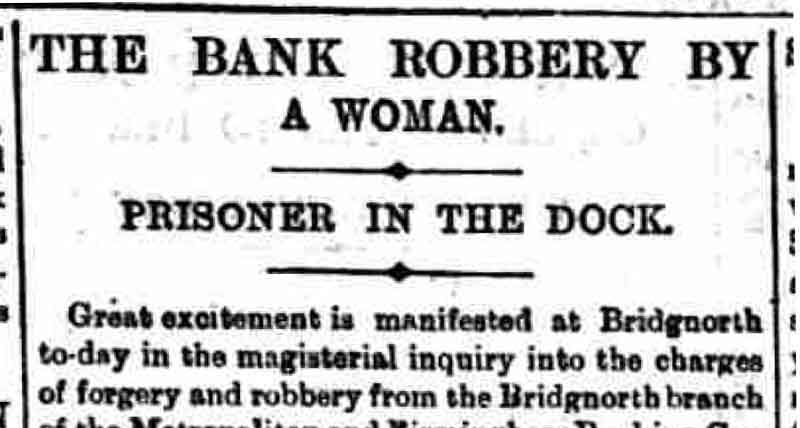
THE BANK ROBBERY BY A WOMAN.
PRISONER IN THE DOCK.

Great excitement is manifested at Bridgnorth to-day in the magisterial inquiry into the charges of forgery and robbery from the Bridgnorth branch of the Metropolitan and Birmingham Banking Co., preferred against Eliza Jane Scoffham. Prisoner’s career is exceedingly sensational. In March last she, with her sister, secured damages against a Wolverhampton tradesman for £1,000 for false accusations, and the sequel now tends to prove that the gentleman was justified in his conduct. The offences for which she is now charged were committed last Wednesday, when she presented a cheque for £210, bearing the alleged signature of a Bridgnorth lady. The money was counted out and payment delayed while inquiries were being made, during which the prisoner stole the money and decamped.
When arrested immediately afterwards she was removing a wig and clothing, by means of which she had most effectively disguised herself. The prosecuting counsel, in opening the case, said the fraud committed was one of the most audacious and impudent known in the annals of crime. When she presented herself at the bank the prisoner was dressed in the garb of a hospital nurse, wearing a long veil. After the robbery she was found in a water-closet taking off her disguise, and held the stolen money in her hand.
Prisoner owed a lady, whose name she forgets, £100, which she had failed to obtain. Scoffham obtained a cheque book from the Bank, left for a short time, and then returned and presented a cheque for £210. It was evident that ten cheques had been used from the book, these being subsequently torn in fragments, the prisoner having practised Mrs Blathwayt’s signature. The prisoner requested the money to be paid in gold.
Analysis of Laws, People, Businesses & Events (1889):
Legal Context (1889 UK):
-
Forgery and fraud were criminal offences under the Forgery Act 1861, which covered making false documents or signatures with intent to defraud.
-
Bank robbery, especially using deception, would be treated under larceny and theft statutes, and aggravating factors (disguise, premeditation) increased the severity.
-
Disguising oneself (impersonating a nurse) and fleeing (decamping) would contribute to the case being considered premeditated and “impudent”.
-
Trials began with magisterial inquiries, where evidence was reviewed before a full trial at Quarter Sessions or Assizes.
Eliza Jane Scoffham:
-
A complex character: previously awarded £1,000 in damages for a false accusation, suggesting legal savvy or manipulation.
-
Her use of disguise, forgery of Mrs Blathwayt’s name, and calm in executing the crime shows confidence and planning.
-
Her reason—debts owed to another woman—reveals a motive of financial desperation or possibly compulsive fraudulence.
The Bank & Businesses Involved:
-
Metropolitan and Birmingham Banking Co.: a major bank in Victorian Britain, serving regional towns like Bridgnorth.
-
The use of gold instead of banknotes highlights the era’s partial reliance on precious metals and public mistrust of paper currency.
-
Cheque fraud was becoming more common with wider adoption of banking by middle-class women.
Occupations and Social Observations:
-
The accused disguised herself as a hospital nurse—a respected profession for women, aiding her deception.
-
A lady in Bridgnorth was impersonated—likely a middle- or upper-class woman with a bank account, suggesting limited but growing financial independence of women.
-
The use of wigs and veils, and the mention of a water-closet, show the increasing urban infrastructure and personal autonomy.
Historical Value for Historians and Family Historians:
-
Genealogists can trace Eliza Jane Scoffham or her associates, especially if linked to Bridgnorth or Wolverhampton.
-
Useful in studies of Victorian women’s criminality, class, financial autonomy, and legal struggles.
-
Reveals Victorian attitudes toward female criminals as “audacious” or “impudent” when breaking expected gender roles.
-
Shows development of banking practices, document security, and signature verification in late 19th-century Britain.
-
Indicates the presence of metropolitan-style crime even in smaller market towns like Bridgnorth.
-
Highlights female access to law, both as claimants (damages case) and defendants.
Bridgnorth in 1889:
-
A market town in Shropshire, modest in size but clearly with functioning branches of large banks.
-
Evident social stratification: references to ladies, tradesmen, and the magistracy.
-
Infrastructure: access to public lavatories, urban policing, and legal services.
-
The presence of a magisterial inquiry implies local civic structure with an active police and court system.
The Northern Daily Telegraph history
Origins and Founding (1881)
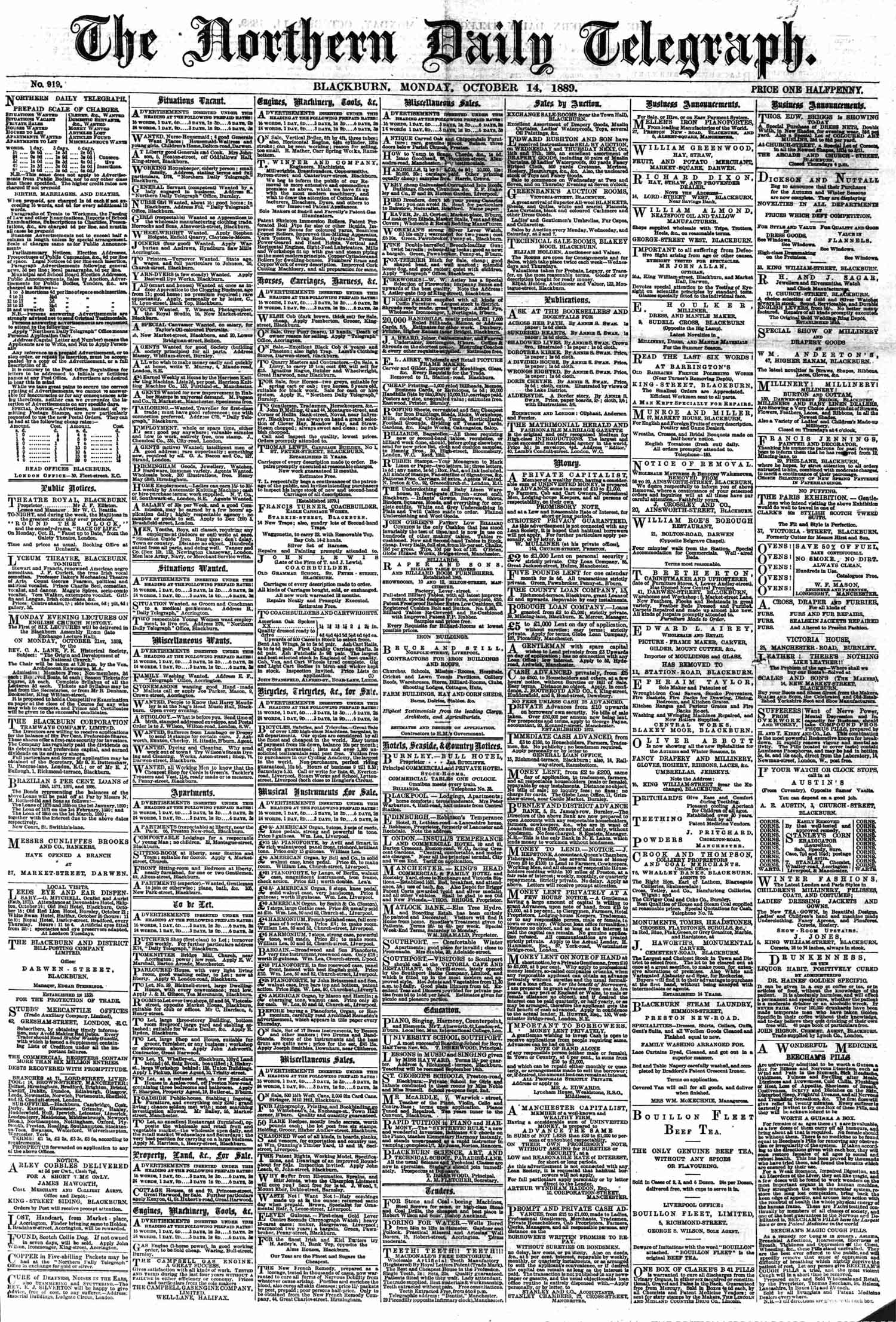
The Northern Daily Telegraph was first published on 26 October 1881 in Blackburn, Lancashire, by the firm of Thomas Purvis & Son, under the guidance of Thomas Purvis, a forward-thinking newspaper proprietor. It was founded to provide the rapidly growing working and middle classes in the North West of England with affordable, accessible, and up-to-date daily news. Its motto was “The Telegraph: The People’s Paper“.
At a time when most daily newspapers were based in London and priced beyond the reach of ordinary people, the Northern Daily Telegraph was both affordable (a halfpenny) and local, giving it a swift foothold in the regional market.
Purpose and Reach
The newspaper was intended to serve the cotton towns and industrial centres of East Lancashire – towns such as Blackburn, Accrington, Burnley, Darwen, Nelson, and Clitheroe. Its coverage focused on:
-
Local and national news
-
Politics and labour movements
-
Crime reports and court proceedings
-
Religious and temperance events
-
Trade, manufacturing, and cotton industry news
-
Literature, serialised fiction, and correspondence
-
Advertisements for local shops, jobs, and housing
It distinguished itself with its use of sensational headlines, lively local court reporting, and a dedication to everyday working people’s concerns.
Technological and Editorial Advancements
From its early days, the Northern Daily Telegraph embraced modern newspaper production methods. It was one of the first provincial papers to use Linotype machines, allowing for faster typesetting and larger circulation. Its printing operations were based in Blackburn’s Railway Road area, and later expanded as circulation increased.
The editorial team prided itself on independence, although it often supported Liberal and Nonconformist causes in its early decades, reflecting much of its readership’s political and religious leanings.
Key Developments and Ownership Changes
-
1890s–1900s: The paper grew in prominence and increased its staff of local correspondents in towns across Lancashire.
-
1910s: World War I reporting brought new challenges; war news dominated the front pages, and obituaries and casualty lists were frequent.
-
1920s–30s: A shift toward broader features and a more modern layout took place. It became known for its human-interest stories and coverage of cinema, radio, and sport.
-
1940s: During World War II, the paper continued despite paper shortages, blackouts, and staff enlisting. Its reporting balanced local life with national news.
-
1956: The Northern Daily Telegraph was renamed the Lancashire Evening Telegraph, better reflecting its regional identity and publication time.
-
2006: The paper became known as the Lancashire Telegraph, still published today (now both online and in print), part of Newsquest, a major regional newspaper group.
Significance and Legacy
The Northern Daily Telegraph played a key role in:
-
Empowering the working class with access to news and literacy
-
Encouraging civic participation, especially in political and union movements
-
Documenting industrial Lancashire’s evolution through its boom and decline
-
Preserving an enormous wealth of social history, from the mundane to the extraordinary
Its detailed court reports, family notices, and local affairs make it an invaluable resource for:
-
Historians: Studying Victorian and 20th-century northern England
-
Family historians: Tracing ancestors, crime cases, business advertisements, or obituaries
-
Cultural researchers: Investigating dialect, customs, public attitudes, and regional identities
Conclusion
The Northern Daily Telegraph was more than a newspaper — it was a mirror of northern English life for over a century. From industrial disputes to football matches, from petty thefts to royal jubilees, it told the stories of everyday people and their times with vigour, detail, and spirit.
In Brief
Victorian True Crime: Eliza Scoffham’s Daring Bank Robbery Disguised as a Nurse!
In 1889 Bridgnorth, a woman forged cheques, stole £210 in gold, and vanished — only to be caught in a loo removing her disguise!
#TrueCrime #History #Bridgnorth #VictorianCrime #Genealogy #BankFraud #WomenInHistory #Forgery #OldNewspapers