Tewkesbury Register – Saturday 31 October 1931
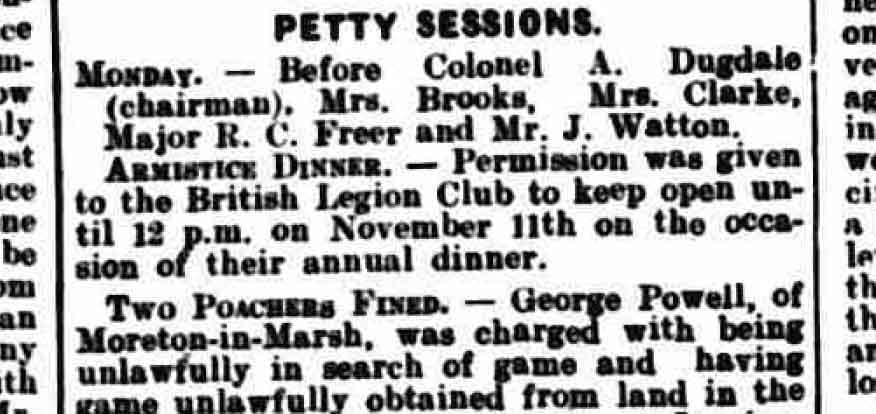
PETTY SESSIONS
Monday. — Before Colonel A. Dugdale (chairman), Mrs. Brooks, Mrs. Clarke, Major R. C. Freer, and Mr. J. Watton.
Armistice Dinner. — Permission was given to the British Legion Club to keep open until 12 p.m. on November 11th on the occasion of their annual dinner.
Two Poachers Fined.
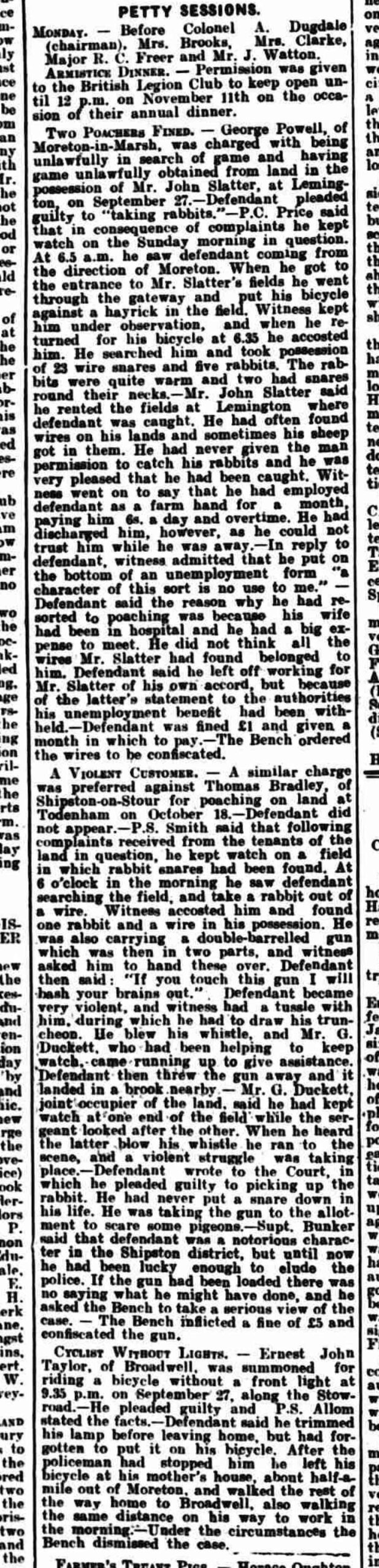
George Powell, of Moreton-in-Marsh, was charged with being unlawfully in search of game and having game unlawfully obtained from land in the possession of Mr. John Slatter, at Lemington, on September 27. — Defendant pleaded guilty to “taking rabbits.” — P.C. Price said that in consequence of complaints he kept watch on the Sunday morning in question. At 6.5 a.m. he saw defendant coming from the direction of Moreton. When he got to the entrance to Mr. Slatter’s fields, he went through the gateway and put his bicycle against a hayrick in the field. Witness kept him under observation, and when he returned for his bicycle, at 6.35, he accosted him. He searched him and took possession of 23 wire snares and five rabbits. The rabbits were quite warm and two had snares round their necks. — Mr. John Slatter said he rented the fields at Lemington where defendant was caught. He had often found wires on his lands and sometimes his sheep got in them. He had never given the man permission to catch his rabbits, and he was very pleased that he had been caught. Witness went on to say that he had employed defendant as a farm hand for a month, paying him 6s. a day and overtime. He had discharged him, however, as he could not trust him while he was away. — In reply to defendant, witness admitted that he put on the bottom of an unemployment form “a character of this sort is no use to me.” — Defendant said the reason why he had resorted to poaching was because his wife had been in hospital and he had a big expense to meet. He did not think all the wires Mr. Slatter had found belonged to him. Defendant said he left off working for Mr. Slatter of his own accord, but because of the latter’s statement to the authorities his unemployment benefit had been withheld. — Defendant was fined £1 and given a month in which to pay. The Bench ordered the wires to be confiscated.
A Violent Customer.
A similar charge was preferred against Thomas Bradley, of Shipston-on-Stour, for poaching on land at Todenham on October 18. — Defendant did not appear. — P.S. Smith said that following complaints received from the tenants of the land in question, he kept watch on a field in which rabbit snares had been found. At 6 o’clock in the morning he saw defendant searching the field and take a rabbit out of a wire. Witness accosted him and found one rabbit and a wire in his possession. He was also carrying a double-barrelled gun which was then in two parts, and witness asked him to hand these over. Defendant then said: “If you touch this gun I will bash your brains out.” Defendant became very violent, and witness had a tussle with him, during which he had to draw his truncheon. He blew his whistle, and Mr. G. Duckett, who had been helping to keep watch, came running up to give assistance. Defendant then threw the gun away and it landed in a brook nearby. — Mr. G. Duckett, joint occupier of the land, said he had kept watch at one end of the field while the sergeant looked after the other. When he heard the latter blow his whistle, he ran to the scene, and a violent struggle was taking place. — Defendant wrote to the Court, in which he pleaded guilty to picking up the rabbit. He had never put a snare down in his life. He was taking the gun to the allotment to scare some pigeons. — Supt. Bunker said that defendant was a notorious character in the Shipston district, but until now he had been lucky enough to elude the police. If the gun had been loaded there was no saying what he might have done, and he asked the Bench to take a serious view of the case. — The Bench inflicted a fine of £5 and confiscated the gun.
Cyclist Without Lights.
Ernest John Taylor, of Broadwell, was summoned for riding a bicycle without a front light at 9.35 p.m. on September 27, along the Stow-road. — He pleaded guilty and P.S. Allom stated the facts. — Defendant said he trimmed his lamp before leaving home, but had forgotten to put it on his bicycle. After the policeman had stopped him, he left his bicycle at his mother’s house, about half a mile out of Moreton, and walked the rest of the way home to Broadwell, also walking the same distance on his way to work in the morning. — Under the circumstances the Bench dismissed the case.
Historical and Social Analysis
Legal Framework in 1931
-
Poaching: Still treated as a criminal offence under the Game Laws of the 19th century, notably the Game Act 1831, which regulated hunting and protected landowners’ rights over game. Poaching rabbits without permission was illegal and punishable by fines or imprisonment.
-
Weapons: Carrying a firearm without a licence or threatening behaviour with one could lead to serious charges. Though not fully governed by modern legislation like the Firearms Act 1968, police viewed it as a severe public safety issue.
-
Cycling Offences: The Highway Act 1835 and subsequent updates required bicycles to be equipped with lights at night. Lack of lighting was treated as a minor but enforceable offence.
People and Life in 1931
George Powell & Thomas Bradley:
Likely part of the working class, possibly unemployed or underemployed farm labourers. Poaching, in these cases, was likely motivated by poverty and desperation during the Great Depression.
Mr. John Slatter:
A land tenant employing casual farm workers. His concerns about rabbits and poaching reflect landowners’ ongoing struggle to protect crops and livestock from game damage and unauthorised hunting.
P.C. Price, P.S. Smith, Supt. Bunker, P.S. Allom:
Police officers from rural divisions. Their patrols, sometimes involving ambushes and physical confrontations, show how rural policing was hands-on and community-focused.
Ernest John Taylor:
A working-class commuter from Broadwell. His detailed explanation shows the long distances people walked even when bicycles were available, indicating limited public transport in rural areas.
What This Tells Us About 1931 in the Cotswolds
-
Poverty and Employment: Widespread unemployment and reliance on manual farm work. Employers held sway over workers’ access to state benefits.
-
Justice System: Petty Sessions were local courts handling minor offences with swift judgments and modest penalties.
-
Policing: Rural police were respected but had to deal with armed and occasionally violent suspects without backup.
-
Community: Tight-knit and observant; landlords and tenants cooperated to prevent poaching.
-
Transport: Bicycles were essential for work commutes. Lighting regulations were enforced to prevent nighttime accidents.
The History and Story of The Tewkesbury Register
Founding and Early Years (1858–1900)
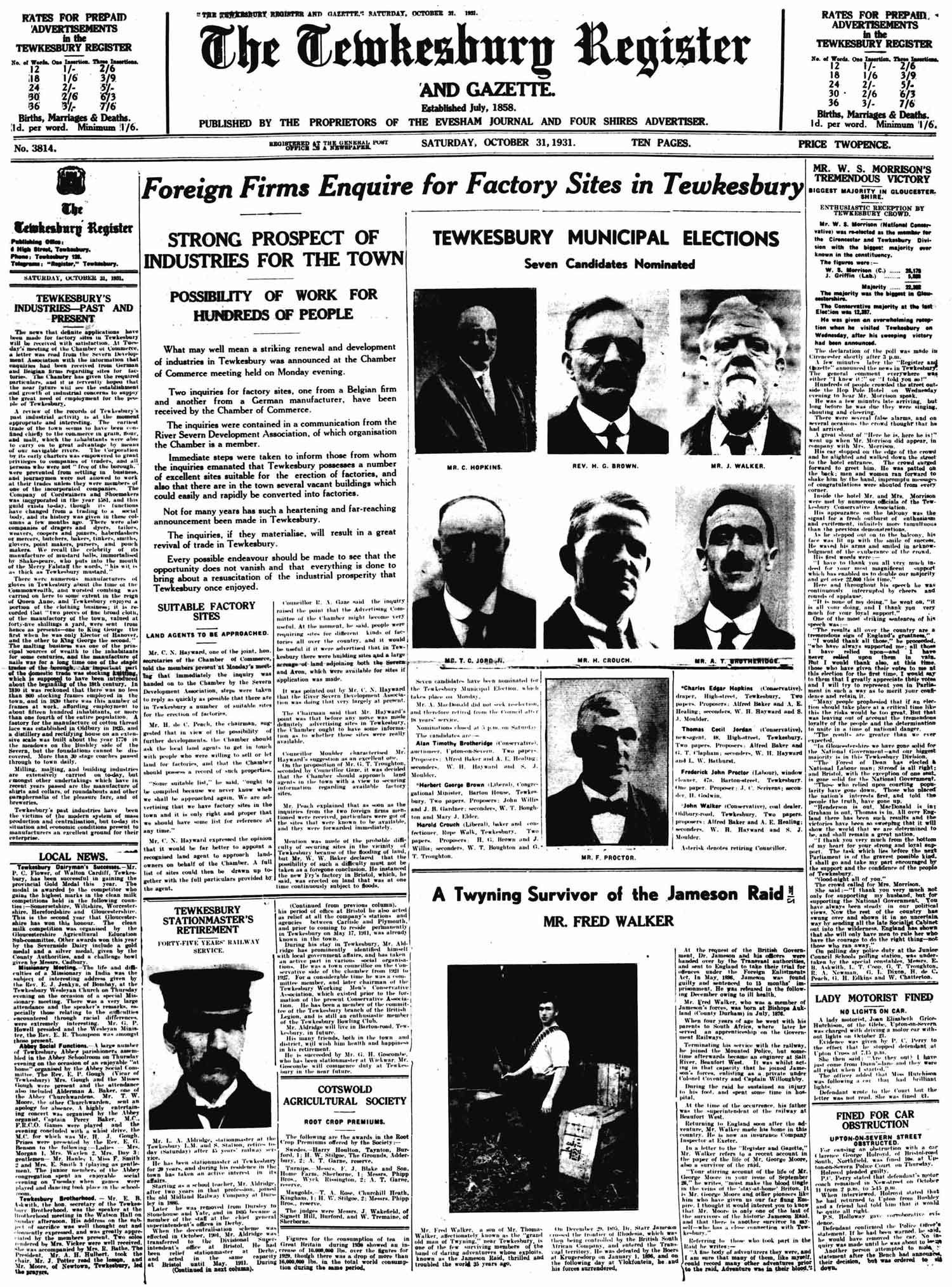
The Tewkesbury Register was founded in 1858 in the Gloucestershire market town of Tewkesbury, one of England’s oldest boroughs. Its launch came at a time when local newspapers were proliferating across Britain following the gradual reduction of taxes on newspapers (notably the repeal of the Stamp Act in 1855). The aim of the paper was to serve the local population by providing comprehensive coverage of local news, petty sessions (magistrates’ court cases), social events, trade reports, agricultural matters, and births, marriages and deaths.
Published weekly, the Register quickly established itself as a vital source of news not only for the residents of Tewkesbury but also for surrounding communities including Bredon, Ashchurch, Northway, Mythe, and Twyning. It became a cornerstone of civic life, giving a voice to local issues, showcasing the decisions of local government and justices, and reflecting the concerns of rural people during a period of great social and economic change.
Role in the Community
During the Victorian and Edwardian eras, the Tewkesbury Register maintained close ties with:
-
Local churches and chapels, often reporting extensively on sermons and congregational events.
-
The Board of Guardians (responsible for administering the Poor Law).
-
Farming and horticultural societies, with regular agricultural reports and grain prices.
-
Education boards, reporting on the conditions and performance of local schools.
The paper also played a part in moral and social education, promoting the ideals of respectability, temperance, and civic duty.
Twentieth Century Developments (1900–1950s)
By the early 20th century, the Tewkesbury Register had modernised its layout and content while retaining its focus on local news. It reported heavily on:
-
The First World War, including enlistment, casualty lists, and local fundraising for the war effort.
-
Rural crime, including petty thefts, poaching, and disputes over land.
-
Public health issues, such as outbreaks of typhoid or influenza.
-
Transport and technological changes, including the arrival of motor buses and electric lighting in the district.
Its coverage of petty sessions like the one reported in the 1931 article offered valuable insight into the lives of working-class people, their hardships, and the mechanisms of local justice.
The paper also served as a forum for classified advertising, job listings, and obituaries—making it an invaluable genealogical source today.
During the Second World War, it continued to operate, albeit with paper shortages and fewer staff. It reported on air-raid precautions, rationing, the Home Guard, and evacuees from cities.
Later Years and Merger
In the 1950s–1970s, with rising costs and the challenges of modernisation, many small local newspapers were either shut down or amalgamated into regional titles. The Tewkesbury Register, like many others, saw a gradual decline in its standalone identity.
Eventually, it merged with the Tewkesbury Weekly Record and later became part of the Gloucestershire Echo and Gloucestershire Chronicle groupings, which were run by larger regional newspaper companies. This allowed the continuation of some of its traditions and archives, though the title itself eventually disappeared from newsstands.
The Legacy Today
Though no longer published as a standalone title, the legacy of the Tewkesbury Register lives on through:
-
Digitised newspaper archives, accessible via platforms such as the British Newspaper Archive and local library services.
-
Family historians and researchers who draw on its detailed court records, announcements, and community notices.
-
Local heritage groups in Tewkesbury, which use its reports to reconstruct 19th and 20th-century life.
Its pages offer a rich portrait of rural and small-town England, documenting everything from agricultural wages and Methodist bazaars to petty thefts and coronation celebrations.
Why It Matters for Historians and Genealogists
For historians, the Tewkesbury Register is a primary source of regional social history. It captures how national issues were experienced at the local level—be that war, economic depression, or new technologies.
For family historians, it offers:
-
Names and details of relatives in court reports, obituaries, wedding notices, and employment news.
-
Insight into working conditions, diseases, housing, and education.
-
An understanding of the local economy, including trades and apprenticeships.
Conclusion
The Tewkesbury Register was more than just a newspaper. It was a chronicle of life for generations of Gloucestershire residents. Though it ceased as an independent publication, its impact endures in the preservation of local memory, and it remains a treasure trove for anyone interested in the rich tapestry of English provincial life.
In Brief
“If you touch this gun I’ll bash your brains out” – A violent poacher, a cycling offence, and rural justice in 1931 Gloucestershire.#LocalHistory #1930sBritain #Cotswolds #Genealogy #Tewkesbury #MoretonInMarsh #ShipstonOnStour #Poaching #BritishJustice #OldNewspapers