Leighton Buzzard Observer and Linslade Gazette – Tuesday, 26 August 1913
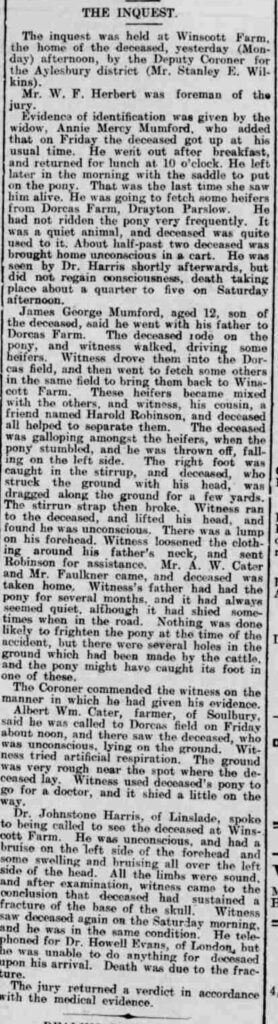
THE INQUEST.
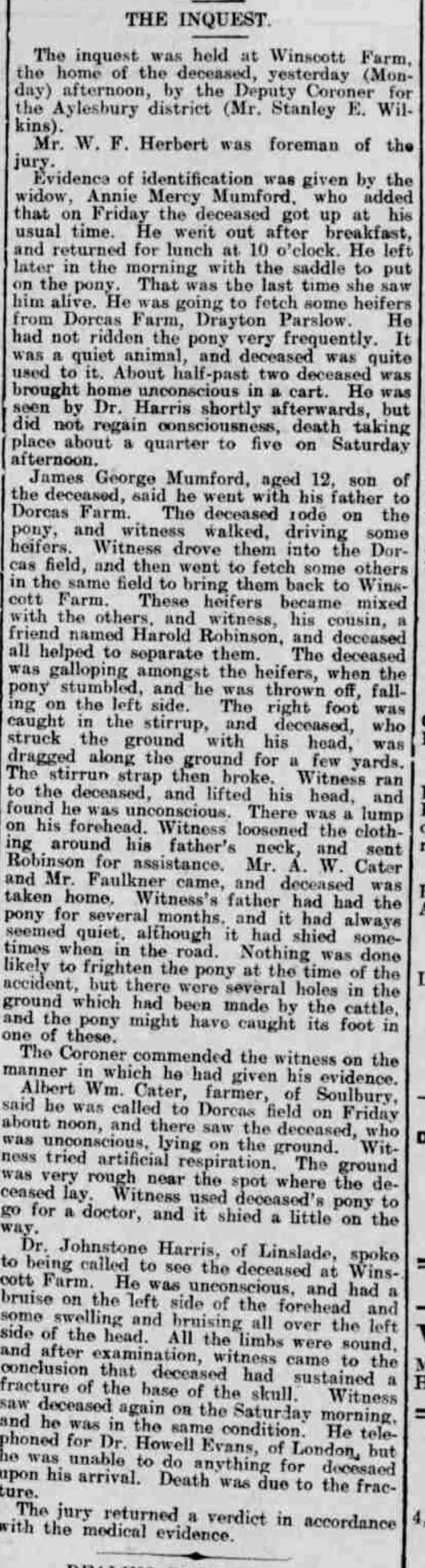
The inquest was held at Winscott Farm, the home of the deceased, yesterday (Monday) afternoon, by the Deputy Coroner for the Aylesbury district (Mr. Stanley E. Wilkins).
Mr. W. F. Herbert was foreman of the jury.
Evidence of identification was given by the widow, Annie Mercy Mumford, who added that on Friday the deceased got up at his usual time. He went out after breakfast, and returned for lunch at 10 o’clock. He left later in the morning with the saddle to go on the pony. That was the last time she saw him alive. He was going to fetch some heifers from Dorcas Farm, Drayton Parslow. He had not ridden the pony very frequently. It was a quiet animal, and deceased was quite used to it. About half-past two deceased was brought home unconscious in a cart. He was seen by Dr. Harris shortly afterwards, but did not regain consciousness, death taking place about a quarter to five on Saturday afternoon.
James George Mumford, aged 12, son of the deceased, said he went with his father to Dorcas Farm. The deceased rode on the pony, and witness walked, driving some heifers. Witness drove them into the Dorcas field, and then went to fetch some others in the same field to bring them back to Winscott Farm. These heifers became mixed with the others, and witness, his cousin, a friend named Harold Robinson, and deceased all helped to separate them. The deceased was galloping amongst the heifers, when the pony stumbled, and he was thrown off, falling on the head. The right foot was caught in the stirrup, and deceased, who struck the ground with his head, was dragged along the ground for a few yards. The stirrup strap then broke. Witness ran to the deceased, and lifted his head, and found he was unconscious. There was a lump on his forehead. Witness loosened the clothing around his father’s neck, and sent Robinson for assistance. Mr. A. W. Cater and Mr. Faulkner came, and deceased was taken home. Witness’s father had had the pony for several months, and it had always seemed quiet, although it had shied sometimes when in the road. Nothing was done likely to frighten the pony at the time of the accident, but there were several holes in the ground which had been made by the cattle, and the pony might have caught its foot in one of these.
The Coroner commended the witness on the manner in which he had given his evidence.
Albert Wm. Cater, farmer, of Soulbury, said he was called to Dorcas field on Friday about noon, and there saw the deceased, who was unconscious, lying on the ground. Witness tried artificial respiration. The ground was very rough near the spot where the deceased lay. Witness used deceased’s pony to go for a doctor, and it shied a little on the way.
Dr. Johnstone Harris, of Linslade, spoke to being called to see the deceased at Winscott Farm. He was unconscious, and had a bruise on the left side of the forehead and some swelling and bruising all over the left side of the head. All the limbs were sound, and after examination, witness came to the conclusion that deceased had sustained a fracture of the base of the skull. Witness saw deceased again on the Saturday morning, and he was in the same condition. He telephoned for Dr. Howell Evans, of London, but he was unable to do anything for deceased on his arrival. Death was due to the fracture.
The jury returned a verdict in accordance with the medical evidence.
FULL HISTORICAL ANALYSIS:
People Involved:
-
Annie Mercy Mumford – widow of the deceased.
-
James George Mumford – 12-year-old son of the deceased.
-
Mr. W. F. Herbert – foreman of the jury.
-
Mr. Stanley E. Wilkins – Deputy Coroner for Aylesbury.
-
Harold Robinson – cousin or friend, present at the scene.
-
Albert Wm. Cater – local farmer from Soulbury.
-
Mr. Faulkner – assisted with transport after the accident.
-
Dr. Johnstone Harris – doctor from Linslade.
-
Dr. Howell Evans – London doctor summoned too late to intervene.
Occupations and Local Businesses:
-
Farming – central to this case. The deceased was clearly a working farmer, and the setting is rural Buckinghamshire with neighbouring farms involved in animal handling.
-
Dorcas Farm and Winscott Farm – local farms, suggesting cooperative rural work.
-
Veterinary and Medical Care – reliance on local doctors like Dr. Harris and the more specialist urban doctors like Dr. Evans.
-
Coroner’s Office – in the Aylesbury district, suggests structured legal and investigative procedures in place even in rural areas.
Legal Framework (1913):
Inquests in England in 1913 were governed by the Coroners Act 1887. The coroner’s role was to investigate sudden, unnatural, or violent deaths. The jury (as used here) was standard practice and would typically include local men. Their role was to assist the coroner in determining the cause of death.
The verdict of death by accident or misadventure, supported by medical evidence, was routine. No legal proceedings or criminal implications appear in this case – it was a tragic farming accident.
Implications and Use for Historians / Family Historians:
This article is rich with value:
-
Genealogical detail: Full names, relationships (widow, son), and age (James George, aged 12) are gold for family history research.
-
Occupational insight: Describes daily rural life, farming practices, and risks.
-
Medical detail: Describes the injuries in lay and medical terms.
-
Social insight: Reveals communal rural efforts – neighbours and friends rallying, reliance on local knowledge, and medical limitations.
-
Legal procedures: Insight into rural coroners’ inquests.
It situates the reader in the pre-war rural English countryside, where transportation was still animal-based, and medical intervention was often too late.
Life in the Aylesbury Area in 1913:
-
Dominated by agriculture and livestock management.
-
Horse and pony transport still common, though more dangerous than often assumed.
-
Medical services were limited and relied on availability – often a local GP, with specialists being far and not always reachable in time.
-
Children were involved in farm work, even at 12 years of age – common in working-class and rural settings.
-
Community: Strong sense of collective effort – neighbours helped without hesitation.
-
Road and field conditions: described as rough, uneven – hazards of country life.
The History of The Leighton Buzzard Observer and Linslade Gazette
Origins and Foundation (19th Century)
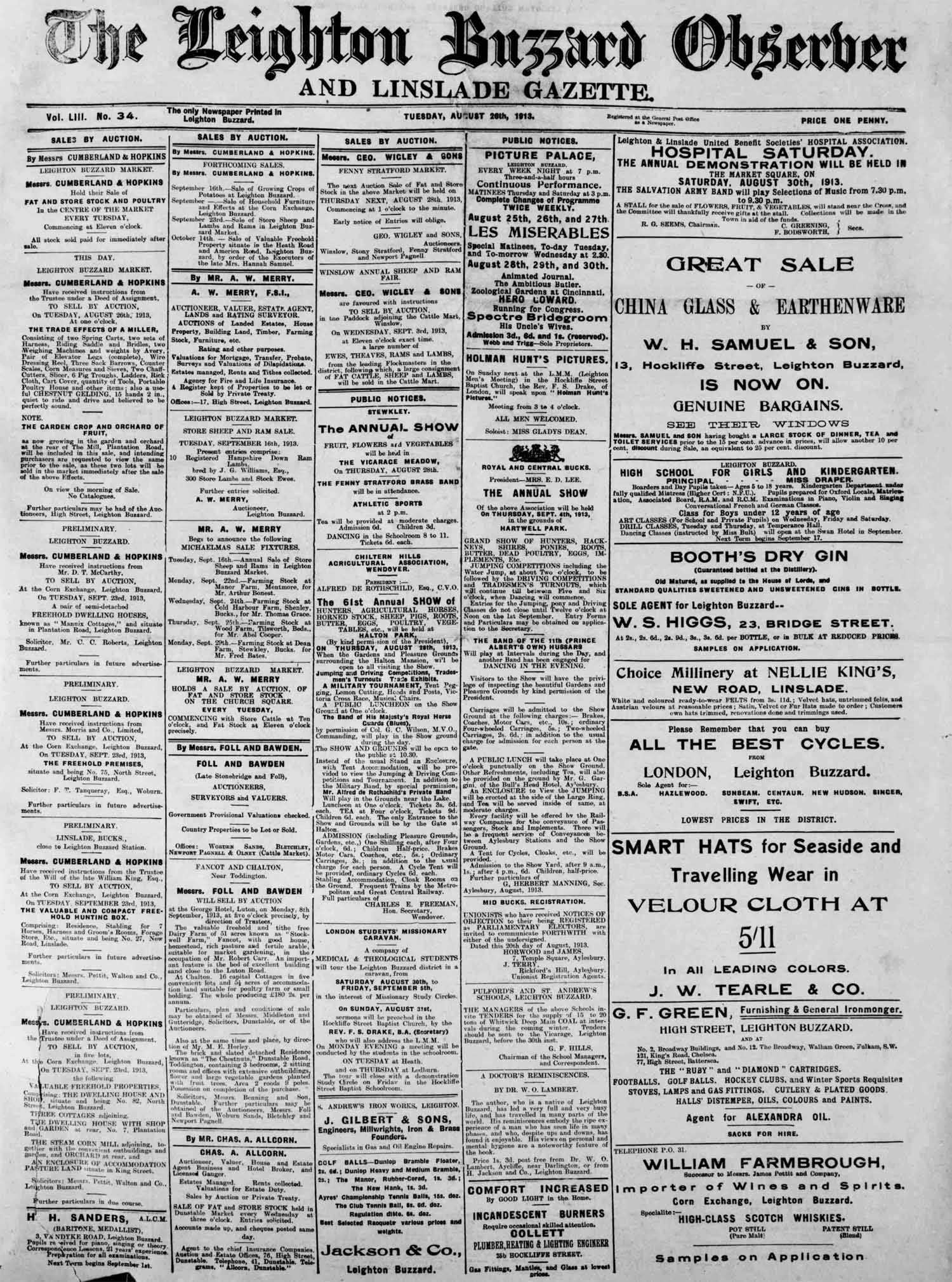
The Leighton Buzzard Observer was founded in 1861, amid a period of growing literacy, civic awareness, and increasing public demand for regional news across Victorian England. Its primary purpose was to serve the town of Leighton Buzzard, in Bedfordshire, and the adjacent town of Linslade, just across the county border in Buckinghamshire. These towns were already closely linked economically, socially, and geographically, despite belonging to separate counties.
The newspaper emerged during the golden age of local press, a time when rural and provincial newspapers flourished in Britain, facilitated by:
-
The repeal of the Newspaper Stamp Duty in 1855, which made newspaper publishing more affordable.
-
The spread of the railway network, which allowed for wider and faster distribution of newspapers.
-
The rise of mass literacy, especially after the 1870 Education Act.
Originally titled the Leighton Buzzard Observer, the paper later expanded its name to include Linslade Gazette, acknowledging the growing population and importance of Linslade, particularly after the arrival of the railway in the mid-19th century.
Editorial Focus and Readership
From its earliest days, the Observer established itself as a conservative-leaning, locally focused publication. Its typical content in the late 19th and early 20th centuries included:
-
Local news: Including farming reports, civic meetings, church and chapel activities, and major town events.
-
Births, deaths, and marriages: Of key importance to genealogists today.
-
Court reports and inquests: Offering detailed insight into crime, justice, and accident investigations.
-
School events and educational updates
-
Advertisements: For local businesses, tradesmen, shops, auctions, and property.
The paper catered primarily to the local middle class, including farmers, shopkeepers, clergy, tradespeople, and landowners, but also provided coverage relevant to working-class readers, particularly through its reporting on local employment, railway development, and charitable events.
Significance and Role in the Community
For over a century, the Observer played a central role in shaping and reflecting community identity. In an era when most communication was local and parochial, it provided a platform for:
-
Local political engagement
-
Civic accountability – with reports of council meetings and decisions
-
Religious dialogue – including updates from Anglican and Nonconformist churches
-
Community memory – preserving the legacy of events, individuals, and places
It was often the only public record of many life events, particularly in small villages with no parish magazine or formal registry access. The Observer also served as a bridge between town and country, reporting on both urban concerns and rural farming matters.
20th Century Evolution
As the 20th century progressed, the Observer continued to evolve. Major developments included:
-
World War I reporting (1914–1918): The paper reported on enlistments, casualties, letters from the front, and home front activities such as fundraising and rationing.
-
Inter-war years: It captured the changing face of local society – from the impact of the motor car to the rise of women’s societies and sporting clubs.
-
World War II (1939–1945): Again, the paper played a crucial role in keeping local morale high, providing information on blackouts, civil defence, evacuees, and post-war recovery efforts.
-
Post-war decline of local press independence: Like many others, the Observer eventually came under the umbrella of larger regional press groups, but it retained its title and local editorial flavour.
Mergers and Modern Era
In the late 20th and early 21st centuries, the newspaper experienced changes in ownership and format, reflecting national trends. Print readership declined, but local papers like the Leighton Buzzard Observer transitioned to digital formats.
Key transitions include:
-
Becoming part of Johnston Press, one of the largest local media groups in the UK.
-
Moving towards weekly publication, often issued on a Tuesday.
-
Integration with online platforms, while still retaining a loyal local readership in print.
Historical Value and Legacy
For historians, family historians, social researchers, and genealogists, the Leighton Buzzard Observer and Linslade Gazette is an irreplaceable resource. It:
-
Documents 160+ years of social history.
-
Provides primary source material for understanding everyday life in Bedfordshire and Buckinghamshire.
-
Offers contextual richness to events often overlooked in national history.
Conclusion
The Leighton Buzzard Observer and Linslade Gazette is more than just a newspaper; it is a living repository of local identity, a chronicler of both momentous and ordinary events, and a lens through which we can view over a century and a half of community evolution.
It stands testament to the enduring value of local journalism — accurate, accountable, and intimately connected to its readership.
In Brief
📜 “Dragged by his pony: tragic 1913 farming death near Aylesbury” — Aged 12, James watched his father die in a freak accident. Full inquest transcript & historical context.
🔍 #1913 #FamilyHistory #LeightonBuzzard #Aylesbury #Genealogy #BritishHistory #CoronersCourt #RuralLife #OldNewspapers #FarmAccident #HistoricalRecords #UKHistory