ALARMING EPIDEMIC NEAR BOLTON.
SALE OF POISONOUS MILK.
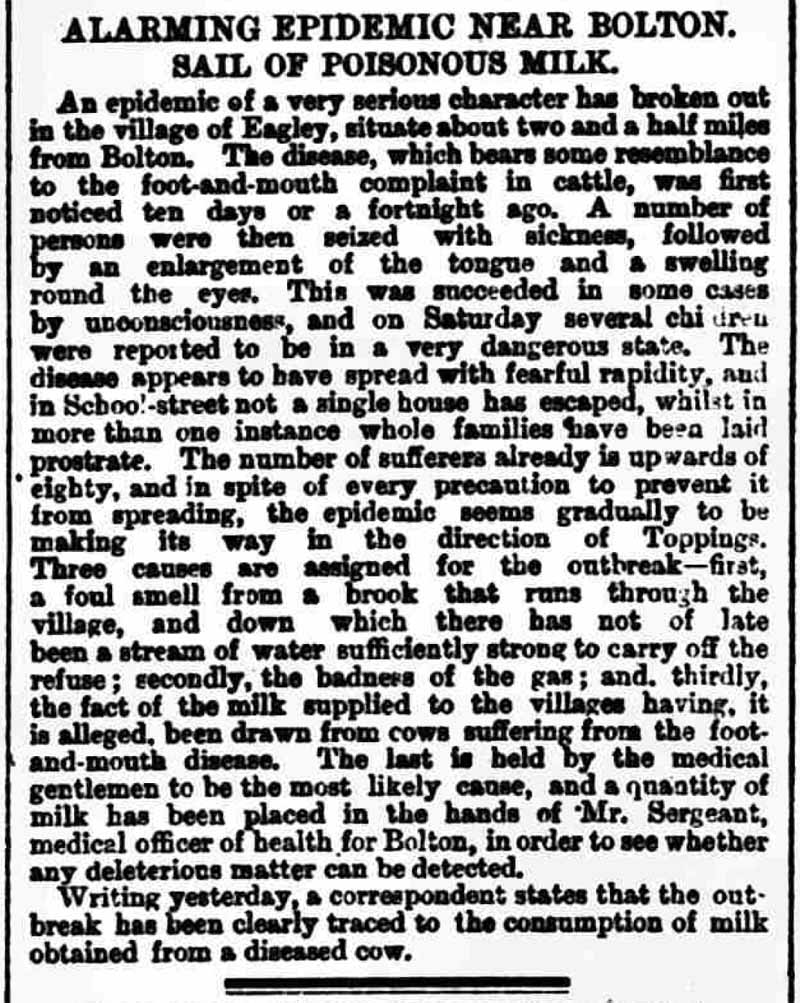
An epidemic of a very serious character has broken out in the village of Egley, situate about two and a half miles from Bolton. The disease, which bears some resemblance to the foot-and-mouth complaint in cattle, was first noticed ten days or a fortnight ago. A number of persons were then seized with sickness, followed by an enlargement of the tongue and a swelling round the eyes. This was succeeded in some cases by unconsciousness, and on Saturday several children were reported to be in a very dangerous state. The disease appears to have spread with fearful rapidity, and in School-street not a single house has escaped, whilst in more than one instance whole families have been laid prostrate. The number of sufferers already is upwards of eighty, and in spite of every precaution to prevent it from spreading, the epidemic seems gradually to be making its way in the direction of Toppings.
Three causes are assigned for the outbreak—first, a foul smell from a brook that runs through the village, and down which there has not of late been a stream of water sufficiently strong to carry off the refuse; secondly, the badness of the gas; and thirdly, the fact of the milk supplied to the villages having, it is alleged, been drawn from cows suffering from the foot-and-mouth disease. The last is held by the medical gentlemen to be the most likely cause, and a quantity of milk has been placed in the hands of Mr. Sergeant, medical officer of health for Bolton, in order to see whether any deleterious matter can be detected.
Writing yesterday, a correspondent states that the outbreak has been clearly traced to the consumption of milk obtained from a diseased cow.
Historical Analysis and Context (1876, Bolton)
1. Laws and Regulations at the Time
In 1876, Britain was still in the early stages of regulating food safety and public health. Key laws relevant to this article include:
- The Public Health Act 1875 – This was a landmark law that consolidated previous health regulations and empowered local authorities to manage sanitation, sewage, and water supply. However, it was only just beginning to be enforced at the time of this outbreak.
- The Contagious Diseases (Animals) Act 1869 – This act aimed to prevent the spread of livestock diseases like foot-and-mouth disease, but enforcement was inconsistent, and contaminated milk still entered the food supply.
- Sale of Food and Drugs Act 1875 – Introduced the year before this article, it sought to prevent the sale of adulterated food, including contaminated milk, but its enforcement was still weak in many areas.
Milk safety was not yet fully understood, and pasteurisation was not in widespread use. The connection between diseased cows and human illness was only starting to be scientifically investigated.
2. Implications of the Epidemic
The outbreak had several implications:
- Health Crisis: The rapid spread of illness in Egley and nearby Toppings suggests a lack of medical infrastructure to contain it. The symptoms described (swelling, unconsciousness) indicate severe poisoning or infection.
- Economic Impact: Affected families would struggle with lost income due to illness. Farmers whose cattle were suspected of spreading disease could lose their livelihoods.
- Regulatory Change: Cases like this contributed to growing awareness of the need for stricter food safety laws.
3. People, Occupations, and Businesses
- Medical Officer of Health: Mr. Sergeant was responsible for investigating the milk. Public health officers were a relatively new role created by the 1875 Public Health Act.
- Farmers and Milk Sellers: The milk was likely supplied by a local dairy farmer who either knowingly or unknowingly sold milk from infected cows.
- Residents: The villagers of Egley were likely working-class people, employed in mills, factories, or farming.
- Gas Supply Issues: The reference to “badness of the gas” suggests problems with the local gasworks, possibly leading to poisoning from poor air quality.
4. Everyday Life in 1876 Bolton
- Housing: Workers in Egley likely lived in small, overcrowded homes with poor sanitation.
- Food Supply: Milk was a staple, often unregulated and unpasteurised. Many households relied on local deliveries.
- Health Care: Access to doctors was limited, and diseases could spread quickly due to poor public sanitation.
- Industry: Bolton was a major textile hub, so many residents worked in cotton mills with harsh conditions.
5. Importance for Historians and Family Historians
This article provides key insights for researchers:
- Health and Epidemics: Understanding how diseases spread and were managed.
- Occupations and Daily Life: Shows the living conditions of working-class communities.
- Local History: Reveals how villages like Egley and Toppings were affected by wider economic and public health issues.
- Genealogy: If researching ancestors from Egley, this outbreak may explain family deaths or illnesses in 1876.
About Eagley in 1876
In 1876, Eagley was a small village near Bolton, Lancashire, England, with approximately 500 inhabitants. The village experienced a significant health crisis when an epidemic, identified as typhoid fever, rapidly affected about one-fifth of its population. The outbreak was so severe that, within ten days, between 70 and 80 residents fell ill.
Eagley was historically part of Lancashire and is situated on the southern slopes of the West Pennine Moors. Eagley Brook runs through the village, passing by Eagley Mills, which were operational during that period.
The village’s industrial activity was primarily centred around these mills, which played a significant role in the local economy. The presence of Eagley Mills indicates that the textile industry was a major employer in the area, providing livelihoods for many residents.
The 1876 epidemic highlighted the challenges faced by such communities, particularly concerning public health and sanitation. The rapid spread of typhoid fever underscored the need for improved sanitary conditions and medical interventions to prevent similar occurrences in the future.
Overall, life in Eagley during 1876 reflected the broader experiences of industrial villages in Lancashire, balancing industrial work with the challenges of maintaining public health amidst growing populations.
History of the Wolverhampton Express and Star
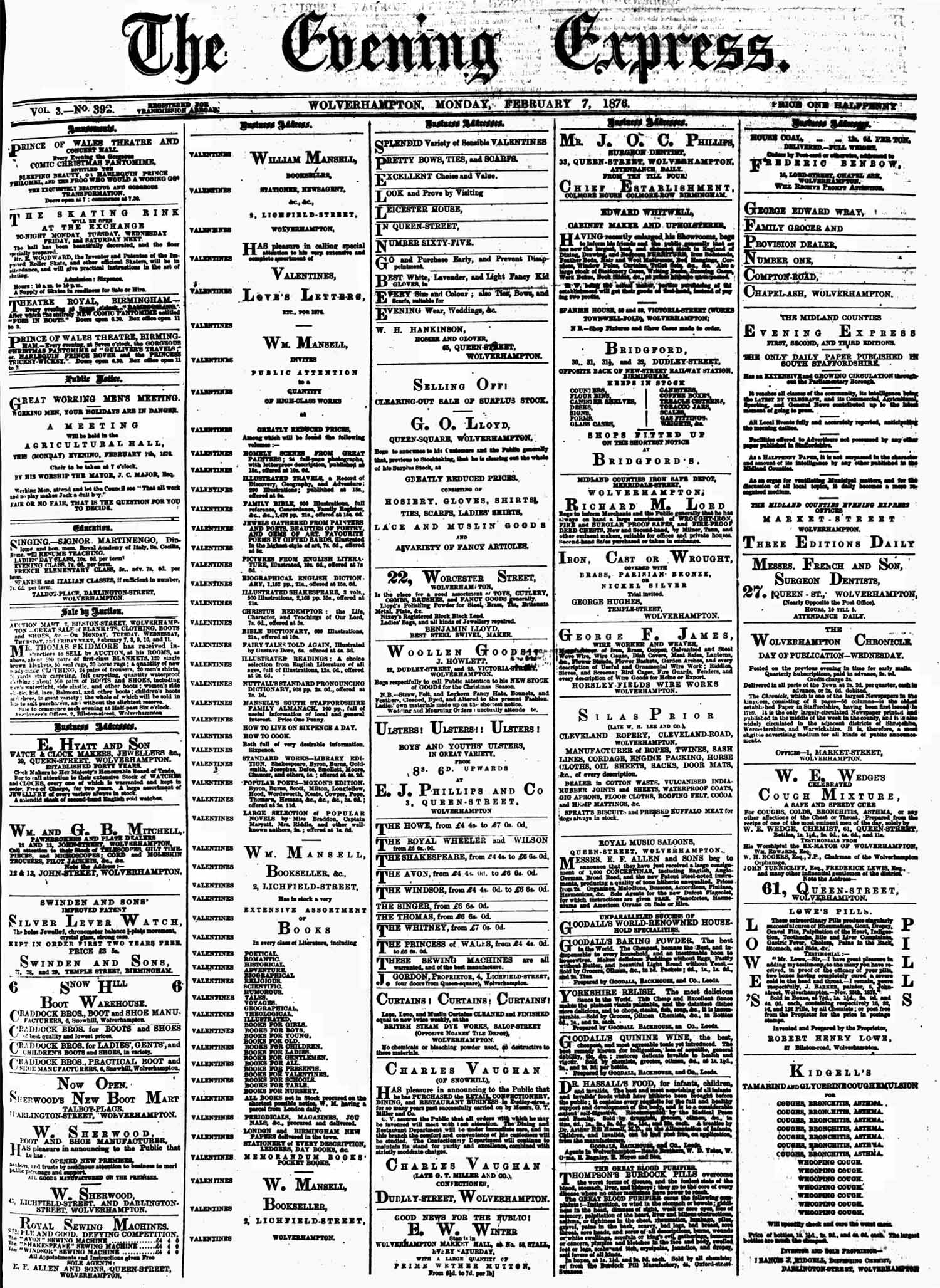
The Express & Star is a prominent regional newspaper based in Wolverhampton, England, with a rich history dating back to the 19th century.
Origins and Early Development
The newspaper’s roots can be traced to the Evening Star, established in 1880 as a liberal publication in Wolverhampton. This venture was founded by Scottish-American philanthropist Andrew Carnegie and local councillor Thomas Graham. Their collaboration aimed to provide a liberal perspective in the region’s media landscape. In 1882, the Evening Star acquired its conservative competitor, the Evening Express (founded in 1874), leading to the amalgamated title Express & Star in 1889.
Ownership Transition
Carnegie divested his interests in the newspaper in 1902, leaving the Graham family as the sole proprietors. Under their stewardship, the Express & Star expanded its influence throughout the Black Country region, becoming a significant voice in local journalism.
Mid-20th Century Growth
By the 1930s, the newspaper’s circulation had surpassed 100,000 copies daily. During World War II, despite newsprint shortages necessitating a reduction in size, the Express & Star maintained its publication and community engagement, notably raising £160,000 for wartime comforts.
Technological Advancements
The post-war era saw the Express & Star embracing technological innovations. In the 1970s, it introduced the first Visual Display Unit (VDU) system and adopted computeris
ed accounting and facsimile transmission, positioning itself at the forefront of modern newspaper production.
Recent Developments
In September 2023, after more than 140 years of Graham family ownership, the Express & Star was sold to National World PLC. This transition marked a new chapter in the newspaper’s history, reflecting broader trends in the media industry.
Legacy and Community Role
Throughout its existence, the Express & Star has been more than just a newspaper; it has served as a pillar of the West Midlands community. The publication has supported numerous local initiatives, including business awards, charitable campaigns, and cultural events, cementing its role as an integral part of the region’s social fabric.
As it continues to adapt to the evolving media landscape, the Express & Star remains committed to delivering quality journalism and serving the communities of the West Midlands.
In Brief
🚨 ALARMING EPIDEMIC NEAR BOLTON (1876) 🚨
A serious disease outbreak in Egley linked to poisonous milk from diseased cows. 80+ affected, families devastated. #Bolton #History #VictorianBritain #FoodSafety #PublicHealth #Genealogy #WolverhamptonExpressAndStar