
Beckenham Journal – Saturday 14 May 1892
Penge

Keeping a Dog Without a License.—David Green, 84, Laurel Grove, Penge, was summoned at the Penge Petty Sessions on Tuesday for keeping a dog without a license. Defendant admitted the offence and was fined 10s. and 5s. 6d. costs.
Transfer of License.—At the Penge Petty Sessions on Tuesday, before Mr. H. H. Heath in the chair, Dr. Hetley and Messrs. Brookbank and Tollhurst, the license of the “Duke of Edinburgh,” Arpley Road, was temporarily transferred from Charles Fryer to Thomas James Eveleigh. The Chairman said he supposed Mr. Eveleigh knew the character of the road he was going into. The house would require very careful management.
Gambling at Penge.—George Mansfield, aged 15, of 58, Arpley Road, Penge, was summoned at the Penge Petty Sessions on Tuesday for playing pitch and toss in Maple Road on Sunday, May 1st. P.C. Whitehead deposed that he saw the defendant and several other boys playing pitch and toss with money. On seeing him, they ran away, returning when he had passed. Last month the defendant was fined at Lambeth Police Court for a similar offence. Defendant’s mother denied the constable’s statement, but the magistrates imposed a fine of 5s. and 5s. 6d. costs.
Accident to a Boy.—Last Saturday evening, about nine o’clock, a boy named Albert Litchfield, 14, of 80, Trinity Road, Penge, in the employ of Messrs. Pickford & Co., while passing along the Beckenham Road, fell out of one of the large covered vans used by the firm and severely injured his left foot. He was picked up by Mr. Holland, of 6, Kingswood Road, and taken to Dr. Morris’s surgery, where it was found that no bones were broken, although the foot was a good deal cut and bruised. The lad was subsequently taken home by Mr. Holland.
Home and Infirmary for Sick Children, Sydenham.—At the monthly committee meeting, held on Tuesday, the Matron reported 15 admissions and 12 discharged, leaving 45 in the Home. The Treasurer’s account showed receipts £586 10s. 8d.; expenditure £441 9s. 8d.; in hand, £95 10s. Cheques were received of £10 10s. from the Skinners’ Company, and £37 3s. 5d. from Easter offertories at St. Stephen’s, South Dulwich. A legacy of £50 was received from Nurse MacDonald and also £50 from Mr. and Mrs. W. H. Stone, for the naming of a cot as thank offering for the recovery of their little daughter.
Embezzlement.—At the Lambeth Police Court on Wednesday, before Mr. Hopkins, Walter Beaumont, 27, traveller, living in Kingswood Road, Penge, was charged with embezzling £1 received by him on account of his employer, Henry Clay, cigar merchant, of Beckenham Road. It was part of the prisoner’s duty to deliver goods, and on his return to account for money received. With regard to the present case, he had forged a receipt. There were several other cases against him, but the prosecutor only desired to proceed with this one. Mr. Hopkins sentenced the prisoner to two months’ hard labour.
Historical Analysis & Context
Legal Context & Implications (1892):
-
Dog Licensing Act 1878 (and amendments):
-
Required all dog owners to obtain an annual dog license (7s 6d). Failure to comply led to a fine, as seen in David Green’s case. The prosecution was handled by local magistrates’ courts or “petty sessions.”
-
-
Transfer of Licenses (Licensing Act 1872 onwards):
-
Public house licenses were transferable under regulation and supervision. The magistrates had the power to question character and suitability, crucial given the association of pubs with rowdy or criminal activity.
-
-
Gambling (Gaming Act 1845):
-
Street gambling, especially by youths (pitch and toss being a common coin game), was illegal and widely associated with juvenile delinquency. Repeat offenders like George Mansfield faced harsher penalties.
-
-
Health & Safety at Work:
-
The incident with Albert Litchfield reflects the absence of modern workplace safety laws. Child labour, especially in manual trades (e.g., Pickford & Co. were a major haulage firm), was still common.
-
-
Charitable Homes for Sick Children:
-
Philanthropy played a significant role in Victorian child healthcare. Donations from institutions and individuals like the Skinners’ Company or the Stones reflect widespread support for hospitals.
-
-
Embezzlement (Larceny Act 1861):
-
Embezzlement was a serious offence, especially involving forged receipts. Two months’ hard labour was a typical penalty for a first offence, but Mr. Beaumont may have faced further charges later.
-
Story of Pitch and Toss
Pitch and Toss is a traditional British street gambling game involving coins, usually played by children or working-class men in the 19th and early 20th centuries. It was simple, needed no equipment beyond coins and open ground, and became so widespread that it was eventually outlawed in many places due to its association with gambling, truancy, and street disorder.
How Pitch and Toss Was Played
Basic Rules:
Players:
Usually two or more.
Most often boys or young men.
Played in alleys, streets, schoolyards, or open lots.
Equipment:
Any small coins (often pennies, halfpennies, or farthings).
A wall or a marked line on the ground.
The Game:
Each player takes turns pitching (throwing) their coin at a wall (or a set mark), trying to get it as close as possible.
The player whose coin lands closest to the wall or target wins that round.
Toss:
Once the closest-to-the-wall winner is determined, that player would “toss” all the coins—either all the coins played or just those belonging to losing players, depending on the local variation.
The toss is like “heads or tails”: the winner throws all the coins into the air and claims those that land heads-up, or sometimes gets first pick.
The remaining coins may go to the second-best player, or be re-tossed.
Winning:
The overall winner was usually the one who claimed the most coins by the end.
In gambling variants, this meant players risked and often lost their own money.
Historical & Legal Context
Why It Was Controversial:
It involved money and chance, making it a form of illegal street gambling.
It attracted young boys and unemployed men, which made it a target for Victorian reformers and police.
It was seen as a cause of truancy, theft (to fund play), and disorder in public spaces.
Laws Used to Prosecute It:
The Betting Act 1853 and earlier Vagrancy Acts were often used to prosecute pitch and toss players.
It was regularly mentioned in local court reports, particularly when boys were fined or given short terms of imprisonment or corporal punishment.
Cultural References
Rudyard Kipling referenced pitch and toss famously in his poem “If—”:
“If you can make one heap of all your winnings
And risk it on one turn of pitch-and-toss…”
This line symbolises the risk-taking spirit, the courage to win or lose everything on a gamble and start again.
The game was popular well into the 20th century, especially in industrial towns and inner-city areas, before gradually disappearing with the rise of formalised sport, stricter enforcement, and changes in youth culture.
What It Teaches Us Historically
It reveals how leisure, gambling, and law intersected in working-class communities.
It reflects how youth behaviour was policed and moralised in the 19th century.
It helps historians understand how boys and young men socialised in public spaces, long before organised youth clubs or sports leagues became widespread.
Cases of pitch and toss often appear in court records and newspapers, making them useful for family historians tracing ancestors involved in minor legal infractions.
People, Professions & Places
-
David Green – Likely a working-class resident; 84 Laurel Grove suggests a terraced home.
-
Thomas James Eveleigh & Charles Fryer – Associated with managing the “Duke of Edinburgh” pub.
-
George Mansfield – A teenage repeat offender, possibly from a troubled background.
-
Albert Litchfield – A working boy, age 14, employed by Pickford & Co.
-
Walter Beaumont – A travelling salesman for Henry Clay, a cigar merchant.
-
Henry Clay – Employer and cigar dealer, probably running a local business out of Beckenham Road.
-
Mr. Holland – Likely a concerned resident who rendered assistance.
-
Mr. and Mrs. W.H. Stone – Local philanthropists.
Life in Penge, 1892
Penge in 1892 was a lower-middle to working-class suburb of London, in transition. Originally a hamlet in Surrey, it had grown rapidly with the arrival of the railway (Mid-19th century). Many residents were tradespeople, labourers, and junior clerks. Life was modest, disciplined, and bound by Victorian morals and authority. Law enforcement was actively involved in community control — from licensing to minor gambling.
Penge had issues common to Victorian suburbs:
-
Youth delinquency.
-
Workplace accidents.
-
Public health concerns.
-
Increasing reliance on charity for healthcare and child welfare.
History of the Beckenham Journal
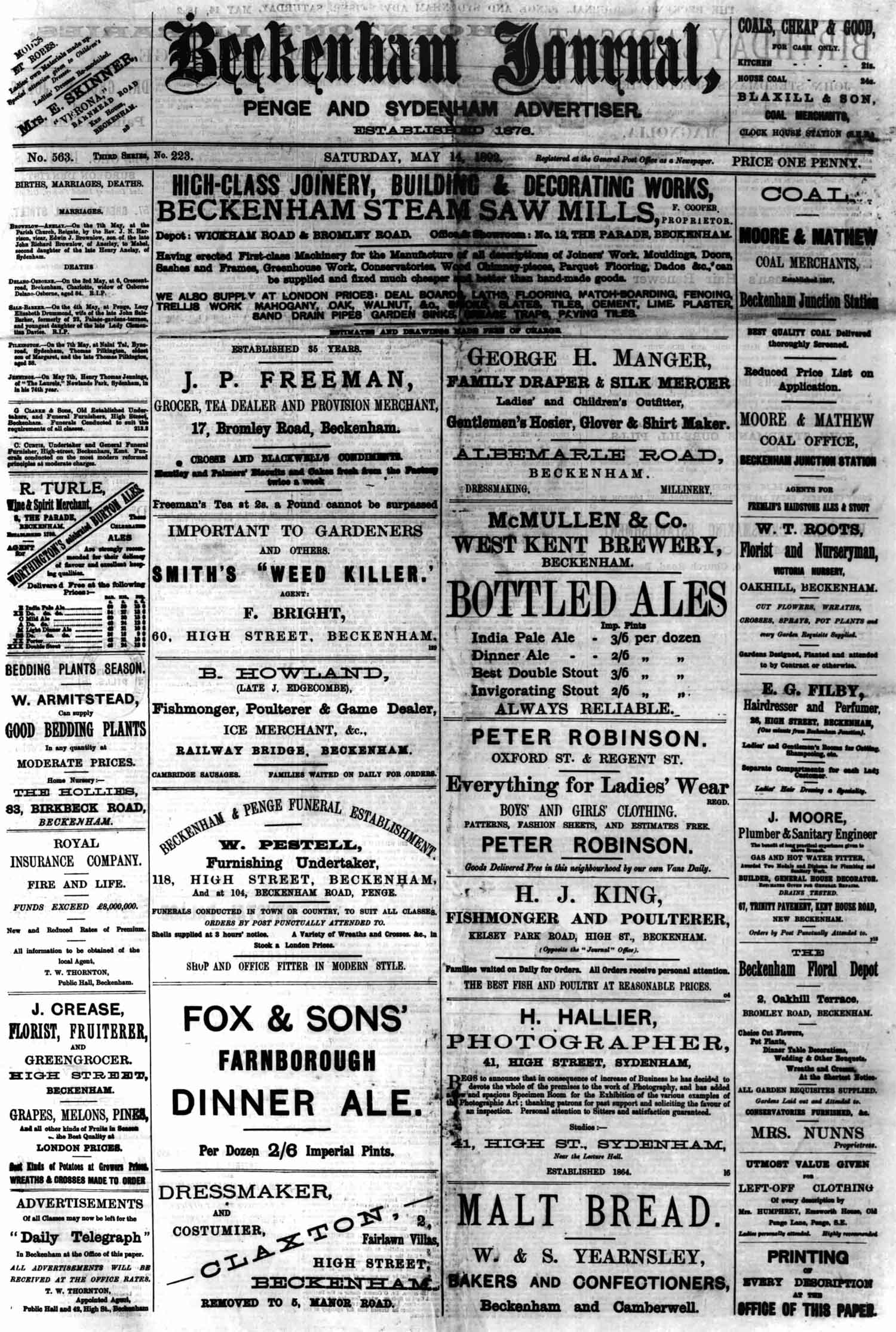
The Beckenham Journal was a significant local newspaper that served the communities of Beckenham, Penge, and surrounding areas in Kent (now part of Greater London) from its inception in 1876 until its cessation in 1965. Its evolution reflects the broader trends in local journalism and community engagement during this period.
Origins and Early Years
Established in 1876, the Beckenham Journal began as a 24-page monthly publication priced at one penny. In 1881, it was acquired by Tom William Thornton, who transformed it into a weekly newspaper. Under Thornton’s leadership, the paper became a platform for local advocacy, encouraging residents to participate in civic matters and stay informed about local issues. London Remembers
Content and Community Role
The newspaper covered a wide array of topics pertinent to the local populace, including:
-
Local Governance: Reports on council meetings, public health initiatives, and infrastructure developments.
-
Legal Affairs: Summaries of court proceedings, highlighting local disputes and legal decisions.
-
Social Events: Announcements of weddings, funerals, and community gatherings.
-
Economic Updates: Information on local businesses, employment opportunities, and market trends.
By providing comprehensive coverage of these areas, the Beckenham Journal served as a vital source of information and a unifying force within the community.
Decline and Legacy
The newspaper ceased publication in 1965, a casualty of the changing media landscape and the consolidation of local news outlets. Despite its closure, the Beckenham Journal remains a valuable resource for historians and genealogists. Its archives offer insights into the social fabric of the area, chronicling the lives of its residents and the evolution of the community over nearly a century.
Today, editions of the Beckenham Journal are preserved in digital format, providing accessible historical records for research and personal exploration.
Value to Historians & Genealogists
-
Genealogy: Names, addresses, occupations, employers, and social standing (e.g., employer vs. employee, landlord vs. worker).
-
Local History: Insight into daily life, crime, philanthropy, child labour, and education.
-
Urban Development: Street names, housing patterns, and emerging public services (surgeries, infirmaries).
-
Social Norms: Clear evidence of Victorian morality, discipline, charity, and a still-developing welfare system.
In Brief
Penge, 1892: Dog licenses, pub transfers, teen gambling, child labour, and cigar fraud—all in one week! Victorian justice and daily life as reported by the Beckenham Journal. #History #Penge #VictorianLondon #Genealogy #LocalHistory #Newspapers #OnThisDay