Taunton Courier and Western Advertiser – Wednesday 11 August 1875
RAILWAY ACCIDENT.
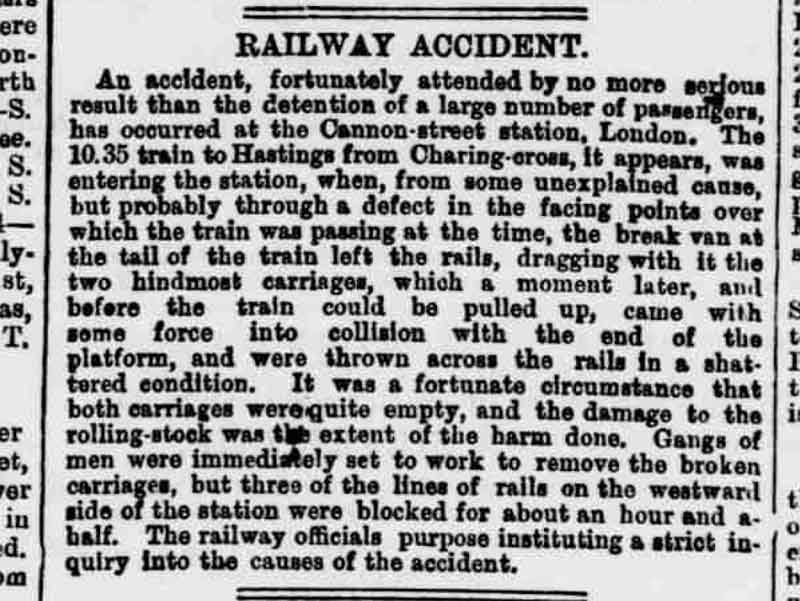
An accident, fortunately attended by no more serious result than the detention of a large number of passengers, has occurred at the Cannon-street station, London. The 10.35 train to Hastings from Charing-cross, it appears, was entering the station, when, from some unexplained cause, but probably through a defect in the facing points over which the train was passing at the time, the break van at the tail of the train left the rails, dragging with it the two hindmost carriages, which a moment later, and before the train could be pulled up, came with some force into collision with the end of the platform, and were thrown across the rails in a shattered condition. It was a fortunate circumstance that both carriages were quite empty, and the damage to the rolling-stock was the extent of the harm done. Gangs of men were immediately set to work to remove the broken carriages, but three of the lines of rails on the westward side of the station were blocked for about an hour and a half. The railway officials propose instituting a strict inquiry into the causes of the accident.
The article from the Taunton Courier and Western Advertiser dated Wednesday, 11 August 1875, reports on a railway accident that occurred at Cannon Street Station in London. The incident involved empty railway carriages colliding with the platform end, resulting in significant damage to the rolling stock and temporary obstruction of several westward lines for approximately an hour and a half. Fortunately, there were no casualties, and railway officials promptly initiated an inquiry into the accident’s causes.
Analysis of the 1875 Railway Accident at Cannon Street Station
Legal Context in 1875
During the Victorian era, the rapid expansion of the railway network in the United Kingdom necessitated the development of safety regulations and legal frameworks. By 1875, the Regulation of Railways Act 1871 was in effect, granting the Board of Trade authority to investigate railway accidents and enforce safety measures. This act aimed to reduce accidents by mandating proper signaling systems, regular inspections, and reporting of incidents. The prompt inquiry initiated by railway officials following the Cannon Street accident aligns with these legal obligations.
Implications and Frequency of Railway Accidents in Victorian Times
Railway accidents were relatively common in the Victorian era due to the burgeoning nature of the industry and evolving safety standards. The Times estimated in 1875 that approximately 1,000 railway workers died annually in the UK, highlighting the hazardous conditions faced by railway employees. Passenger accidents, though less frequent, still occurred, underscoring the need for stringent safety protocols.
Occupations and Businesses Involved
The railway industry in 1875 encompassed a wide range of occupations, including engineers, conductors, signalmen, and maintenance crews. Companies such as the South Eastern Railway, which operated services through Cannon Street Station, played pivotal roles in transportation and commerce. The accident would have involved various personnel, from train operators to station managers, all integral to railway operations.
Events Surrounding the Accident
The collision at Cannon Street Station involved empty carriages being propelled into the platform end, leading to their derailment and obstruction of multiple tracks. The immediate response involved deploying work gangs to clear the debris and restore normal operations. The decision to conduct a thorough investigation reflects the era’s growing emphasis on accountability and safety in railway management.
Value for Historians and Family Historians
For historians, this incident provides insight into the operational challenges and safety concerns of Victorian railways. It illustrates the complexities of managing rapidly expanding railway networks and the legislative measures implemented to mitigate accidents. Family historians may find such reports valuable for understanding the working conditions of ancestors employed in the railway industry, offering context to their daily lives and occupational hazards.
Insights Gained
This account sheds light on the precarious nature of railway travel and employment in 1875. It highlights the industry’s efforts to improve safety standards and the critical role of prompt investigations in preventing future incidents. The incident also underscores the importance of railway stations like Cannon Street as hubs of activity and potential points of vulnerability within the transport network.
Life for Residents, Railway Workers, and Passengers
Residents near major stations like Cannon Street would have been accustomed to the constant movement and occasional disruptions caused by railway operations. Railway workers faced demanding and often dangerous tasks, with accidents posing significant risks to their well-being. Passengers relied on the efficiency and safety of train services, and incidents like this would have influenced public perception and trust in railway travel.
History of Cannon Street Station
Cannon Street Station, opened in 1866 by the South Eastern Railway, served as a crucial terminus in the City of London. Designed by Sir John Hawkshaw and Sir John Wolfe Barry, the station featured a prominent arched roof and twin towers facing the River Thames. Throughout its history, the station has undergone significant changes, including damage during World War II and subsequent modernisations. Despite these transformations, Cannon Street Station remains an integral part of London’s railway infrastructure.
History of the Taunton Courier and Western Advertiser
The Taunton Courier and Western Advertiser: A Respected Voice of Somerset
Origins and Early History
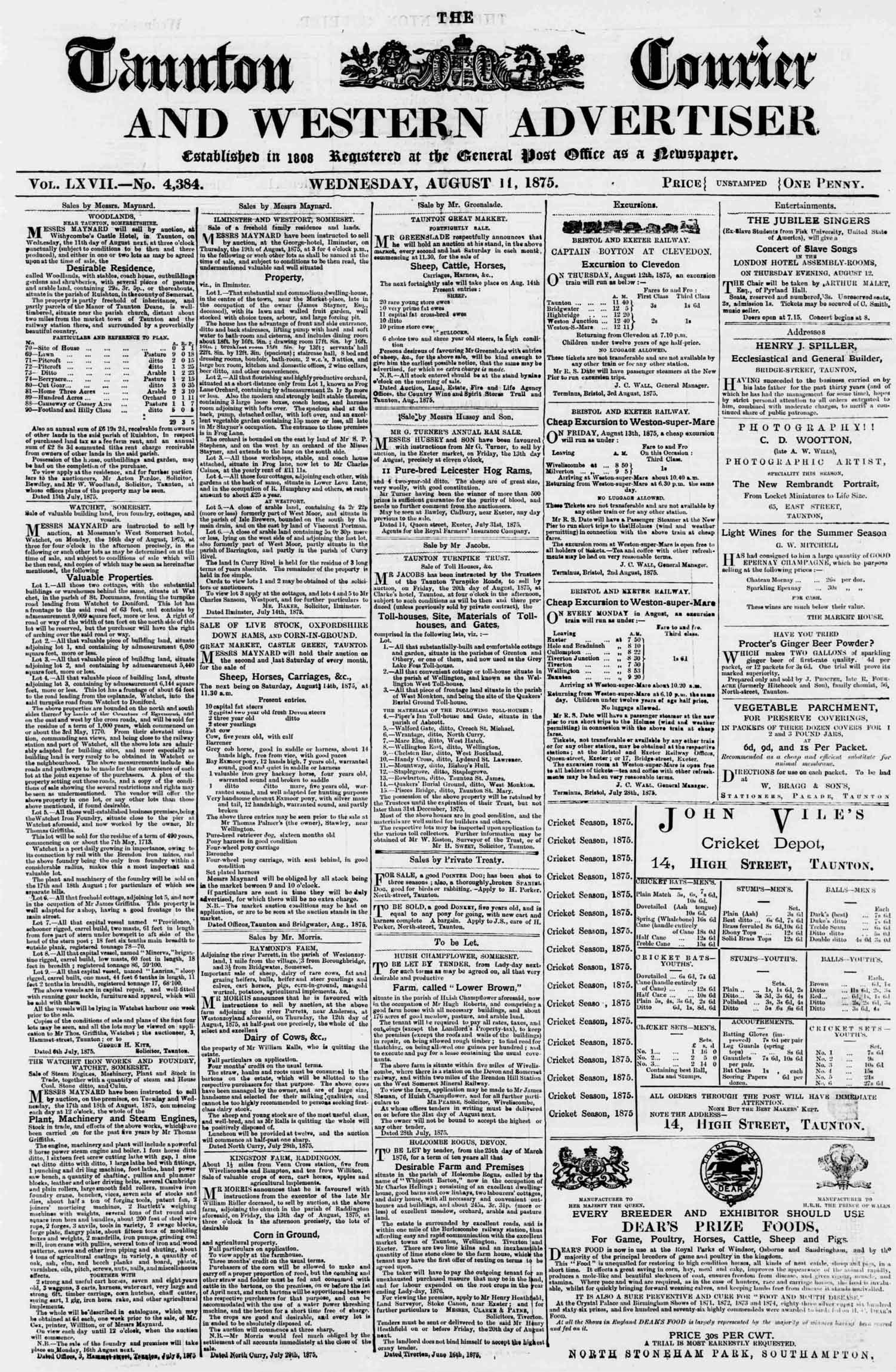
The Taunton Courier and Western Advertiser traces its origins back to the early 19th century, during a time when the British press was expanding rapidly alongside rising literacy rates and growing public appetite for news. It was first published in 1808, under the title The Taunton Courier, making it one of Somerset’s earliest newspapers.
It was founded in the county town of Taunton, a long-established centre for the wool trade, governance, and agriculture. Like many provincial newspapers of the era, it began as a weekly publication serving the local gentry, tradespeople, and rural communities, offering a blend of local news, national affairs, foreign intelligence, market reports, and classified advertisements.
Name Changes and Expansion
By the mid-19th century, the paper had developed a substantial readership beyond Taunton and expanded its name to reflect this wider geographical reach, becoming known as The Taunton Courier and Western Advertiser.
The inclusion of “Western Advertiser” signalled its broadened editorial ambition, appealing to readers across Somerset, Devon, and parts of Dorset, while maintaining a firm focus on the Taunton area. It continued to publish weekly, typically on Wednesdays, and was widely available through local newsagents, libraries, and subscription services.
Editorial Content and Influence
The newspaper was typical of its time in that it combined both editorial authority and commercial utility. The editorial tone was measured and respectable, often reflecting the views of the Conservative-leaning middle classes of Somerset. The paper reported extensively on:
-
Local government and municipal affairs
-
Crime and court proceedings
-
Agricultural markets
-
Births, marriages, and deaths
-
Railway developments
-
Education, religious matters, and moral commentary
It also provided serialised fiction, poetry, and reviews in keeping with Victorian tastes.
Its advertisements were just as important as the editorial content, listing employment opportunities, property for sale, livestock auctions, and upcoming public events—a vital resource for local businesses and the farming community.
Role in the Victorian Era
During the Victorian period, the Courier served as a critical chronicler of local society at a time of enormous change. Taunton and the surrounding regions were being transformed by the railway age, industrial development, and social reform. The newspaper captured the voices and concerns of people living through these shifts.
Events such as:
-
The arrival of the railway in Taunton in 1842
-
The Poor Law reforms
-
The Chartist agitation
-
The rise of nonconformist movements
…were all reflected and debated within its pages.
World Wars and the 20th Century
During both World Wars, the Taunton Courier played a key role in keeping citizens informed of war news, casualty lists, recruitment drives, and rationing notices. It also became a medium through which families could honour lost loved ones and support wartime charities.
In the post-war era, as rural communities became more connected to the rest of Britain, the Courier adapted, modernising its design and editorial tone. By the late 20th century, the paper had undergone several ownership changes, aligning with larger regional newspaper groups.
Later Years and Integration
The newspaper eventually became part of the Northcliffe Newspapers Group, and later Local World, which was subsequently acquired by Trinity Mirror (now Reach plc).
As the century closed, the newspaper was merged or phased into the Somerset County Gazette, with archives of the Courier surviving in libraries, archives, and on microfilm.
Value to Historians and Family Historians
For both academic historians and genealogists, the Taunton Courier and Western Advertiser is a treasure trove of information. It provides:
-
Eyewitness accounts of Victorian life in rural Somerset
-
Occupational records, including adverts and appointments
-
Reports on accidents, inquests, and local crimes
-
Detailed birth, marriage, and death announcements
-
Social and economic history in context
-
Military records, war memorials, and obituaries
By following a family’s surname or tracing addresses and occupations, a reader can build a vivid picture of an ancestor’s life and community.
Legacy
Although the Taunton Courier and Western Advertiser no longer exists as an independent title, its legacy endures. It was a faithful recorder of local life for nearly two centuries, a vital part of the community’s identity, and remains a window into the past for anyone seeking to understand the history of Somerset and the West of England.
In Brief
“Uncovering the 1875 Cannon Street Station Collision: A Glimpse into Victorian Railway Challenges” #VictorianRailways #CannonStreetStation #RailwayHistory #1875Accident #HistoricalInquiry