
Morning Advertiser – Monday 23 March 1868
THE ALLEGED MURDER ON A RAILWAY.
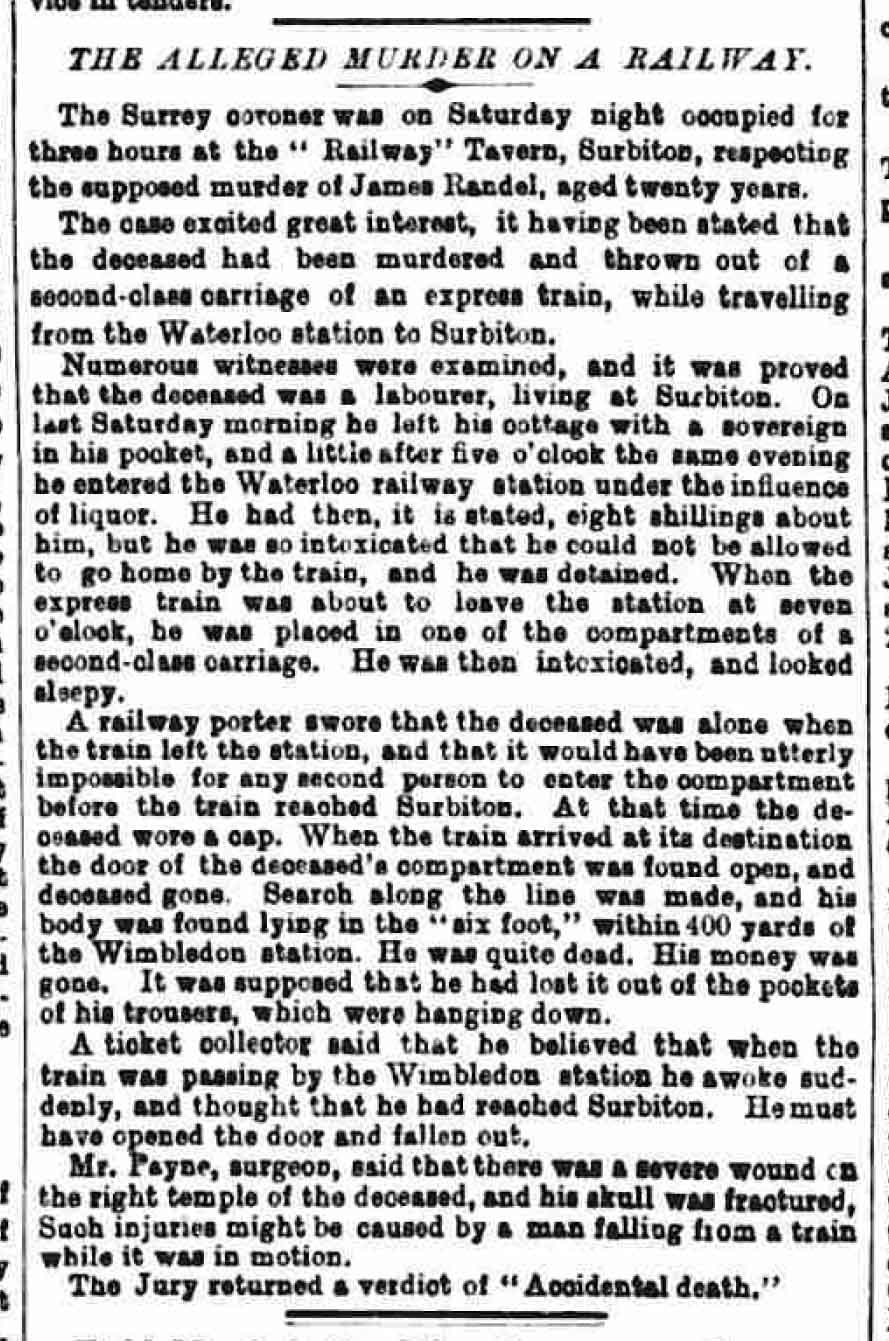
The Surrey coroner was on Saturday night occupied for three hours at the “Railway” Tavern, Surbiton, respecting the supposed murder of James Randel, aged twenty years.
The case excited great interest, it having been stated that the deceased had been murdered and thrown out of a second-class carriage of an express train, while travelling from the Waterloo station to Surbiton.
Numerous witnesses were examined, and it was proved that the deceased was a labourer, living at Surbiton. On last Saturday morning he left his cottage with a sovereign in his pocket, and a little after five o’clock the same evening he entered the Waterloo railway station under the influence of liquor. He had then, it is stated, eight shillings about him, but he was so intoxicated that he could not be allowed to go home by the train, and he was detained. When the express train was about to leave the station at seven o’clock, he was placed in one of the compartments of a second-class carriage. He was then intoxicated, and looked sleepy.
A railway porter swore that the deceased was alone when the train left the station, and that it would have been utterly impossible for any second person to enter the compartment before the train reached Surbiton. At that time the deceased wore a cap. When the train arrived at its destination the door of the deceased’s compartment was found open, and he was gone. Search along the line was made, and his body was found lying in the “six foot,” within 400 yards of the Wimbledon station. He was quite dead. His money was gone. It was supposed that he had lost it out of the pockets of his trousers, which were hanging down.
A ticket collector said that he believed that when the train was passing by the Wimbledon station he awoke suddenly, and thought that he had reached Surbiton. He must have opened the door and fallen out.
Mr. Payne, surgeon, said that there was a severe wound on the right temple of the deceased, and his skull was fractured. Such injuries might be caused by a man falling from a train while it was in motion.
The Jury returned a verdict of “Accidental death.”
Full Historical Analysis
Context of the Time: Legal, Social, and Economic
In 1868, England was undergoing vast industrial and social transformation. The railways, having boomed since the 1830s, were the prime method of long-distance travel for both goods and people. Laws governing public safety on the railways were still developing, with the Regulation of Railways Act 1868 only just coming into effect in July of that year—four months after this event. This Act would later mandate intercommunication between compartments and improved braking systems, which would directly address the kind of isolation that contributed to incidents like James Randel’s death.
The Coroner’s Inquest, held in a public house (a common venue at the time), was a key legal process in determining the cause of suspicious or sudden deaths. It was presided over by the county coroner, in this case, the Surrey coroner, and attended by a jury of local men. A verdict of “accidental death” meant no criminal charges would follow.
The railway staff mentioned (porter, ticket collector) were typically working-class men in steady employment with railway companies—possibly the London and South Western Railway (LSWR), which operated out of Waterloo and ran services through Surbiton and Wimbledon.
The deceased, James Randel, is described as a labourer, aged twenty—suggesting he worked in manual trades, possibly in construction or railways themselves. That he had a cottage implies either modest independence or residence with family. His intoxication, use of shillings and a sovereign, and treatment by station staff reflect societal attitudes: drunkenness was tolerated to a degree but could impede travel. Placing an intoxicated man in a locked compartment suggests the absence of safeguards we’d expect today.
Individuals and Institutions
-
James Randel: A 20-year-old labourer of Surbiton. No further detail is given about his family or employer, but local directories, parish records, or census documents (1861/1871) might reveal more for family historians.
-
The Railway Tavern, Surbiton: A key location for the inquest. Taverns often served as informal community centres. It likely stood near Surbiton Station, which opened in 1838 and was central to the town’s expansion.
-
Mr. Payne, surgeon: An early form of forensic medical witness. Likely a local general practitioner called to support inquests.
-
LSWR staff (porter, collector): Employed in roles critical to public safety and passenger service. Their testimonies suggest professionalism and adherence to duty.
Social and Historical Insights
-
Safety: The isolation of railway compartments without intercommunication contributed to both crime and accidents, particularly when intoxicated or confused passengers travelled alone. Incidents like this would pressure reforms.
-
Alcohol and Public Transport: Public drunkenness was common, and railway staff had discretion over whether to allow passengers to board. This case illustrates the risks and the lack of medical or supervisory support for inebriated travellers.
-
Surbiton in 1868: Then a developing suburban area, Surbiton had grown rapidly due to the railway. It attracted tradesmen and workers who could commute into London or work locally. Its cottages, like the one Randel lived in, would have housed artisans, railway workers, or labourers.
Use for Historians and Family Historians
-
Historians: The article is a lens into Victorian railway travel, coroner practices, and working-class life. It illustrates the evolving nature of public transport law, medical involvement in legal processes, and societal norms around alcohol.
-
Family Historians: This report is a rare primary source providing name, age, occupation, residence, and social habits of an ordinary man not otherwise in the public record. For descendants or researchers tracing the Randel family or Surbiton inhabitants in 1868, it offers valuable leads.
The Morning Advertiser: History
Origins (1794)
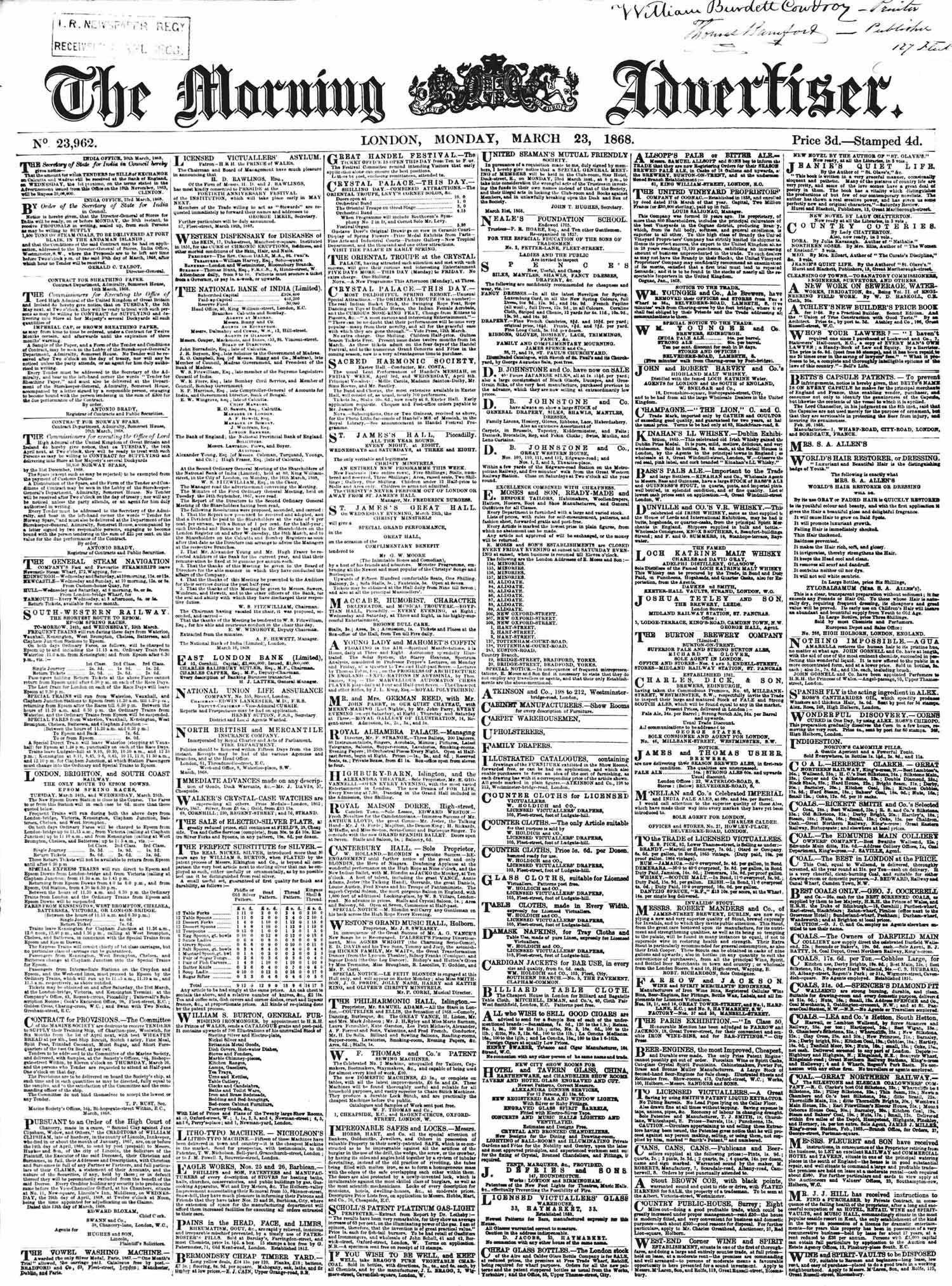
The Morning Advertiser was founded in 1794 in London, during a time of immense political and social change. Unlike most newspapers of its era, it was not established by a group of wealthy individuals or political interests, but instead by a trade organisation—the Society of Licensed Victuallers (later known as the Licensed Victuallers’ Association).
This society represented the interests of publicans, tavern-keepers, brewers, and others involved in the licensed trade (the selling of alcohol). The paper was initially conceived as a means of providing news and information relevant to this sector, including updates on licensing laws, taxes, market prices for wines and spirits, and other matters affecting the hospitality industry.
It was also intended to counterbalance the London Gazette and other government-aligned papers, giving the working-class readership a stronger voice, especially those employed in public houses and the drinks trade.
The 19th Century: A Unique Position in the Press
During the 1800s, The Morning Advertiser held a unique position. While it provided general news coverage, including politics, criminal reports, inquests, theatre reviews, and international affairs, its primary readership remained those connected to the licensed trade.
It was often described as “the voice of the public house,” with strong editorials defending the rights of tavern-keepers and criticising attempts by the temperance movement and certain politicians to restrict the sale of alcohol.
It was the first newspaper in Britain to achieve mass circulation without relying on aristocratic or party patronage. Its survival was supported by a large network of taverns and public houses that subscribed to it en masse, ensuring high distribution figures across London and beyond.
By the mid-19th century, the Advertiser had grown into one of London’s best-read morning dailies, especially among working- and middle-class readers.
Notable Contributions
-
Court and inquest reporting: The Morning Advertiser frequently covered coroner’s inquests, criminal trials, and police reports. As such, it is a valuable source for historians and genealogists seeking information on otherwise undocumented individuals.
-
Theatrical and musical reviews: With ties to the London pub and entertainment scene, it also regularly published detailed reviews of plays, operas, music halls, and early music performances.
-
Alcohol licensing law reporting: It closely followed legislation, debates, and prosecutions related to the sale and regulation of alcohol.
-
Adverts and social notices: These ranged from job advertisements for barmaids and publicans to notices of bankruptcies and estate sales, making it a rich source for social historians.
20th Century Evolution
By the early 20th century, The Morning Advertiser had narrowed its focus more specifically to the licensed and hospitality trades, gradually reducing its coverage of broader political and cultural news. This change came as mass-market newspapers (such as the Daily Mail and Daily Express) took hold of the general readership.
In 1921, the paper merged briefly with the Morning Herald, and later, it was absorbed into the publishing group behind several trade journals. Despite these changes, it retained its independence for many decades and continued to serve as the primary newspaper for the drinks and pub industry.
By the late 20th century, the print edition had become highly specialised—offering news, regulatory updates, product launches, hospitality trends, and features focused on publicans, bar managers, and brewers.
Digital Era and Merger
In 2011, The Morning Advertiser merged with The Publican, another long-standing licensed trade publication, to form The Publican’s Morning Advertiser. This marked a consolidation of Britain’s two most important trade journals for the pub and bar industry.
It transitioned into a fully digital-first publication, with a continuing print edition, and is now published by William Reed Business Media, a company specialising in trade publishing.
As of the 2020s, the publication (often referred to as just The Morning Advertiser again) continues to serve the UK’s hospitality sector with news, opinion, regulation updates, events coverage, and insight into trends affecting pubs, bars, and alcohol producers.
Legacy and Historical Value
For historians, The Morning Advertiser is:
-
An essential primary source for understanding working-class London, particularly in relation to the drinks trade, transport, and crime.
-
A key voice in the debate over licensing laws, temperance, and public morality.
-
A newspaper that reflected the concerns, humour, habits, and interests of the Victorian and Edwardian publican class.
For family historians, it can provide:
-
Names, addresses, and occupations of victuallers, barmaids, waiters, brewers, and labourers.
-
Details of inquests, accidents, and criminal trials often not covered by larger dailies.
-
Obituaries, bankruptcy notices, and social news of working-class communities often omitted elsewhere.
Summary Timeline
| Year | Event |
|---|---|
| 1794 | The Morning Advertiser founded by the Society of Licensed Victuallers |
| 1830s–1860s | Becomes one of the most-read daily newspapers in London |
| Late 1800s | Covers court cases, inquests, theatre, and licensing laws extensively |
| 1921 | Briefly merges with Morning Herald |
| 2011 | Merges with The Publican to become The Publican’s Morning Advertiser |
| 2020s | Operates as a digital-first trade journal for the UK pub industry |
In Brief
🚨 ALLEGED RAILWAY MURDER, 1868 🚂
James Randel, 20, found dead near Wimbledon after falling from an express train from Waterloo to Surbiton. Inquest held at the Railway Tavern. Jury: “Accidental death.”
Was it drink, misjudgement—or more?
#VictorianCrime #RailwayHistory #FamilyHistory #Surbiton #Waterloo1868 #RailwayAccident #OldBritishNews