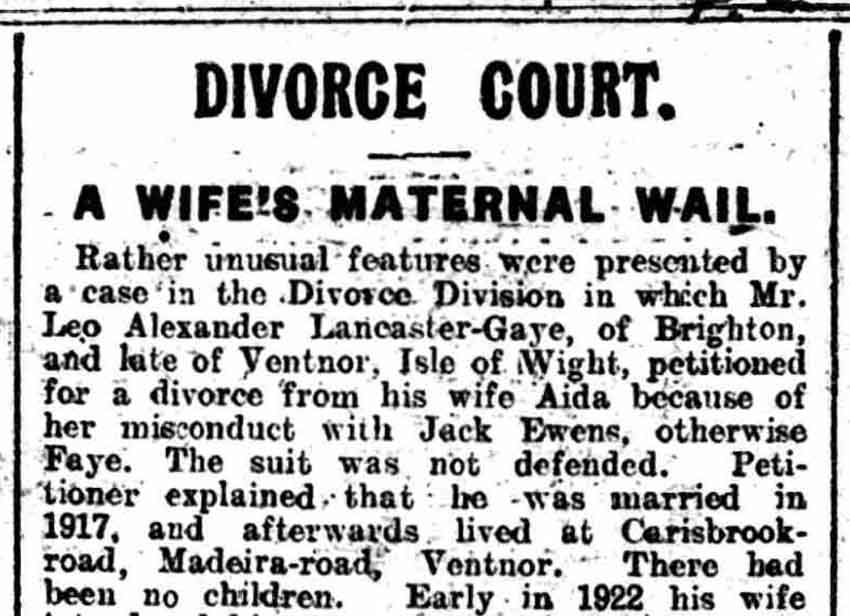
Illustrated Police News – Thursday 04 January 1923
DIVORCE COURT.
A WIFE’S MATERNAL WAIL.
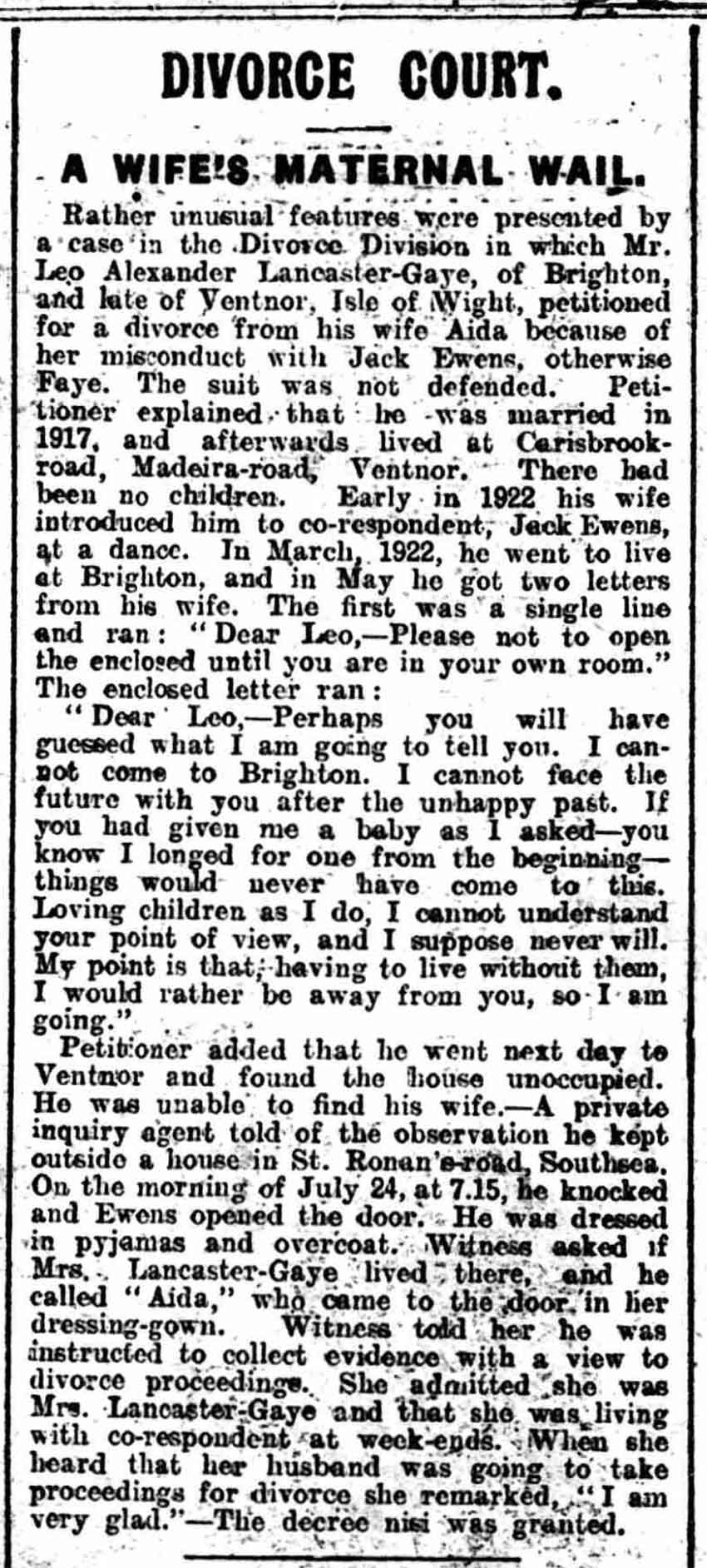
Rather unusual features were presented by a case in the Divorce Division in which Mr. Leo Alexander Lancaster-Gaye, of Brighton, and late of Ventnor, Isle of Wight, petitioned for a divorce from his wife Aida because of her misconduct with Jack Ewens, otherwise Faye. The suit was not defended. Petitioner explained that he was married in 1917, and afterwards lived at Carisbrook-road, Madeira-road, Ventnor. There had been no children. Early in 1922 his wife introduced him to co-respondent, Jack Ewens, at a dance. In March, 1922, he went to live at Brighton, and in May he got two letters from his wife. The first was a single line and ran: “Dear Leo, — Please not to open the enclosed until you are in your own room.” The enclosed letter ran:
“Dear Leo, — Perhaps you will have guessed what I am going to tell you. I cannot come to Brighton. I cannot face the future with you after the unhappy past. If you had given me a baby as I asked — you know I longed for one from the beginning — things would never have come to this. Loving children as I do, I cannot understand your point of view, and I suppose never will. My point is that, having to live without them, I would rather be away from you, so I am going.”
Petitioner added that he went next day to Ventnor and found the house unoccupied. He was unable to find his wife. — A private inquiry agent told of the observation he kept outside a house in St. Ronan’s-road, Southsea. On the morning of July 24, at 7.15, he knocked and Ewens opened the door. He was dressed in pyjamas and overcoat. Witness asked if Mrs. Lancaster-Gaye lived there, and he called “Aida,” who came to the door in her dressing-gown. Witness told her he was instructed to collect evidence with a view to divorce proceedings. She admitted she was Mrs. Lancaster-Gaye and that she was living with co-respondent at week-ends. When she heard that her husband was going to take proceedings for divorce she remarked, “I am very glad.” — The decree nisi was granted.
Detailed Analysis and Historical Context
Legal Context (England, 1923)
In 1923, divorce law in England was governed by the Matrimonial Causes Acts, most notably the Matrimonial Causes Act 1857, and its later amendments. At the time:
-
Men could petition for divorce solely on grounds of the wife’s adultery.
-
Women, however, had to prove adultery and another offence (e.g., cruelty or desertion).
-
Divorce cases were heard in the Divorce Division of the High Court.
-
Evidence of adultery was usually gathered by private detectives.
-
A decree nisi was the first step toward final divorce; if no objections were raised in a few months, a decree absolute would be issued, officially ending the marriage.
This case follows the legal structure precisely: a husband alleging adultery (with corroboration) and being granted a decree nisi. The court was not interested in emotional pleas unless they contributed to proving misconduct.
The People Involved
-
Leo Alexander Lancaster-Gaye: Petitioner, formerly of Ventnor, later of Brighton. No occupation mentioned, but given the cost of legal proceedings and hiring a private detective, he was likely middle to upper-middle class.
-
Aida Lancaster-Gaye: Wife of Leo. Her emotional letter shows deep longing for children — a reflection of the time’s maternal expectations of women. Her use of “I am very glad” implies a sense of relief, possibly from a loveless or constrained marriage.
-
Jack Ewens (aka Faye): Co-respondent. Possibly an alias suggests either showbusiness or other reasons for discretion. No occupation given. Presence in pyjamas at Aida’s residence was taken as evidence of cohabitation.
Private Inquiry Agents
Private detectives played a crucial role in early 20th-century divorce cases. Their job was to obtain proof of adultery — typically via:
-
Photographic surveillance,
-
Observing overnight stays,
-
Witnessing inappropriate dress or circumstances (such as pyjamas at early hours).
This case shows how even indirect evidence (shared residence, informal dress) could satisfy the court.
Implications and Uses for Historians & Family Historians
-
Marital Norms: This article gives insight into marital expectations: women were judged partly by fertility and maternal instinct, men by economic provision and fidelity.
-
Gender Roles: Aida’s letter reveals the pain of being childless and how motherhood was tied to feminine identity.
-
Social Class: Hiring private detectives and taking legal action suggests the Lancaster-Gayes were not working class.
-
Residential Detail: Addresses like Carisbrook Road, Madeira Road (Ventnor), and St. Ronan’s Road (Southsea) provide location data useful for local history and genealogy mapping.
-
Attitudes Toward Divorce: Divorce was still rare, slightly scandalous, and mostly available to the affluent. Public court reports were also a form of moral policing.
-
Language & Culture: The tone and wording offer a glimpse into early 20th-century British language, sentiment, and emotional expression.
-
Name Variations: Useful for tracing individuals who may have used aliases (like “Jack Ewens otherwise Faye”).
Life in England, 1923
-
Post-War Society: The country was recovering from WWI. Marriages like Leo and Aida’s (1917) may have been wartime unions.
-
Social Expectations: Pressure on women to produce children was intense; failure to do so could result in deep personal and social consequences.
-
Housing & Living: Movement between towns (Ventnor to Brighton, Brighton to Southsea) suggests mobility among the middle class.
-
Marriage Breakdown: Emotional and physical estrangement were often kept private unless legally required.
The History of The Illustrated Police News
Origins and Founding (1864)
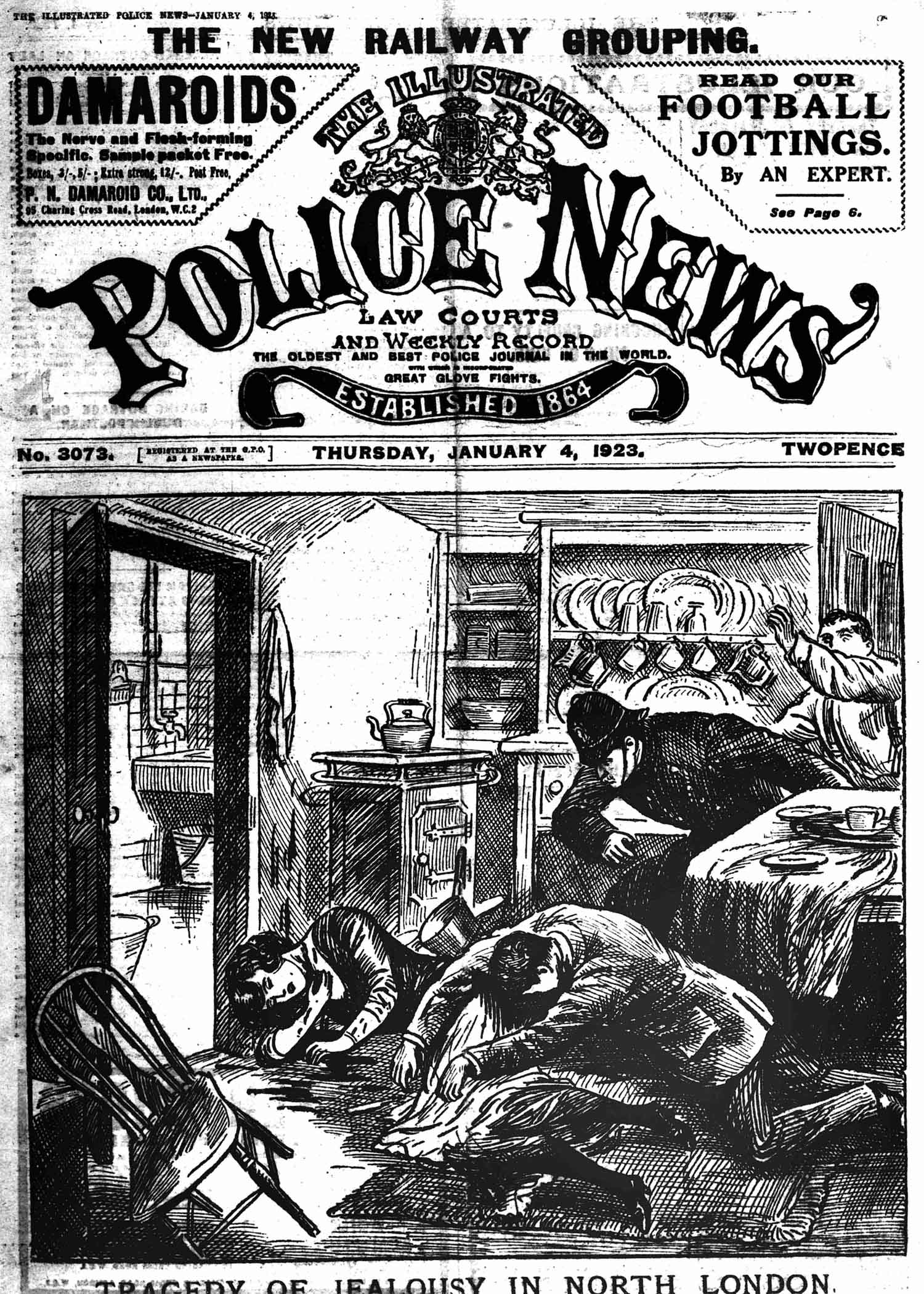
The Illustrated Police News was first published in London in 1864 by George Purkess, a bookseller and publisher. He recognised a growing public appetite for crime reporting and sensational news, particularly among the urban working classes of Victorian England. Inspired in part by France’s Gazette des Tribunaux, Purkess saw an opportunity to deliver court proceedings and crime stories in a vivid, accessible format.
It soon became one of the first and most notorious tabloid newspapers in British history.
Format and Content
The paper typically consisted of eight pages, filled with:
-
Woodcut illustrations of crime scenes, accidents, executions, and courtrooms.
-
Dramatised reports of murder trials, thefts, suicides, domestic violence, and sensational divorce cases.
-
Stories involving public executions, police actions, and “moral fall” tales.
-
International crime stories and disasters, especially those involving British subjects abroad.
-
Sections on curiosities, such as bizarre deaths or strange animal stories.
It was deliberately lurid, theatrical, and emotionally charged, making full use of exaggeration to grip its readers. The language was often melodramatic, echoing the style of penny dreadfuls, with titles such as:
“Horrible Murder of a Child by Her Own Mother!”
“The Hatchet Murder in Shoreditch: Blood on the Walls”
The illustrations were drawn by in-house artists who based their work on courtroom sketches or witness descriptions, as photography was not yet common in newspapers.
Audience and Popularity
The Illustrated Police News was one of the most widely read newspapers of its kind during the late 19th century. Its audience consisted primarily of the working class and lower middle class, many of whom were semi-literate or newly literate following education reforms.
-
It cost just one penny, making it affordable.
-
Sold in railway stations, markets, and by street vendors.
-
Often read aloud in pubs and households for communal entertainment.
-
Widely condemned by moral reformers and the elite, but enjoyed immense popularity nonetheless.
It played a similar cultural role to modern tabloid newspapers or true crime documentaries.
Moral Backlash and Controversy
The paper was frequently criticised for:
-
Sensationalising violence and glorifying crime.
-
Being morally corrupting, especially to women and children.
-
Exploiting real human tragedy for entertainment.
The National Vigilance Association and other moral campaigners condemned it, urging censorship. However, the paper defended itself by arguing it educated the public about the dangers of crime and showcased the triumph of justice.
In truth, it blurred the line between news and entertainment, with a strong undercurrent of moral instruction, albeit wrapped in highly dramatic prose.
Change and Decline (Early 20th Century)
By the early 1900s, the public’s appetite began to shift:
-
The emergence of photographic journalism reduced reliance on engravings.
-
More respectable newspapers like the Daily Mail and News of the World began to dominate the market.
-
Rising literacy meant readers could now access a wider range of media, including novels, magazines, and political papers.
In response, The Illustrated Police News tried to modernise. It toned down the worst excesses, added sport and human interest stories, and included more overseas news.
Despite these changes, it never fully regained its former popularity.
Closure and Legacy (1938)
The final edition of The Illustrated Police News was published in 1938, after 74 years in circulation.
Though its decline was inevitable, it left behind a remarkable social and historical archive, valuable for:
-
Crime historians
-
Social historians
-
Family historians and genealogists
-
Researchers of gender, morality, media and Victorian life
Today, its issues are preserved in archives, such as the British Library and online databases like the British Newspaper Archive. Many of its stories are referenced in scholarly works about crime, media, and popular culture.
Cultural and Historical Importance
-
Victorian Morality and Crime: It reflects how crime was perceived, punished, and moralised in 19th-century Britain.
-
Gender and Class: Offers insight into roles, expectations, and treatment of men, women, and the poor.
-
Policing and Justice: Documents trials, legal practices, and the evolution of the British justice system.
-
Visual Culture: Its vivid illustrations are among the earliest examples of mass-market visual journalism.
-
Popular Culture: A predecessor to modern tabloids, true crime writing, and even TV crime dramas.
Quotes from Scholars
-
Historian Judith Rowbotham describes it as:
“A window into Victorian anxieties and fascinations — where crime, punishment and morality met theatre.”
-
Professor Richard Altick wrote:
“It stood at the noisy intersection of journalism, melodrama, and moral preaching.”
Key Facts at a Glance:
| Category | Detail |
|---|---|
| First Issue | 1864 |
| Final Issue | 1938 |
| Founder | George Purkess |
| Price | 1 penny |
| Focus | Crime, courts, morality, domestic drama |
| Style | Sensational, illustrated, emotional |
| Audience | Working-class readers, semi-literate public |
| Legacy | Early tabloid model, rich historical source |
In Brief
“She longed for a baby. He hired a detective. A shocking divorce in 1923 reveals gender roles, heartbreak, and a woman’s ‘maternal wail’ in the courts. #DivorceCourt #1920sBritain #FamilyHistory #Genealogy #TrueStory #HistoryMatters”