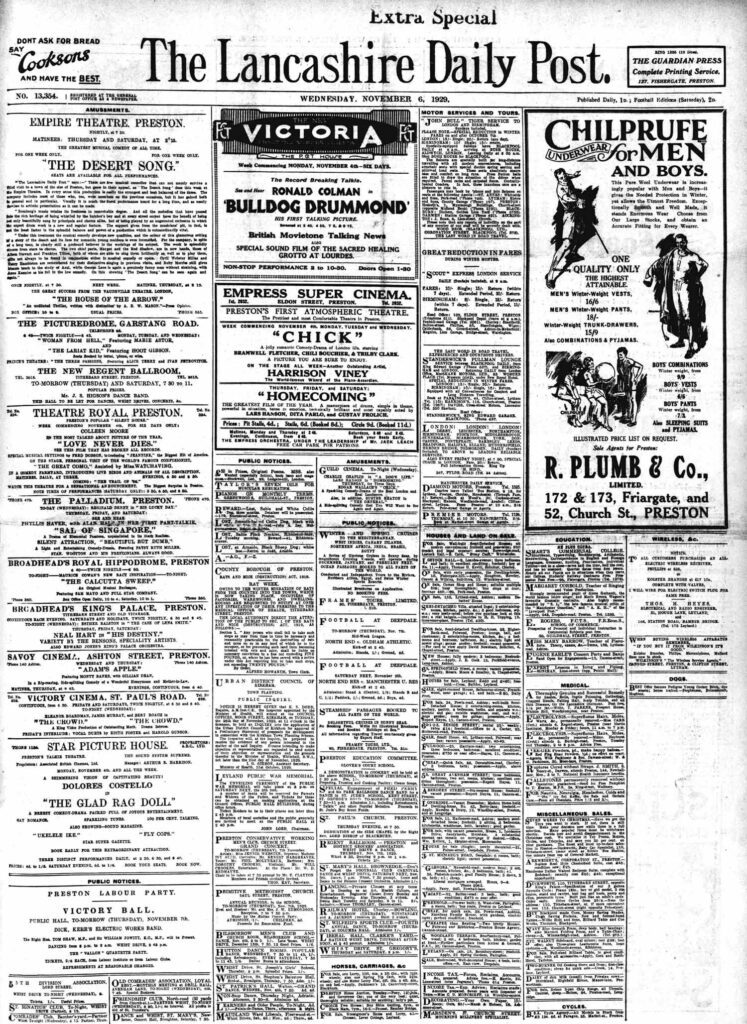
Lancashire Evening Post – Wednesday 06 November 1929
VIOLENT STREET FIGHT.
NINE MEN INVOLVED IN A NIGHT SCUFFLE AT PRESTON.
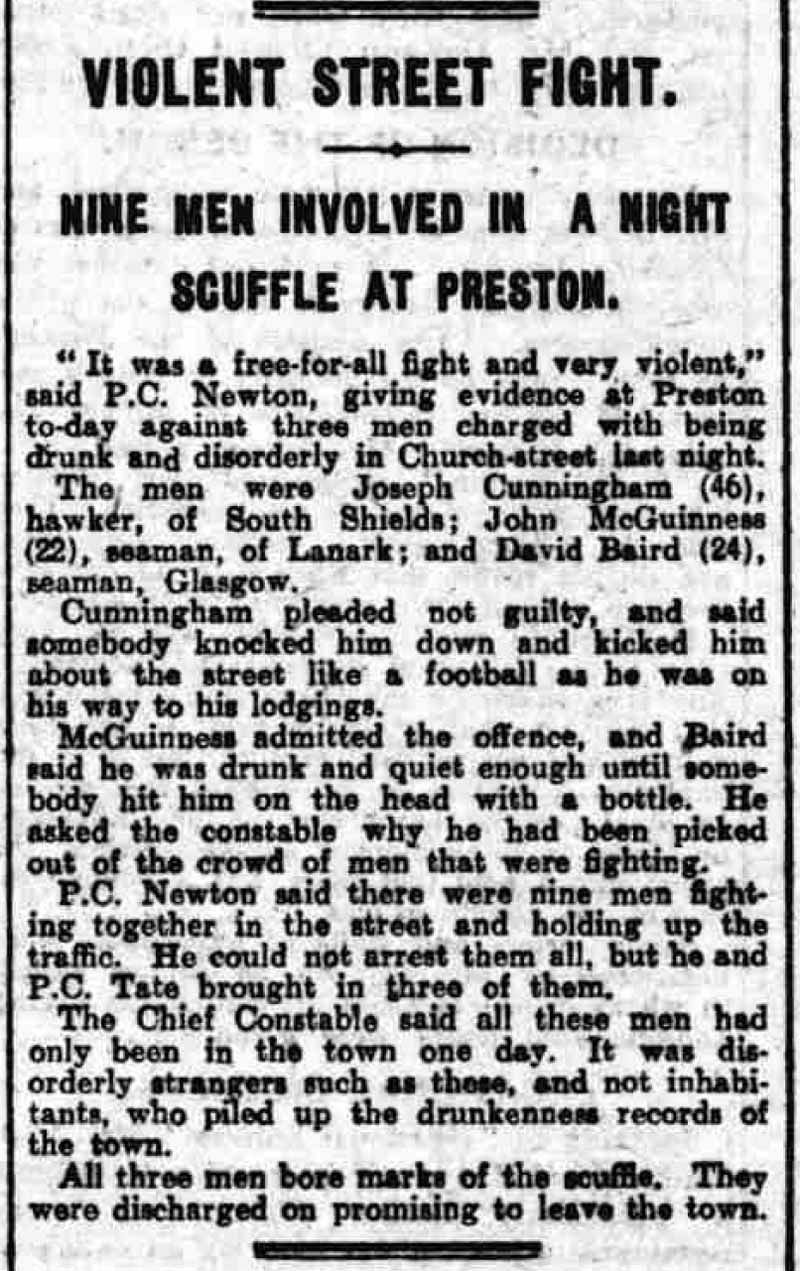
“It was a free-for-all fight and very violent,“ said P.C. Newton, giving evidence at Preston to-day against three men charged with being drunk and disorderly in Church-street last night.
The men were Joseph Cunningham (46), hawker, of South Shields; John McGuinness (22), seaman, of Lanark; and David Baird (24), seaman, Glasgow.
Cunningham pleaded not guilty and said somebody knocked him down and kicked him about the street like a football as he was on his way to his lodgings.
McGuinness admitted the offence, and Baird said he was drunk and quiet enough until somebody hit him on the head with a bottle. He asked the constable why he had been picked out of the crowd of men that were fighting.
P.C. Newton said there were nine men fighting together in the street and holding up the traffic. He could not arrest them all, but he and P.C. Tate brought in three of them.
The Chief Constable said all these men had only been in the town one day. It was disorderly strangers such as these, and not inhabitants, who piled up the drunkenness records of the town.
All three men bore marks of the scuffle. They were discharged on promising to leave the town.
Historical Analysis and Context
Legal Implications in 1929
During this period, public drunkenness and disorderly conduct were criminal offences under English law. The Inebriates Act 1898 and the Licensing Act 1902 gave authorities the power to detain those found drunk and disorderly in public places. Assault, especially when using a weapon like a bottle, could result in a more severe charge, such as grievous bodily harm (GBH) under the Offences Against the Person Act 1861.
However, in this case, the magistrate appears to have taken a lenient view, possibly influenced by the fact that the men were transient workers (seamen and a hawker) rather than local troublemakers. This reflects a tendency at the time to blame outsiders for lawlessness and seek quick resolutions to avoid prolonged legal proceedings.
Who Were the People Involved?
- Joseph Cunningham (46) – A hawker from South Shields, meaning he likely made his living by selling goods from town to town. Hawkers often travelled extensively, selling household wares, clothing, or foodstuffs.
- John McGuinness (22) – A seaman from Lanark (though Lanark is inland, he may have been associated with a port such as Glasgow).
- David Baird (24) – Another seaman, from Glasgow, a major maritime hub at the time.
The fact that the Chief Constable noted that these men had only been in town for one day suggests that they had recently arrived, possibly seeking work or passing through after docking at a nearby port.
Businesses and Employment in Preston (1929)
Preston in 1929 was an industrial town, dominated by textile mills, engineering works, and railway employment. It was also a hub for shipbuilding trade, which explains why transient seamen like McGuinness and Baird might have been in the area.
Given their occupations:
- Cunningham (hawker) may have been selling goods to factory workers or mill staff.
- McGuinness and Baird (seamen) may have been on shore leave, waiting for their next ship assignment.
Drunken street fights involving sailors were relatively common in port-adjacent industrial towns, where alcohol was a key part of both social life and leisure.
The Event’s Broader Significance
The Chief Constable’s statement about disorderly “strangers” filling the town’s drunkenness records hints at growing anti-outsider sentiment in industrial towns of the late 1920s.
This fits into a broader pattern in British society at the time, where vagrants, travelling workers, and transient labourers were often blamed for crime and disorder, even when locals were just as likely to be involved in such incidents.
Life in Preston in 1929
- Preston was heavily working-class, with most people employed in cotton mills, foundries, and railway yards.
- Public drunkenness was common, especially among labourers, dockers, and travelling workers.
- The Licensing Act 1921 had already reduced pub opening hours to control alcohol-related crime, but enforcement remained difficult.
- Police resources were limited, so officers often dealt with minor crimes by informal punishment—as seen here with the accused men being released on the promise to leave town rather than being formally convicted.
The Lancashire Evening Post
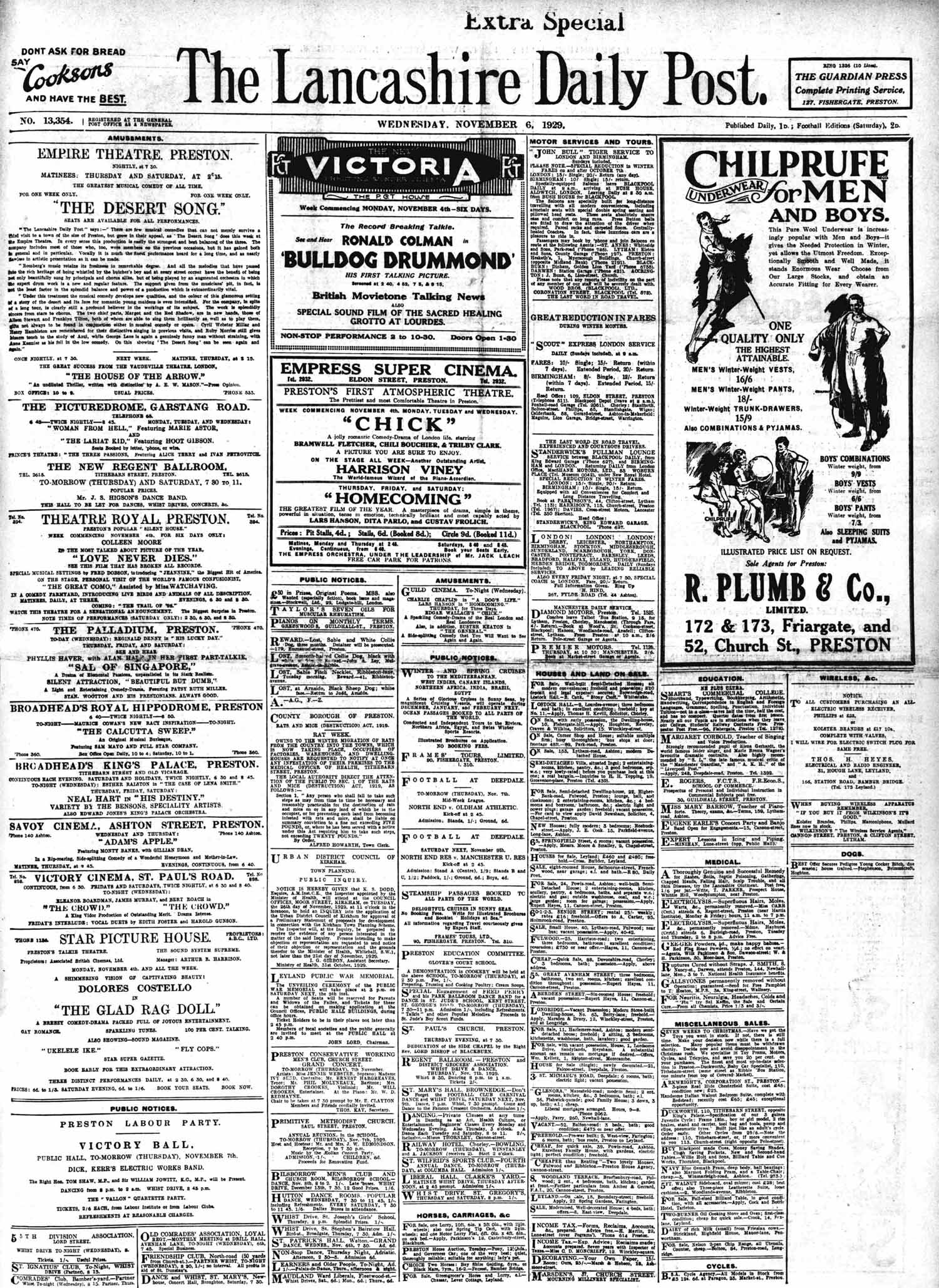
The Lancashire Evening Post (LEP) has been a cornerstone of regional journalism in Lancashire since its inception in 1886. Founded by George Toulmin and Sons, the newspaper aimed to provide comprehensive news coverage to the local populace.
Early Beginnings and Growth
The first edition of the LEP was published on 18 October 1886, consisting of four pages and priced at one halfpenny. The front page was primarily devoted to advertisements, while the inner pages covered local news, including events in towns like Lytham, Blackpool, Blackburn, and Haslingden. By the end of its first week, the newspaper reported on Preston North End’s football match, marking the beginning of its long-standing tradition of local sports coverage.
The newspaper quickly gained popularity, extending its reach beyond Preston. In 1893, it underwent a rebranding to become the Lancashire Daily Post, a title it retained until reverting to its original name in the mid-20th century.
Technological Advancements
Throughout its history, the LEP embraced technological innovations to enhance its production quality. The newspaper transitioned through various power sources—from manual to steam, gas, and eventually electricity—to meet the increasing demand for news. Notably, it was produced on a combined web printing and folding machine designed by Joseph Foster’s, a Preston-based company. This evolution in printing technology allowed for more efficient production and distribution.
Editorial Leadership
The LEP has been shaped by notable editorial figures over the years. One such individual was Barry Askew, who became editor in 1969. Under his leadership, the newspaper conducted significant investigations, including exposing abuses at Whittingham Hospital and uncovering police corruption, leading to the dismissal of Chief Constable Stanley Parr. Askew’s tenure exemplified the newspaper’s commitment to investigative journalism and holding power to account.
Modern Developments
In 1989, the LEP relocated from its Fishergate premises to a new site in Fulwood, Preston. This move was accompanied by substantial investments in state-of-the-art printing technology, marking the transition to more modern production methods. In January 2017, the newspaper underwent a rebranding, dropping “Evening” from its title to become the Lancashire Post, reflecting changes in publication times and modern news consumption habits.
Current Status
Today, the Lancashire Post continues to serve the Lancashire community, providing news coverage both in print and through its digital platforms. Despite challenges faced by regional newspapers globally, the LEP remains a trusted source of local news, upholding its legacy of journalistic integrity and community engagement.
Throughout its history, the Lancashire Evening Post has adapted to the evolving media landscape, maintaining its relevance and commitment to delivering quality journalism to the people of Lancashire.
Summary: What Can We Learn?
- This article is a valuable resource for historians and genealogists, as it provides real names, occupations, and locations of individuals in 1929.
- It highlights public order issues and the legal system’s approach to minor crimes.
- Shows how local newspapers influenced perceptions of crime and reinforced social divides between locals and transient workers.
- Offers a glimpse into life in Preston, including work, leisure, and the role of the police in maintaining public order.
This small article gives a snapshot of working-class life, showing the tensions between law enforcement, transient workers, and local communities in early 20th-century Britain.
In Brief
📰 Violent Street Fight in Preston! Nine Men Brawl in Church-Street – Police Arrest Three, Others Escape! (Lancashire Evening Post, 1929)
#Preston #History #1929 #Crime #Police #Lancashire #Seafarers #Hawker #OldNewspapers #Genealogy #FamilyHistory #Archives #LancashireEveningPost #UKHistory