The Surrey Mercury – Tuesday, 20 July 1847
LAMBETH.

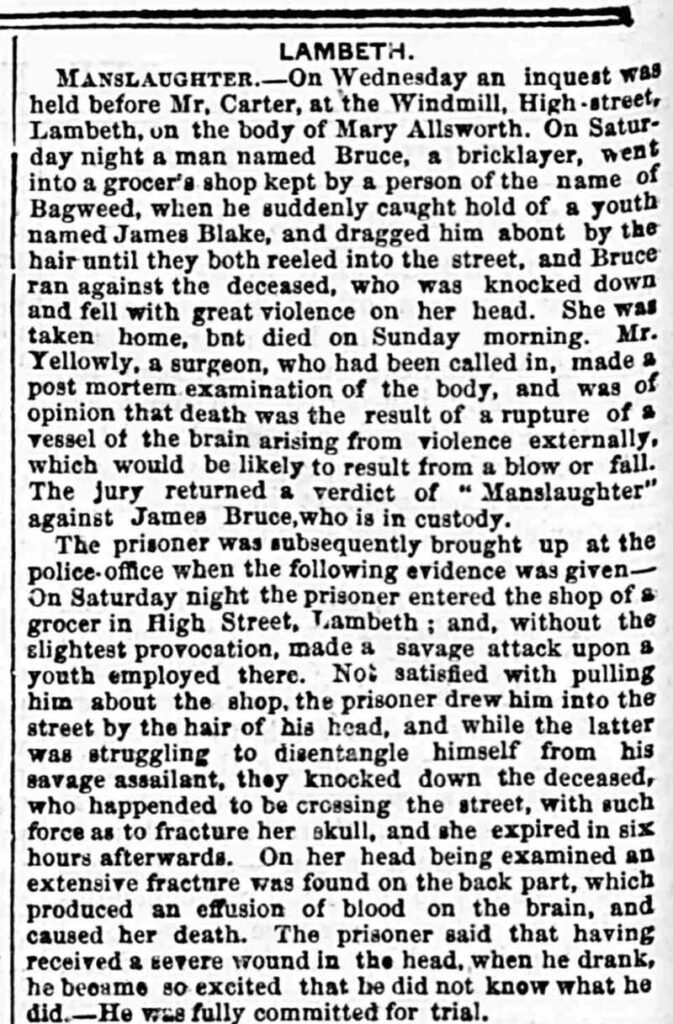
MANSLAUGHTER.—On Wednesday an inquest was held before Mr. Carter, at the Windmill, High-street, Lambeth, on the body of Mary Allsworth. On Saturday night a man named Bruce, a bricklayer, went into a grocer’s shop kept by a person of the name of Bagweed, when he suddenly caught hold of a youth named James Blake, and dragged him about by the hair until they both reeled into the street, and Bruce ran against the deceased, who was knocked down and fell with great violence on her head. She was taken home, but died on Sunday morning. Mr. Yellowly, a surgeon, who had been called in, made a post mortem examination of the body, and was of opinion that death was the result of a rupture of a vessel of the brain arising from violence externally, which would be likely to result from a blow or fall. The jury returned a verdict of “Manslaughter” against James Bruce, who is in custody.
The prisoner was subsequently brought up at the police-office when the following evidence was given—On Saturday night the prisoner entered the shop of a grocer in High Street, Lambeth; and, without the slightest provocation, made a savage attack upon a youth employed there. Not satisfied with pulling him about the shop, the prisoner drew him into the street by the hair of his head, and while the latter was struggling to disentangle himself from his savage assailant, they knocked down the deceased, who happened to be crossing the street, with such force as to fracture her skull, and she expired in six hours afterwards. On her head being examined an extensive fracture was found on the back part, which produced an effusion of blood on the brain, and caused her death. The prisoner said that having received a severe wound in the head, when he drank, he became so excited that he did not know what he did.—He was fully committed for trial.
Historical Analysis and Context
Legal Implications in 1847
During this period, the legal system in England categorised unlawful killings under several offences, including murder, manslaughter, and justifiable homicide. The jury in this case ruled that James Bruce was guilty of manslaughter, which was considered a lesser charge than murder, as it implied there was no premeditated intent to kill.
- Definition of Manslaughter (1847): English law at the time defined manslaughter as an unlawful killing without malice aforethought. Bruce did not deliberately attack Mary Allsworth but caused her death through reckless violence, which made him culpable.
- Criminal Proceedings: After the coroner’s inquest, Bruce was “fully committed for trial,” meaning he would stand before a judge, likely at the Surrey Assizes or the Old Bailey, to determine his punishment.
- Potential Sentence: Sentences for manslaughter in the mid-19th century varied. Bruce might have faced transportation (exile to Australia), penal servitude, or imprisonment, depending on the judge’s view of the severity of his actions.
The People and Their Occupations
-
James Bruce (The Accused)
- A bricklayer, a common working-class trade in Victorian England. Bricklayers were essential for the rapidly expanding urban landscape, especially in London, which was undergoing industrial growth.
- His defence mentioned a “severe wound in the head” and the effects of alcohol, suggesting he may have suffered from a traumatic brain injury or mental instability worsened by drinking.
-
Mary Allsworth (The Victim)
- The deceased, described simply as “crossing the street”, could have been a resident or a shopper in Lambeth.
- Her death highlights the dangerous and chaotic nature of urban streets at the time, where violence could erupt without warning.
-
James Blake (The Youth)
- Employed by the grocer, possibly as an apprentice or shop assistant.
- In the 1840s, young boys frequently worked in shops to gain experience in retail or trade before moving on to better opportunities.
-
Mr. Bagweed (Grocer & Shop Owner)
- Likely a local tradesman, grocers were vital community figures, supplying basic goods to working-class families.
- Grocers’ shops in 1847 typically stocked flour, sugar, tea, and other daily necessities, often on credit to trusted customers.
-
Mr. Yellowly (Surgeon)
- The medical examiner who performed the post-mortem.
- Surgeons in 1847 were evolving from barber-surgeons to more formally trained professionals as medical science advanced.
Life in Lambeth in 1847
Lambeth was a dense and working-class district in 1847, characterised by:
- Industrialisation: Many residents worked in construction, bricklaying, and factory jobs.
- Overcrowding and Poverty: Housing conditions were poor, leading to frequent outbreaks of cholera and typhoid due to contaminated water.
- Violence and Crime: Public drunkenness and street brawls were common, often spilling out of pubs and small shops into the streets, as seen in this case.
- Policing: The Metropolitan Police had been formed in 1829, but crime prevention was still inconsistent.
History of The Surrey Mercury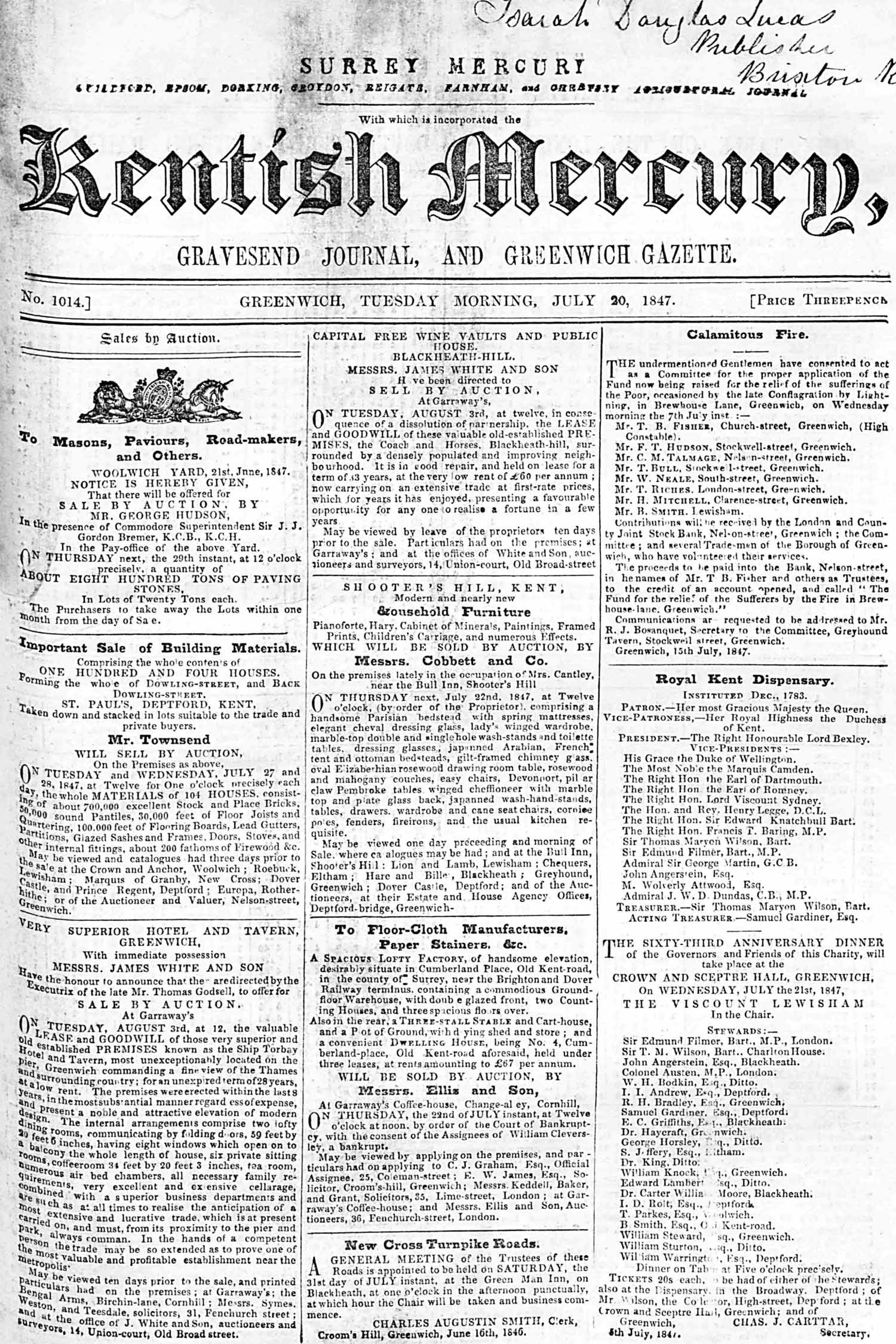
Surrey Mercury – Tuesday 20 July 1847
The Surrey Mercury was a regional newspaper serving the county of Surrey and parts of South London during the mid-19th century. Its publication spanned a brief period from 1845 to 1847, during which it provided local and international news to its readership.
Publication Period and Content
The Surrey Mercury offered its readers a mix of local news, including reports on community events, legal proceedings, and public notices, as well as international news stories. This blend of content aimed to keep the residents of Surrey informed about both local happenings and broader global events.
Archival Records
Today, historians and researchers can access 906 pages of the Surrey Mercury through the British Newspaper Archive, which holds editions from 1845 to 1847. These archives serve as valuable resources for understanding the historical context of Surrey during that era.
Significance for Research
Despite its short run, the Surrey Mercury provides insights into mid-19th-century life in Surrey. Articles covering local events, societal issues, and legal matters offer a window into the daily lives and concerns of the community during that period.
Conclusion
While the Surrey Mercury was in circulation for only a few years, its preserved editions continue to be a valuable asset for those interested in the history of Surrey and its surrounding regions during the mid-1800s.
Significance for Historians & Family Historians
This article is valuable for both social historians and genealogists because it provides:
- Crime and Justice Insights – A detailed look at how manslaughter cases were handled in the 19th century.
- Occupational Records – Mentions of a bricklayer, grocer, and shop assistant, which can help trace family professions.
- Local History of Lambeth – Highlights everyday violence, social interactions, and street life.
- Medical and Legal Development – Demonstrates early forensic techniques in post-mortem examinations.
In Brief
🚨 LAMBETH 1847: BRICKLAYER KILLS WOMAN IN STREET BRAWL! 🚨
James Bruce charged with manslaughter after knocking down Mary Allsworth in a drunken fight outside a grocer’s shop. Justice of the 19th century! ⚖️📰
#Lambeth #VictorianCrime #TrueCrime #History #OldBailey #LondonHistory #Bricklayer #GroceryShop #1847Crime #HistoricalNewspapers #Genealogy