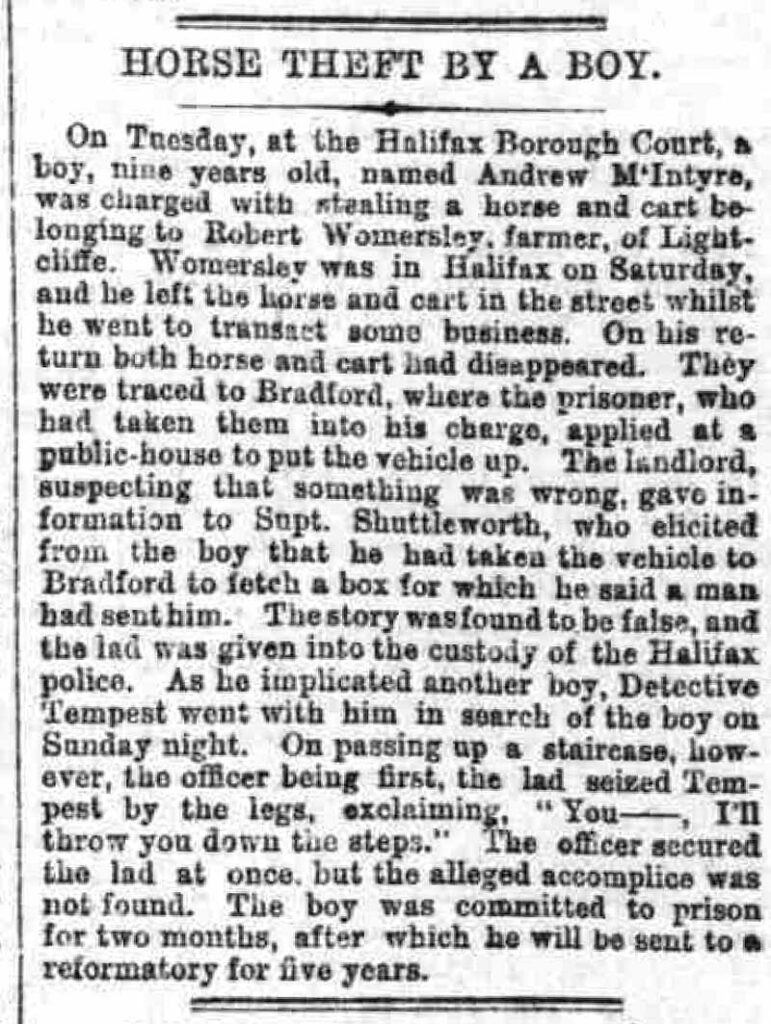
Liverpool Weekly Courier – Saturday 21 September 1872
HORSE THEFT BY A BOY.
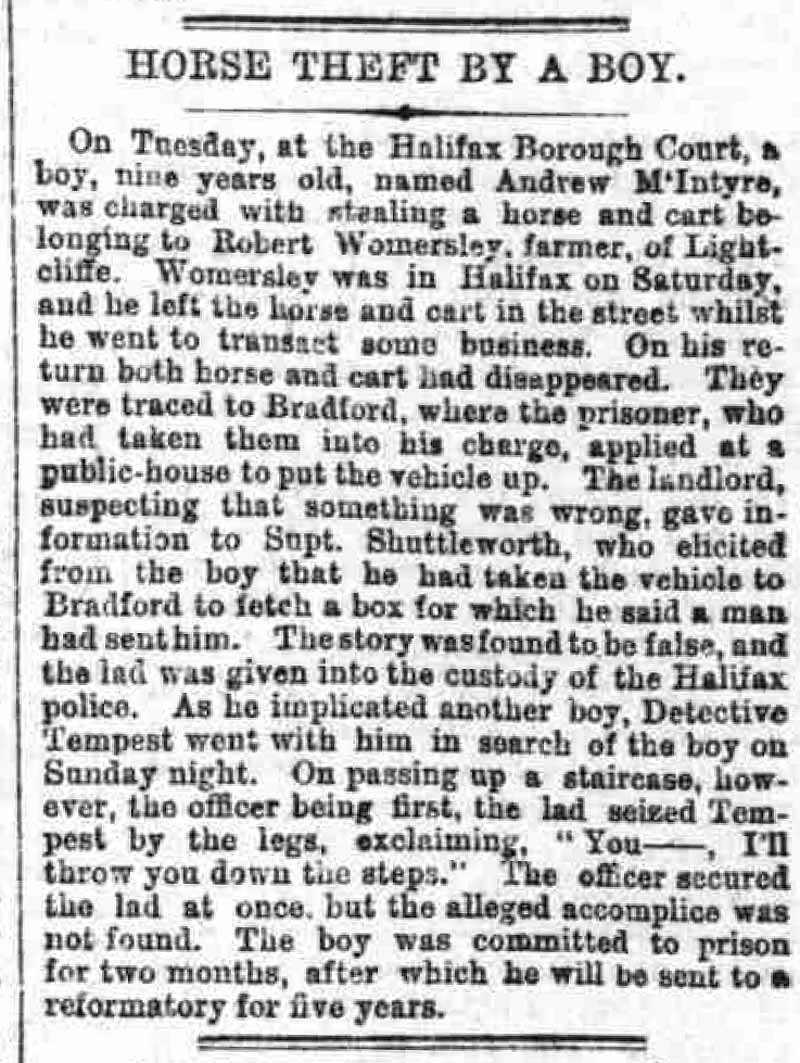
On Tuesday, at the Halifax Borough Court, a boy, nine years old, named Andrew M’Intyre, was charged with stealing a horse and cart belonging to Robert Womersley, farmer, of Lighthcliffe. Womersley was in Halifax on Saturday, and he left the horse and cart in the street whilst he went to transact some business. On his return both horse and cart had disappeared. They were traced to Bradford, where the prisoner, who had taken them into his charge, applied at a public-house to put the vehicle up. The landlord, suspecting that something was wrong, gave information to Supt. Shuttleworth, who elicited from the boy that he had taken the vehicle to Bradford to fetch a box for which he said a man had sent him. The story was found to be false, and the lad was given into the custody of the Halifax police. As he implicated another boy, Detective Tempest went with him in search of the boy on Sunday night. On passing up a staircase, however, the officer being first, the lad seized Tempest by the legs, exclaiming, “You——, I’ll throw you down the steps.” The officer secured the lad at once, but the alleged accomplice was not found. The boy was committed to prison for two months, after which he will be sent to a reformatory for five years.
Historical Analysis
Legal Context in 1872
In 1872, England’s legal system still operated under laws that were shaped by Victorian attitudes toward crime and punishment. Children could be charged with serious offences like adults, but their sentences often included reformative elements, such as reformatory schools.
Key legal considerations:
- Criminal Responsibility: At the time, the minimum age of criminal responsibility was seven years old. This meant that Andrew M’Intyre, at nine years old, was legally capable of understanding right from wrong and could be convicted.
- Horse Theft: Under the Larceny Act of 1861, stealing a horse was a serious offence, as horses were valuable property, essential for transport and farming.
- Use of Reformatories: The Reformatory Schools Act 1854 established special institutions for young offenders. Instead of sending them straight to adult prison, they could be detained in reformatories to receive moral and industrial training.
- Sentencing: M’Intyre received a two-month prison sentence followed by five years in a reformatory—indicative of the Victorian approach of punishing the immediate crime while attempting long-term rehabilitation.
Implications of the Case
- Harsh Treatment of Young Offenders: A nine-year-old receiving a five-year reformatory sentence shows how strict Victorian justice was. Many working-class children, especially those from troubled backgrounds, found themselves in similar situations.
- Social Class and Crime: The fact that M’Intyre was trusted by an unknown man (as he claimed) suggests he may have been part of a working-class or itinerant population where young boys often ran errands.
- Public-House Culture: The fact that the landlord of a public house played a crucial role in alerting the authorities shows the importance of pubs as centres of local information.
Key People Mentioned
- Andrew M’Intyre (Defendant) – A nine-year-old boy who stole a horse and cart.
- Robert Womersley (Victim) – A farmer from Lightcliffe, which was a rural area known for agriculture. Farmers relied heavily on their horses for business.
- Superintendent Shuttleworth – A senior police officer involved in the case. His role suggests Halifax had a structured police force in 1872.
- Detective Tempest – Another police officer, implying Halifax had detectives, which was relatively modern for the time.
- Unnamed Landlord – The public-house landlord who suspected the crime and informed the police, showcasing the role of innkeepers as community watchmen.
Life in Halifax in 1872
Halifax was a major industrial town during the Victorian era, known for textiles, wool production, and engineering. The economy was booming, but there were stark contrasts between the wealthy mill owners and the working-class poor.
Key aspects of life in Halifax at the time:
- Crime and Justice: Petty theft was common, and punishments were severe. The rise of police forces and detective units shows a shift toward more structured law enforcement.
- Child Labour and Street Life: Many children worked in factories, mines, or on the streets as errand boys, apprentices, or hawkers. A boy like M’Intyre may have been accustomed to handling animals, making it easier for him to steal a horse and cart.
- Reformatory Schools: These institutions were meant to prevent juvenile offenders from a life of crime. However, conditions were often harsh, with strict discipline and hard labour.
- Transport and Communication: The fact that the stolen horse and cart were traced to Bradford suggests a well-connected road network, used for trade and business.
Historical Significance for Historians & Family Historians
This article is valuable for:
- Genealogists: Anyone researching the M’Intyre, Womersley, Shuttleworth, or Tempest families may find this case part of their history.
- Social Historians: Provides insight into juvenile crime, law enforcement, and daily life in Halifax.
- Legal Historians: Shows the application of Victorian criminal law to children.
- Local Historians: Highlights connections between Halifax and Bradford, and the role of public houses in community surveillance.
Reformatory Schools in Victorian Britain
In mid-19th century Britain, societal concerns about juvenile delinquency led to the establishment of reformatory schools. These institutions aimed to reform young offenders through education, discipline, and vocational training, offering an alternative to traditional imprisonment.
Legislative Foundations
The foundation of reformatory schools was laid by key legislative acts:
-
Youthful Offenders Act 1854: This act allowed courts to sentence young offenders to reformatory schools instead of prisons, focusing on rehabilitation rather than mere punishment.
-
Reformatory Schools Act 1854: This act formalised the establishment of reformatory schools, setting standards and regulations for their operation.
-
Industrial Schools Act 1857: This act addressed children who were destitute or deemed at risk of falling into crime, allowing their placement in industrial schools for preventive measures.
These acts reflected a shift towards understanding the importance of environment and education in preventing juvenile crime.
Purpose and Function
Reformatory schools were designed for children convicted of crimes, providing structured environments where they could receive education and learn trades. The goal was to remove them from negative influences and equip them with skills for lawful employment upon release. Children could be sentenced to these institutions for up to five years.
Industrial schools, on the other hand, catered to destitute children who had not yet committed serious crimes but were vulnerable to criminal activities. Both types of schools aimed to reform and integrate children into society as productive members.
Notable Figures in Reformatory Movement
One prominent figure in the reformatory movement was Mary Carpenter (1807–1877), a social reformer who played a pivotal role in advocating for and establishing reformatory and industrial schools. Her efforts highlighted the need for specialised institutions to address the unique needs of juvenile offenders and destitute children.
Individuals Mentioned in the 1872 Case
-
Andrew M’Intyre: Specific historical records about Andrew M’Intyre are scarce. Given the commonality of the name and the passage of time, detailed information about his life beyond the 1872 incident is limited.
-
Robert Womersley: As a farmer from Lightcliffe, West Yorkshire, Robert Womersley likely relied on horses for agricultural work and transportation. Horse theft during this period was a significant crime due to the essential role horses played in daily life and commerce.
-
Superintendent Shuttleworth: While specific details about Superintendent Shuttleworth are not readily available, his title indicates a senior position within the Halifax police force during the 1870s. The establishment of structured police forces during this era was part of broader efforts to maintain public order amid rapid industrialisation.
-
Detective Tempest: Similarly, specific records about Detective Tempest are limited. His role as a detective reflects the evolving nature of law enforcement, with specialised units focusing on investigation and crime prevention.
Role of Public Houses in Crime Prevention
In 19th-century England, public houses (pubs) were more than just establishments serving alcohol; they functioned as community hubs where information was exchanged. Landlords often knew their patrons well and could identify unusual activities. In the 1872 case, the landlord’s suspicion and subsequent alert to authorities highlight the informal yet crucial role pubs played in community-based crime prevention.
Conclusion
The 1872 case involving nine-year-old Andrew M’Intyre underscores the Victorian approach to juvenile delinquency, emphasising both punishment and rehabilitation. Reformatory schools emerged as institutions aiming to redirect young offenders towards productive lives, reflecting a societal shift towards reform and prevention. The individuals involved in this case, from law enforcement officers to community members, illustrate the collaborative efforts in maintaining social order during a transformative period in British history.
History of The Liverpool Weekly Courier
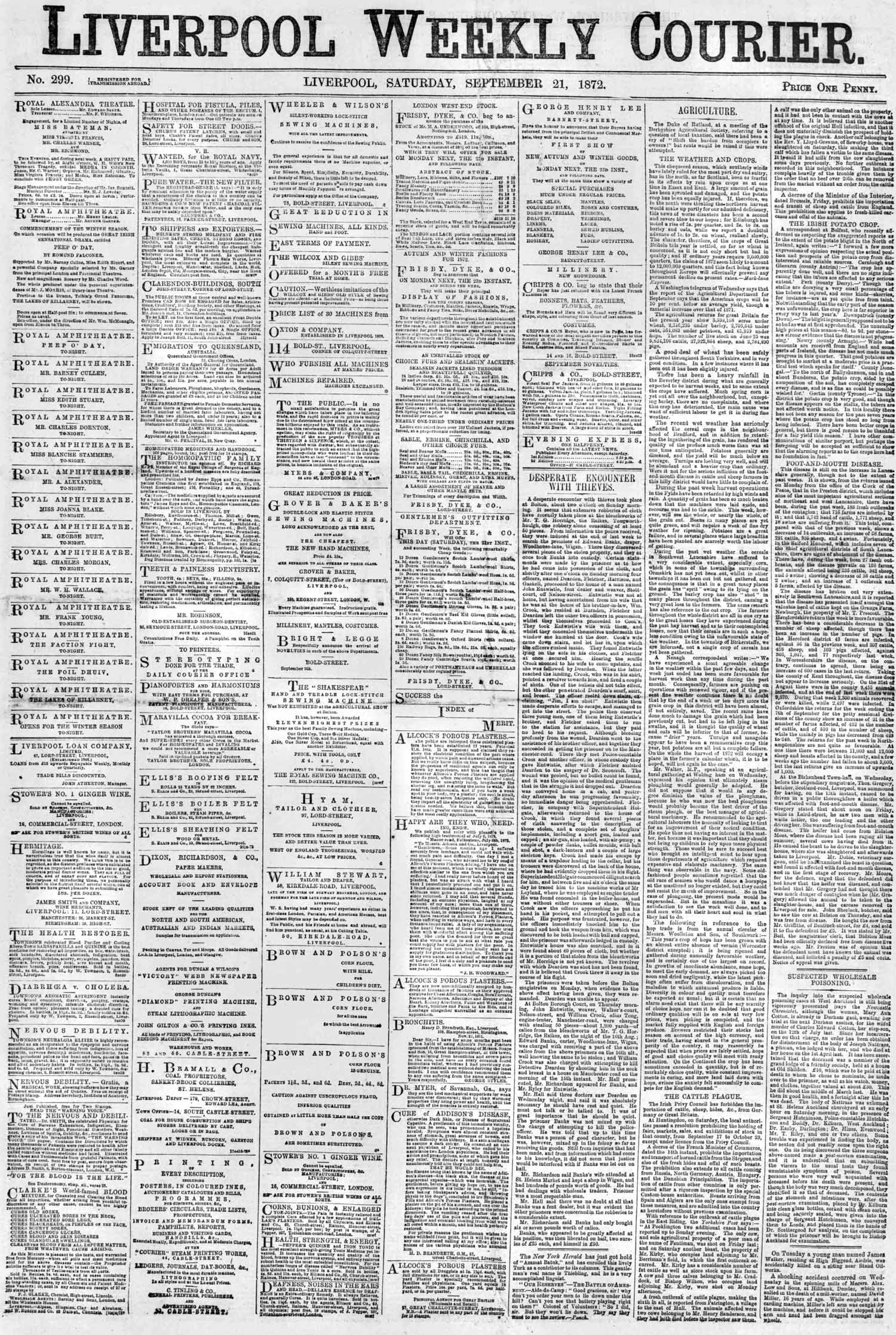
The Liverpool Weekly Courier was a prominent newspaper in Liverpool, England, during the 19th and early 20th centuries. First published on 5 January 1867, it served as the weekly edition of the Liverpool Courier, providing readers with a comprehensive digest of news, events, and advertisements.
Origins and Development
The Liverpool Courier itself was established earlier, on 6 January 1808, by Thomas Kaye. Initially a four-page weekly political paper priced at sixpence, it offered political news, details on departing ships, cargoes, ship locations, and announcements of births, deaths, and bankruptcies. Over time, the Courier evolved, reflecting the growing demand for more frequent news updates. By 1863, under the editorship of John A. Willox, it transitioned into a daily publication, leading to the inception of the Liverpool Weekly Courier as its weekly counterpart.
Content and Coverage
The Liverpool Weekly Courier provided a broad spectrum of content, including local and international news, political developments, commercial reports, and social events. It catered to Liverpool’s diverse readership, offering insights into the city’s bustling port activities, industrial growth, and cultural happenings. The newspaper also featured sections on literature, entertainment, and public notices, making it a vital source of information for the community.
Ownership and Editorial Leadership
John Archibald Willox played a pivotal role in the newspaper’s history. Starting as an apprentice journalist, he rose through the ranks to become the owner of the Liverpool Courier. Under his leadership, the paper expanded its reach and influence, establishing the Evening Courier in 1870, which later became the Evening Express. Willox’s contributions to journalism were significant, and he also served as a Conservative Member of Parliament for Liverpool Everton from 1892 until his death in 1905.
Evolution and Name Changes
Throughout its history, the newspaper underwent several name changes, reflecting its evolving identity and the changing landscape of journalism:
- Liverpool Courier and Commercial Advertiser (1808–1863)
- Daily Courier (1863–1882)
- Liverpool Courier (1882–1922)
- Liverpool Daily Courier (1922)
- Daily Courier (1922–1929)
These changes mirrored the newspaper’s adaptation to the increasing demand for timely news and its efforts to stay relevant in a competitive market.
Cessation and Legacy
The Liverpool Weekly Courier ceased publication in 1903, while its parent daily edition continued until 1929. The newspaper’s archives, spanning from 1867 to 1903, are preserved and accessible through the British Newspaper Archive, offering valuable insights into Liverpool’s history during a period of significant social and economic transformation.
Today, the legacy of the Liverpool Weekly Courier endures as a testament to the rich journalistic heritage of Liverpool, reflecting the city’s dynamic past and its role in shaping public opinion and disseminating information during a pivotal era in British history.
In Brief
📰 1872: 9-Year-Old Boy Sentenced for Horse Theft!
Andrew M’Intyre, just 9 years old, stole a horse and cart in Halifax, was caught in Bradford, and sentenced to 2 months’ prison + 5 years in a reformatory. Victorian justice was harsh! #History #Halifax #Crime #VictorianEra #TrueCrime #FamilyHistory