Norfolk News – Saturday 05 December 1896
BRIGHTON RAILWAY OUTRAGE.
ATTACK ON A SUFFOLK WOMAN.
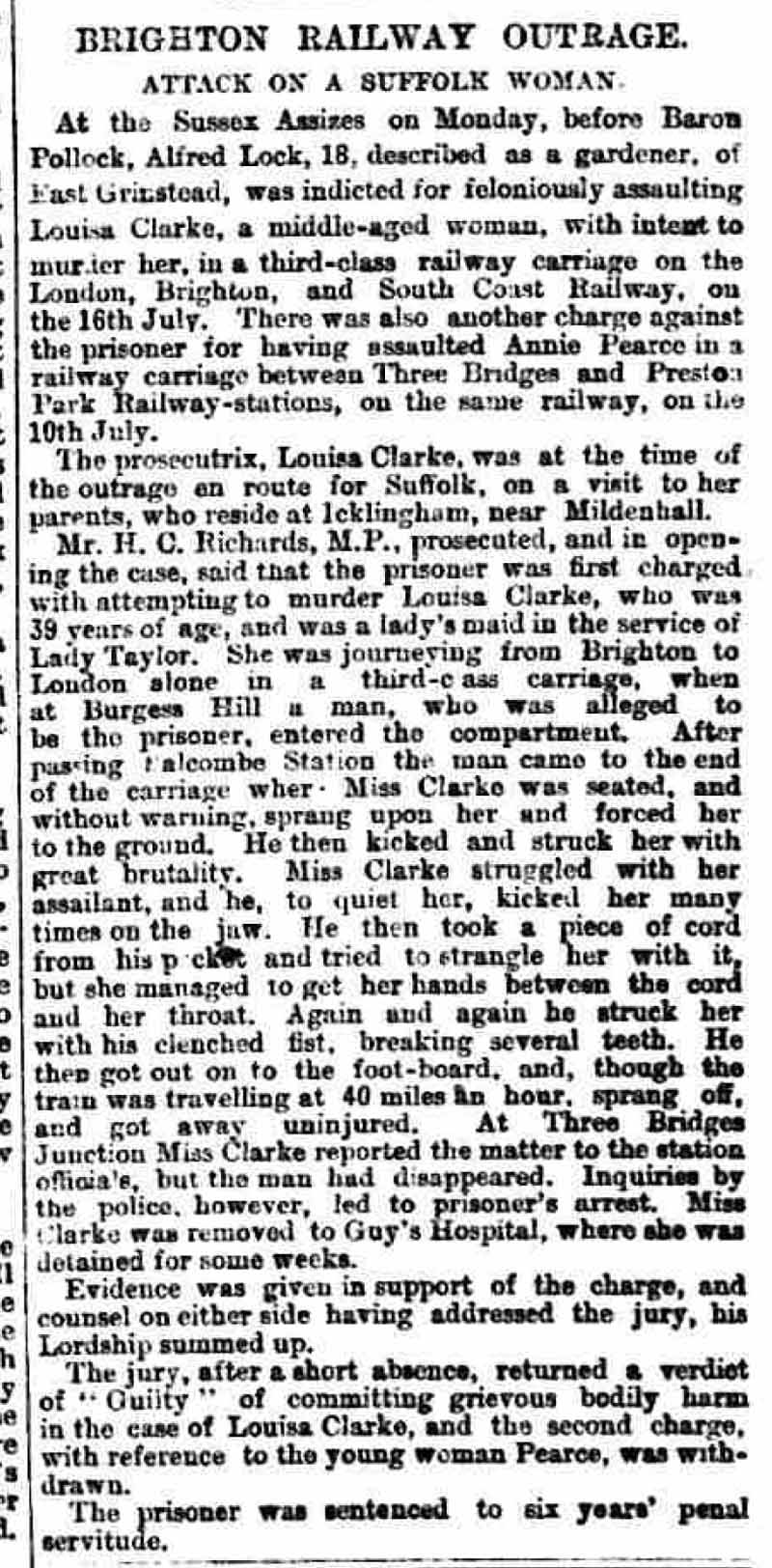
At the Sussex Assizes on Monday, before Baron Pollock, Alfred Lock, 18, described as a gardener, of East Grinstead, was indicted for feloniously assaulting Louisa Clarke, a middle-aged woman, with intent to murder her, in a third-class railway carriage on the London, Brighton, and South Coast Railway, on the 16th July. There was also another charge against the prisoner for having assaulted Annie Pearce in a railway carriage between Three Bridges and Preston Park Railway-stations, on the same railway, on the 10th July.
The prosecutrix, Louisa Clarke, was at the time of the outrage en route for Suffolk, on a visit to her parents, who reside at Icklingham, near Mildenhall.
Mr. H. C. Richards, M.P., prosecuted, and in opening the case, said that the prisoner was first charged with attempting to murder Louisa Clarke, who was 39 years of age, and was a lady’s maid in the service of Lady Taylor. She was journeying from Brighton to London alone in a third-class carriage, when at Burgess Hill a man, who was alleged to be the prisoner, entered the compartment. After passing Balcombe Station the man came to the end of the carriage where Miss Clarke was seated, and without warning, sprang upon her and forced her to the ground. He then kicked and struck her with great brutality. Miss Clarke struggled with her assailant, and he, to quiet her, kicked her many times on the jaw. He then took a piece of cord from his pocket and tried to strangle her with it, but she managed to get her hands between the cord and her throat. Again and again he struck her with his clenched fist, breaking several teeth. He then got out on to the foot-board and, though the train was travelling at 40 miles an hour, sprang off, and got away uninjured.
At Three Bridges Junction Miss Clarke reported the matter to the station officials, but the man had disappeared. Inquiries by the police, however, led to the prisoner’s arrest. Miss Clarke was removed to Guy’s Hospital, where she was detained for some weeks.
Evidence was given in support of the charge, and counsel on either side having addressed the jury, his Lordship summed up.
The jury, after a short absence, returned a verdict of “Guilty” of committing grievous bodily harm in the case of Louisa Clarke, and the second charge, with reference to the young woman Pearce, was withdrawn.
The prisoner was sentenced to six years’ penal servitude.
Table of Contents
ToggleAnalysis & Historical Context
Legal Context: Victorian Laws on Assault and Attempted Murder
At the time of this case, English law had strict penalties for violent crimes. The Offences Against the Person Act 1861 defined and penalised different forms of assault. Attempted murder was a capital offence until the Criminal Law Amendment Act 1864 reduced the penalty to life imprisonment or penal servitude.
- Grievous Bodily Harm (GBH) was punishable by up to life imprisonment, but six years was a relatively standard sentence.
- Penal Servitude meant hard labour, usually in prisons or workhouses, or even transportation earlier in the century.
Victorian Railways & Passenger Dangers
Railways in Victorian Britain were widely used but relatively dangerous, especially for women travelling alone. Many trains had individual compartments without connecting corridors, meaning passengers were isolated. This allowed criminals to commit assaults with little chance of intervention.
- Third-class carriages were cheap but uncomfortable, often with wooden benches and minimal security.
- Railway police existed, but policing moving trains was difficult.
- Cases like this were not uncommon, leading to later railway security reforms.
The People Involved
- Alfred Lock (18, Gardener, East Grinstead) – A young working-class man. His motive is unclear, but his violent nature suggests a history of criminality.
- Louisa Clarke (39, Lady’s Maid) – Employed by Lady Taylor, a woman of aristocratic or wealthy standing.
- Annie Pearce (Young woman, victim of a prior assault) – Her case was withdrawn, possibly due to lack of evidence.
- Mr. H. C. Richards, M.P. (Prosecutor) – A Member of Parliament, indicating the case had high legal attention.
- Baron Pollock (Judge) – A high-ranking judge in Sussex at the time.
Use for Historians & Family History
This article provides insight into:
- Victorian crime & justice – How railway crimes were prosecuted.
- Railway travel – The risks, third-class conditions, and lack of security.
- Women’s history – The vulnerability of working-class women travelling alone.
- Legal history – The workings of the Victorian legal system.
- Genealogy – Individuals named may be useful for family history researchers.
History of The Norfolk News
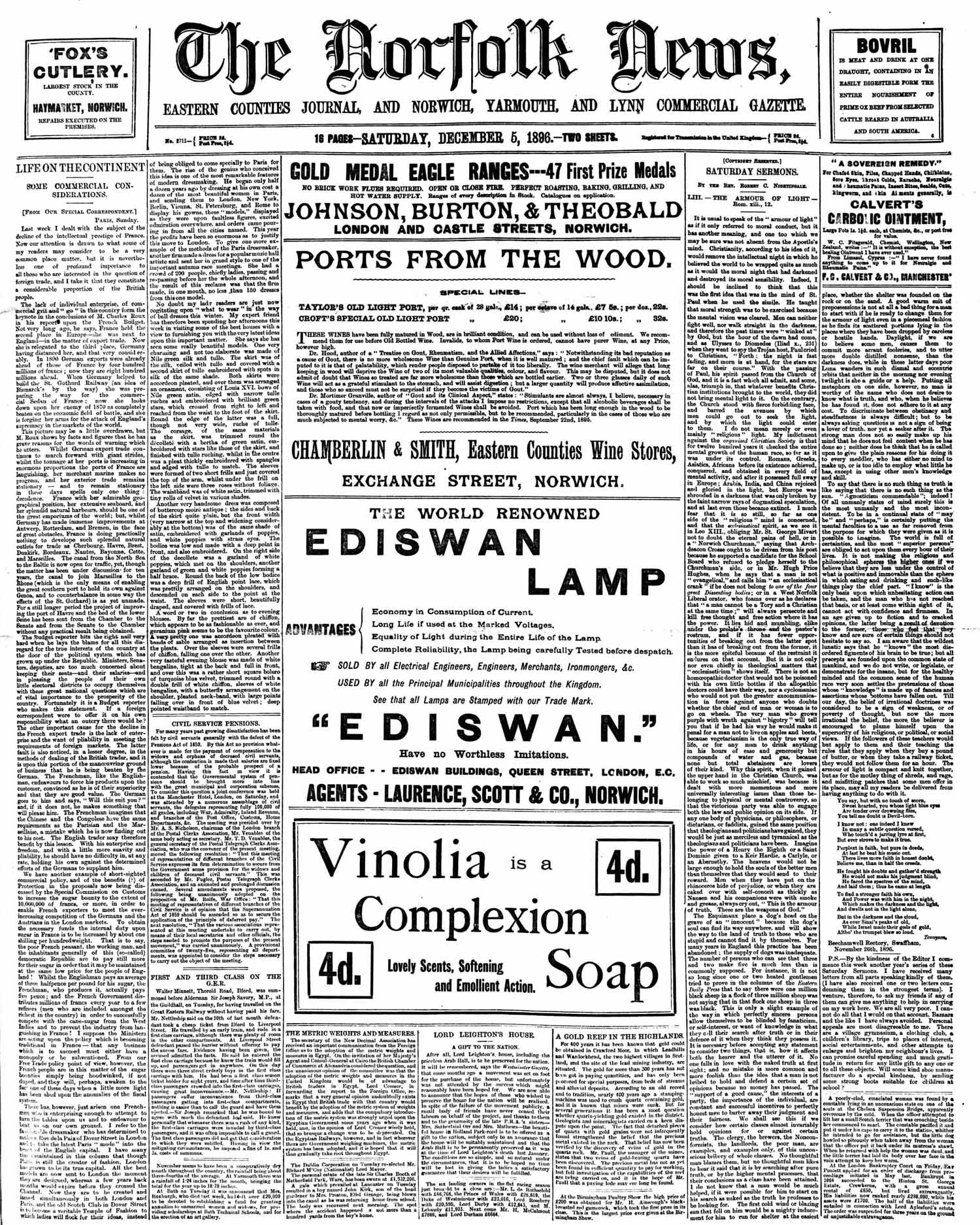
The Norfolk News was a prominent regional weekly newspaper based in Norwich, England, with a publication history spanning from 1845 to 1961. Founded in January 1845, it served the entire county of Norfolk, delivering local and national news to its readership every Saturday. The newspaper’s offices were located on Exchange Street in Norwich.
The establishment of The Norfolk News was backed by notable local figures, including Jacob Henry Tillett, Jeremiah Colman, and the Copeman brothers, John and Jonathan. These individuals were influential in Norwich’s civic and business communities, with Jeremiah Colman being particularly renowned for founding Colman’s Mustard, a staple in British households.
Throughout its 116-year history, The Norfolk News played a vital role in informing the public about regional events, political developments, and social issues. It provided a platform for discourse and was instrumental in shaping public opinion in Norfolk during the 19th and early 20th centuries. Notably, Edmund Rogers served as the editor from 1848 to 1870, guiding the newspaper through significant periods of change and growth.
In 1961, The Norfolk News ceased publication. However, its legacy continued through its archives, which remain a valuable resource for historians and researchers. Copies of the newspaper covering most of its publication years are preserved at the Local History Library in Norwich, offering insights into the region’s past and serving as a testament to the newspaper’s enduring impact on the community.
The foundation of The Norfolk News in 1845 marked a significant development in Norwich’s media landscape. This period saw the establishment of various cultural and educational institutions in the city, reflecting a broader trend of societal advancement and a growing emphasis on public information and engagement.
The newspaper’s inception also coincided with the early days of what would become Archant Limited, a major media publishing company headquartered in Norwich. Archant’s origins trace back to the same year, 1845, with the launch of The Norfolk News. Over time, Archant expanded its portfolio, becoming one of the UK’s leading regional media groups.
In summary, The Norfolk News was more than just a newspaper; it was a cornerstone of Norfolk’s journalistic heritage, reflecting and shaping the community it served for over a century. Its contributions to local media and its role in documenting the region’s history continue to be recognised and appreciated by scholars and the public alike.
In Brief
🚂 BRIGHTON RAILWAY OUTRAGE!
In 1896, a violent attack on a lady’s maid aboard a third-class carriage led to a brutal legal case. Alfred Lock, 18, was sentenced to six years’ penal servitude. Read this chilling Victorian crime story!
🔗 #VictorianCrime #RailwayHistory #TrueCrime #UKHistory #Brighton #Sussex #OldNewspapers #History #FamilyHistory #Genealogy