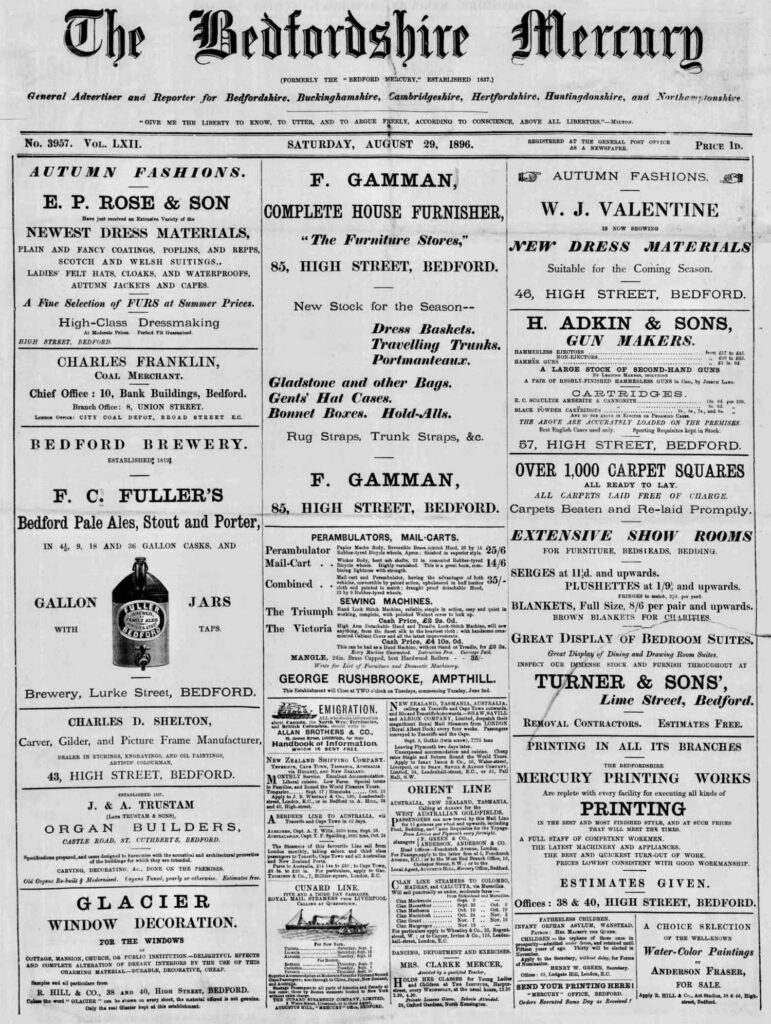
Bedfordshire Mercury – Saturday 29 August 1896
ASSAULTING A WIFE.
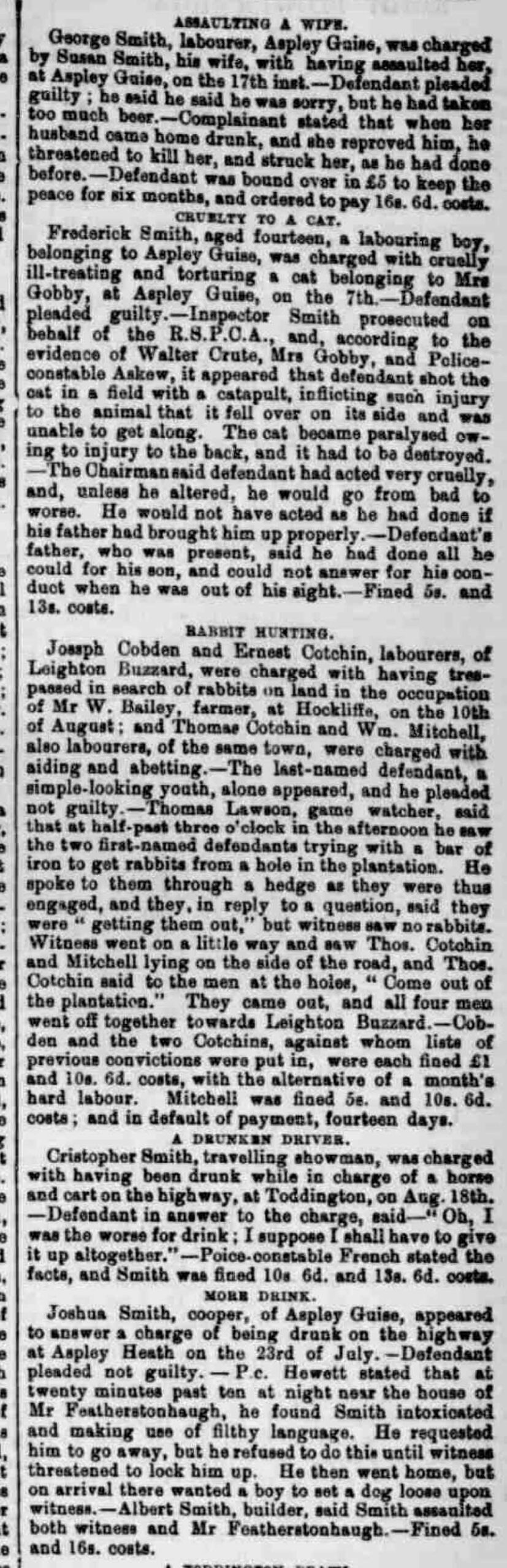
George Smith, labourer, Aspley Guise, was charged by Susan Smith, his wife, with having assaulted her at Aspley Guise, on the 17th inst. — Defendant pleaded guilty; he said he was sorry, but he had taken too much beer. — Complainant stated that when her husband came home drunk, and she reproved him, he threatened to kill her, and struck her, as he had done before. — Defendant was bound over in £5 to keep the peace for six months, and ordered to pay 16s. 6d. costs.
CRUELTY TO A CAT.
Frederick Smith, aged fourteen, a labouring boy belonging to Aspley Guise, was charged with cruelly ill-treating and torturing a cat belonging to Mrs Gobby, at Aspley Guise, on the 17th. — Defendant pleaded guilty. — Inspector Smith prosecuted on behalf of the R.S.P.C.A., and, according to the evidence of Walter Crute, Mrs Gobby and Police-constable Askew, it appeared that defendant shot the cat in the side with a catapult, inflicting such injury to the animal that it fell over on its side and was unable to get along. The cat became paralysed owing to injury to the back, and it had to be destroyed. — The Chairman said defendant had acted very cruelly, and, unless he altered, he would go from bad to worse. He would not have acted as he had done if his father had brought him up properly. — Defendant’s father, who was present, said he had done all he could for his son, and could not answer for his conduct when he was out of his sight. — Fined 5s. and 13s. costs.
RABBIT HUNTING.
Joseph Cobden and Ernest Cotchin, labourers, of Leighton Buzzard, were charged with having trespassed in search of rabbits on land in the occupation of Mr W. Bailey, farmer, at Heathcliffe, on the 10th of August; and Thomas Cotchin and Wm. Mitchell, also labourers, of the same town, were charged with aiding and abetting. — The last-named defendant, a simple-looking youth, alone appeared, and he pleaded not guilty. — Thomas Lawson, game watcher, said that at half-past three o’clock in the afternoon he saw the two first-named defendants trying with a bar of iron to get rabbits from a hole in the plantation. He spoke to them through a hedge as they were thus engaged, and they, in reply to a question, said they were “getting them out,” but witness saw no rabbits. — Witness went on a little way and saw Thos. Cotchin and Mitchell lying on the side of the road, and Thos. Cotchin said to the men at the holes, “Come out of the plantation.” They came out, and all four men went off together towards Leighton Buzzard. — Cobden and the two Cotchins, against whom lists of previous convictions were put in, were each fined £1 and 10s. 6d. costs, with the alternative of one month’s hard labour. Mitchell was fined 5s. and 10s. 6d. costs; and in default of payment, fourteen days.
A DRUNKEN DRIVER.
Christopher Smith, travelling showman, was charged with having been drunk while in charge of a horse and cart on the highway, at Toddington, on Aug. 18th. — Defendant in answer to the charge, said—“Oh, I was the worse for drink; I suppose I shall have to give it up altogether.” — Police-constable French stated the facts, and Smith was fined 10s. 6d. and 13s. 6d. costs.
MORE DRINK.
Joshua Smith, cooper, of Aspley Guise, appeared to answer a charge of being drunk on the highway at Aspley Heath on the 23rd of July. — Defendant pleaded not guilty. — P.C. Howett stated that at twenty minutes past ten at night near the house of Mr Featherstonhaugh, he found Smith intoxicated and making use of filthy language. He requested him to go away, but he refused to do this until witness threatened to lock him up. He then went home, but on arrival there wanted a boy to set a dog loose upon witness. — Albert Smith, builder, said Smith assaulted both witness and Mr Featherstonhaugh. — Fined 5s. and 16s. costs.
Analysis and Context
Legal Implications (1896)
- Assaulting a Wife: Domestic violence was a criminal offence, but punishments were relatively lenient by today’s standards. The defendant, George Smith, was fined and bound over to keep the peace, which was a common legal measure to deter further violence.
- Animal Cruelty: The case involving Frederick Smith and the cat was prosecuted by the Royal Society for the Prevention of Cruelty to Animals (RSPCA), which was founded in 1824. The fine indicates that animal cruelty was taken seriously but still not as heavily punished as today.
- Rabbit Hunting (Poaching): Poaching was a significant legal issue in Victorian England. Landowners had strong rights over game, and trespassing in search of rabbits was a criminal offence.
- Drunkenness: The repeated charges of being drunk in public and while driving a horse and cart reflect the growing concern over public intoxication. The fines were substantial, showing that authorities were attempting to control drunken behaviour.
People, Occupations, and Businesses
- Labourers: Several individuals were described as labourers, a common working-class occupation at the time, often involving agricultural work.
- Cooper: Joshua Smith was a cooper, meaning he worked making barrels and casks.
- Travelling Showman: Christopher Smith’s occupation as a showman suggests he was part of a fairground or travelling entertainment business.
- Farmer: Mr W. Bailey, a farmer, owned the land where the poaching incident took place.
- Gamekeeper: Thomas Lawson was a game watcher, employed to prevent poaching.
Use for Historians and Family Historians
- Social History: The article reveals common crimes, punishments, and societal attitudes toward violence, poaching, and public behaviour in late Victorian England.
- Local History: Mentions of Aspley Guise, Leighton Buzzard, and Toddington provide insight into law enforcement and rural community issues.
- Genealogy: Surnames and occupations can be useful for those tracing family history.
History of The Bedfordshire Mercury
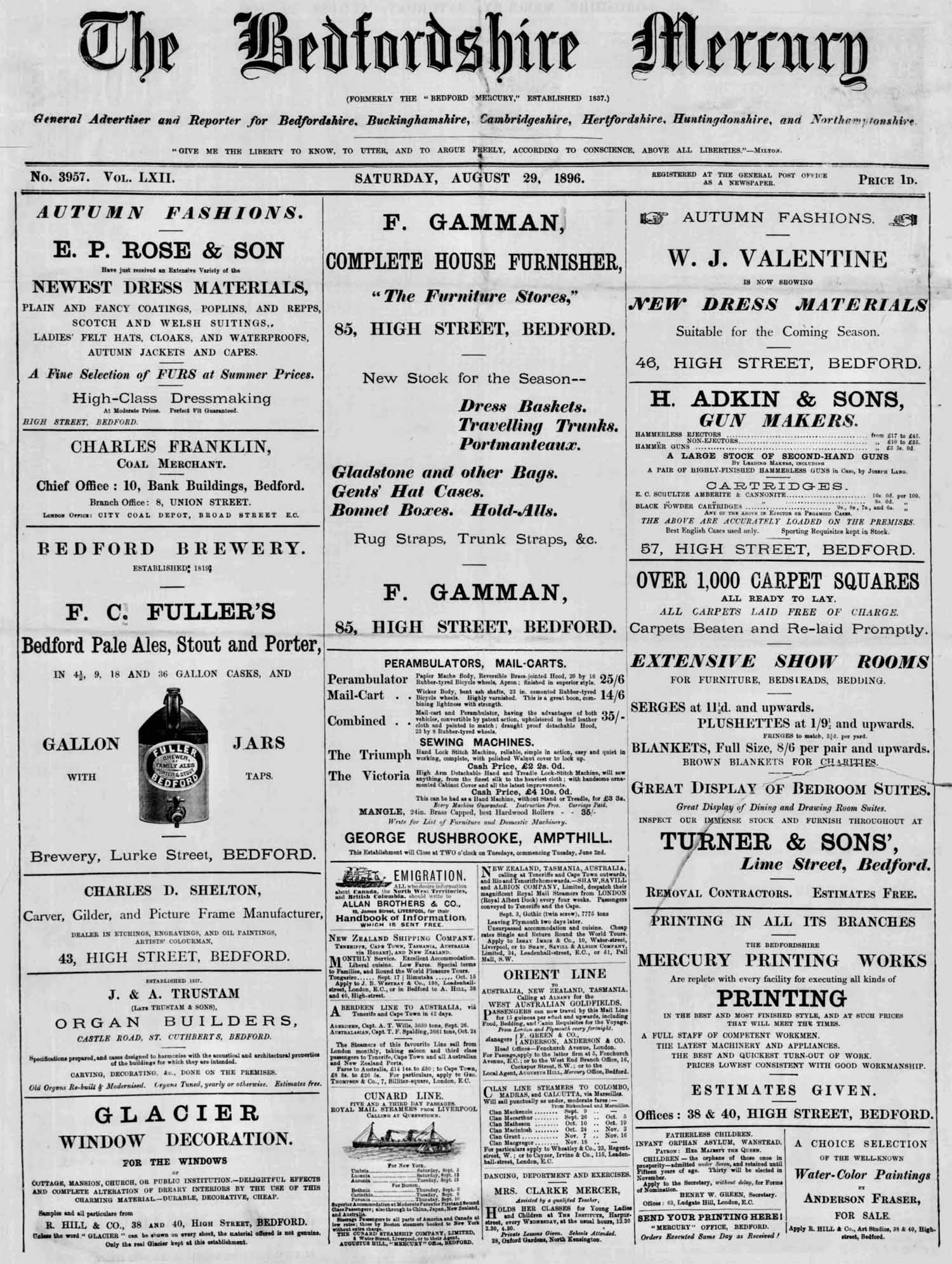
The Bedfordshire Mercury was a prominent local newspaper serving Bedfordshire, England, during the 19th and early 20th centuries. Its publication history reflects the dynamic nature of regional journalism during that era.
Publication Timeline
-
1837-1845: The newspaper commenced its journey in 1837, providing weekly news coverage to the residents of Bedfordshire. This initial phase lasted until 1845.
-
1858-1896: After a brief hiatus, the Bedfordshire Mercury resumed publication in 1858, continuing its role as a vital source of local news and information until 1896.
-
1902-1905; 1907: The newspaper saw intermittent publication during these years, indicating possible challenges in the local press industry or shifts in readership dynamics.
-
1912: The final known issues of the Bedfordshire Mercury were published in this year, marking the end of its presence in the local media landscape.
Content and Focus
Throughout its existence, the Bedfordshire Mercury covered a wide array of topics pertinent to its readership. This included local news, community events, legal proceedings, and issues affecting the daily lives of Bedfordshire’s residents. The newspaper served as a crucial platform for information dissemination and public discourse.
In Brief
Victorian Crime in Bedfordshire – 1896 Court Cases
🔹 Wife Assaulted
🔹 Cruelty to a Cat
🔹 Poaching Rabbits
🔹 Drunk Driving with Horse & Cart
#Bedfordshire #History #VictorianCrime #OldNewspapers #Genealogy #Poaching #AnimalCruelty #VictorianEngland