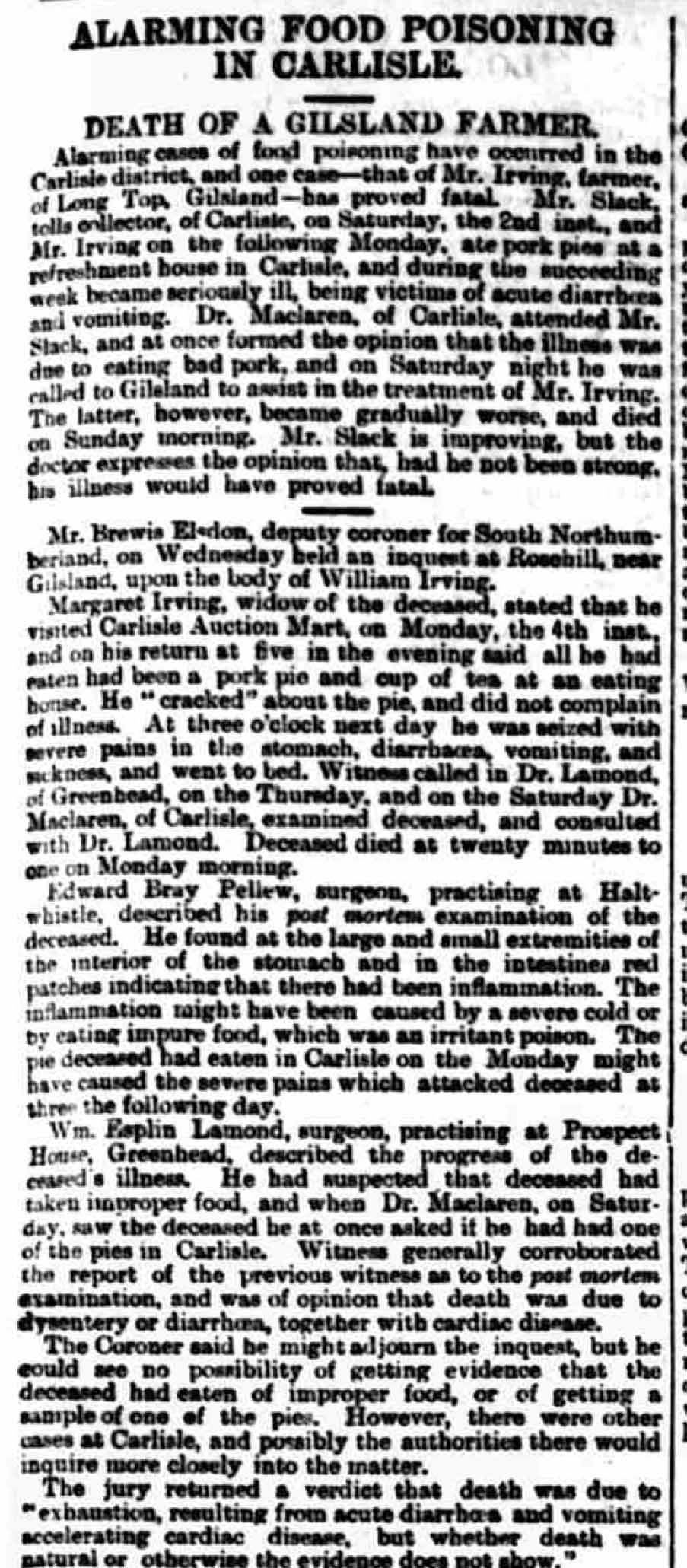
Alarming cases of food poisoning have occurred in the Carlisle district, and one case—that of Mr. Irving, farmer, of Long Top, Gilsland—has proved fatal. Mr. Slack, tolls collector, of Carlisle, on Saturday, the 2nd inst., and Mr. Irving on the following Monday, ate pork pies at a refreshment house in Carlisle, and during the succeeding week became seriously ill, being victims of acute diarrhoea and vomiting.
Dr. Maclaren, of Carlisle, attended Mr. Slack and at once formed the opinion that the illness was due to eating bad pork, and on Saturday night he was called to Gilsland to assist in the treatment of Mr. Irving. The latter, however, became gradually worse and died on Sunday morning. Mr. Slack is improving, but the doctor expresses the opinion that, had he not been strong, his illness would have proved fatal.
Mr. Brewis Eldon, deputy coroner for South Northumberland, on Wednesday held an inquest at Rosehill, near Gilsland, upon the body of William Irving.
Margaret Irving, widow of the deceased, stated that he visited Carlisle Auction Mart on Monday, the 4th inst., and on his return at five in the evening said all he had eaten had been a pork pie and a cup of tea at an eating house. He “cracked” about the pie and did not complain of illness. At three o’clock the next day, he was seized with severe pains in the stomach, diarrhoea, vomiting, and sickness, and went to bed. Witness called in Dr. Lamond, of Greenhead, on the Thursday, and on the Saturday, Dr. Maclaren, of Carlisle, examined the deceased and consulted with Dr. Lamond. The deceased died at twenty minutes to one on Monday morning.
Edward Bray Pellew, surgeon, practising at Haltwhistle, described his post-mortem examination of the deceased. He found at the large and small extremities of the interior of the stomach and in the intestines red patches indicating that there had been inflammation. The inflammation might have been caused by a severe cold or by eating impure food, which was an irritant poison. The pie deceased had eaten in Carlisle on the Monday might have caused the severe pains which attacked the deceased three days later.
Wm. Esplin Lamond, surgeon, practising at Prospect House, Greenhead, described the progress of the deceased’s illness. He had suspected that the deceased had taken improper food, and when Dr. Maclaren, on Saturday, saw the deceased, he at once asked if he had had one of the pies in Carlisle. Witness generally corroborated the report of the previous witness as to the post-mortem examination and was of the opinion that death was due to dysentery or diarrhoea, together with cardiac disease.
The Coroner said he might adjourn the inquest, but he could see no possibility of getting evidence that the deceased had eaten improper food, or of getting a sample of one of the pies. However, there were other cases at Carlisle, and possibly the authorities there would inquire more closely into the matter.
The jury returned a verdict that death was due to exhaustion, resulting from acute diarrhoea and vomiting accelerating cardiac disease, but whether death was natural or otherwise the evidence does not show.
Analysis and Historical Significance
1. Food Safety and Public Health in the 19th Century
The case highlights the dangers of food poisoning in the late 19th century, a time when food hygiene standards were far less regulated than today. The sale of spoiled or contaminated food was common, as there were no refrigeration systems and food preservation relied heavily on methods such as salting, curing, or smoking. Contaminated meat, particularly pork, was a well-known health risk.
2. Legal and Medical Aspects
At the time, food safety laws were rudimentary. The Adulteration of Food Act 1872 and the Sale of Food and Drugs Act 1875 were in place, but enforcement was weak. These laws made it illegal to sell food that was “injurious to health,” but proving foodborne illness was difficult due to a lack of scientific understanding. In this case, no clear legal action was taken because there was no way to directly link the pie to the death with certainty.
From a medical standpoint, the doctors identified symptoms consistent with food poisoning, likely caused by bacteria such as Salmonella or Clostridium perfringens, common in tainted pork. However, they could not determine whether the poisoning was the direct cause of death or if it simply worsened a pre-existing cardiac condition. This reflects the limited diagnostic capabilities of the time.
3. Social and Economic Context
This case provides insight into the eating habits of working-class people in 1889. Mr. Irving, a farmer, ate a pork pie and tea at a refreshment house—common fast food for workers and traders visiting the market. The fact that multiple people fell ill suggests that food safety in public eating establishments was a widespread issue.
4. The Role of the Coroner and Jury
The coroner’s role was primarily to determine cause of death rather than assign criminal responsibility. The jury’s verdict of “exhaustion from diarrhoea and vomiting accelerating cardiac disease” reflects a common practice at the time—acknowledging that illness contributed to death but stopping short of assigning blame.
Use for Historians and Family Researchers
Genealogists researching William Irving or his widow, Margaret Irving, may find this report valuable in constructing family history.
Medical historians can use this case to study early diagnoses of food poisoning and its complications.
Legal historians can examine the limitations of 19th-century food laws and their enforcement.
Local historians interested in Carlisle and Gilsland can explore food supply chains and public health concerns in the region.
About the Newcastle Chronicle
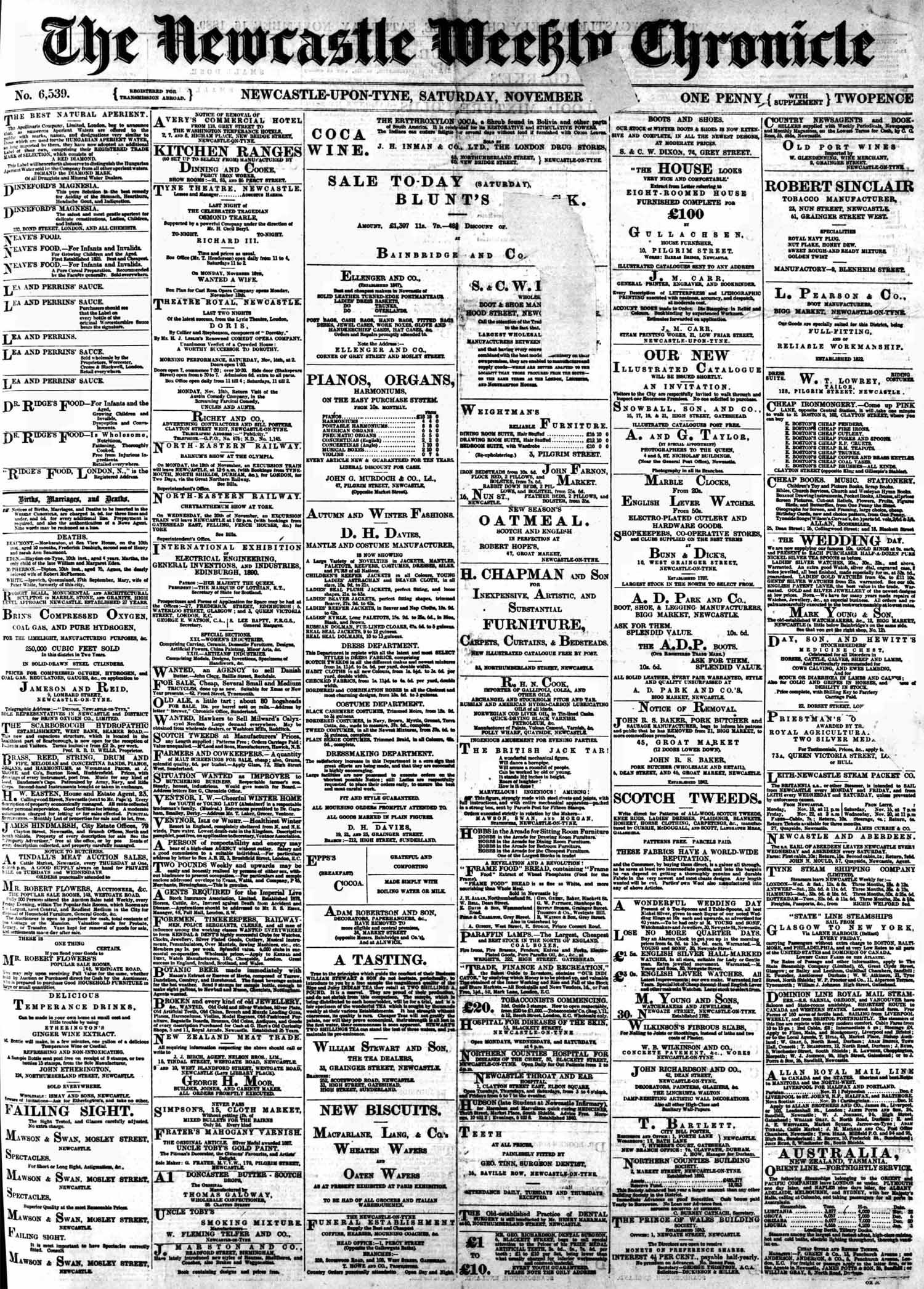
Newcastle Chronicle – Saturday 16 November 1889
The Newcastle Chronicle (now the Chronicle Live) was established in 1764 by Thomas Slack. It became one of the most influential newspapers in the North East of England, covering local news, politics, and social issues. By the late 19th century, it was a key source of news on industrial developments, crime, and public health issues, such as this food poisoning case.
In brief
⚠️ ALARMING FOOD POISONING IN CARLISLE: 1889 CASE STUDY! A farmer’s death linked to pork pies—was it food poisoning or something more? Read the shocking inquest report! 🥧⚖️ #History #FoodSafety” #Carlisle #FoodPoisoning #History #VictorianLife #19thCentury #Genealogy #NewcastleChronicle #UKHistory
Tewkesbury Register – Saturday 31 October 1931 PETTY SESSIONS Monday. — Before Colonel A. Dugdale (chairman), Mrs. Brooks, Mrs. Clarke, Major R. C. Freer, […]