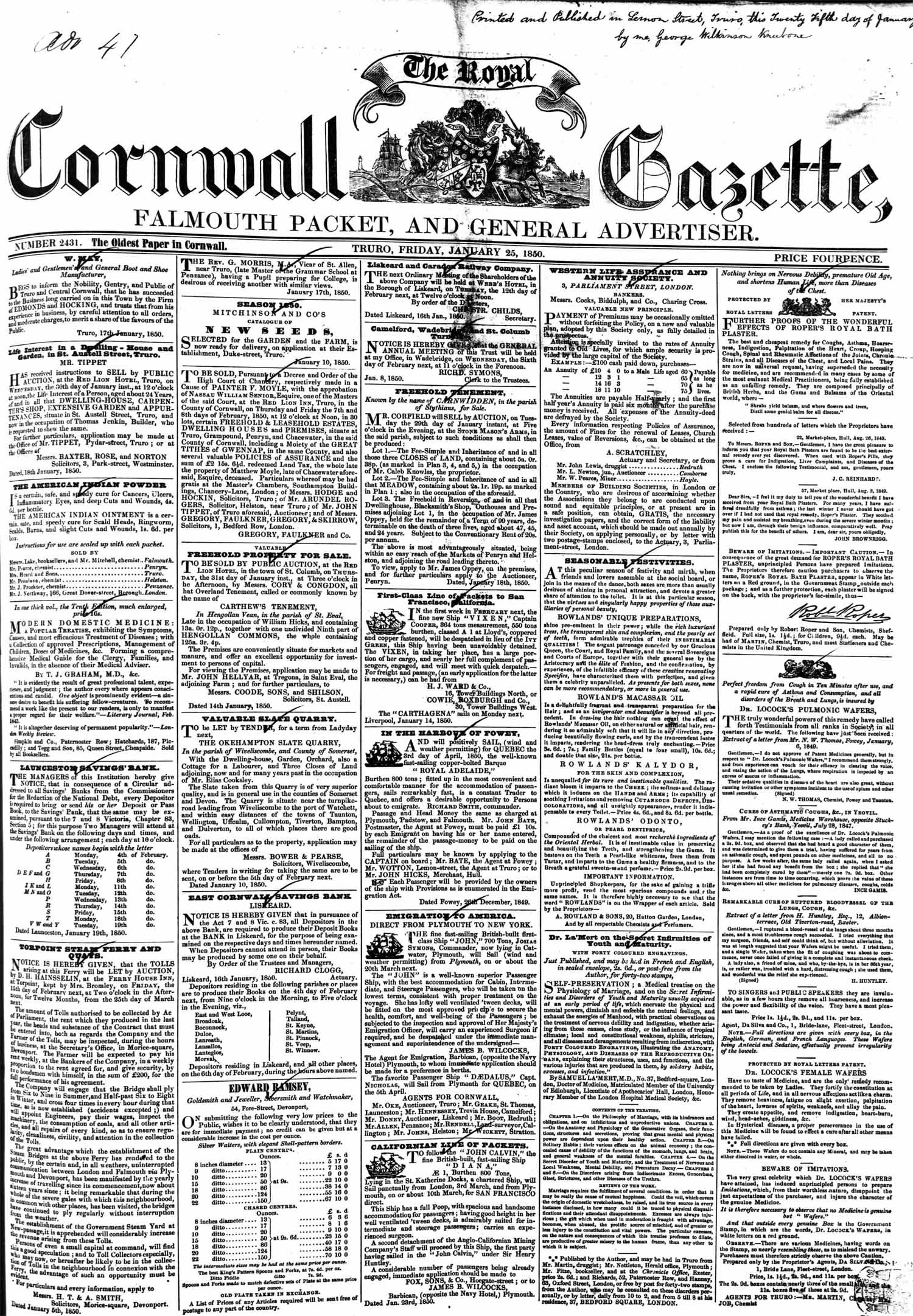
Royal Cornwall Gazette – Friday 25 January 1850
Table of Contents
ToggleHelston – Money Lost
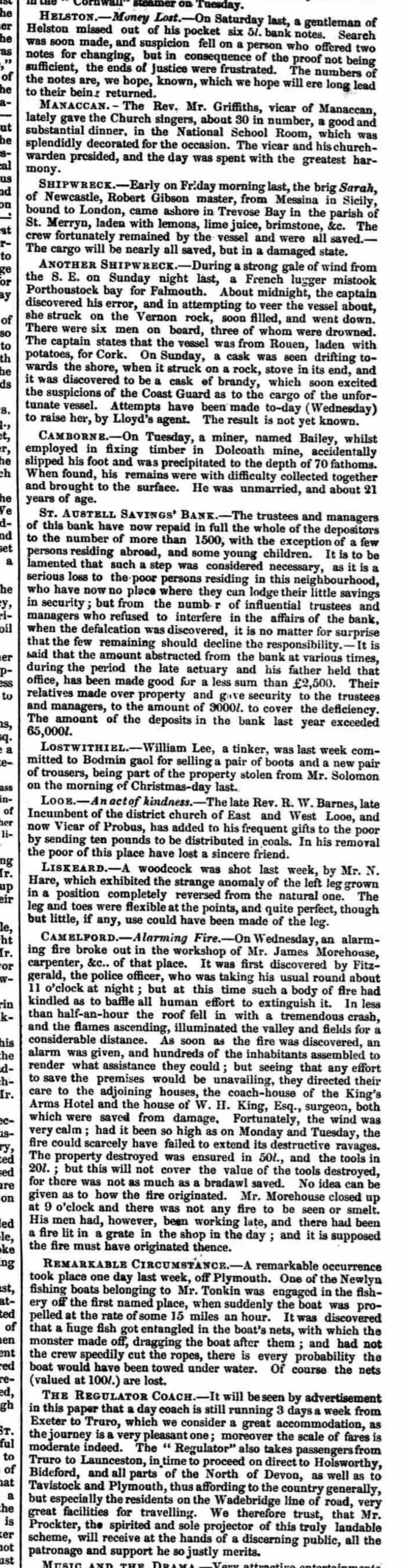
On Saturday last, a gentleman of Helston missed out of his pocket six £5 bank notes. Search was soon made, and suspicion fell on a person who offered the notes for changing, but in consequence of the proof not being sufficient, the ends of justice were frustrated. The numbers of the notes are, we hope, known, which we hope will ere long lead to their being returned.
Manaccan
The Rev. Mr. Griffiths, vicar of Manaccan, lately gave the Church singers, about 30 in number, a good and substantial dinner in the National School Room, which was splendidly decorated for the occasion. The vicar and his churchwarden presided, and the day was spent with the greatest harmony.
Shipwreck
Early on Friday morning last, the brig Sarah, of Newcastle, Robert Gibson master, from Messina in Sicily, bound to London, came ashore in Trevose Bay in the parish of St. Merryn, laden with lemons, lime juice, brimstone, etc. The crew fortunately remained by the vessel and were all saved. The cargo will be nearly all saved but in a damaged state.
Another Shipwreck
During a strong gale of wind from the S.E. on Sunday night last, a French lugger mistook the light of St. Anthony for Falmouth. About midnight, the captain discovered his error, and attempted to return to sea, but the vessel struck on the rocks. Three men and a boy were drowned. Three of the crew, including the captain, were saved and taken to Cork. The captain stated that there was some difficulty with the crew, some of whom were offering to return to the wreck. The authorities were still investigating, and there was suspicion of the Coast Guard regarding the cargo of the vessel. Attempts were being made to raise her, by Lloyd’s agent. The result is not yet known.
Camborne
On Tuesday, a miner, named Bailey, whilst employed in fixing timber in Dolcoath mine, accidentally slipped his foot and was precipitated to the depth of 70 fathoms. When found, his remains were with difficulty collected together and brought to the surface. He was unmarried and about 21 years of age.
St. Austell Savings’ Bank
The trustees and managers of this bank have now repaid in full the whole of the depositors, numbering more than 1500, with the exception of a few persons residing abroad and some young children. It is to be lamented that such a step was considered necessary, as it is a serious loss to the poor persons residing in this neighbourhood, who have now no place where they can lodge their little savings in security. From the number of influential trustees and managers who refused to interfere in the affairs of the bank when the defalcation was discovered, it is no matter for surprise that the few remaining should decline the responsibility. It is said that the amount abstracted from the bank at various times, during the period the late actuary and his father held that office, has been made good for a less sum than £2,500. Their relatives made over property and gave security to the trustees and managers, to the amount of £3,000 to cover the deficiency. The amount of the deposits in the bank last year exceeded £65,000.
Lostwithiel
William Lee, a tinker, was last week committed to Bodmin gaol for selling a pair of boots and a new pair of trousers, being part of the property stolen from Mr. Solomon on the morning of Christmas-day last.
Looe – An Act of Kindness
The late Rev. R. W. Barnes, late incumbent of the district church of East and West Looe, and now Vicar of Probus, has added to his frequent gifts to the poor by sending ten pounds to be distributed in coals. In his removal, the poor of this place have lost a sincere friend.
Liskeard
A woodcock was shot last week by Mr. N. Hare, which exhibited the strange anomaly of the left leg grown in a position completely reversed from the natural one. The leg and toes were flexible at the points and quite perfect, though but little, if any, use could have been made of the leg.
Camelford – Alarming Fire
On Wednesday, an alarming fire broke out in the workshop of Mr. James Morehouse, carpenter, etc., of that place. It was first discovered by Fitzgerald, the police officer, who was taking his usual round about 11 o’clock at night; but at this time such a body of fire had kindled as to baffle all human effort to extinguish it. In less than half an hour the roof fell in with a tremendous crash, and the flames ascending illuminated the valley and fields for a considerable distance. As soon as the fire was discovered, an alarm was given, and hundreds of the inhabitants assembled to render what assistance they could. Seeing that any effort to save the premises would be unavailing, they directed their care to the adjoining houses, the coach-house of the King’s Arms Hotel, and the house of W. H. King, Esq., surgeon, both of which were saved from damage. Fortunately, the wind was very calm; had it been as high as on Monday and Tuesday, the fire could scarcely have failed to extend its destructive ravages. The property destroyed was insured for £50, and the tools in £20; but this will not cover the value of the tools destroyed, for there was not as much as a bradawl saved. No idea can be given as to how the fire originated. Mr. Morehouse closed up at 9 o’clock and there was not any fire to be seen or smelt. His men had, however, been working late, and there had been a fire lit in a grate in the shop in the day; it is supposed the fire must have originated thence.
Remarkable Circumstance
A remarkable occurrence took place one day last week, off Plymouth. One of the Newlyn fishing boats belonging to Mr. Tonkin was engaged in the fishery off Plymouth, when suddenly the boat was propelled at the rate of some 15 miles an hour. It was discovered that a huge fish got entangled in the boat’s nets, with which the monster made off, dragging the boat after them; and had not the crew speedily cut the ropes, there is every probability the boat would have been towed under water. Of course, the nets (valued at £100) are lost.
The Regulator Coach
It will be seen by advertisement in this paper that a day coach is still running three days a week from Exeter to Truro, which we consider a great accommodation, as the journey is a very pleasant one; moreover, the scale of fares is moderate. The Regulator also takes passengers from Truro to Launceston, in time to proceed directly to Holsworthy, Bideford, and all parts of North Devon, as well as to Tavistock and Plymouth, thus affording the country generally, but especially the residents on the Wadebridge line of road, great facilities for travelling. We therefore trust that Mr. Prockter, the spirited and sole projector of this truly laudable scheme, will receive at the hands of a discerning public all the patronage and support he so justly merits.
Analysis
Crimes and Law in Cornwall (1850s)
- Theft: William Lee, a tinker, was jailed for selling stolen goods. The severity of punishments for petty crimes in the 1850s often resulted in imprisonment or even transportation.
- Fraud and Mismanagement: The St. Austell Savings’ Bank case highlights financial fraud, which was a major concern in Victorian Britain.
- Loss and Suspicion: The missing bank notes in Helston show how banking and financial security were vulnerable.
Occupations
- Miner, vicar, police officer, carpenter, tinker, fisherman, bank actuary, surgeon, coach operator.
This newspaper provides insight into crime, disasters, acts of charity, and daily life in 1850s Cornwall
The history of The Royal Cornwall Gazette
The Royal Cornwall Gazette holds the distinction of being Cornwall’s first newspaper, with its inaugural issue published on 2 July 1803 in Truro by Thomas Flindell. Flindell, born in Helston in 1767, was a printer and editor who had previously managed the Doncaster Gazette. Before establishing the Royal Cornwall Gazette, he launched the Cornwall Gazette and Falmouth Packet in 1801; however, this venture ceased in 1802 due to financial difficulties. Undeterred, Flindell relocated to Truro, where he successfully founded the Royal Cornwall Gazette, which quickly became a prominent weekly publication.
Initially, the newspaper catered to a readership comprising doctors, bankers, lawyers, and landowners. To broaden its audience, copies were made available in inns and guest houses, enhancing its appeal to advertisers. The Royal Cornwall Gazette maintained a Conservative stance throughout its publication history. In 1811, Flindell sold the newspaper, and by 1831, under the proprietorship of T.R. Gillett Jr., the paper was priced at seven pence and featured four pages of six columns each. Edward Osler, a surgeon with literary and scientific interests, served as editor from 1841, further enriching the paper’s content.
By 1850, the Royal Cornwall Gazette had expanded to eight pages, with a reduced price of four pence. George Wilkinson Kneebone was the printer and publisher at this time. The newspaper offered a diverse range of content, including legal, railway, and mining reports, as well as miscellaneous entries that provided readers with both information and entertainment. In 1882, its circulation was estimated at approximately 12,000 copies, with a cover price of one penny.
The Royal Cornwall Gazette continued its weekly publication throughout the late 19th century, covering a wide array of topics from local news to fashion and market reports. However, in May 1951, the newspaper ceased publication and was incorporated into the West Briton, another longstanding Cornish newspaper.
Throughout its nearly 150-year history, the Royal Cornwall Gazette played a pivotal role in documenting and shaping public opinion in Cornwall, providing valuable insights into the social, political, and economic developments of the region.
In brief