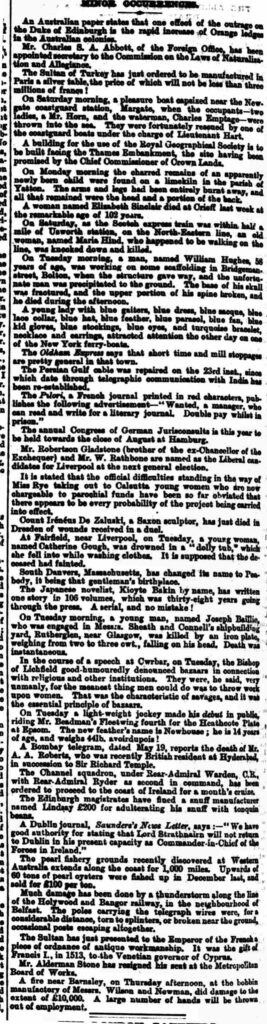
Weekly Dispatch (London) – Sunday 31 May 1868
MINOR OCCURRENCES.
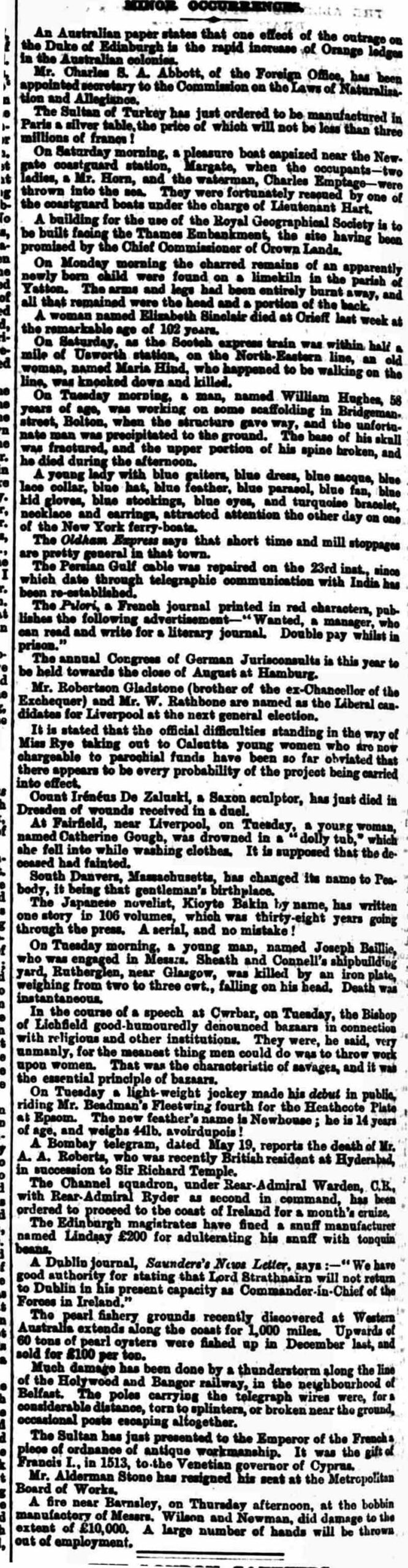
An Australian paper states that one effect of the outrage on the Duke of Edinburgh is the rapid increase of Orange lodges in the Australian colonies.
Mr. Charles S. A. Abbott, of the Foreign Office, has been appointed secretary to the Commission on the Laws of Naturalisation and Allegiance.
The Sultan of Turkey has just ordered to be manufactured in Paris a silver table, the price of which will not be less than two millions of francs!
On Saturday morning, a pleasure boat capsized near the New coastguard station, Margate, when the occupants—two ladies, a Mr. Horn, and the waterman, Charles Emptage—were thrown into the sea. They were fortunately rescued by one of the coastguard boats under the charge of Lieutenant Hart.
A building for the use of the Royal Geographical Society is to be built facing the Thames Embankment, the site having been promised by the Chief Commissioner of Crown Lands.
On Monday morning, the astonishing remains of an apparently newly-born child were found on a limekiln in the parish of Cheadle. The arms and legs had been completely burnt off, but what remained were the head and portions of the back.
A remarkable old woman, Elizabeth Sinclair, died in Orkney last week at the remarkable age of 102 years.
The same morning, while a goods train was within half a mile of Garforth station, on the North-Eastern line, an old woman named Maria Hind, who happened to be walking on the line, was knocked down and killed.
On Tuesday morning, a man named William Hughes, 58 years of age, was working on some scaffolding in Bridgeman-street, Bolton, when the structure gave way, and the unfortunate man was precipitated to the ground. The base of his skull was fractured, and the upper portion of his spine broken, and he died during the afternoon.
A young lady with blue gaiters, blue dress, blue sacque, blue lace collar, blue hat, blue feather, blue parasol, blue fan, blue kid gloves, blue stockings, blue eyes, and turquoise bracelet, necklace, and earrings, attracted attention the other day on one of the New York ferry-boats.
The Oldham Express says that short time and mill stoppages are pretty general in that town.
The Persian Gulf cable was repaired on the 23rd inst., since which date through telegraphic communication with India has been re-established.
The Pelori, a French journal printed in red characters, publishes the following advertisement—”Wanted, a manager, who can read and write for a literary journal. Double pay whilst in prison.”
The annual Congress of German Jurisconsults is this year to be held towards the close of August at Hamburg.
Mr. Robertson Gladstone (brother of the ex-Chancellor of the Exchequer) and Mr. W. Rathbone are named as the Liberal candidates for Liverpool at the next general election.
It is stated that the official difficulties standing in the way of Miss Rye taking out to Calcutta young women who are chargeable to parochial funds have been so far obviated that there appears to be every probability of the project being carried out.
Count Irenæus De Zaluskí, a Saxon sculptor, has just died in Dresden of wounds received in a duel.
At Fairfield, near Liverpool, on Tuesday, a young woman named Catherine Gough was drowned in a “dolly tub,” which she fell into while washing clothes. It is supposed that the deceased had fainted.
South Danvers, Massachusetts, has changed its name to Peabody, it being that gentleman’s birthplace.
The Japanese novelist, Kiyoto Ekin by name, has written one story in 106 volumes, which was thirty-eight years going through the press. A serial, and no mistake!
On Tuesday morning, a young man named Joseph Baillie, who was engaged in Messrs. Sheath and Connell’s shipbuilding yard, Batherglen, near Glasgow, was killed by an iron chain, weighing from two to three cwts., falling on his head. Death was instantaneous.
In the course of a speech at Cwrbar, on Tuesday, the Bishop of Lichfield good-humouredly denounced bazaars in connection with religious and other institutions. They were, he said, no better than raffles, by which young men could do worse than lose their money. That was the characteristic of savages, and it was an unchristian principle to adopt.
At Epsom on Wednesday, the weight jockey made his début in public riding on Mr. Bending-Pleet’s horse for the Heathcote Plate.
A Bombay telegram, dated May 19, reports the death of Mr. A. R. Roberts, a well-known British resident at Hyderabad.
The Channel squadron, under Rear-Admiral Warden, C.B., with Rear-Admiral Ryder as second in command, has been ordered to proceed to the coast of Ireland for a month’s cruise.
The Edinburgh magistrates have fined a snuff manufacturer named Lindsay £200 for adulterating his snuff with tobacco beans.
A Dublin journal, Saunders’s News Letter, says:—”We have good authority for stating that Lord Strathnairn will not return to Dublin in his present capacity as Commander-in-Chief of the Forces in Ireland.”
The pearl fishery grounds recently discovered at Western Australia extend along the coast for 1,000 miles. Upwards of 60 tons of pearl oysters were fished up in December last, and sold for £100 per ton.
Much damage has been done by a thunderstorm along the line of the Holywood and Bangor railway, in the neighbourhood of Belfast. The poles carrying the telegraph wires were, in many instances, torn to splinters, or broken near the ground, and the electrical storm was altogether remarkable.
The Sultan has just presented to the Emperor of the French a piece of goldsmith’s antique workmanship. It was the gift of Francis I, in 1513, to the Venetian Government.
Mr. Alderman Stone has resigned his seat at the Metropolitan Board of Works.
A fire near Barnsley, on Thursday afternoon, at the bobbin manufactory of Messrs. Wilson and Newman, did damage to the extent of £10,000. A large number of hands will be thrown out of employment.
Analysis and Research Insights
Law in 1868 Related to These Events
- Crime and Punishment: The discovery of the burned remains of a child in Cheadle suggests infanticide, which was a severe crime at the time, often leading to capital punishment or life imprisonment.
- Labour Laws and Safety: The deaths of workers in Bolton (scaffolding collapse) and Glasgow (falling iron chain) highlight the lack of workplace safety regulations. The Factories Act 1867 had started regulating conditions in factories, but construction and shipyards remained largely unregulated.
- Consumer Protection: The £200 fine imposed on the Edinburgh snuff manufacturer for adulteration shows early moves towards food and product quality control, though formal consumer protection laws were still rudimentary.
- Communications Law: The repair of the Persian Gulf telegraph cable demonstrates the growing importance of international communication networks, which were regulated by government contracts.
People, Lives, and Occupations
- Workplace Hazards: Fatalities in industries such as shipbuilding and railway work were common, with little legal recourse for families.
- Women’s Roles: Stories like the old woman killed on the railway, the young woman drowning while washing clothes, and Miss Rye’s efforts to take poor women to India, reveal women’s vulnerability and limited rights.
- Industrialisation: The stoppages in Oldham mills reflect the economic instability of industrial towns reliant on textiles.
- Globalisation and Empire: News from Australia, India, and Japan reflect Britain’s imperial reach.
History of The Weekly Dispatch
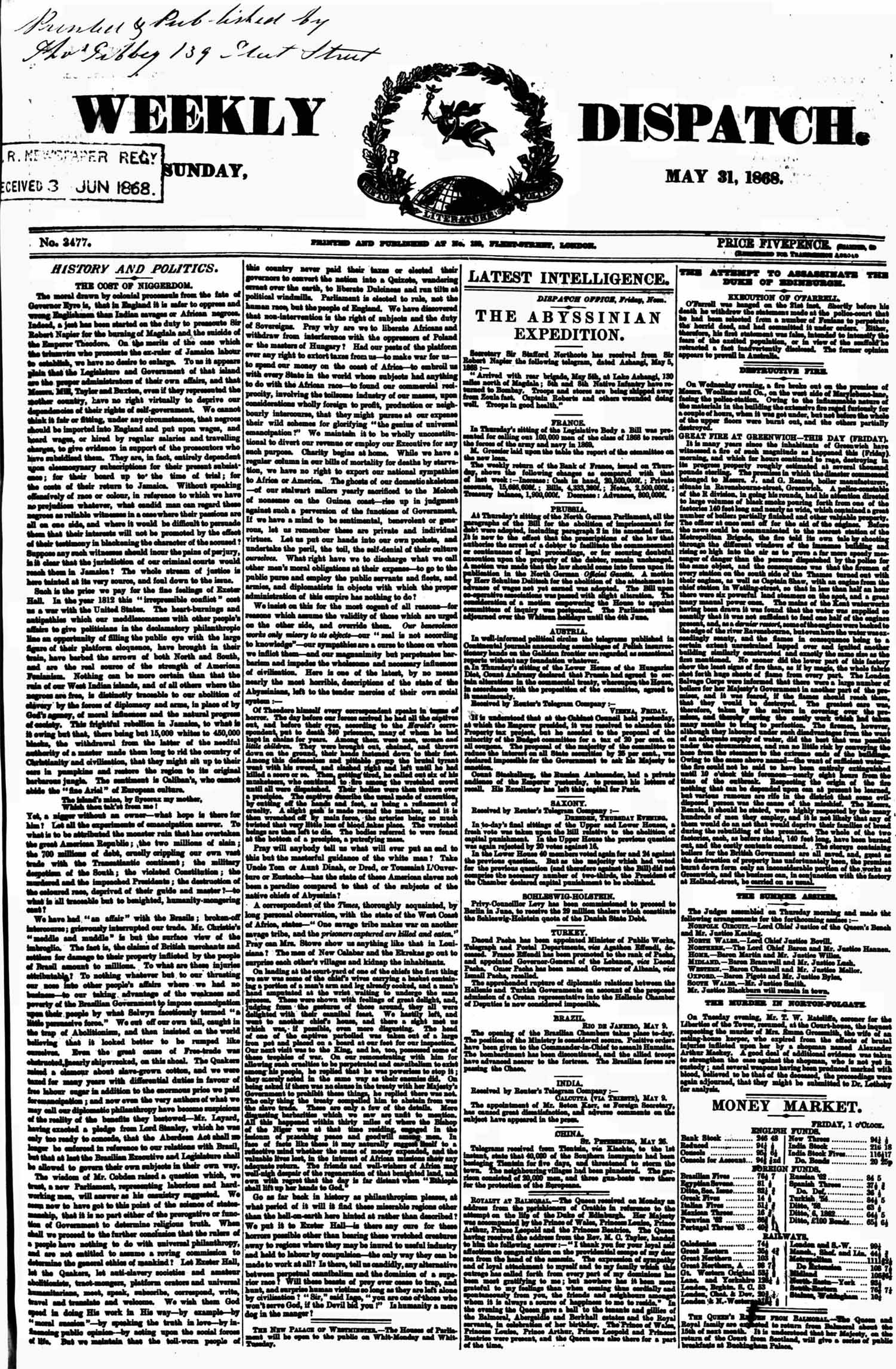
The Weekly Dispatch was a prominent British newspaper established in London on 27 September 1801. Initially, it catered to readers interested in sensational news, including reports on prize-fights and other vivid accounts. Over time, it evolved to cover a broader spectrum of topics, including politics, crime, and social issues.
In the mid-19th century, the newspaper was owned by James Harmer, a notable solicitor who served as a model for the character Jaggers in Charles Dickens’s “Great Expectations”. Under Harmer’s ownership, the Weekly Dispatch gained a reputation for its radical viewpoints, often challenging established institutions and advocating for social reforms. The paper’s circulation saw significant growth during this period, reaching approximately 60,000 by 1843.
Throughout its history, the Weekly Dispatch featured contributions from various notable writers. For instance, poet Eliza Cook began submitting her works to the paper in 1836, becoming a regular contributor for the next decade.
Additionally, in the early 1920s, author Henry Williamson wrote articles for the newspaper, providing insights into post-World War I Britain.
In 1928, the newspaper underwent a rebranding, changing its name to the Sunday Dispatch. This period marked a continuation of its influence in British journalism, with contributions from esteemed writers such as Sir Arthur Conan Doyle, who published several articles and a short story in the paper between 1920 and 1930.
Despite its longstanding presence in British media, the Sunday Dispatch faced increasing competition in the mid-20th century. In 1961, it was merged with the Sunday Express, marking the end of its independent publication.
Today, archives of the Weekly Dispatch are preserved and accessible for research, offering valuable insights into British society, politics, and culture from the 19th and early 20th centuries.
In brief
Tragedy, Scandal, and Empire: A Glimpse into 19th-Century Britain’s News. A pleasure boat capsizes, a burned infant is discovered, workers die in industrial accidents, and a snuff manufacturer gets fined—Victorian Britain was full of grim yet fascinating stories. #VictorianNews #History #UKHistory #OnThisDay #19thCentury #WeeklyDispatch #HistoricalNewspapers #CrimeHistory #IndustrialRevolution #BritishHistory