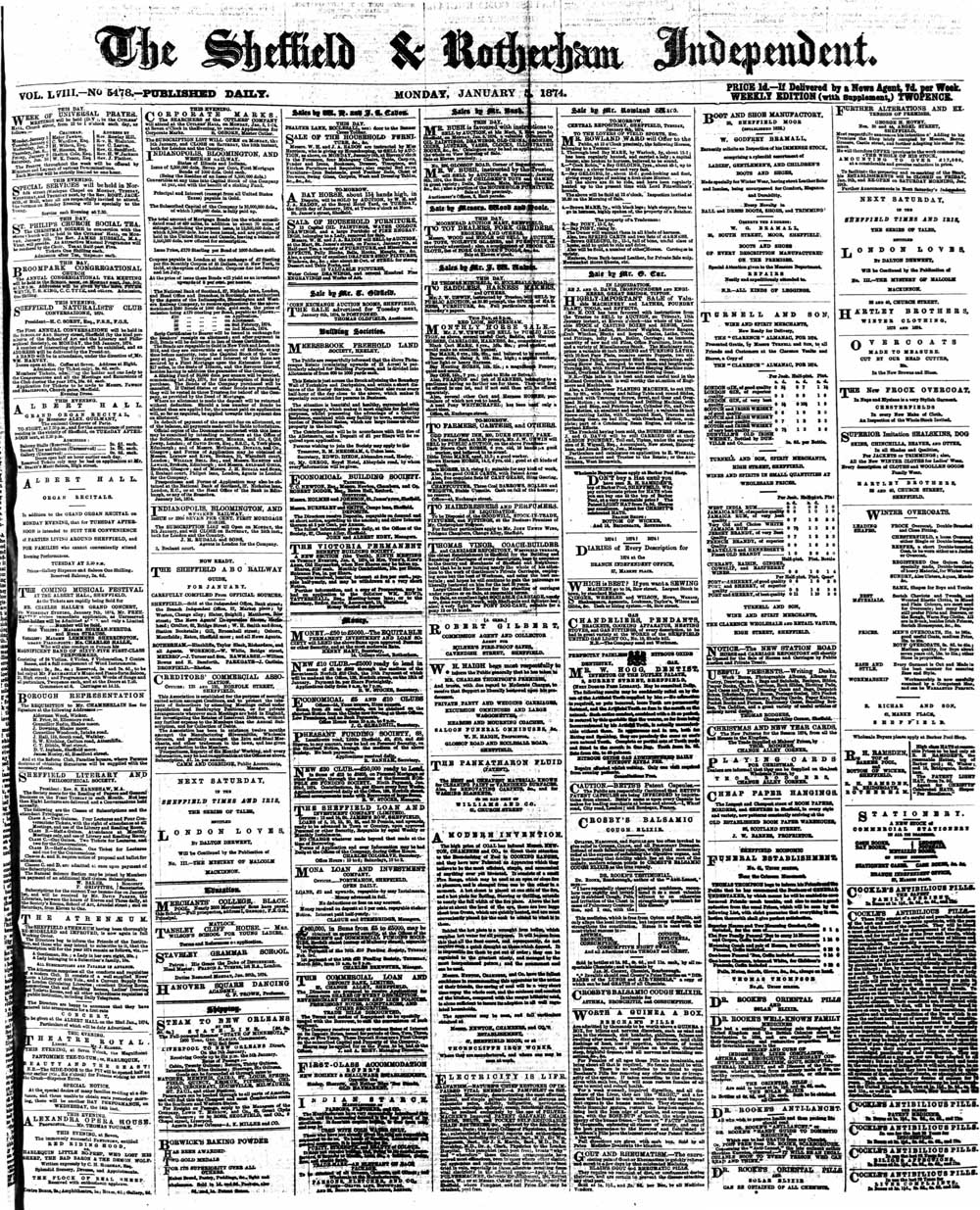
North Devon Journal – Thursday 22 September 1898
THE BRAKELESS BICYCLE DANGER
TWO RIDERS KILLED
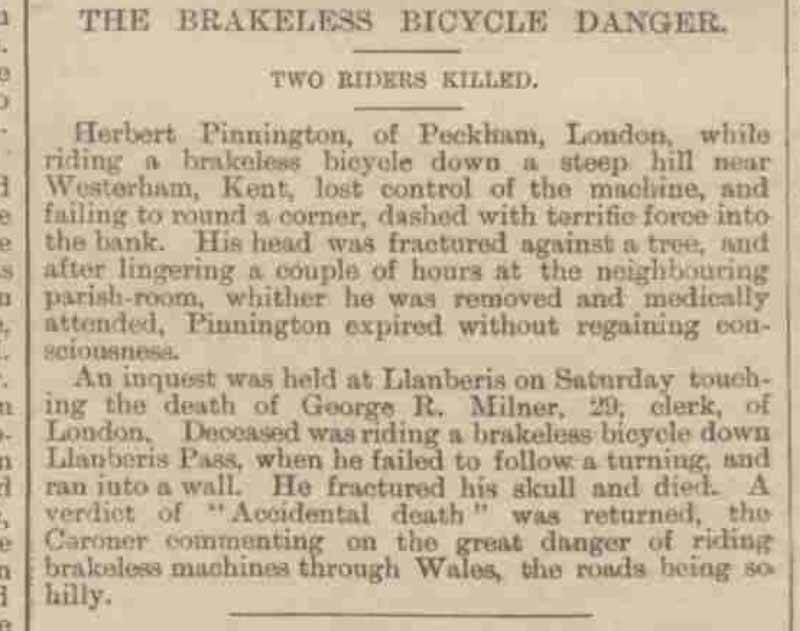
Herbert Finnington, of Peckham, London, while riding a brakeless bicycle down a steep hill near Westerham, Kent, lost control of the machine, and failing to round a corner, dashed with terrific force into the bank. His head was fractured against a tree, and after lingering a couple of hours at the neighbouring parish-room, whither he was removed and medically attended, Finnington expired without regaining consciousness.
An inquest was held at Llanberis on Saturday touching the death of George R. Milner, 29, clerk, of London. Deceased was riding a brakeless bicycle down Llanberis Pass, when he failed to follow a turning, and ran into a wall. He fractured his skull and died. A verdict of “Accidental death” was returned, the coroner commenting on the great danger of riding brakeless machines through Wales, the roads being so hilly.
Analysis and Historical Context
Bicycles in the 1890s
During the 1890s, bicycles were becoming a mainstream mode of transport, with the safety bicycle (a design much like today’s bicycles, with two equal-sized wheels and a chain drive) replacing the earlier, more hazardous penny-farthing. However, braking technology was still developing. Many bicycles, particularly fixed-gear models, relied on back-pedalling resistance or rudimentary rim brakes, which were not always reliable on steep descents.
Brakeless Bicycles
In this article, the reference to “brakeless bicycles” likely means that these machines either lacked effective brakes or were fixed-gear bicycles without freewheeling mechanisms. This was common in the late Victorian era, particularly for racing and track cycling. On steep roads, such as those in Kent or Llanberis Pass, riders had to rely on their leg strength and skill to control speed—a dangerous endeavour, as these fatalities illustrate.
Road Conditions in the 1890s
Roads in North Devon and Wales at this time were largely unpaved, narrow, and winding. Many routes were originally designed for horse-drawn transport, and with the advent of bicycles, riders faced hazards such as loose gravel, mud, deep ruts, and sudden drops. In hilly areas like Llanberis Pass in Wales, steep inclines made cycling particularly perilous, especially without proper braking mechanisms.
Dangers of Cycling in the 1890s
Cycling in the late 19th century was inherently risky, especially in rural areas where emergency medical assistance was not readily available. Many cyclists suffered injuries due to poor road conditions, mechanical failures, or simply a lack of experience handling high speeds. Newspapers often reported fatalities, helping to push for improved safety measures, including better braking systems and road maintenance.
Impact on Cycling Regulations
Fatal accidents like those described in the article contributed to the growing awareness of the need for safer cycling technology. By the early 20th century, coaster brakes (which allowed back-pedalling to engage a braking mechanism) and calliper brakes (which pressed rubber pads against the wheel rim) became more common. Additionally, organisations such as the Cyclists’ Touring Club (CTC) advocated for better road surfaces and clearer safety guidelines.
Conclusion
This article serves as a stark reminder of the risks associated with early cycling, particularly on steep and hazardous terrain. The dangers faced by Herbert Finnington and George R. Milner highlight the technological limitations of bicycles in the 1890s, the challenges of road infrastructure, and the growing need for safety improvements. For historians, this piece sheds light on Victorian cycling culture, transportation history, and the evolution of road safety awareness.
History of The North Devon Journal
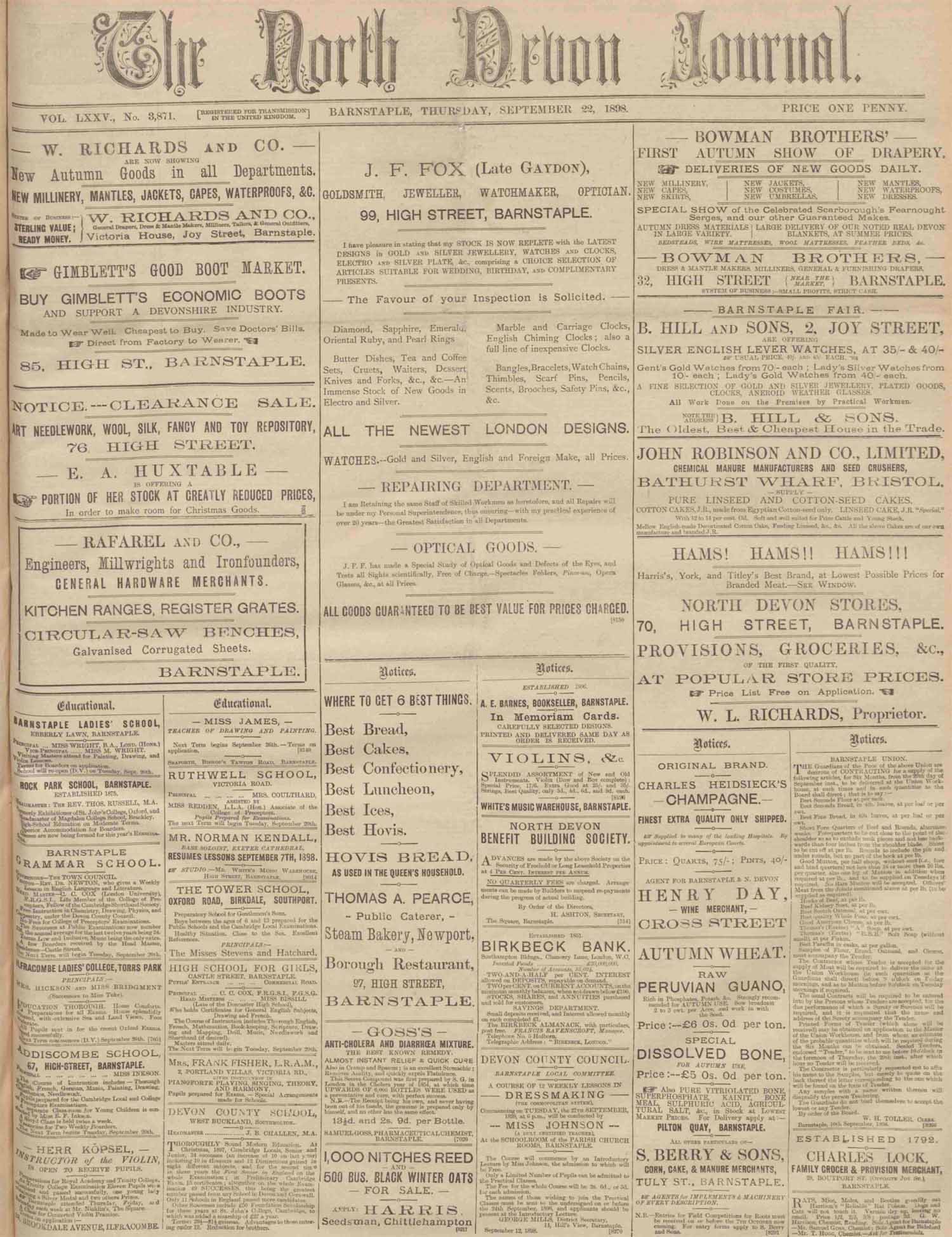
The North Devon Journal, a weekly newspaper, was first published in Barnstaple on Friday, 2 July 1824, by local bookseller John Avery, priced at 7d. The Avery family maintained a long association with the paper, which circulated throughout the North Devon area.
In September 1836, following a reduction in stamp duty, the Journal’s price was reduced from 7d to 4d. The price was further lowered to 2d in 1863, and in 1885, it reached its lowest ever price of 1d.
A daily edition was briefly produced in 1870, during which the Journal printed a second edition to keep readers updated on the Franco-Prussian War.
The Liberal-leaning Journal faced significant competition with the emergence of Robert Lawrence’s North Devon Herald in July 1870. This Conservative paper was priced at 1d, half the cost of the Journal. Despite the rivalry, both papers continued independently until 1941, when they amalgamated to become the North Devon Journal-Herald. In 1986, the publication dropped ‘Herald’ from its title when it transitioned from broadsheet to tabloid format.
In 2012, Local World acquired the Journal’s owner, Northcliffe Media, from the Daily Mail and General Trust. Local World was subsequently acquired by Trinity Mirror (now Reach PLC).
As of 2022, the North Devon Journal, now published in tabloid format, had a circulation of 3,464.
🚴♂️ The Perils of Brakeless Bicycles in 1898! 🚴♂️
Two tragic deaths highlight the dangers of riding brakeless bicycles on steep roads in Victorian Britain. No brakes, no chance!
#CyclingHistory #VictorianEra #RoadSafety #BicycleAccidents #NorthDevonJournal