Blackburn Times – Saturday 06 January 1877
DARWEN.
SUSPICIOUS DEATH.
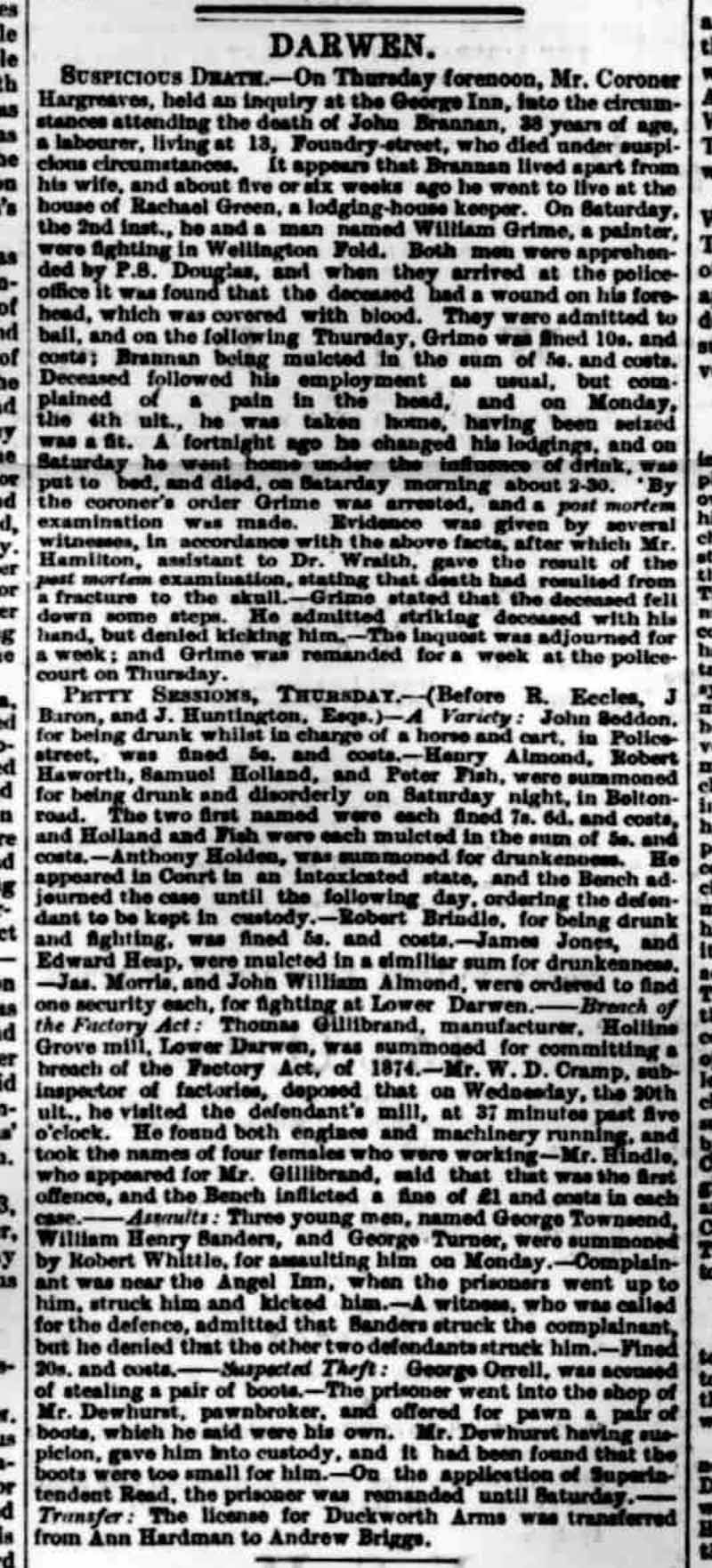
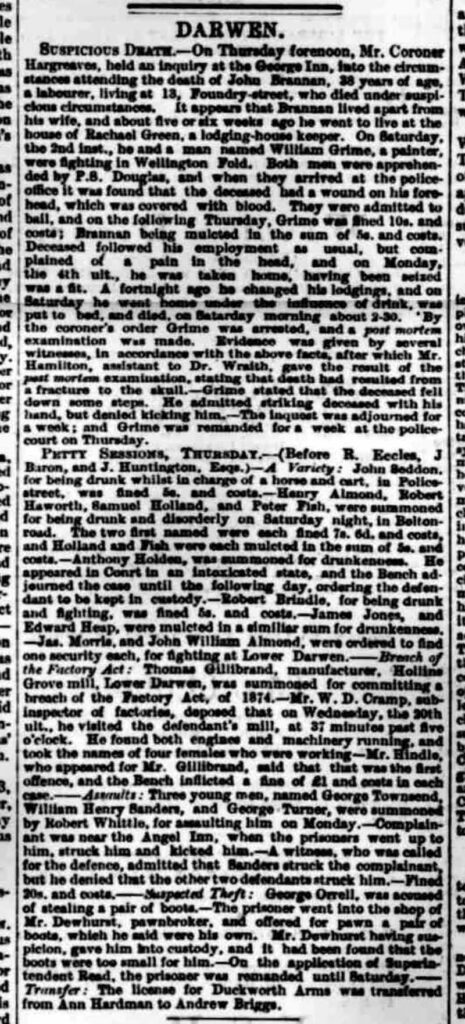
On Thursday forenoon, Mr. Coroner Hargreaves held an inquiry at the George Inn into the circumstances attending the death of John Brannan, 38 years of age, a labourer, living at 13, Foundry Street, who died under suspicious circumstances.
It appears that Brannan lived apart from his wife, and about five or six weeks ago he went to live at the house of Rachel Green, a lodging-house keeper. On Saturday, the 2nd inst., he and a man named William Grime, a painter, were fighting in Wellington Fold. Both men were apprehended by P.S. Douglas, and when they arrived at the police office, it was found that the deceased had a wound on his forehead, which was covered with blood. They were admitted to bail, and on the following Thursday, Grime was fined 10s. and costs, and Brannan being mulcted in the sum of 5s. and costs.
The deceased followed his employment as usual but continued complaining of a pain in the head, and on Monday, the 4th ult., he was taken home, having been seized with a fit. A fortnight ago he changed his lodgings, and on Saturday, he went home under the influence of drink, was put to bed, and died on Saturday morning, about 3:30.
By the coroner’s order, Grime was arrested, and a post-mortem examination was made. Evidence was given by several witnesses, in accordance with the above facts, after which Mr. Hamilton, assistant to Dr. Wraith, gave the result of the post-mortem examination, stating that death had resulted from a fracture to the skull.
Grime stated that the deceased fell down some steps. He admitted striking the deceased with his hand, but denied kicking him. The inquest was adjourned for a week, and Grime was remanded for a further hearing at the police court on Thursday.
PETTY SESSIONS, THURSDAY.
(Before R. Eccles, J. Baron, and J. Huntington, Esqs.)
VARIETY:
- John Seddon, for being drunk whilst in charge of a horse and cart, in Police Street, was fined 5s. and costs.
- Henry Almond, Robert Haworth, Samuel Holland, and Peter Fish, were summoned for being drunk and disorderly on Saturday night in Bolton Road. The two first named were each fined 7s. 6d. and costs, and Holland and Fish were each mulcted in the sum of 5s. and costs.
- Anthony Holden was summoned for drunkenness. He appeared in Court in an intoxicated state, and the Bench adjourned the case until the following day, ordering the defendant to be kept in custody.
- Robert Brindle, for being drunk and fighting, was fined 5s. and costs.
- James Jones and Edward Heap were mulcted in a similar sum for drunkenness.
- James Morris and John William Almond were ordered to find one security each for fighting at Lower Darwen.
BREACH OF THE FACTORY ACT:
- Thomas Gillibrand, manufacturer, Hollins Grove Mill, Lower Darwen, was summoned for committing a breach of the Factory Act of 1874.
- Mr. W.D. Cramp, sub-inspector of factories, deposed that on Wednesday, the 20th ult., he visited the defendant’s mill at 37 minutes past five o’clock.
- He found both engines and machinery running and took the names of four females who were working.
- Mr. Hindle, who appeared for Gillibrand, said this was the first offence, and the Bench inflicted a fine of £1 and costs in each case.
ASSAULTS:
- Three young men, named George Townsend, William Henry Sanden, and George Turner, were summoned by Robert Whittle for assaulting him on Monday.
- Complainant was near the Angel Inn, when the prisoners went up to him, struck him, and kicked him.
- A witness, who was called for the defence, admitted that Sanden struck the complainant, but he denied that the other two defendants struck him.
- Fined 20s. and costs.
SUSPECTED THEFT:
- George Orrell was accused of stealing a pair of boots.
- The prisoner went into the shop of Mr. Dewhurst, pawnbroker, and offered for pawn a pair of boots, which he said were his own.
- Mr. Dewhurst, having suspicions, gave him into custody, and it had been found that the boots were too small for him.
- On the application of Superintendent Read, the prisoner was remanded until Saturday.
TRANSFER:
- The license for Duckworth Arms was transferred from Ann Hardman to Andrew Briggs.
Analysis and Historical Context: Life in Blackburn and Darwen in 1877
This newspaper extract provides a valuable glimpse into everyday life in Darwen and Blackburn in 1877, illustrating social, legal, and economic aspects of the period.
Key Themes and Observations
-
Crime and Violence
- Alcohol-related offences dominate the court proceedings. Many individuals were fined for drunkenness, disorderly conduct, and fighting.
- The suspicious death of John Brannan suggests how violence and alcohol were often intertwined. The case also highlights concerns about police handling of suspects and the legal process in Victorian England.
- Assault cases like the one near the Angel Inn show how brawls and physical confrontations were commonplace.
-
Labour and Industrial Work Conditions
- The breach of the Factory Act at Hollins Grove Mill illustrates poor enforcement of working regulations.
- The fact that four females were found working past legal hours suggests exploitative conditions, particularly for women in textile mills.
- Fines were relatively small (£1 per offence), indicating that factory owners could afford these penalties and likely continued violations.
-
Living Conditions and Social Welfare
- The lodging-house mentioned in John Brannan’s case suggests that many people, particularly single men or those estranged from family, lived in rented accommodations.
- Alcoholism was a common issue, affecting work, relationships, and leading to premature deaths.
-
Legal System and Punishments
- The justice system relied heavily on fines and custody rather than more severe punishments.
- Petty crimes (such as theft of boots) were taken seriously and could result in remand.
- The license transfer of a public house (Duckworth Arms) reflects the importance of pubs and drinking culture in the community.
What Do We Learn About the People Involved?
- John Brannan – A labourer, possibly from the working-class poor, estranged from his wife, and involved in street fights before dying in suspicious circumstances.
- William Grime – A painter, suggesting some level of skill and income, but also engaged in violent street fights.
- Rachel Green – A lodging-house keeper, reflecting the importance of boarding houses in working-class communities.
- Factory workers – Including women working past permitted hours, revealing poor labour conditions.
Conclusions for Historians and Family Researchers
This report offers rich historical insights into Victorian Lancashire life, workplace conditions, social struggles, and justice administration, making it valuable for family history research and local history studies.
History of The Blackburn Times
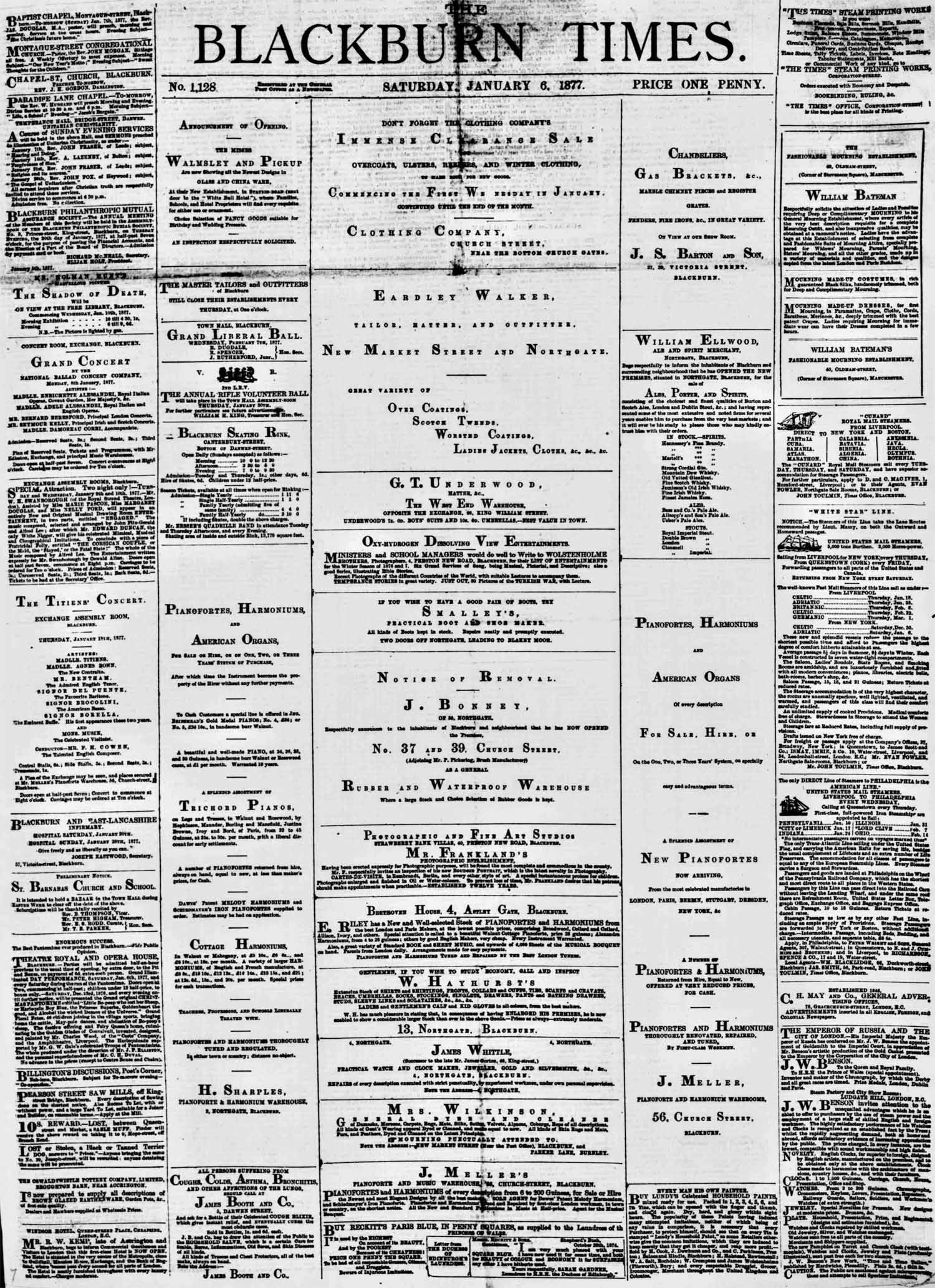
The Blackburn Times was first published on 7 January 1860 under the title The Blackburn Weekly Times. In 1861, it was renamed The Blackburn Times and continued publication until 1933. Over its 73-year history, the newspaper produced 6,844 pages across 781 issues. The Blackburn Times provided local and international news, serving as a significant source of information for the community during a period of substantial social and economic change.
The Blackburn Standard
Another notable publication, The Blackburn Standard, released its inaugural issue on 21 January 1835. Initially comprising eight pages with four columns each, it was priced at seven pence. The newspaper underwent several title changes:
- The Blackburn Standard (1835–1876)
- The Blackburn Standard, Darwen Observer, and North-East Lancashire Advertiser (1877–1888)
- The Blackburn Standard and Weekly Express (1888–1893)
- The Weekly Standard and Express (1893–1900)
By 1875, the price had decreased to one penny, reflecting broader trends in newspaper accessibility. The publication eventually merged with the Blackburn Gazette in 1909.
Lancashire Telegraph
Founded by Thomas Purvis Ritzema, the Lancashire Telegraph (originally the Northern Daily Telegraph) published its first issue on 26 October 1886, selling for half a penny. It holds the distinction of being East Lancashire’s first evening newspaper. The publication underwent several name changes, becoming the Northern Evening Telegraph in 1956 and the Lancashire Evening Telegraph in 1963. In 2006, it adopted its current name, the Lancashire Telegraph, and transitioned to morning distribution. The newspaper continues to serve the East Lancashire area, covering towns such as Blackburn, Burnley, Accrington, and Darwen.
Notable Figures in Blackburn’s Newspaper History
-
Sir George Toulmin: An English journalist and newspaper proprietor, Toulmin founded the Lancashire Daily Post in 1886 and, with his brother, established the Blackburn Times and the Warrington Examiner. He also served as a Liberal Party politician, representing Bury in Parliament from 1902 to 1918.
-
Benjamin Bryan: An English journalist and editor, Bryan edited newspapers in Blackburn, including The Patriot and The Standard. He was also a prominent anti-vivisection and animal welfare activist, leading the National Anti-Vivisection Society and the National Canine Defence League.
These publications and individuals played pivotal roles in shaping the media landscape of Blackburn, reflecting the town’s dynamic social and industrial evolution.