Sun (London) – Tuesday 02 January 1810
NAVAL NEWS.
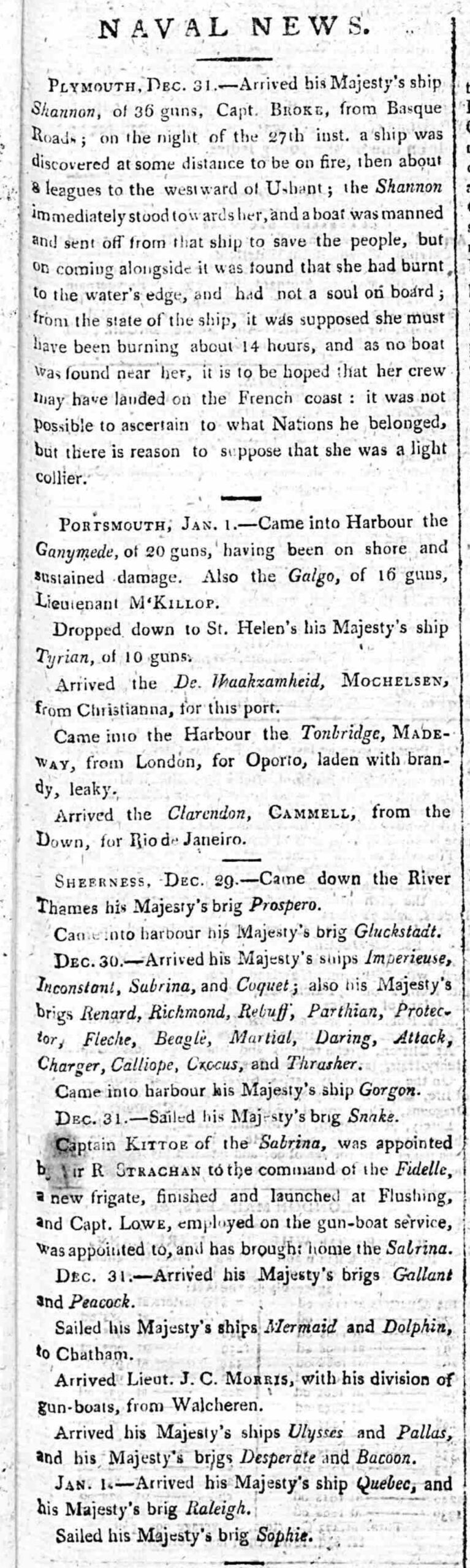
PLYMOUTH, Dec. 31.—Arrived his Majesty’s ship Shannon, of 36 guns, Capt. Broke, from Basque Roads; on the night of the 27th inst. a ship was discovered at some distance to be on fire, then about 8 leagues to the westward of Ushant; the Shannon immediately stood towards her, and a boat was manned and sent off from that ship to save the people, but on coming alongside it was found that she had burnt to the water’s edge, and had not a soul on board; from the state of the ship, it was supposed she must have been burning about 14 hours, and as no boat was found near her, it is to be hoped that her crew may have landed on the French coast: it was not possible to ascertain to what Nation she belonged, but there is reason to suppose that she was a light collier.
PORTSMOUTH, Jan. 1.—Came into Harbour the Ganymede, of 20 guns, having been on shore and sustained damage. Also the Galgo, of 16 guns, Lieutenant M‘Killop.
Dropped down to St. Helen’s his Majesty’s ship Tyrian, of 10 guns.
Arrived the De. Hhaakzamheid, Mochelsen, from Christianna, for this port.
Came into the Harbour the Tonbridge, Madeway, from London, for Oporto, laden with brandy, leaky.
Arrived the Clarendon, Gammell, from the Downs, for Rio de Janeiro.
SHEERNESS, Dec. 29.—Came down the River Thames his Majesty’s brig Prospero.
Came into harbour his Majesty’s brig Gluckstadt.
Dec. 30.—Arrived his Majesty’s ships Imperieuse, Inconstant, Sabrina, and Coquet; also his Majesty’s brigs Renard, Richmond, Rebuff, Parthian, Protector, Fleche, Beagle, Martial, Daring, Attack, Charger, Calliope, Coccus, and Thrasher.
Came into harbour his Majesty’s ship Gorgon.
Dec. 31.—Sailed his Majesty’s brig Snake.
Captain Kittoe of the Sabrina, was appointed a new frigate, finished and launched at Flushing, and Capt. Lowe, employed on the gun-boat service, was appointed to, and has brought home the Sabrina.
Dec. 31.—Arrived his Majesty’s brigs Gallant and Peacock.
Sailed his Majesty’s ships Mermaid and Dolphin, to Chatham.
Arrived Lieut. J. C. Morris, with his division of gun-boats, from Walcheren.
Arrived his Majesty’s ships Ulysses and Pallas, and his Majesty’s brigs Desperate and Bacon.
Jan. 1.—Arrived his Majesty’s ship Quebec, and his Majesty’s brig Raleigh.
Sailed his Majesty’s brig Sophie.
Explanation and Historical Context (1810, Britain, News Reporting, British Navy)
This article, published in The Sun (London) on 2 January 1810, provides an overview of naval activity at the end of 1809 and the beginning of 1810. It reports on ship arrivals, departures, incidents at sea, and naval movements, which were critical given Britain’s ongoing war with Napoleonic France.
Key Events in 1810 Affecting Britain
- Napoleonic Wars (1803–1815): Britain was at war with France, and naval dominance was crucial to blockades and supply lines.
- Walcheren Expedition (1809-1810): A failed British military campaign in the Netherlands resulted in high troop losses due to disease.
- Continental Blockade: Napoleon’s Continental System aimed to block British trade with Europe, making naval power vital.
- Industrial Revolution: Britain’s economy and military capabilities were growing due to industrial advances.
News Reporting in 1810
- Importance of the Navy: Reports of ship movements, battles, and naval operations were of national interest.
- Limited Communication: News was slow due to reliance on ships, horseback messengers, and printed newspapers.
- Official Naval Reports: Much of the naval news came from Admiralty sources, making these reports reliable but limited in civilian perspectives.
The British Navy in 1810
- Dominance at Sea: The Royal Navy controlled key trade routes and conducted blockades against France.
- Ship Classes: Ships were classified by the number of guns they carried (e.g., 36-gun frigates like Shannon).
- Strategic Locations: Ports like Plymouth, Portsmouth, and Sheerness were major naval hubs.
- Naval Warfare: The British focused on disrupting French supply lines and protecting British merchants.
Use for Historians
This article is valuable for historians studying:
- The Royal Navy’s role in 1810: Ship movements, engagements, and logistics.
- Economic and Trade History: Details of cargo, destinations, and maritime commerce.
- Naval Warfare Strategy: How Britain managed naval resources during the Napoleonic Wars.
- British-French Relations: Reports of a burning ship off the French coast suggest ongoing conflict.
Location and Events
- Plymouth: Naval base; HMS Shannon‘s report on a burning vessel.
- Portsmouth: Ships arriving, sustaining damage, and being repaired.
- Sheerness: Deployment of brigs and gunboats, critical to coastal defences.
- Walcheren: British gunboats returning from the disastrous campaign.
This article illustrates how crucial the Royal Navy was to Britain’s war effort and provides insight into early 19th-century naval operations, trade, and wartime logistics.
The History of The Sun Newspaper (1792–1876)
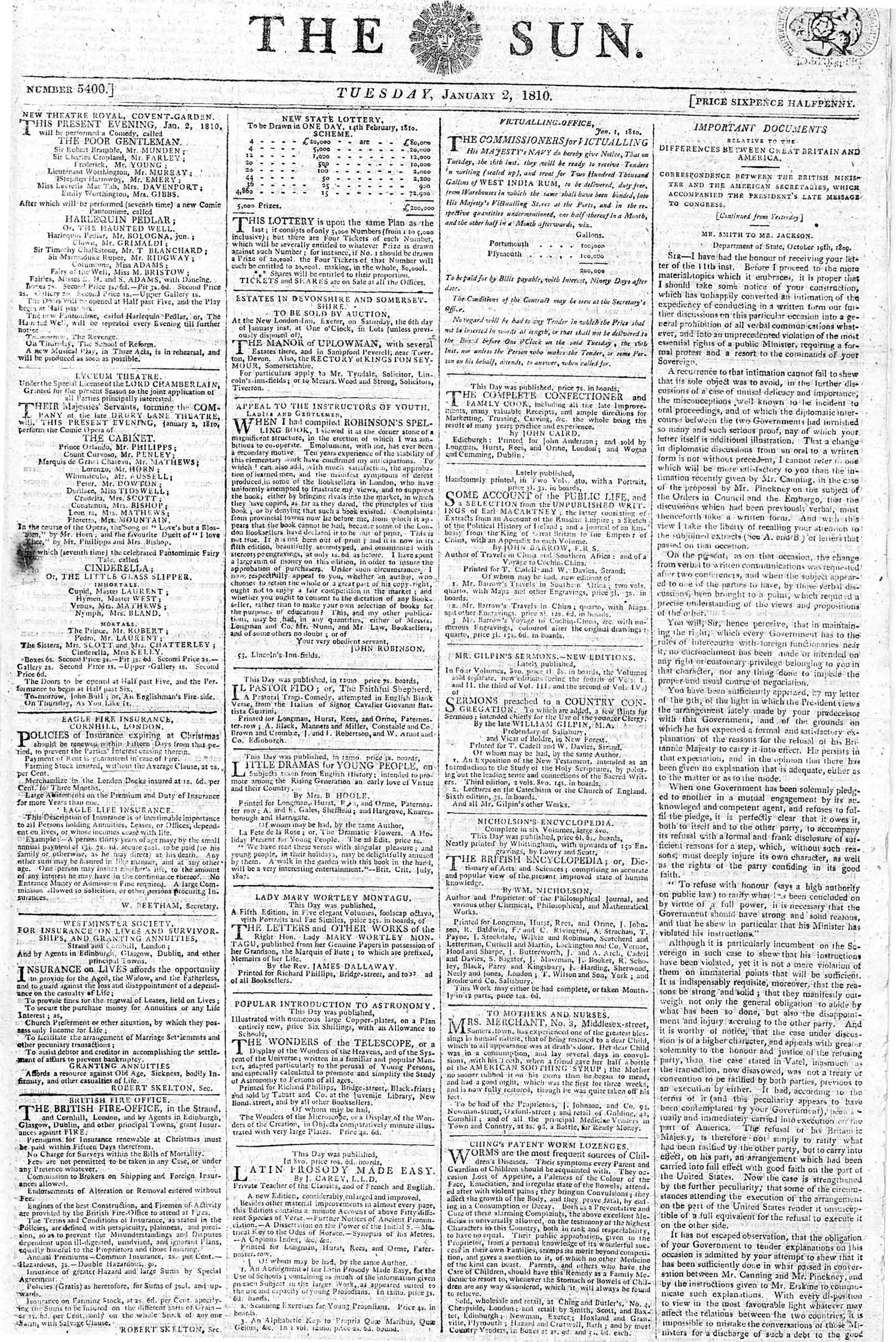
The Sun, a prominent daily evening newspaper, was established in 1792 by the writer and journalist John Heriot. The newspaper was founded with the strong backing of Prime Minister William Pitt the Younger and his government, who saw it as a valuable tool for shaping public opinion. During its formative years, The Sun received government subsidies and actively promoted a staunchly pro-government, anti-French Revolutionary stance. At a time when Britain was facing growing tensions with Revolutionary France, the publication played a crucial role in reinforcing patriotic sentiment and countering revolutionary ideas.
Early Years and Editorial Style (1792–1800s)
The first edition of The Sun was published on 1st October 1792. The newspaper’s masthead was immediately recognisable, featuring a distinctive motif of the sun encircled by rays, prominently positioned at the centre of its title. Like many newspapers of its time, The Sun followed the typical layout of the period:
- The front page was dominated by advertisements, a common practice before the later shift towards front-page news stories.
- The subsequent pages covered parliamentary proceedings, offering detailed reports on debates and decisions from the House of Commons and the House of Lords.
- Foreign and domestic news filled the later pages, providing readers with insights into both national affairs and international developments.
Although The Sun eventually introduced additional content such as theatre reviews and literary critiques, it remained primarily focused on political reporting. Its strong editorial voice and close alignment with the government ensured that it quickly gained influence. Within a short period, The Sun achieved an impressive circulation of approximately 4,000 copies per day, a notable figure for the time. This widespread reach was bolstered by the hundreds of copies distributed free of charge by the government, further amplifying its influence among policymakers and the public.
Shifting Political Views and the Anti-Corn Law Movement (1830s–1840s)
By the mid-1830s, the political stance of The Sun had undergone a significant transformation. Moving away from its earlier government-aligned conservatism, the newspaper embraced more liberal and free-trade principles. One of the most defining aspects of this ideological shift was The Sun’s vocal opposition to the Corn Laws, a controversial set of trade restrictions that imposed high tariffs on imported grain, keeping domestic grain prices artificially high.
The newspaper regularly featured articles condemning the Corn Laws, highlighting their detrimental impact on working-class families who struggled to afford basic foodstuffs. It also published advertisements for meetings organised by the Anti-Corn Law League, a powerful lobbying group that campaigned vigorously for the abolition of these protectionist measures. This change in editorial direction reflected the growing public demand for economic reforms and greater market liberalisation.
A Landmark Edition: Queen Victoria’s Coronation (1838)
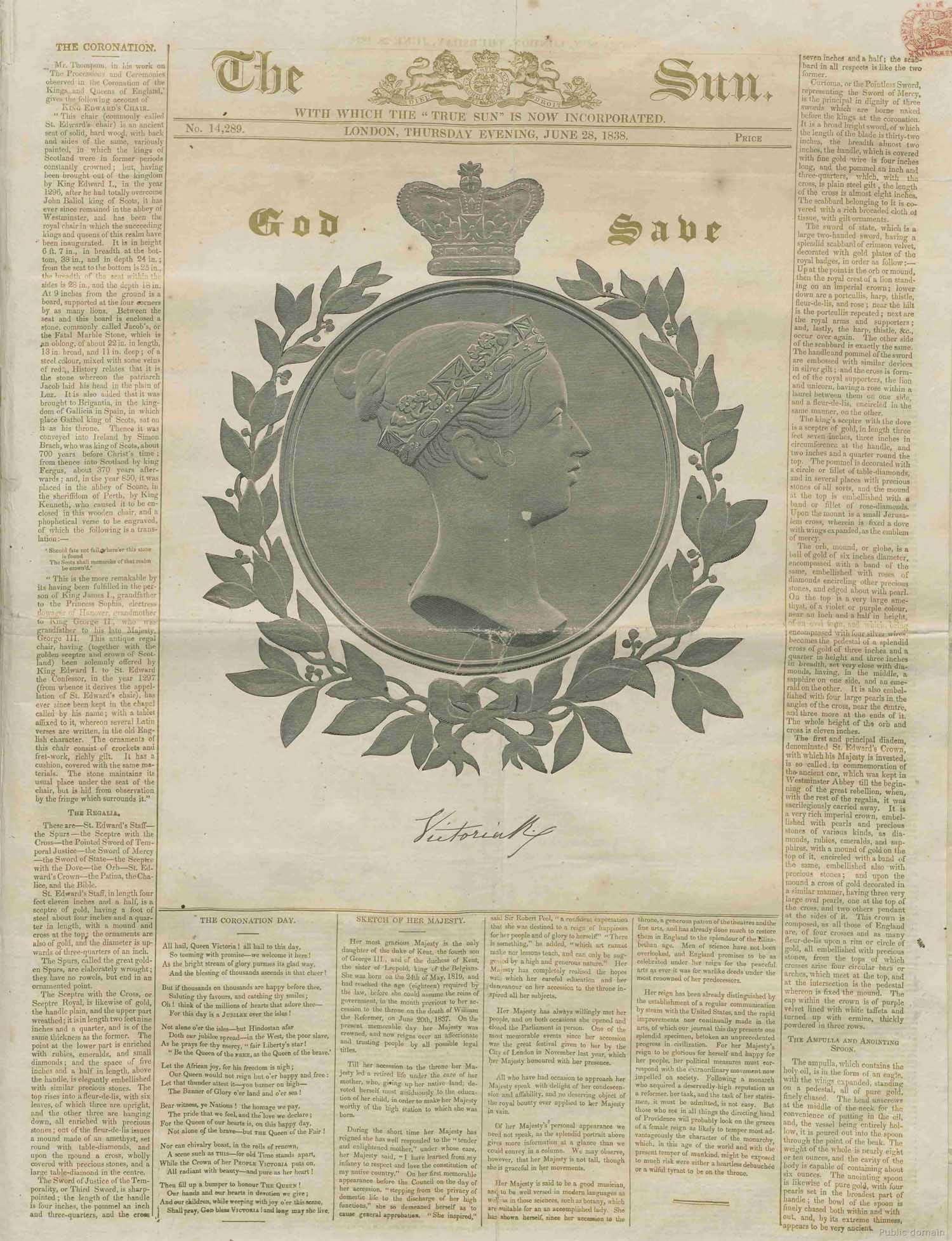
One of The Sun’s most famous and ground-breaking issues was its commemorative edition celebrating the coronation of Queen Victoria on 28th June 1838. To mark this momentous occasion, the newspaper produced an entirely unique front page, printed entirely in gold typeface—a pioneering design choice at the time. At the centre of the front page was an elaborate engraving of Queen Victoria, styled as a large medallion portrait, creating a striking and luxurious effect.
This special edition proved to be an extraordinary success. Estimates suggest that it sold a remarkable 250,000 copies, an unprecedented circulation figure for the era. The immense popularity of this issue demonstrated the increasing influence of visual presentation in newspapers and the growing demand for commemorative publications celebrating national events.
Later Years, Decline, and Final Publication (1870s)
By the 1870s, The Sun had begun to struggle in an increasingly competitive newspaper market. In 1871, in an attempt to revitalise its fortunes, it merged with the Central Press, leading to a temporary rebranding as The Sun and Central Press. However, this partnership was short-lived, and by 1873, the two newspapers had separated once again.
Despite efforts to maintain its readership, The Sun found itself in gradual decline. As the years passed, the publication shrunk in size, and an increasing proportion of its content was dedicated to advertising rather than original reporting. This shift reflected broader changes in the newspaper industry, where emerging publications were adopting more modern journalistic approaches and engaging in more aggressive competition for readership.
Ultimately, after nearly 84 years in print, The Sun ceased publication. Its final issue was printed on 15th April 1876, marking the end of a newspaper that had played a notable role in British journalism.
Legacy and Historical Significance
Although The Sun is no longer in circulation, its historical significance remains noteworthy. The newspaper was a key player in shaping public discourse during pivotal moments in British history, from the French Revolutionary Wars to the anti-Corn Law movement and the early years of Queen Victoria’s reign.
For historians, The Sun serves as an invaluable primary source, offering insights into:
- British political discourse across different eras, including government propaganda and liberal reformist movements.
- Public opinion and media influence, particularly in relation to economic policies such as the Corn Laws.
- The evolution of print journalism, from simple political bulletins to more visually striking, commercially-driven newspapers.
Through its shifting political stance, ground-breaking editorial decisions, and enduring influence on 19th-century journalism, The Sun remains an important chapter in the history of British newspapers.
🔥 Naval Mystery! HMS Shannon Discovers Burnt Ship off Ushant – No Survivors Found! 1810🚢🔥 #1810History #OnThisDay #NapoleonicWars #RoyalNavy #MaritimeMystery #HistoricalNews #BritishHistory