Portsmouth Evening News – Monday 15 June 1903
Table of Contents
ToggleCORONER’S COURT.
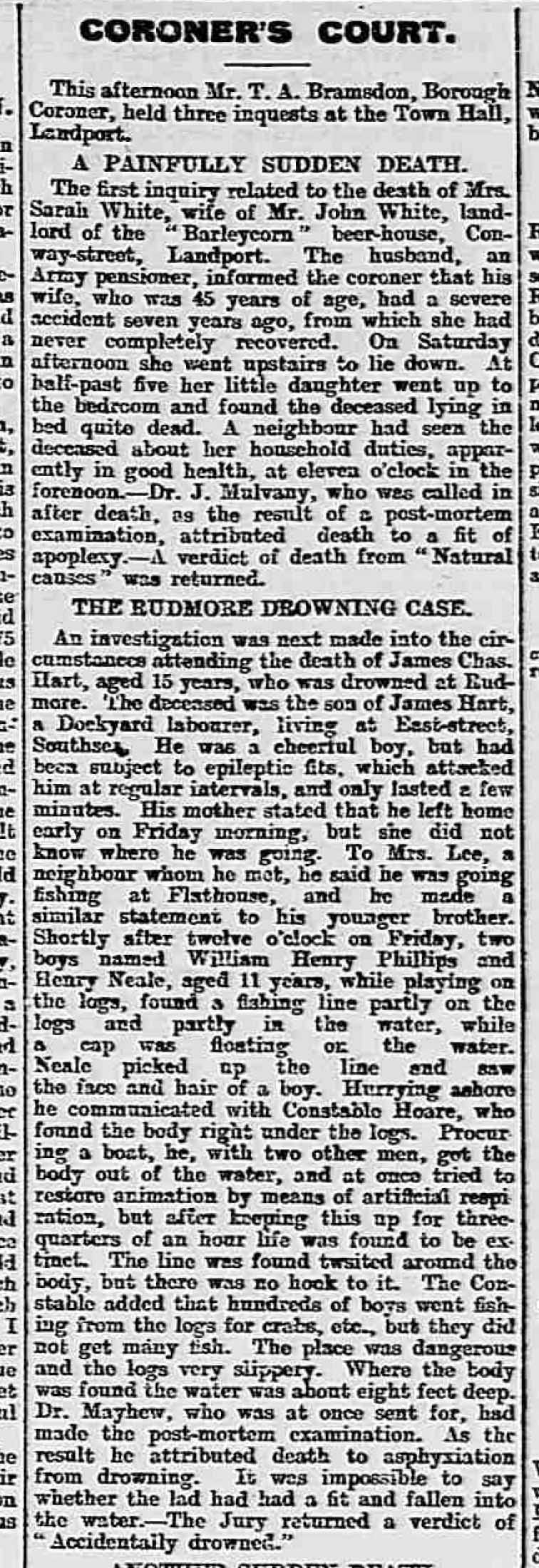
This afternoon Mr. T. A. Bramston, Borough Coroner, held three inquests at the Town Hall, Landport.
A PAINFULLY SUDDEN DEATH.
The first inquiry related to the death of Mrs. Sarah White, wife of Mr. John White, landlord of the “Barleycorn” beer-house, Conway-street, Landport. The husband, an Army pensioner, informed the coroner that his wife, who was 45 years of age, had a severe accident seven years ago, from which she had never completely recovered. On Saturday afternoon, she went upstairs to lie down. At half-past five, her little daughter went up to the bedroom and found the deceased lying in bed quite dead. A neighbour had seen the deceased about her household duties, apparently in good health, at eleven o’clock in the forenoon. Dr. J. Mulvany, who was called in after death, as the result of a post-mortem examination, attributed death to a fit of apoplexy. A verdict of “death from natural causes” was returned.
THE RUDMORE DROWNING CASE.
An investigation was next made into the circumstances attending the death of James Chas. Hart, aged 15 years, who was drowned at Rudmore. The deceased was the son of James Hart, a Dockyard labourer, living at East-street, Southsea. He was a cheerful boy, but had been subject to epileptic fits, which attacked him at regular intervals, and only lasted a few minutes. His mother stated that he left home early on Friday morning, but she did not know where he was going. To Mrs. Lee, a neighbour whom he met, he said he was going fishing at Flathouse, and he made a similar statement to his younger brother.
Shortly after twelve o’clock on Friday, two boys named William Henry Phillips and Henry Neale, aged 11 years, while playing on the logs, found a fishing line partly on the logs and partly in the water, while a cap was floating on the water. Neale picked up the line and saw the face and hair of a boy. Hurrying ashore, he communicated with Constable Hoare, who found the body right under the logs. Procuring a boat, he, with two other men, got the body out of the water, and at once tried to restore animation by means of artificial respiration, but after keeping this up for three-quarters of an hour, life was found to be extinct.
The line was found twisted around the body, but there was no hook to it. The Constable added that hundreds of boys went fishing from the logs for crabs, etc., but they did not get many fish. The place was dangerous, and the logs very slippery. Where the body was found, the water was about eight feet deep. Dr. Mayhew, who was at once sent for, had made the post-mortem examination. As the result, he attributed death to asphyxiation from drowning. It was impossible to say whether the lad had had a fit and fallen into the water. The Jury returned a verdict of “Accidentally drowned”.
Explanation and Historical Context
The Law and the Coroner’s Court
At the time, Coroner’s Courts were responsible for investigating sudden, unexplained, or suspicious deaths. The Borough Coroner, Mr. T. A. Bramston, presided over this session, which was held at Landport Town Hall. The inquests followed standard procedures of the era:
- Witness testimony – Relatives, neighbours, and officials provided statements.
- Medical examination – A post-mortem was conducted to determine the cause of death.
- Jury involvement – A jury was called to decide the official verdict.
In these cases:
- Mrs. Sarah White was deemed to have died from natural causes (apoplexy).
- James Chas. Hart was accidentally drowned, though the possibility of an epileptic fit leading to his death could not be confirmed.
People Involved
- Mrs. Sarah White – A 45-year-old woman, wife of John White, a publican and Army pensioner.
- James Chas. Hart – A 15-year-old boy, son of a Dockyard labourer, known to suffer from epileptic fits.
- Dr. J. Mulvany – The medical examiner who determined Mrs. White’s cause of death.
- Dr. Mayhew – The medical examiner in the drowning case.
- Constable Hoare – The policeman who helped recover Hart’s body.
- William Henry Phillips & Henry Neale (aged 11) – The boys who discovered the body.
The Circumstances
- Apoplexy (Stroke)
- Mrs. White’s case reflects the high risk of strokes (apoplexy) in middle-aged individuals, especially after prior health issues.
- Her sudden collapse in bed, despite appearing healthy earlier, was not uncommon for the time.
- Child Accidents and Dangerous Play Areas
- The Rudmore area was known for slippery docks and water hazards.
- Many working-class boys fished and played near the docks, despite the dangers.
- Epileptic seizures were poorly understood, and no precautions were in place for children with such conditions.
For Historians
This article provides a snapshot of early 20th-century Portsmouth, highlighting:
- Working-class life: The deceased in both cases were from modest backgrounds—a pub landlord’s wife and a dockyard worker’s son.
- Health conditions: Stroke and epilepsy were poorly understood, and no advanced treatments were available.
- Child labour & recreation: Young boys had little supervision, often engaging in risky activities near water and industrial areas.
- The legal process: Inquests were quick and informal by today’s standards, yet essential for official death records.
Social and Medical Analysis of the Cases in the 1903 Coroner’s Court Report
This article from the Portsmouth Evening News (15 June 1903) provides a valuable window into working-class life, health concerns, and legal procedures in early 20th-century Britain. Below is an in-depth analysis from both social and medical perspectives.
1. Social Analysis
a) The Role of the Coroner’s Court
The Coroner’s Court functioned as an essential part of the justice system, investigating sudden, unexplained, or unnatural deaths. These inquests were not criminal trials, but they determined cause of death and ensured that suspicious circumstances were ruled out.
Key observations:
- The Borough Coroner, Mr. T. A. Bramston, was responsible for several inquests in a single afternoon, indicating that deaths from accidents and sudden illness were frequent and routine.
- Verdicts such as “Natural Causes” and “Accidentally Drowned” were common in cases where foul play was not suspected.
b) Working-Class Life in Portsmouth
Both Mrs. White and James Chas. Hart came from working-class backgrounds, reflecting common societal conditions in 1903.
The Pub Industry and Military Pensions
- John White, Mrs. White’s husband, was both an Army pensioner and a publican (landlord of a beer-house).
- Many former soldiers became publicans after retiring, as pubs provided a steady income and community status.
- Beer-houses such as The Barleycorn in Landport were hubs of social life, catering to working-class drinkers.
- Mrs. White’s role would have included managing household duties and helping run the pub, which was typical for women in such establishments.
Childhood and Recreation in Industrial Areas
- James Chas. Hart, the 15-year-old who drowned, came from a Dockyard labourer’s family.
- Portsmouth’s Dockyard and waterfront were central to local life, and many working-class children played around the docks, despite the dangers.
- Boys often fished for crabs near docks and piers, using makeshift equipment. This was a common pastime but also a hazardous one.
The Danger of Unsupervised Play
- The report highlights that “hundreds of boys” regularly played near the docks.
- The lack of formal leisure spaces for children meant they played in dangerous environments such as industrial sites, railway yards, and riverbanks.
- Safety measures, such as fences, warning signs, and supervision, were minimal.
c) Gender Roles and Women’s Health
- Mrs. White’s role as a publican’s wife meant she likely had a physically demanding lifestyle—managing household duties and assisting with the beer-house.
- Working-class women often worked until the day they died, with no retirement or medical support.
- A sudden death at 45 was not unusual, given the stress, poor nutrition, and lack of healthcare many working-class women faced.
2. Medical Analysis
a) Stroke (Apoplexy) in 1903
- Mrs. White’s cause of death was attributed to “apoplexy”, which is the old term for a stroke.
- Strokes were poorly understood, and treatment options were non-existent.
- Mrs. White had suffered a serious accident seven years earlier, which may have contributed to long-term health complications.
- Risk factors for strokes (though not recognised as such at the time) included:
- High blood pressure (which was not routinely diagnosed in 1903).
- Poor diet, with excessive salt, fats, and alcohol in working-class diets.
- Lack of medical care, since most people only saw a doctor when seriously ill.
b) Epilepsy and Accidental Drowning
- James Chas. Hart suffered from epilepsy, which was not well understood in 1903.
- There were no effective anti-epileptic drugs at the time, and seizures were often feared or misunderstood.
- The coroner acknowledged the possibility that James had a seizure and fell into the water, but it could not be proven.
- The verdict of “Accidentally Drowned” was given because, even if he had a seizure, the lack of witnesses meant there was no direct proof.
How Epilepsy Was Viewed in 1903
- Medical stigma: Epilepsy was sometimes considered a mental illness or even demonic possession in the past.
- No formal care: There were no support services for epileptic children, and they were expected to live normal lives despite the risks.
- Dangers in daily life: Falls, burns, and drowning were common causes of death among epileptic individuals.
- Lack of public understanding: Even trained professionals struggled to determine whether a seizure had occurred in cases like James Hart’s.
c) Lack of Medical Intervention and First Aid
- James Hart’s body was found in deep water, and efforts were made to revive him using artificial respiration.
- However, CPR as we know it today did not exist—the methods used were rudimentary and often ineffective.
- Drowning victims in 1903 had a very low survival rate, partly due to:
- Delayed rescue (it took time for rescuers to reach the body).
- Lack of medical knowledge on effective resuscitation techniques.
- Cold water exposure reducing survival chances.
3. Comparison to Today
| Aspect | 1903 | Today |
|---|---|---|
| Medical Care for Strokes | No treatment available, no understanding of risk factors. | Immediate hospital treatment (e.g., clot-busting drugs, surgery). |
| Epilepsy Treatment | No medications, seizures were poorly understood. | Anti-epileptic drugs, MRI scans, and safety guidance for patients. |
| Child Safety by Water | No safety regulations, children played in hazardous areas. | Safety fences, warning signs, and supervised activities. |
| Resuscitation (CPR) | Artificial respiration methods were basic and rarely effective. | CPR training widely available, leading to higher survival rates. |
Conclusion
This 1903 inquest report reflects a society with limited medical knowledge and safety regulations. Key takeaways:
- Medical science was still developing, with strokes and epilepsy poorly understood.
- Working-class people faced high risks of sudden death, with minimal medical intervention available.
- Children played in dangerous environments, with no formal supervision or safety measures.
- First aid techniques were primitive, and drowning victims rarely survived.
From a historical perspective, this article highlights the daily dangers of early 20th-century life and the progress made in medicine and public safety since then.
History of The Portsmouth Evening News
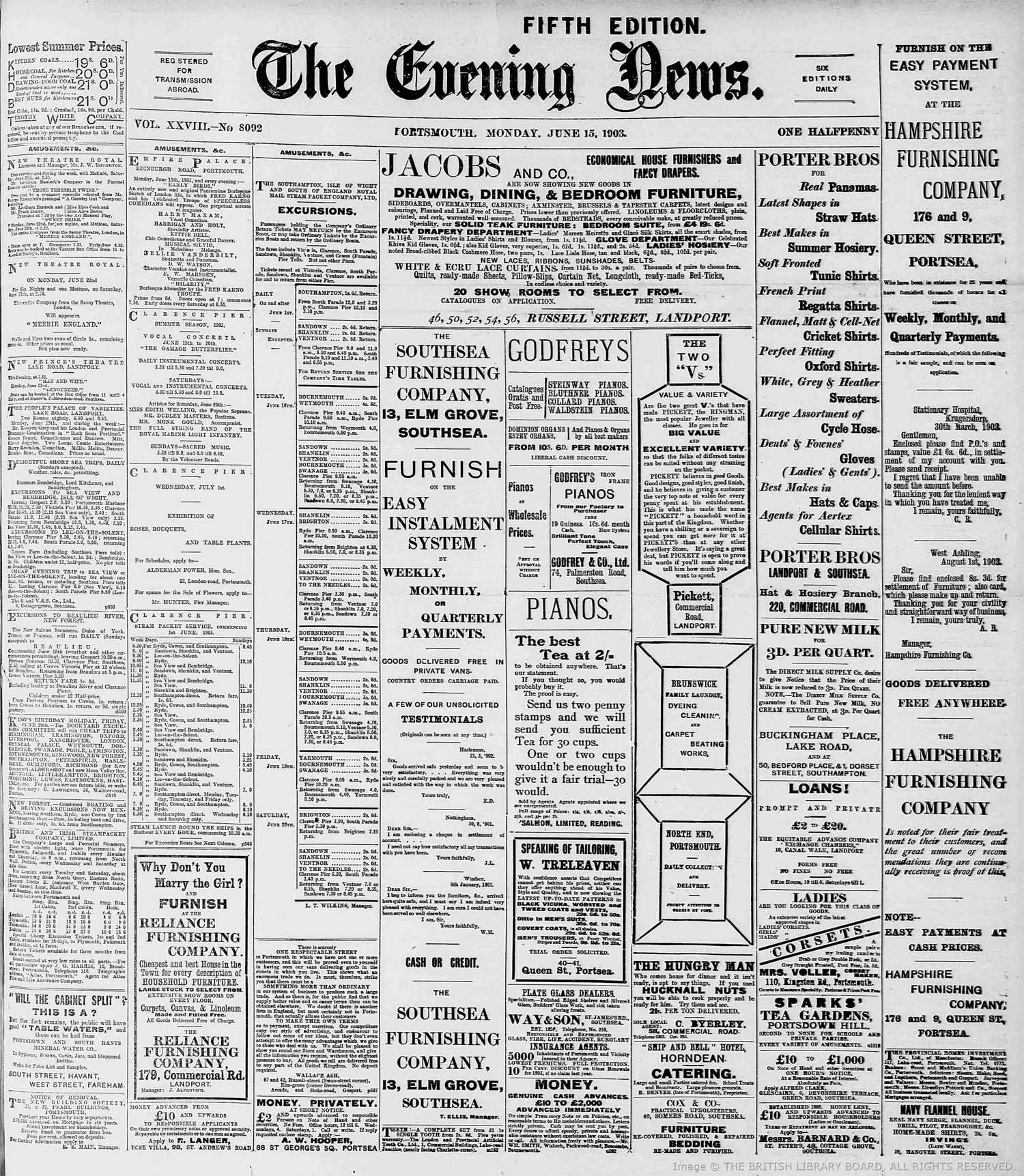
The Portsmouth Evening News was established in Portsmouth in 1877 by James Graham Niven as a daily evening newspaper. Niven personally managed the publication, undertaking the roles of reporter, editor, and distributor. The paper consisted of four pages and was sold for a halfpenny.
In 1883, Niven sold a majority share to Samuel Storey but continued to publish the paper. Storey, originally from Durham, had been a Liberal MP for Sunderland since 1881 and was already the owner of the Sunderland Echo and the Tyneside Echo. He was also part of a syndicate, alongside Scots-American steel magnate Andrew Carnegie, which aimed to expand the radical Liberal press by acquiring newspapers to support their political objectives. By the end of 1884, the syndicate controlled a significant number of daily and weekly publications. However, when it dissolved in 1885, Storey retained a controlling interest in the Portsmouth Evening News, Sunderland Echo, and Northern Daily Mail.
The Evening News operated as an independent company until 1934, when it became part of Storey’s Portsmouth and Sunderland Newspapers Ltd.
🚨 TRAGIC DEATHS IN LANDPORT: SUDDEN STROKE & DOCKYARD DROWNING 🚨📰 Portsmouth Evening News – Monday, 15 June 1903 – A 45-year-old publican’s wife, Mrs. Sarah White, died suddenly of apoplexy (stroke) at home, while 15-year-old James Hart drowned at Rudmore after possibly suffering an epileptic seizure. The Coroner’s inquest ruled “Natural Causes” for Mrs. White and “Accidentally Drowned” for young Hart. The dangers of poor healthcare, hazardous play areas, and lack of medical understanding are starkly evident in these heart-breaking cases. 🔍 #PortsmouthHistory #VictorianEra #CoronersCourt #Drowning #EpilepsyAwareness #PublicHealth #DockyardLife #MedicalHistory #StrokeAwareness #1903News