Sometimes this researcher accidentally comes across an old British news article that’s really from another world.
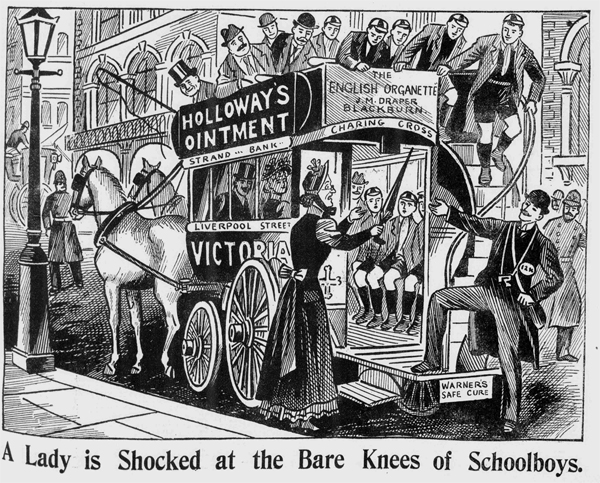
Illustrated Police News – Saturday 31 October 1896 was reporting the dreadful scene on a London omnibus whereby a lady fell into shock at the sight of the knees of a collection of boys who had just been playing football.
I’d love to know who the lady was as she was a member of The National Vigilance Association. My guess is that it could have been Millicent Garrett (1847-1929); Feminist and Suffragist. or one of her associates.
A LADY IS SHOCKED AT THE BARE KNEES OF SCHOOLBOYS.
LAUGHABLE OCCURRENCE.
[SUBJECT OF ILLUSTRATION.]
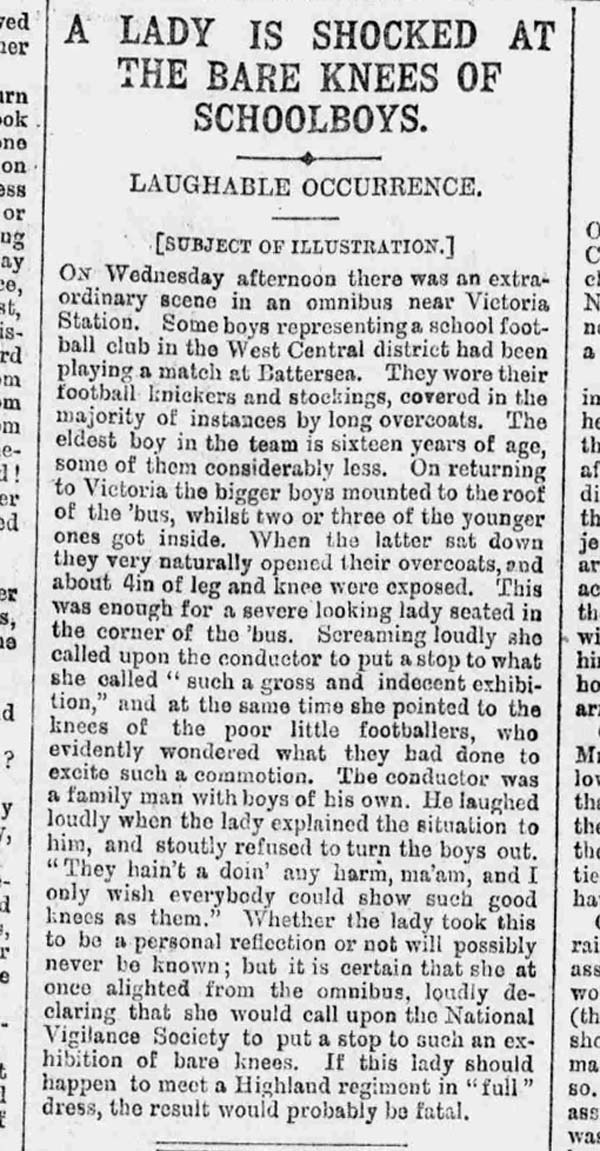
On Wednesday afternoon there was an extraordinary scene in an omnibus near Victoria Station. Some boys representing a school football club in the West Central district had been playing a match at Battersea. They wore their football knickers and stockings, covered in the majority of instances by long overcoats.
The eldest boy in the team is sixteen years of age, some of them considerably less. On returning to Victoria the bigger boys mounted to the roof of the ’bus, whilst two or three of the younger ones got inside. When the latter sat down they very naturally opened their overcoats, and about 4in of leg and knee were exposed.
This was enough for a severe looking lady seated in the corner of the ’bus. Screaming loudly she called upon the conductor to put a stop to what she called “such a gross and indecent exhibition,” and at the same time she pointed to the knees of the poor little footballers, who evidently wondered what they had done to excite such a commotion. The conductor was a family man with boys of his own. He laughed loudly when the lady explained the situation to him, and stoutly refused to turn the boys out. “They hain’t a doin’ any harm, ma’am, and I only wish everybody could show such good knees as them.”
Whether the lady took this to be a personal reflection or not will possibly never be known; but it is certain that she at once alighted from the omnibus, loudly declaring that she would call upon the National Vigilance Society to put a stop to such an exhibition of bare knees. If this lady should happen to meet a Highland regiment in “full” dress, the result would probably be fatal.
Millicent Garrett Fawcett (1847–1929)
Leader of the Constitutional Women’s Suffrage Movement
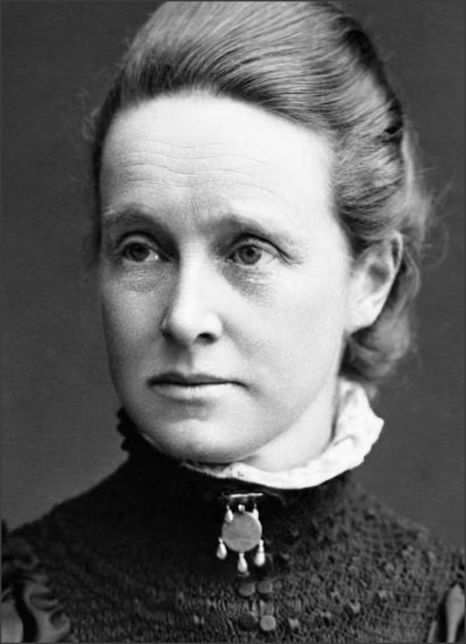
Millicent Garrett Fawcett, born on 11 June 1847 in Aldeburgh, Suffolk, was one of the most influential figures in the British campaign for women’s rights.
She was the daughter of Newson Garrett, a prosperous businessman, and Louisa Garrett (née Dunnell). She grew up in a remarkable family: her sisters included Elizabeth Garrett Anderson, the first woman to qualify as a physician and surgeon in Britain, Agnes Garrett, an interior designer and activist, and Louise Garrett Smith. From an early age, the Garrett sisters shared a commitment to women’s advancement and Liberal politics.
Early Influences and Marriage
Millicent’s political awakening began in 1865, when she attended a speech in London by the philosopher John Stuart Mill, then standing as a parliamentary candidate advocating women’s suffrage. Too young to sign Mill’s famous 1866 petition for votes for women, she nonetheless attended the Commons debate on the subject in May 1867.
A month earlier, in April 1867, she had married Henry Fawcett, Professor of Political Economy at Cambridge and Radical Liberal MP for Brighton. Blinded in a hunting accident, Henry relied heavily on Millicent, who became both his secretary and political collaborator. Their partnership was one of intellectual equality and mutual support. The couple had one child, Philippa Garrett Fawcett (1868–1948), who later became a distinguished mathematician. That same year, Millicent published her first article on women’s education.
Early Suffrage Work
In July 1867, she joined the executive committee of the newly formed London National Society for Women’s Suffrage and, two years later, spoke at its first public meeting. After Mill’s death in 1874, she shifted her allegiance to the Central Committee for Women’s Suffrage, despite initial hesitation over its association with the controversial campaign to repeal the Contagious Diseases Acts.
When suffrage organisations united in 1877, Millicent helped shape the new Central Committee for Women’s Suffrage, steering it towards moderate and constitutional methods. She was not a frequent public speaker during these years, but after Henry Fawcett’s death in 1884, she re-entered public life with renewed determination. By 1886 she had become a prominent touring lecturer and campaigner for women’s suffrage.
Campaigns for Public Morality
Fawcett was also active in wider campaigns for morality and social reform. In 1885, she helped establish the National Vigilance Association, alongside reformers such as Josephine Butler and W.T. Stead, to combat child exploitation and vice. In the 1890s, she waged a high-profile campaign against Conservative MP Henry Cust, whom she considered morally unfit for office due to his seduction of a young woman. Although controversial within the suffrage movement, her stance reflected her deep concern for public morality.
Liberal Unionist and Organisational Leadership
Although long associated with the Liberal Party, Fawcett opposed Gladstone’s Home Rule policy and joined the Liberal Unionists. She co-founded the Women’s Liberal Unionist Association, reflecting her growing independence from party politics. Internal disputes over political affiliations within the suffrage movement led to fractures, but Fawcett played a key role in reconciling the divisions.
In 1896, she presided over a joint suffrage meeting that laid the foundation for the National Union of Women’s Suffrage Societies (NUWSS). She became its honorary secretary and later served on its parliamentary committee. In 1907, she was elected President of the NUWSS, a position she held until 1919, leading the organisation during its most influential years.
Boer War and International Work
By 1901, her reputation was such that she was appointed to a government Commission of Inquiry into concentration camps during the Boer War—the first woman to sit on such a body. Internationally, she became vice-president of the International Woman Suffrage Alliance in 1902 and later worked on issues of women’s status in India, continuing an interest she had shared with her husband.
Key Suffrage Campaigns
Fawcett’s NUWSS was committed to peaceful, constitutional methods in contrast to the militant tactics of the Women’s Social and Political Union (WSPU) led by Emmeline Pankhurst. Under her leadership:
-
The NUWSS organised the “Mud March” of February 1907, the largest demonstration for women’s suffrage up to that time.
-
In June 1908, they staged a major procession from the Embankment to the Royal Albert Hall.
-
In 1912, Fawcett served on the Fighting Fund Committee, raising resources to support pro-suffrage candidates in by-elections.
Despite divisions, her patient, moderate approach gave the movement credibility and long-term resilience.
First World War and Reform
At the outbreak of war in 1914, Fawcett suspended NUWSS political campaigning in favour of supporting the war effort. This decision split the organisation, with several members resigning, but she retained control. She vetoed NUWSS attendance at the 1915 Women’s Peace Congress in The Hague, believing that suffrage work would be harmed by association with pacifism.
Her support for women’s war work strengthened the case for reform. In 1918, the Representation of the People Act enfranchised over 8 million women aged 30 and over. Fawcett witnessed the long-awaited success of her life’s work. The following year, she attended the Women’s Peace Conference in Paris, lobbying governments during the post-war peace negotiations.Later Life and Honours
In 1919, she retired when the NUWSS re-formed as the National Union of Societies for Equal Citizenship (NUSEC), though she remained on the executive committee for a time. She chaired the women’s journal The Women’s Leader and was made Dame Grand Cross of the Order of the British Empire (GBE) in 1925. That same year, she resigned from NUSEC after opposing its support for family allowances.
Even in her seventies, she remained active, travelling to the Far East with her sister Agnes. She died in London on 5 August 1929, aged 82.
Legacy
Millicent Garrett Fawcett’s life embodied perseverance, principle, and moderation in the pursuit of justice. Unlike the militants, she believed change must come through constitutional means—and her strategy was vindicated in 1918. Her statue now stands in Parliament Square, a fitting tribute to the woman who led the largest and most influential suffrage organisation in Britain.