London’s Mayor-Elect of 1890: A Huguenot Heritage in Public Office
Today voters across England, Wales, and Scotland head to the polls for local elections, including high-profile mayoral contests in London, Liverpool, and Salford. The noise of campaigns, the scrutiny of manifestos, and the political theatre that now surrounds such events makes a striking contrast with the quieter mood of municipal elections in the late Victorian age.

When this researcher turned to the archives for coverage of the London Mayor 1890 election, the material was surprisingly thin. Even the most diligent newspaper rummaging offered little to excite the modern political blogger. Yet the York Herald of Wednesday, 1 October 1890, did single out one notable appointment in London — the election of a new Lord Mayor.
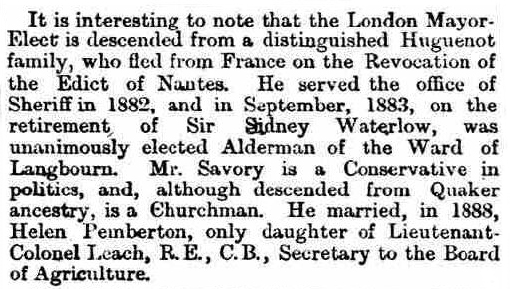
The Mayor-elect of 1890 was Sir Joseph Savory (1843–1921), a Conservative politician and businessman whose ancestry traced back to the Huguenots — French Protestants who fled religious persecution after the Revocation of the Edict of Nantes in 1685. Thousands of Huguenots settled in England, bringing with them skills in finance, commerce, and the crafts, and over time their descendants integrated into the political and cultural life of Britain. Savory’s rise to the highest civic office in the City of London was a telling example of this legacy.
The Herald reminded readers that Savory had already served as Sheriff in 1882 and, following the retirement of Sir Sidney Waterlow in 1883, was unanimously elected Alderman of the Ward of Langbourn. His politics were staunchly Conservative. Although descended from Quaker stock, he was a committed Anglican — a point of interest to Victorian readers still alive to the distinctions of sect and denomination.
In his personal life, Savory married in 1888 to Helen Pemberton Leach, only daughter of Lieutenant-Colonel Leach, R.E., C.B., Secretary to the Board of Agriculture. His combination of Huguenot heritage, mercantile success, Conservative politics, and Anglican faith reflected the intricate tapestry of late-Victorian London civic life.
Compared with today’s mayoral contests — complete with social media campaigns, televised hustings, and a 24-hour news cycle — the election of 1890 passed with an almost genteel quiet. Yet, even in that quieter age, the office carried weight. The Lord Mayor was not only a ceremonial figure but also a prominent representative of London’s financial power and civic pride.
It is a reminder that while the theatre of politics has changed, the stories of those who take office — their origins, convictions, and connections — continue to shape public interest.