Warrington Examiner – Saturday 03 August 1901
BEFORE THE MAGISTRATES
Cruelty to Horses.
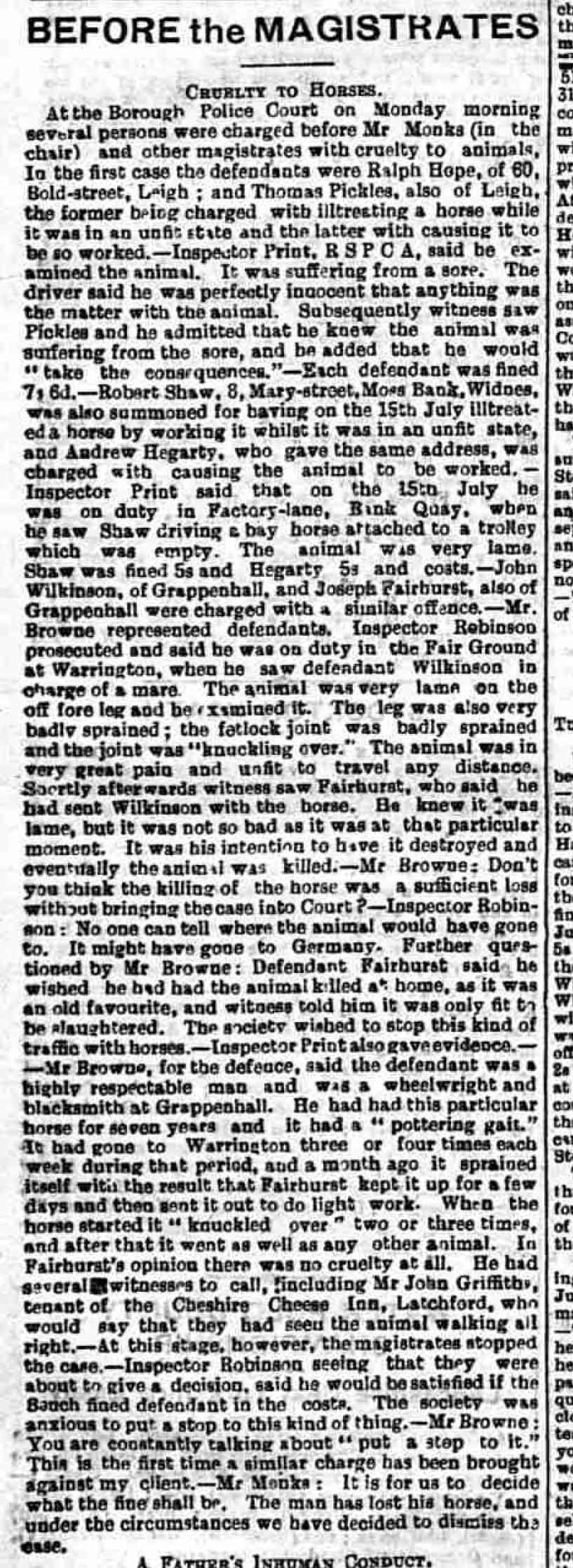
At the Borough Police Court on Monday morning, several persons were charged before Mr. Monks (in the chair) and other magistrates with cruelty to animals. In the first case, the defendants were Ralph Hope, of 60 Bold Street, Leigh; and Thomas Pickles, also of Leigh. The former was charged with ill-treating a horse while it was in an unfit state, and the latter with causing it to be so worked.
Inspector Print, RSPCA, said he examined the animal. It was suffering from a sore. The driver said he was perfectly innocent that anything was the matter with the animal. Subsequently, witness saw Pickles, and he admitted that he knew the animal was bad, sent Wilkinson with the horse. He knew it was lame, but it was not so bad as it was at that particular moment. It was his intention to have it destroyed, and eventually, the animal was killed.
Mr. Browne: Don’t you think the killing of the horse was a sufficient loss without bringing the case into Court?
Inspector Robinson: No one can tell where the animal would have gone to. It might have gone to Germany.
Further questioned by Mr. Browne: Defendant Fairhurst said he wished he had had the animal killed at home, as it was an old favourite, and witness told him it was coy.
It had gone to Warrington three or four times each week during that period, and a month ago it sprained itself, with the result that Fairhurst kept it up for a few days and then sent it out to do light work. When the horse started, it “knuckled over” two or three times, and after that, it went as well as any other animal. In Fairhurst’s opinion, there was no cruelty at all. He had several witnesses to call, including Mr. John Griffiths, tenant of the Cheshire Cheese Inn, Latchford, who…
Note: The transcription is incomplete due to missing portions in the original document.
Analysis of the Article:
The article reports on a case of alleged animal cruelty brought before the Borough Police Court in Warrington in August 1901. The defendants, Ralph Hope and Thomas Pickles, both from Leigh, were accused of working a horse that was deemed unfit due to injury.
Legal Context in 1901:
During this period, animal welfare was governed by the Cruelty to Animals Act 1876, which aimed to prevent the mistreatment of animals. The Royal Society for the Prevention of Cruelty to Animals (RSPCA) played a pivotal role in enforcing these laws and bringing offenders to justice. The Act made it an offence to cause unnecessary suffering to animals, and those found guilty could face fines or imprisonment.
Implications of the Case:
The case highlights the societal attitudes towards animal welfare at the time and the legal mechanisms in place to address cruelty. It also underscores the role of the RSPCA in monitoring and enforcing animal welfare standards. For the defendants, a conviction could result in financial penalties and damage to their reputations, particularly if their livelihoods depended on working animals.
Individuals and Occupations:
-
Ralph Hope: Resident of 60 Bold Street, Leigh.
-
Thomas Pickles: Resident of Leigh.
-
Inspector Print: Representative of the RSPCA, responsible for investigating animal cruelty cases.
-
Mr. Browne: Likely the defence solicitor representing the accused.
-
Mr. Monks: Presiding magistrate at the Borough Police Court.
-
Mr. John Griffiths: Tenant of the Cheshire Cheese Inn, Latchford, mentioned as a potential witness.
Businesses and Employers:
-
Cheshire Cheese Inn, Latchford: A public house in Latchford, with Mr. John Griffiths as the tenant.
Events and Social Context:
The early 20th century in Leigh was marked by industrial growth, particularly in textiles and coal mining. Horses were essential for transportation and industrial work, making their welfare a significant concern. This case reflects the tensions between economic demands and emerging animal welfare considerations.
Relevance to Historians and Family Historians:
This article offers insights into:
-
Legal History: Understanding the application of animal welfare laws in the early 1900s.
-
Social History: Examining societal attitudes towards animal cruelty and the role of organisations like the RSPCA.
-
Genealogy: Providing information on individuals involved in legal proceedings, which can be valuable for constructing family histories.
Insights into Life in Leigh in 1901:
Leigh, located in Lancashire, was undergoing significant industrialsation during this period. The town’s economy was primarily driven by coal mining and textile manufacturing. The population had grown substantially, leading to urban development and the expansion of local services. Legal cases such as the one reported highlight the everyday challenges and societal issues faced by residents.
History of The Warrington Examiner
Origins and Early Years (1869–1879)
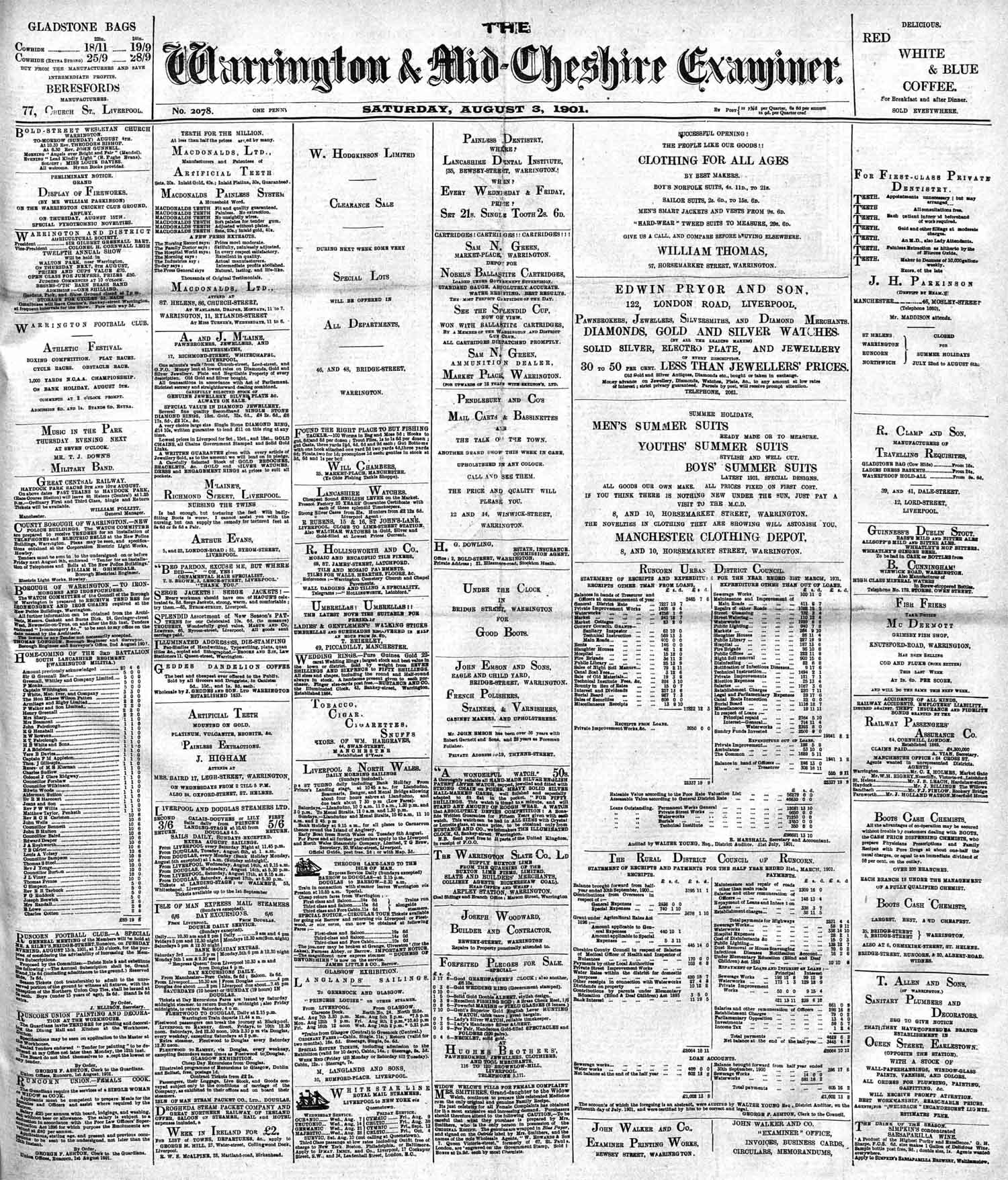
The Warrington Examiner was founded in 1869 during the golden age of local and regional press expansion across the United Kingdom. The mid-Victorian era saw a rapid increase in literacy, greater public interest in civic affairs, and legislative changes such as the repeal of the newspaper stamp duty in 1855, which made newspapers more accessible and affordable. The Examiner was established to serve the town of Warrington, then part of Lancashire, a booming industrial and market town strategically situated between Liverpool and Manchester.
The paper emerged at a time when local newspapers were crucial sources of information for ordinary people. National newspapers had limited penetration outside London, so towns like Warrington relied heavily on their own local press. The Warrington Examiner initially reported on local governance, church and chapel life, markets, social events, court proceedings, and the growing influence of trade unions and co-operative societies.
Expansion and Rebranding (1879–1909)
In 1879, the newspaper changed its title to the Warrington and Mid-Cheshire Examiner, reflecting an expansion in geographical coverage. This rebranding coincided with the increasing importance of nearby Mid-Cheshire towns such as Northwich, Frodsham, and Runcorn. The newspaper reported on events across the Cheshire Plain, especially focusing on rural and agricultural matters, as well as developments in transport, sanitation, and education in smaller boroughs.
During this period, the Examiner was known for its thorough reporting, court reports, advertisements for local tradesmen, births, marriages and deaths, and nonconformist religious content, which appealed to Warrington’s significant Methodist and Congregationalist population.
It served as a platform for civic debate and middle-class reformist causes. Politically, like many local newspapers of its day, it often leaned towards the Liberal Party, supporting issues such as Home Rule, temperance, and educational reform.
The paper was printed in broadsheet format, published weekly (typically on Saturdays), and available via subscription or from local newsagents and stationers. It also carried substantial advertising content, including apprentice placements, domestic service jobs, and local sales.
Twilight Years and Cessation (1909–1911)
In 1909, the title reverted to the original Warrington Examiner. By this time, however, the newspaper was under pressure from competitors, including the more modernised Warrington Guardian, which had a broader readership, better printing technology, and closer ties to established Conservative interests.
The last known issue of the Warrington Examiner appeared in 1911, marking the end of over 40 years of publication. Its closure reflected the broader consolidation trend in local newspapers during the early 20th century. Improved transport and communication meant that readers were beginning to receive news faster and in greater variety, reducing the viability of many small or medium-scale regional titles.
Editorial and Cultural Impact
The Warrington Examiner made a lasting contribution to the documentary heritage of Warrington and its surrounding communities. It provided unfiltered, contemporary records of life in the town — including crime, charity, trade, religion, industrial disputes, and the rise of new suburbs.
Its reports are now valuable primary sources for:
-
Local and family historians, especially court and inquest records, property notices, and personal announcements.
-
Social historians, interested in class, religion, and reform movements in northern England.
-
Cultural studies, analysing how local identities and institutions evolved in response to industrialisation and urban growth.
-
Legal historians, through its coverage of borough magistrates’ courts and Poor Law boards.
Legacy and Preservation
Though now defunct, the Warrington Examiner lives on through the British Newspaper Archive and microfilm collections in regional libraries and archives. It remains a rich historical resource for those researching the Victorian and Edwardian eras in North West England.
The Examiner’s articles continue to provide first-hand evidence of how ordinary people lived, worked, worshipped, and sometimes clashed in the bustling industrial landscape of late 19th- and early 20th-century Warrington and its surrounding districts.
In Brief
🐴⚖️ Cruelty to Horses in 1901 Leigh Court Case — Insight into Edwardian justice, animal welfare, and working-class life. A horse worked lame, local men charged, magistrates decide… #HistoryUnfolded#Leigh1901 #WarringtonExaminer #AnimalWelfare #RSPCA #EdwardianJustice #LancashireHistory #BritishNewspapers #FamilyHistory #WorkingClassHistory #CourtCases #Genealogy #HorsePower #LocalHistory #OldNewspapers #SocialHistory #RuralJustice #HistoriansOfTwitter