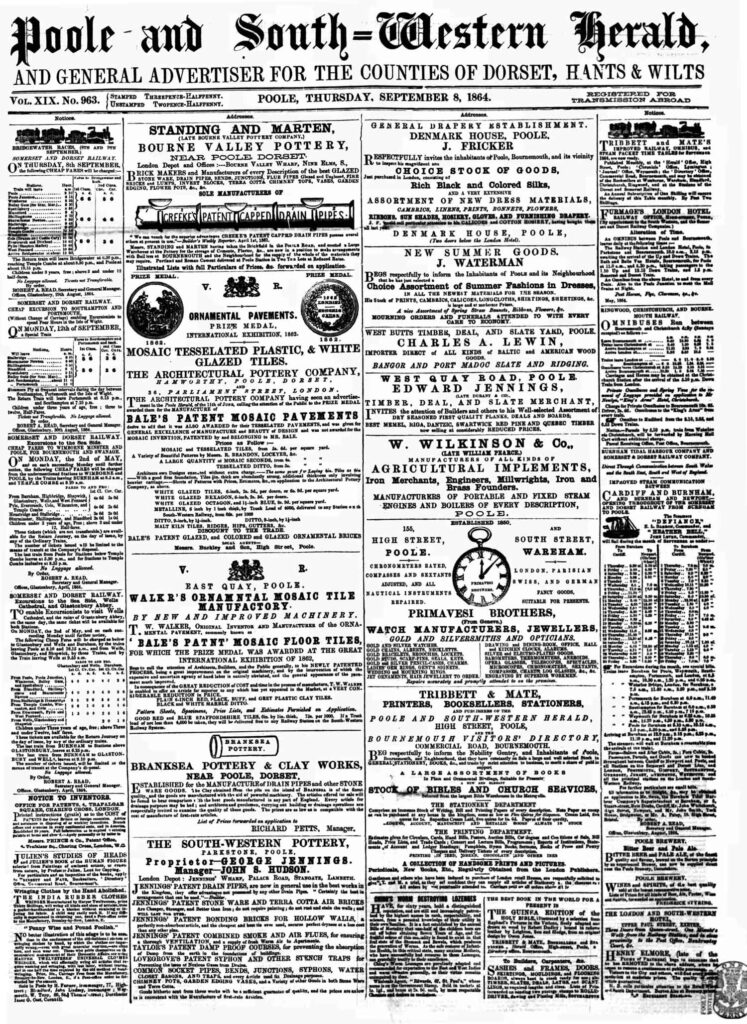
Poole & Dorset Herald – Thursday 08 September 1864
POOLE PETTY SESSIONS
THURSDAY, September 1.
Before E. Mullett and J. Lankester, Esqs.
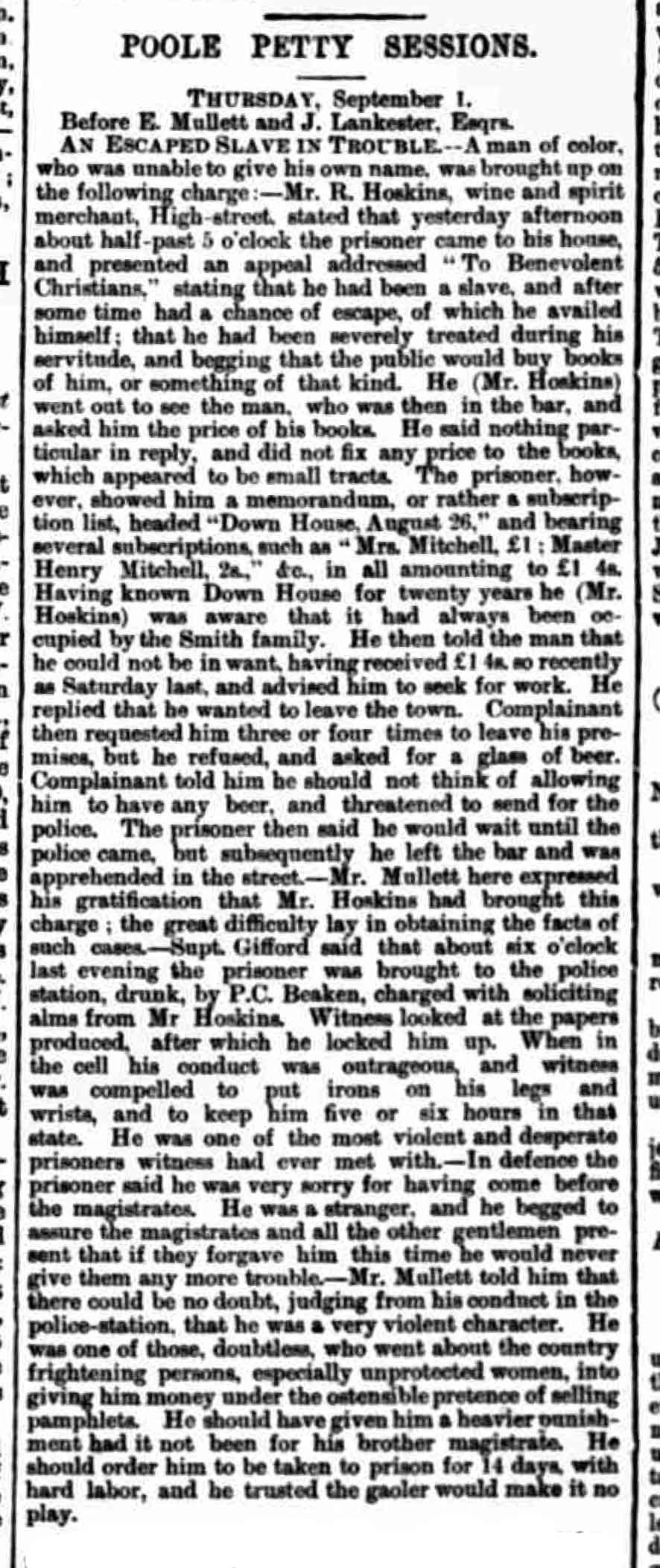
AN ESCAPED SLAVE IN TROUBLE. – A man of colour, who was unable to give his own name, was brought up on the following charge – Mr. R. Hoskins, wine and spirit merchant, High-street, stated that yesterday afternoon about half-past 5 o’clock the prisoner came to his house, and presented an appeal addressed “To Benevolent Christians,” stating that he had been a slave, and after some time had a chance of escape, of which he availed himself; that he had been severely treated during his servitude, and begging that the public would buy books of him, or something of that kind. He (Mr. Hoskins) went out to see the man, who was then in the bar, and asked him the price of his books. He said nothing particular in reply, and did not fix any price to the books, which appeared to be small tracts. The prisoner, however, showed him a memorandum, or rather a subscription list, headed “Down House, August 25,” and bearing several subscriptions, such as “Mrs. Mitchell, £1; Master Henry Mitchell,” &c., in all amounting to £1 4s. Having known Down House for twenty years he (Mr. Hoskins) was aware that it had always been occupied by the Smith family. He then told the man that he could not be in want, having received £1 4s. so recently as Saturday last, and advised him to seek for work. He replied that he wanted to leave the town. Complainant then requested him three or four times to leave his premises, but he refused, and asked for a glass of beer. Complainant told him he should not think of allowing him to have any beer, and threatened to send for the police. The prisoner then said he would wait until the police came, but subsequently he left the bar and was apprehended in the street.
Mr. Mullett here expressed his gratification that Mr. Hoskins had brought this charge; the great difficulty lay in obtaining the facts of such cases. – Supt. Gifford said that about six o’clock last evening the prisoner was brought to the police station, drunk, by P.C. Beaken, charged with soliciting alms from Mr. Hoskins. Witness looked at the papers produced, after which he locked him up. When in the cell his conduct was outrageous, and witness was compelled to put irons on his legs and wrists, and to keep him five or six hours in that state. He was one of the most violent and desperate prisoners witness had ever met with. – In defence the prisoner said he was very sorry for having come before the magistrates. He was a stranger, and he begged to assure the magistrates and all the other gentlemen present that if they forgave him this time he would never give them any more trouble. – Mr. Mullett told him that there could be no doubt, judging from his conduct in the police-station, that he was a very violent character. He was one of those, doubtless, who went about the country frightening persons, especially unprotected women, into giving him money under the ostensible pretence of selling pamphlets. He should have given him a heavier punishment had it not been for his brother magistrate. He should order him to be taken to prison for 14 days, with hard labour, and he trusted the gaoler would make it no play.
⚖️ Historical & Legal Context
Laws at the Time
In 1864, Britain was decades past the Slavery Abolition Act (1833), which ended slavery throughout the British Empire. However, escaped slaves from the United States – particularly during the Civil War (1861–65) – sometimes found their way to Britain. Begging or soliciting alms without a license was illegal under vagrancy laws, and public intoxication or causing disturbances could result in arrest.
Magistrates like E. Mullett and J. Lankester had local judicial power under the Petty Sessions to deal with minor criminal offences, including vagrancy, drunkenness, fraud, and disorderly conduct. Their judgments were often swift and without the need for a jury.
Implications
This man, likely a former slave fleeing from America or the Caribbean, represents a broader reality of displaced and traumatised individuals struggling for survival. His arrest and treatment reflect both suspicion and systemic hardship faced by outsiders, especially Black people. His failure to provide a name, drunkenness, and refusal to leave premises might be seen as desperation, but was judged harshly by local law enforcers.
Key Individuals and Businesses
-
Mr. R. Hoskins: A wine and spirit merchant on High Street, Poole – an affluent tradesman with long knowledge of local affairs. Likely part of the town’s middle class.
-
E. Mullett and J. Lankester: Local magistrates (possibly also businessmen or landowners).
-
P.C. Beaken: Police Constable involved in the arrest.
-
Superintendent Gifford: Senior police officer.
-
The Smith Family: Long-time residents of “Down House” – suggesting stability and respectability.
Life in Poole in 1864
Overview of the Town
In 1864, Poole was a bustling maritime town on the south coast of Dorset, England. With a population of roughly 10,000–12,000, the town was known for its long-standing seafaring heritage, thriving coastal trade, and community centred around fishing, shipping, and artisanal work. Poole retained its status as a borough, with its own local governance, police force, and courts, such as the weekly Petty Sessions.
Economy and Occupations
Maritime Work
- Fishing (notably mackerel, herring, and oysters)
- Coastal trade with Newfoundland, London, and the Channel Islands
- Shipbuilding and boat repairs (though waning due to the rise of steamships)
- Warehousing for salt, coal, timber, and imported goods
Trades and Businesses
- Wine and spirit merchants, grocers, bakers, butchers, ironmongers
- Public houses and inns catering to locals and visiting sailors
- Tradespeople: tailors, cobblers, carpenters, blacksmiths
- Women’s work: laundresses, domestic servants, lace-makers, seamstresses
Middle Classes
Included clergymen, solicitors, schoolmasters, doctors, and a small number of affluent business owners.
Social Life and Class
Victorian Poole had a rigid social structure:
- Upper middle classes lived in larger houses near the town centre
- Working-class residents occupied modest cottages, often overcrowded and damp
- Poverty was prevalent; many were unemployed or reliant on seasonal work
- The Poor Law and local workhouses dealt with destitution
- Moral respectability and religious observance were highly valued
Women had limited public roles and were mostly employed in service or domestic industries. Children often contributed to family income through odd jobs or apprenticeships.
Religion and Morality
- The Church of England was dominant, alongside Methodist, Baptist, and Congregational chapels
- Sunday Schools played a significant role in children’s education
- Regular churchgoing was a mark of respectability
- Temperance and charitable societies promoted moral conduct and sobriety
Justice and Law
Local justice was handled by magistrates at the Petty Sessions:
- Common charges: vagrancy, drunkenness, disorderly conduct
- Cases heard weekly; punishments included fines, imprisonment, and hard labour
- Poole’s police force was still evolving, shaped by national policing reforms
- Public order and moral discipline were tightly enforced
Housing and Health
- Most homes lacked sanitation; shared privies and open drains were common
- Diseases like cholera had previously ravaged the town
- The Medical Officer of Health role was emerging but still limited
- Working-class homes were small, dark, and overcrowded
- Middle-class homes featured parlours, servants, and small gardens
Education and Modernisation
- No universal education yet; schooling provided by charity and church schools
- Sunday schools also taught literacy and arithmetic
- Poole was slowly modernising: gas lighting, improved roads, and steamship access
- Railway expansion was approaching (station opened 1872)
Leisure and Recreation
- Pubs and alehouses were popular social centres
- Music halls, fairs, and lectures provided entertainment
- Reading gained popularity due to cheap newspapers and serial novels
- Harbour walks and market days were regular local events
- Cricket, rowing, and fishing were common pastimes
Civic Identity
Poole in 1864 was:
- Proud of its independence and maritime tradition
- Conservative in values and religious in character
- Suspicious of outsiders, particularly the poor or itinerant
- Governed by a strong sense of social order and moral duty
It was a town in transition: retaining its historic identity while gradually adapting to the forces of industrialisation and modernity.
Use for Historians and Family Historians
This article is valuable for:
-
Genealogists tracing individuals in Poole – especially magistrates, merchants, or police officials.
-
Historians of Black British History – rare insight into the treatment of escaped slaves or free Black men in 1860s Britain.
-
Legal historians examining justice, class, and race in minor courts.
-
Social historians studying Victorian attitudes toward poverty, race, and public conduct.
Names, occupations, and addresses (like Mr. Hoskins of High Street and “Down House”) offer points for archival research, census lookup, or business directories.
TheHistory of The Poole & Dorset Herald
Origins and Founding
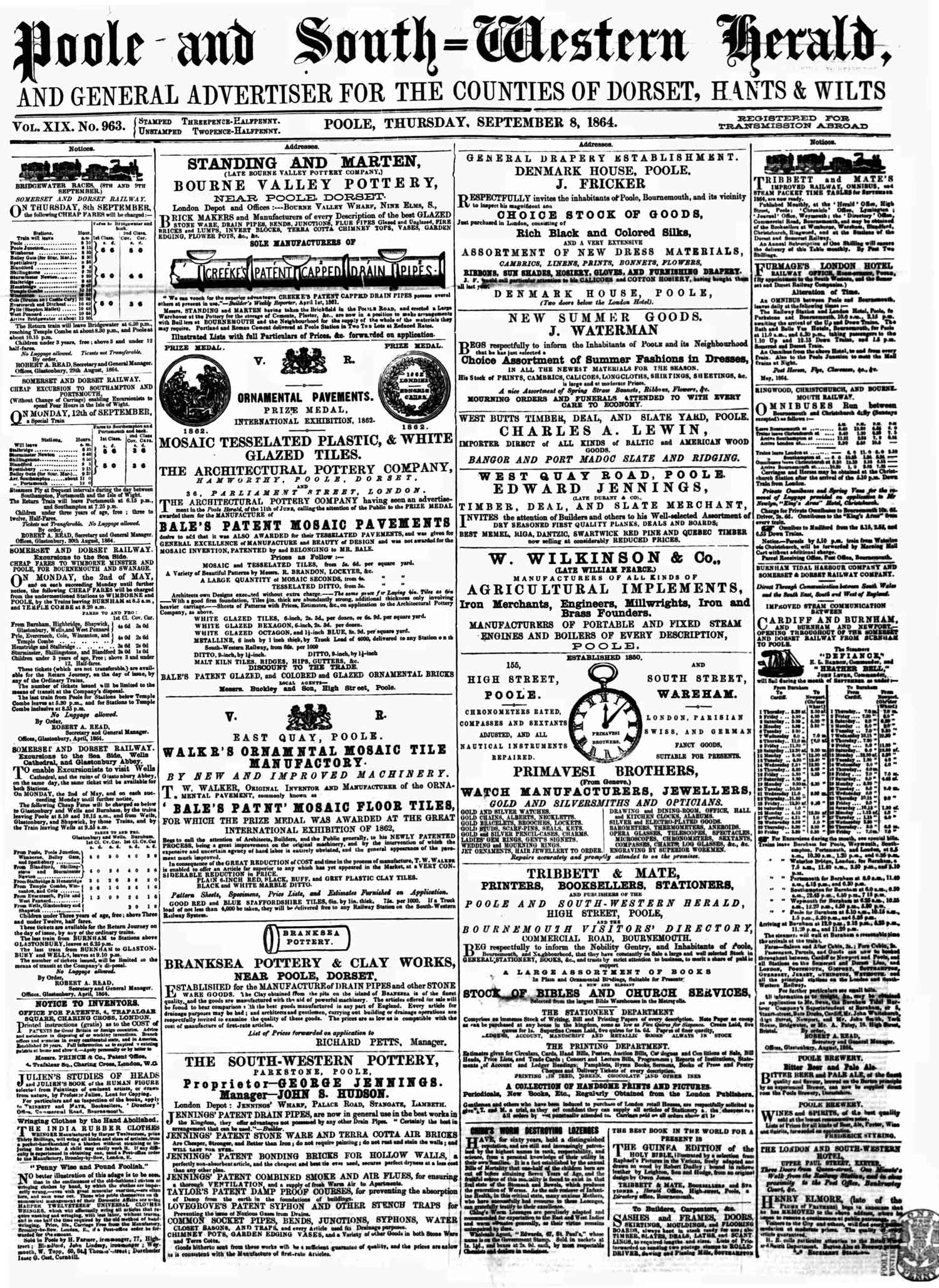
The Poole & Dorset Herald was a local weekly newspaper founded in the early-to-mid 19th century, serving the port town of Poole and the surrounding county of Dorset, in the south of England. Although its exact launch date is difficult to pinpoint due to the patchy survival of early provincial press records, evidence shows it was active by the 1850s and remained in circulation at least into the 1870s.
It was one of many regional newspapers established in the wake of the 1836 Newspaper Act, which reduced the newspaper tax and made it more viable for towns like Poole to support a local publication. Its foundation reflects the growth in literacy, civic pride, and demand for local news in Victorian Britain.
Editorial Focus and Content
Like many provincial papers of the time, The Poole & Dorset Herald offered a blend of local and national news, with strong emphasis on:
-
Magistrates’ courts and Petty Sessions reports
-
Local government and borough council matters
-
Commercial and shipping news (Poole was a major port)
-
Church and chapel events
-
Births, deaths, and marriages
-
Crime reports and scandal
-
National and international summaries, often copied from London papers
The tone was typically conservative, moralistic, and geared toward the respectable middle classes – merchants, professionals, tradespeople, and landowners.
Political and Religious Leanings
The Poole & Dorset Herald generally leaned towards Conservative/Church of England values, typical of smaller-town newspapers. While not overtly party-political, its editorial choices supported law and order, traditional morality, and deference to authority.
The newspaper often took a paternalistic view of the working classes, advocating reform through discipline and religion rather than radical change.
Production and Circulation
The paper would have been printed locally using letterpress technology, likely from a small print works near Poole High Street or within a short walk of the harbour. It was a broadsheet publication, printed once a week, possibly on Thursdays, and sold for a few pence per issue.
It had a modest circulation, mostly within Poole, Wareham, Wimborne, Blandford, and surrounding villages, possibly stretching into parts of Hampshire and Wiltshire.
Subscribers included:
-
Local clergymen
-
Gentry and estate owners
-
Traders and shipowners
-
Libraries and reading rooms
-
Inns and coffee houses
Competitors and Evolution
By the mid-19th century, the Poole & Dorset Herald competed with other local titles, such as:
-
The Dorset County Chronicle
-
The Sherborne Mercury
-
The Western Gazette
Its focus on Poole’s unique identity – as a free port, maritime centre, and ancient borough – gave it a distinct flavour, though it may have struggled against the rising professionalism and regional dominance of better-funded newspapers from Bournemouth, Dorchester, or even Southampton.
As the century progressed and the printing industry modernised, many small-town papers either folded, merged, or were bought up by larger publishing houses. It is believed The Poole & Dorset Herald was eventually merged or absorbed into a broader Dorset or southern England newspaper, possibly by the 1880s or 1890s.
Surviving Copies and Archives
Surviving copies of the newspaper are rare, but occasional issues – such as the one from 8 September 1864 – exist in:
-
The British Library Newspaper Archive
-
Dorset History Centre
-
Online resources such as the British Newspaper Archive or FindMyPast
These issues are of immense value to:
-
Family historians tracing people from the area
-
Local historians studying the evolution of Poole
-
Researchers of Victorian justice, education, religion, and migration
-
Black British history (as seen in the 1864 article on the escaped slave)
Legacy
While The Poole & Dorset Herald did not survive into the 20th century, it represents a formative phase in the history of local journalism in Britain. It reflects the values, voices, and concerns of a very specific moment in Victorian life – before the age of mass media and tabloid sensationalism.
It served as:
-
A public record
-
A civic watchdog
-
A platform for local voices
-
And a mirror to the moral and social currents of mid-19th century Dorset.
In doing so, it helped shape and preserve the character of Poole as it transitioned from Georgian port town to Victorian borough, and eventually into the modern seaside town it is today.
In Brief
“Poole, 1864: Escaped Slave Jailed for ‘Violent Conduct’ After Seeking Alms. Rare glimpse into race, law, and local justice in Victorian Dorset. #BlackHistory #Poole #VictorianJustice #Archives”