Hucknall Morning Star and Advertiser – Friday 22 August 1890
DEATH FROM DRINKING SPIRITS.
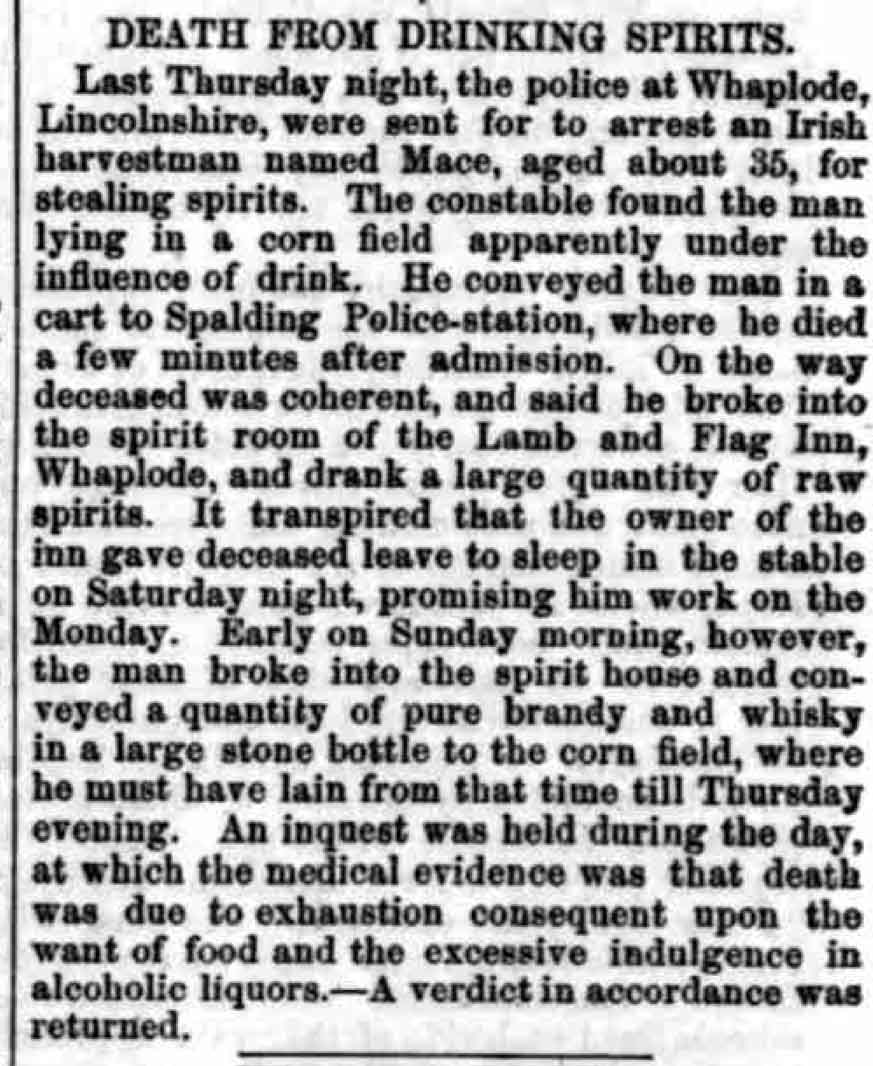
Last Thursday night, the police at Whaplode, Lincolnshire, were sent for to arrest an Irish harvestman named Mace, aged about 35, for stealing spirits. The constable found the man lying in a corn field apparently under the influence of drink. He conveyed the man in a cart to Spalding Police-station, where he died a few minutes after admission. On the way deceased was coherent, and said he broke into the spirit room of the Lamb and Flag Inn, Whaplode, and drank a large quantity of raw spirits. It transpired that the owner of the inn gave deceased leave to sleep in the stable on Saturday night, promising him work on the Monday. Early on Sunday morning, however, the man broke into the spirit house and conveyed a quantity of pure brandy and whisky in a large stone bottle to the corn field, where he must have lain from that time till Thursday evening. An inquest was held during the day, at which the medical evidence was that death was due to exhaustion consequent upon the want of food and the excessive indulgence in alcoholic liquors. — A verdict in accordance was returned.
ANALYSIS
Historical & Legal Context (1890 England)
In late Victorian England, public drunkenness and alcohol-related incidents were common among the labouring classes. The Licensing Act 1872 had already made it an offence to be drunk in public or to be found drunk while in charge of horses, carriages, or even firearms. However, enforcement varied and rural policing often faced challenges, particularly during the harvest season.
Breaking and entering into licensed premises like an inn would have constituted burglary, especially with intent to steal goods (in this case, spirits). But given the man died shortly after being arrested, no formal criminal proceedings could occur.
Occupations & Social Dynamics
-
Irish harvestman: Seasonal workers from Ireland were common in English agricultural areas. Often paid low wages, they faced prejudice and harsh conditions.
-
Police Constable: Rural police often had to travel on foot or by cart and dealt with both crime and social issues.
-
Innkeeper: A significant local figure, often the heart of the village social scene. Inns were both businesses and communal hubs.
-
Medical examiner/inquest jurors: At this time, deaths not attended by a doctor had to be investigated. A coroner’s inquest with a local jury was mandatory.
The Lamb and Flag Inn, Whaplode, appears to have been a functioning public house with accommodation and stabling, typical of rural inns which catered to both locals and travelling workers.
HISTORICAL VALUE FOR HISTORIANS & FAMILY HISTORIANS
For Historians
-
Social insight: Reveals the lives of itinerant labourers and how poverty, alcohol, and lack of social support led to tragic outcomes.
-
Legal procedures: Demonstrates the use of inquests, police methods, and community responses to sudden deaths.
-
Health & mortality: The mention of exhaustion and alcohol poisoning highlights public health issues of the time.
-
Public house regulation: Shows vulnerability of inns to theft and misuse, and the importance of spirits as both valuable commodities and social lubricants.
For Family Historians
-
Names and occupations: The name Mace (if surname) may help descendants trace their ancestry or confirm oral histories.
-
Migration patterns: Indicates Irish seasonal workers’ presence in Lincolnshire and their struggles.
-
Community dynamics: Offers a glimpse into how families, employers, and law enforcement interacted during periods of economic strain.
LIFE IN WHAPLODE, LINCOLNSHIRE IN 1890
Whaplode was a rural, agricultural parish reliant on seasonal labour, particularly during harvest. Life was hard, especially for itinerant workers. Lodgings were basic, and employment precarious. Alcohol was both escape and hazard, especially when combined with poverty and isolation.
Inns like the Lamb and Flag were crucial infrastructure — providing accommodation, alcohol, food, and often employment leads. The community relied on local constables for order and on coroners’ inquests for justice or closure in unexpected deaths.
The history of The Hucknall Morning Star and Advertiser
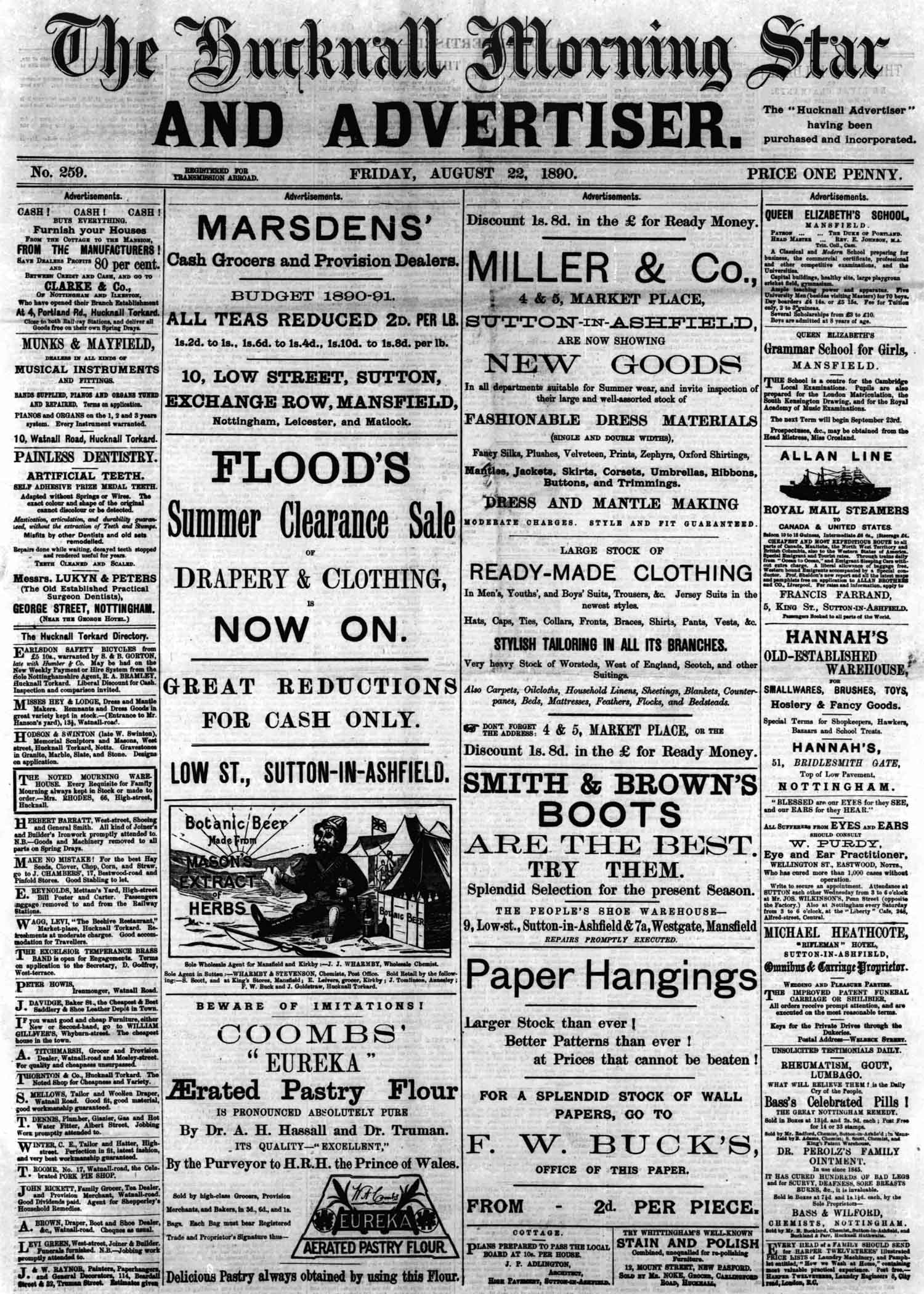
The Hucknall Morning Star and Advertiser was a regional newspaper serving Hucknall, Nottinghamshire, and surrounding areas during the late 19th and early 20th centuries. Its inaugural issue was published on 3 May 1889, and it continued until 28 March 1913. Over its 24-year run, the paper produced approximately 1,188 issues, encompassing around 9,492 pages.
Title Evolution:
-
1889–1909: The Hucknall Morning Star and Advertiser.
-
1909–1911: The Hucknall Star and Rushcliffe Advertiser.
-
1912: The Star and Rushcliffe Advertiser.
-
1912–1913: The Rushcliffe Star and Advertiser.
-
1913: The Hucknall Star and Rushcliffe Advertiser.
These title changes reflect the newspaper’s efforts to expand its reach and cater to a broader audience within Nottinghamshire.
Content and Focus: As a local publication, the newspaper covered a range of topics pertinent to the Hucknall community, including:
-
Local News: Reporting on events, developments, and issues within Hucknall and nearby areas.
-
Advertisements: Featuring local businesses, services, and community announcements.
-
National and International News: Providing readers with broader news coverage, though with a focus on how such events impacted the local community.
Archival Access: For researchers and historians interested in exploring the pages of the Hucknall Morning Star and Advertiser, several resources are available:
-
British Newspaper Archive: A significant portion of the newspaper’s editions from 1889 to 1913 have been digitised and are accessible online.
-
Hucknall Library: Microfilm copies of the newspaper, covering periods from May 1889 to December 1909, are available for consultation. The library provides facilities for viewing these archives, including non-digital microfilm readers and printers.
Historical Significance: The Hucknall Morning Star and Advertiser serves as a valuable historical resource, offering insights into:
-
Community Life: The newspaper provides a window into the daily lives, concerns, and events of the Hucknall community during its publication years.
-
Economic and Social Developments: Advertisements and articles shed light on local businesses, employment opportunities, and social dynamics of the time.
-
Cultural and Political Climate: Editorials and news pieces reflect the cultural attitudes and political issues pertinent to the local populace.
In summary, the Hucknall Morning Star and Advertiser played a pivotal role in documenting and shaping the narrative of Hucknall and its environs during a transformative period in British history.
Summary
This tragic story encapsulates:
-
Harsh rural labour conditions in 1890s England
-
Precarious lives of Irish seasonal workers
-
Alcohol as both refuge and killer
-
The role of inns, police, and inquests in rural Victorian communities
It is a valuable snapshot for both local historians and descendants, painting a grim but honest picture of marginalised life in the era.
In Brief
📰22 Aug 1890 | Hucknall Morning Star & Advertiser
A harvestman died in Whaplode, Lincs after stealing & drinking raw spirits from the Lamb & Flag Inn.
A cautionary tale of poverty, alcohol & rural life.
#History #Genealogy #VictorianEngland #Whaplode #LincsHistory #PubHistory #OldNewspapers #FamilyHistory #Inquests #IrishDiaspora #HarvestLabour