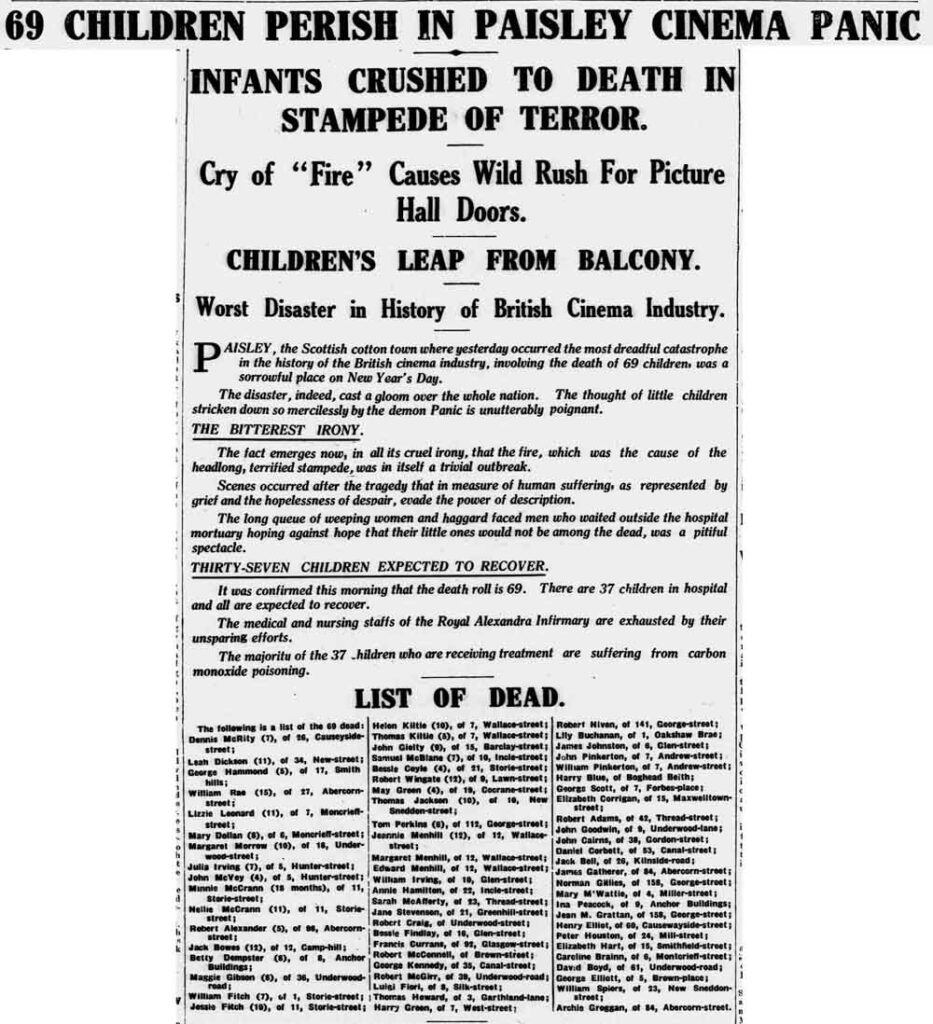
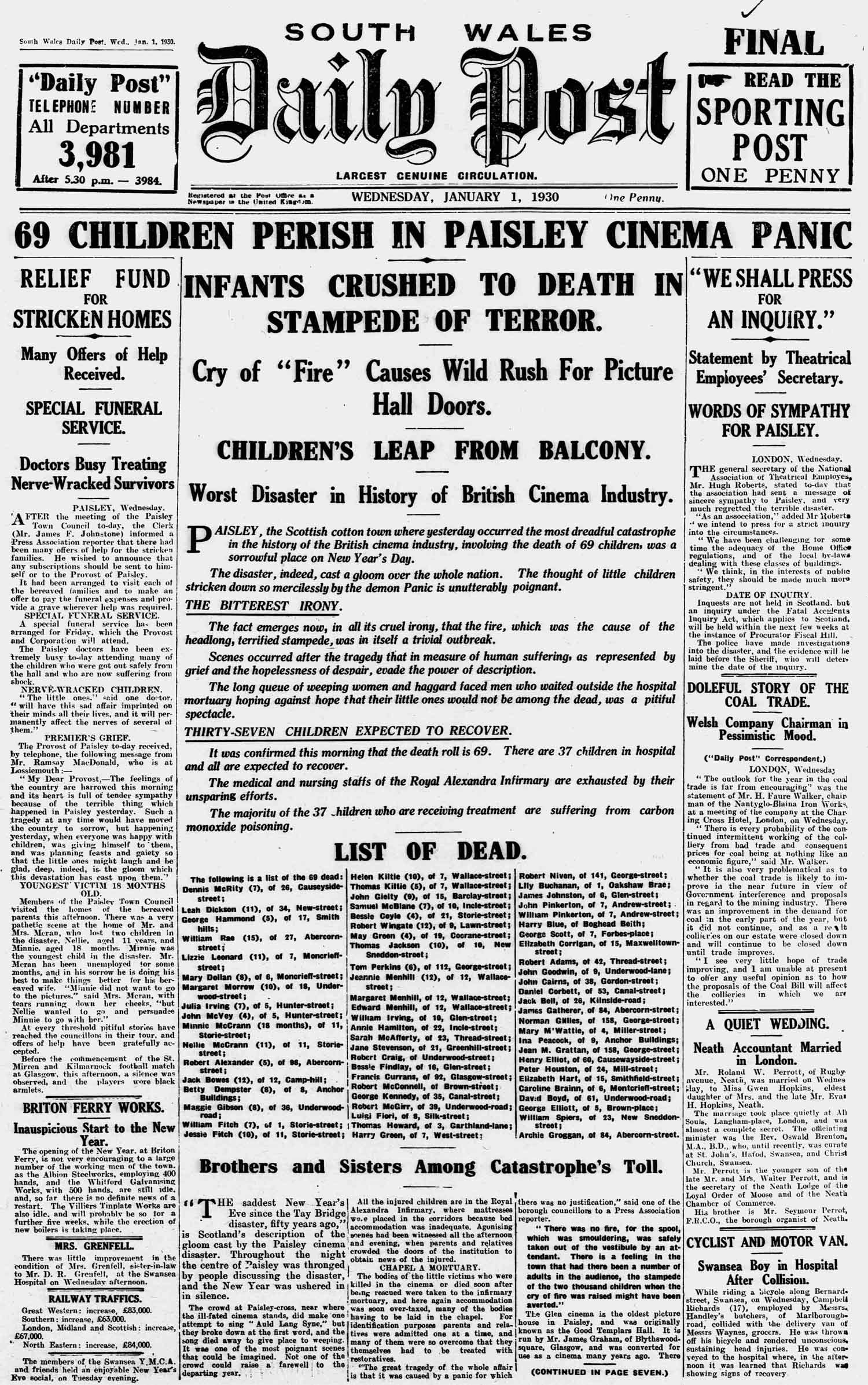
South Wales Daily Post – Wednesday 01 January 1930 front
69 CHILDREN PERISH IN PAISLEY CINEMA PANIC
INFANTS CRUSHED TO DEATH IN STAMPEDE OF TERROR
Cry of “Fire” Causes Wild Rush For Picture Hall Doors
CHILDREN’S LEAP FROM BALCONY
Worst Disaster in History of British Cinema Industry
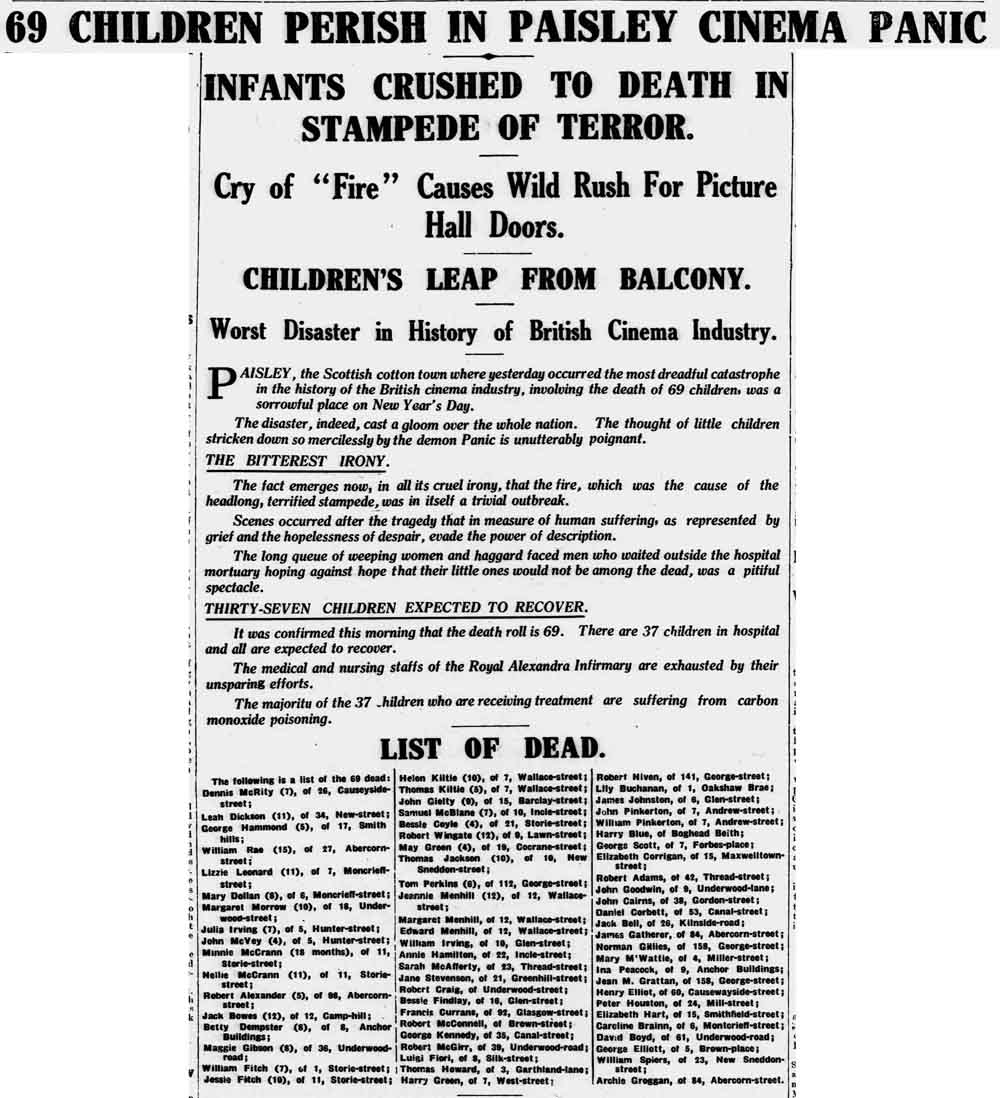
PAISLEY, the Scottish cotton town where yesterday occurred the most dreadful catastrophe in the history of the British cinema industry, involving the death of 69 children, was a sorrowful place on New Year’s Day.
The disaster, indeed, cast a gloom over the whole nation. The thought of little children stricken down so mercilessly by the demon Panic is unutterably poignant.
THE BITTEREST IRONY
The fact emerges now, in all its cruel irony, that the fire, which was the cause of the headlong, terrified stampede, was in itself a trivial outbreak.
Scenes occurred after the tragedy that in measure of human suffering, as represented by grief and the hopelessness of despair, evade the power of description.
The long queue of weeping women and haggard-faced men who waited outside the hospital mortuary hoping against hope that their little ones would not be among the dead, was a pitiful spectacle.
THIRTY-SEVEN CHILDREN EXPECTED TO RECOVER
It was confirmed this morning that the death roll is 69. There are 37 children in hospital and all are expected to recover.
The medical and nursing staffs of the Royal Alexandra Infirmary are exhausted by their unsparing efforts.
The majority of the 37 children who are receiving treatment are suffering from carbon monoxide poisoning.
LIST OF DEAD
The newspaper then lists the names and addresses of the 69 child victims, such as:
-
Dennis McRity (7), of 26 [address illegible]
-
Leah Dickson (11), of 34 New Street
-
George Hammond (5), of 17 Smith Hills
-
Lizzie Leonard (11), of 7 Moncrieff Street
-
Jack Bowes (12), of 12 Camp Hill
-
Helen Kiltie (10), of 7 Wallace Street
-
May Green (4), of 19 Cochrane Street
-
Jeannie Menhill (12), of 12 Wallace Street
-
Luigi Fiori, of 8 Silk Street
-
Robert Niven, of 141 George Street
…and many others across Paisley.
Brothers and Sisters Among Catastrophe’s Toll
“The saddest New Year’s Eve since the Tay Bridge disaster, fifty years ago,” is Scotland’s description of the gloom cast by the Paisley cinema disaster. Throughout the night the centre of Paisley was thronged by people discussing the disaster, and the New Year was ushered in in silence.
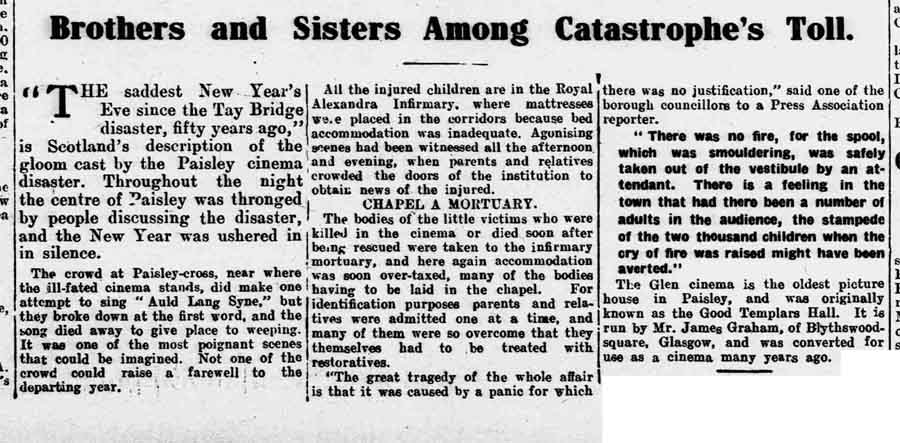
The crowd at Paisley Cross, near where the ill-fated cinema stands, did make one attempt to sing Auld Lang Syne, but most forgot the first word, and the song died away to give place to weeping. It was one of the most poignant scenes that could be imagined. Not one of the crowd could raise a farewell to the departing year.
All the injured children are in the Royal Alexandra Infirmary, where mattresses were placed in the corridors because bed accommodation was inadequate. Agonising scenes had been witnessed all the afternoon and evening, when parents and relatives crowded the doors of the institution to obtain news of the injured.
CHAPEL A MORTUARY
The bodies of the little victims who were killed in the cinema or died soon after being rescued were taken to the infirmary mortuary, and here again accommodation was soon overtaxed. Many of the bodies had to be laid in the chapel. For identification purposes, parents and relatives were admitted one at a time, and many of them were so overcome that they themselves had to be treated with restoratives.
“The great tragedy of the whole affair is that it was caused by a panic for which there was no justification,” said one of the borough councillors to a Press Association reporter.
“There was no fire, for the spool, which was smouldering, was safely taken out of the vestibule by an attendant. There is a feeling in the town that had there been a number of adults in the audience, the stampede of the two thousand children when the cry of fire was raised might have been averted.”
The Glen Cinema, Paisley: A Tragic Chapter in Scottish Cinema History
Origins and Early Years
The Glen Cinema in Paisley, Renfrewshire, Scotland, opened in the early 20th century and was one of the earliest dedicated picture houses in the town. It was originally known as the Good Templars’ Hall, a building linked to the temperance movement, before being converted into a cinema.
By the 1920s, the cinema had become a popular venue for children’s matinees, particularly on weekends and during school holidays. It catered to working-class families in a densely populated area of industrial Paisley, a town historically known for its textile mills and thread manufacturing industry.
The Glen Cinema had a seating capacity of around 1,000 to 1,200 people, with wooden benches and a sloped floor. Like many cinemas of its time, it lacked modern safety features such as illuminated exits, panic bars on doors, or clearly marked evacuation routes. The building was also not equipped with mechanical ventilation or proper smoke extraction, factors that would become tragically significant.
The Disaster: 31 December 1929
On Hogmanay (New Year’s Eve), 31 December 1929, the cinema held a special matinee performance, attended by more than 700 children, most under the age of 14. During the screening of a film, a canister of nitrate film stock began to smoulder in the projection room’s spool box, likely due to overheating.
Nitrate film was highly flammable and produced thick, acrid smoke when burning. Although the fire itself did not spread and was contained, the smoke drifted into the auditorium. Someone shouted “Fire!“, and panic spread rapidly through the crowded hall.
The Stampede
As children scrambled in fear, many rushed to the main exit doors, which had been bolted shut—a common but unsafe practice to prevent people sneaking in without paying. The crowd surged toward these doors, and dozens of children were crushed or asphyxiated in the chaos. Some leapt from balconies, while others were trampled or suffocated against the walls.
When rescuers eventually gained access, the scene was described as harrowing: bodies piled five or six deep, shoes and coats strewn about, and many children already dead or dying from compressive asphyxia or carbon monoxide poisoning.
Casualties and Aftermath
-
69 children died, aged between 18 months and 14 years.
-
At least 30 more were injured and treated at Royal Alexandra Infirmary.
-
Entire families lost multiple children—brothers and sisters were among the dead.
-
The tragedy caused widespread national grief, with front-page coverage in newspapers across the UK.
A public inquiry was swiftly called. Though no one was criminally charged, the event exposed fatal inadequacies in cinema safety standards at the time.
Impact on Safety Regulations
The Glen Cinema disaster was a turning point in public safety and cinema regulation in Britain:
-
Mandatory panic bars and unlocked exit doors became law.
-
Clear, illuminated exit signage was required in all cinemas.
-
Local authorities strengthened licensing requirements for public entertainment venues.
-
The incident led to greater awareness of the dangers of crowd panic, influencing public building codes thereafter.
Legacy and Commemoration
Despite its historical significance, the disaster was not widely discussed in the decades that followed. Many families in Paisley bore their grief in silence, and some survivors never spoke about the event until very late in life.
In recent years, however, the memory of the Glen Cinema disaster has been revived and honoured:
🔹 Memorials and Recognition
-
In 2009, on the 80th anniversary, a memorial plaque was unveiled in Paisley town centre, close to the site of the former cinema.
-
In 2019, for the 90th anniversary, a special commemorative event was held in Paisley Abbey, attended by local officials, historians, and relatives of the victims.
-
Survivors who had never spoken about the incident finally gave public testimony, many in their 90s.
🔹 Educational Projects
-
The tragedy has been explored in school history projects, documentaries, and oral history interviews.
-
A play titled “The Glen Cinema Disaster” was staged to raise awareness among younger generations.
-
The site where the cinema once stood is now part of Paisley’s modern townscape, but the memory remains preserved in collective local heritage.
Historical Importance
The Glen Cinema disaster is not only a tragic chapter in Paisley’s history but a vital moment in the evolution of public safety standards across Britain.
It highlights:
-
The vulnerability of children in public spaces.
-
The need for effective crowd control in venues.
-
The risks associated with early cinema technology.
-
The importance of accessible and responsive emergency design.
For historians and family researchers, the Glen Cinema disaster provides a deeply human account of community, grief, and systemic change. It serves as a reminder of how local tragedies can lead to national reform.
The Glen Cinema was once a beloved place of entertainment for Paisley’s children. Its tragic role in history serves both as a warning and a catalyst for change. Though the building no longer stands, the memory of the 69 lost lives endures, ensuring their story is not forgotten.
ANALYSIS
Safety Regulations for Cinemas in 1930
At the time of this tragedy, the Cinematograph Act 1909 was the primary legislation governing cinemas, requiring them to be licensed and conform to safety standards—particularly concerning flammable nitrate film. However, the 1909 Act focused more on the danger of fire from projection equipment rather than crowd control or building evacuation safety.
The lack of standardised fire drills, insufficient emergency lighting, locked or obstructed exits, and absence of trained staff for evacuation contributed to such disasters. The implementation of mandatory panic bars and illuminated exit signs became more common after events like the Glen Cinema disaster (the actual name of this event).
Legal and Social Implications
Though there was no major prosecution of individuals, the event sparked inquiries into cinema safety across Britain. It exposed significant flaws in how public venues managed crowds, especially children.
The tragedy pushed for reforms in:
-
Fire safety legislation
-
Building codes and public venue design
-
Mandatory staff training for emergencies
-
The Children’s Cinema Matinees (popular at the time) faced scrutiny and eventual regulation.
The People and Their Lives
The victims were largely working-class children, many under 12, enjoying a cheap matinée during the festive season. Their addresses reflect dense industrial housing areas of Paisley, indicating the socioeconomic demographics.
The loss devastated families employed in textile mills and shipyards. With few social protections, the death of a child was both an emotional and economic blow.
Businesses and Employers
The cinema itself—The Glen Cinema—was a local picture house, one of many springing up in working-class towns due to the popularity of silent films and early talkies. The event hurt public confidence in such establishments and placed financial pressure on small cinema owners.
USE FOR HISTORIANS & FAMILY HISTORIANS
This article is:
-
A primary source document, illustrating journalistic tone, language, and public sentiment in 1930.
-
A rare and rich genealogical resource, listing names, ages, and addresses.
-
A lens into social conditions, child welfare, cinema culture, and working-class leisure life in interwar Scotland.
WHAT WE CAN LEARN
-
Public Safety Evolution: How tragic events influence legislation.
-
Community Impact: The role of local tragedy in national mourning.
-
Family Structure & Urban Living: Densely populated homes, extended families, and child independence.
-
Journalism of the Era: Use of emotive headlines and poetic prose to convey sorrow.
LIFE IN PAISLEY, SCOTLAND, IN 1930
-
Industrial town built on cotton weaving, printing, and dyeing.
-
Working-class families lived in tenement buildings, often overcrowded.
-
Cinema was one of the few affordable entertainments for children.
-
Strong sense of community but limited social safety nets.
-
Medical facilities like the Royal Alexandra Infirmary were under severe pressure.
History of The South Wales Daily Post
Origins and Foundation
The South Wales Daily Post was established in 1861 in Swansea, Wales, originally under the title The Daily Post. Its founding was in response to the growing need for a daily newspaper serving industrial South Wales, particularly in the rapidly developing coastal and mining towns of Glamorgan and Carmarthenshire.
Swansea, often dubbed the “metropolis of South Wales”, was a thriving hub of copper smelting, coal exportation, and maritime trade by the mid-19th century. The paper emerged to provide both local and national news, reflecting the interests of a working and middle-class readership, including miners, steelworkers, shopkeepers, and emerging professionals.
Development in the Late 19th and Early 20th Centuries
By the 1880s, the South Wales Daily Post had cemented itself as a reliable regional voice. It frequently covered:
-
Labour disputes in the coalfields
-
Growth of the trade union movement
-
Developments in education and infrastructure
-
National politics, especially with regard to Welsh nationalism and devolution
During this period, the paper expanded both in content and influence, becoming a critical medium for information across Glamorgan, Pembrokeshire, Carmarthenshire, and even into Monmouthshire.
Its editorials during the First World War were noted for their patriotic tone, tempered by sensitivity to the loss of Welsh lives in battles such as the Somme and Ypres. Like many newspapers of its day, it listed local men lost in action and supported wartime charities and recruitment efforts.
Interwar Period and the 1930s
In the 1920s and 1930s, the newspaper remained a significant voice during a period of social and economic upheaval:
-
It reported extensively on the effects of the Great Depression on Welsh mining towns
-
It covered the rise of socialist politics in Wales
-
It supported campaigns for improved housing and public health
The paper also began covering more human interest stories, such as disasters, local crimes, and unusual events—hence its inclusion of major national tragedies like the Paisley Cinema Disaster of 31 December 1929.
Its tone was formal but increasingly compassionate, often using emotive language when describing loss or injustice. This made it a trusted source for both information and moral reflection.
Role During the Second World War
During the Second World War, the South Wales Daily Post played a crucial role in:
-
Disseminating air raid instructions
-
Reporting on local war heroes
-
Providing updates on rationing, conscription, and evacuation
-
Acting as a medium for morale-boosting content, poetry, and letters to the editor
Censorship and paper shortages meant newspapers had to be more concise, but the Daily Post retained its local voice and commitment to balanced reportage.
Post-War Modernisation and Media Shifts
The paper underwent significant transformation in the post-war decades, modernising both layout and tone. By the 1960s and 70s, it:
-
Introduced more photographic content
-
Ran regular features on local sport, cinema, and youth culture
-
Expanded coverage of Welsh arts and politics, especially amid growing debates about devolution
Technological advances in typesetting, printing, and distribution allowed quicker turnarounds and broader reach, although the emergence of television news created strong competition.
Merger and Present-Day Legacy
In 2006, the South Wales Daily Post was formally merged with other regional titles under the Trinity Mirror Group, later renamed Reach plc. It was incorporated into what is today known as the WalesOnline digital platform and South Wales Evening Post in print.
Although the title South Wales Daily Post is no longer published under that name, its journalistic legacy lives on in its successor publications.
Historical Significance
The South Wales Daily Post is invaluable to historians for several reasons:
🔹 Primary Source Material
It provides day-by-day accounts of Welsh and British life across more than a century—including:
-
Industrial development
-
Social reforms
-
Political movements
-
Local responses to national events
🔹 Labour and Working-Class History
The paper gives a voice to Wales’ working people, especially miners and dockworkers, often ignored by national titles.
🔹 Genealogical Research
The inclusion of births, marriages, deaths, and local obituaries makes it a treasure trove for family historians.
🔹 Cultural Insight
From Eisteddfod coverage to rugby match reports, the Daily Post offers a window into Welsh cultural identity.
Conclusion
The South Wales Daily Post was more than just a newspaper—it was the pulse of a region, a recorder of joys and sorrows, and a champion of local voices. Whether covering industrial strikes, cinema tragedies, or community fêtes, it captured the essence of South Wales life across generations.
In Brief
🔴 69 Children Die in 1930 Paisley Cinema Disaster: A Tragedy That Changed UK Fire Laws Forever
#PaisleyDisaster #GlenCinema #ScottishHistory #OnThisDay #CinemaSafety #Genealogy #FamilyHistory #UKHistory