Bell’s Weekly Messenger – Saturday 15 January 1848
ACCIDENTS.
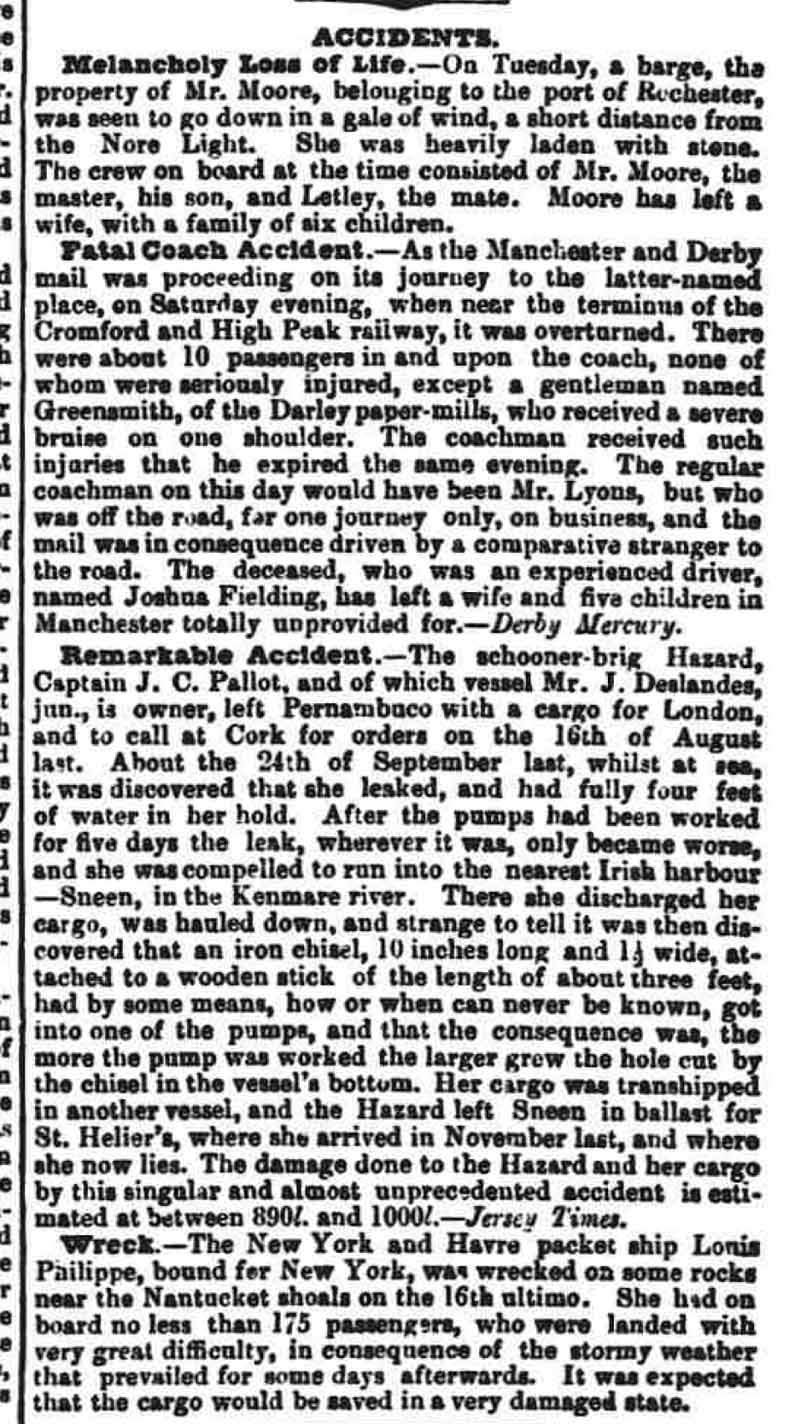
Melancholy Loss of Life.—On Tuesday, a barge, the property of Mr. Moore, belonging to the port of Rochester, was seen to go down in a gale of wind, a short distance from the Nore Light. She was heavily laden with stone. The crew on board at the time consisted of Mr. Moore, the master, his son, and Lesley, the mate. Moore has left a wife, with a family of six children.
Fatal Coach Accident.—As the Manchester and Derby mail was proceeding on its journey to the latter-named place, on Saturday evening, when near the terminus of the Cromford and High Peak railway, it was overturned. There were about 10 passengers in and upon the coach, none of whom were seriously injured, except a gentleman named Greensmith, of the Darley paper-mills, who received a severe bruise on the shoulder. The coachman received such injuries that he expired the same evening. The regular coachman on this day would have been Mr. Lyons, but who was off the road, for one journey only, on business, and the mail was in consequence driven by a comparative stranger to the road. The deceased, who was an experienced driver, named Joshua Fielding, has left a wife and five children in Manchester totally unprovided for.—Derby Mercury.
Remarkable Accident.—The schooner-brig Hazard, Captain J. C. Pallot, and of which vessel Mr. J. Deslandes, jun., is owner, left Pernambuco with a cargo for London, and to call at Cork for orders on the 16th of August last. About the 24th of September last, whilst at sea, it was discovered that she leaked, and had fully four feet of water in her hold. After the pumps had been worked for five days the leak, wherever it was, only became worse, and she was compelled to run into the nearest Irish harbour—Sneen, in the Kenmare river. There she discharged her cargo, was hauled down, and strange to tell it was then discovered that an iron chisel, 10 inches long and 1½ wide, attached to a wooden stick of the length of about three feet, had by some means, how or when can never be known, got into one of the pumps, and that the consequence was, the more the pump was worked the larger grew the hole cut by the chisel in the vessel’s bottom. Her cargo was transhipped in another vessel, and the Hazard left Sneen in ballast for St. Helier’s, where she arrived in November last, and where she now lies. The damage done to the Hazard and her cargo by this singular and almost unprecedented accident is estimated at between £800 and £1000.—Jersey Times.
Wreck.—The New York and Havre packet ship Louis Philippe, bound for New York, was wrecked on some rocks near the Nantucket shoals on the 16th ultimo. She had on board no less than 175 passengers, who were landed with great difficulty, in consequence of the stormy weather that prevailed for some days afterwards. It was expected that the cargo would be saved in a very damaged state.
Table of Contents
ToggleAnalysis of the Article from Bell’s Weekly Messenger (Saturday, 15 January 1848)
This article provides valuable historical insight into transportation, maritime trade, and the risks of everyday life in mid-19th century Britain. It reports on various accidents, including a fatal barge sinking, a tragic coach accident, and maritime mishaps.
Legal and Social Implications in 1848
Maritime Law and Responsibilities
The sinking of Mr. Moore’s barge near the Nore Light raises several legal and economic issues. In 1848, maritime law in Britain was governed by a combination of customary maritime practices, Admiralty Court decisions, and early merchant shipping regulations. Key points include:
- Shipowner Liability: If Mr. Moore’s barge was insured, his widow might have received compensation. However, insurance was not universally adopted in private shipping at the time.
- Cargo Loss: As the barge was laden with stone, its financial loss would have depended on whether it was privately contracted or insured.
- Maritime Safety: The sinking highlights the dangers of small, heavily laden vessels navigating in poor weather. The Merchant Shipping Act of 1854 (six years later) would later formalise safety regulations.
Road Transport Regulations
The fatal coach accident on the Manchester and Derby mail route highlights the precarious nature of road travel in the mid-19th century. Key legal and social aspects:
- Coach Driver Liability: In 1848, roads and turnpikes were still privately maintained, and coach companies had limited regulations regarding driver qualifications. The fact that the deceased driver was a temporary replacement suggests a potential lack of familiarity with the route, increasing the risk of accidents.
- Compensation for Families: The widow and five children of Joshua Fielding would likely have struggled financially. There were no official state pensions or insurance schemes, meaning families relied on charity, local parish relief (Poor Law assistance), or employer goodwill.
Insurance and Liability in Maritime Trade
The Hazard’s peculiar accident—with a chisel damaging the hull—would have led to complex disputes under maritime law.
- Cargo Loss Compensation: The cargo, en route from Pernambuco (Brazil) to London, was likely covered by marine insurance. However, whether the shipowner (J. Deslandes, jun.) could claim full compensation would depend on whether the damage was deemed an accident or negligence.
- Wreck Salvage Rights: Under British Admiralty law, any wrecked cargo could be claimed by salvagers if the owner did not retrieve it. If uninsured, this loss would have been severe.
- Navigation Hazards: The need to divert to an Irish harbour (Sneem in the Kenmare River) demonstrates the lack of port infrastructure along parts of the British Isles.
Transatlantic Shipwrecks and Passenger Safety
The Louis Philippe wreck near Nantucket Shoals (Massachusetts, USA) shows the risks of Atlantic crossings. In 1848, passenger safety laws were minimal:
- Survival Rates: The fact that 175 passengers were landed suggests that lifeboats were available and that the crew managed the crisis well—this was not always the case in shipwrecks of this period.
- Immigrant Travel Risks: Many passengers on transatlantic ships were emigrants heading for the United States. Such wrecks often left passengers destitute upon arrival.
The People, Occupations, and Economic Context
This article provides insight into the lives of working-class individuals and business owners in 19th-century Britain:
Mariners and Shipowners
- Mr. Moore (barge owner) was both a captain and a business owner. His widow and six children would have struggled unless he had personal savings or property.
- Captain J.C. Pallot (master of the Hazard) was responsible for the crew and cargo.
- J. Deslandes, jun. (shipowner) was likely a merchant based in Jersey, reflecting the importance of the Channel Islands in British maritime trade.
Coachmen and Transportation Workers
- Joshua Fielding (coach driver) likely worked for a stagecoach or mail transport company, possibly under a contract with the Royal Mail. His sudden death left his wife and five children in Manchester without financial support, highlighting the lack of social security.
Industrial and Business Figures
- Mr. Greensmith (injured passenger) was from Darley paper-mills, suggesting a connection to the industrial paper production industry in Derbyshire.
Life in Britain in 1848
Transport Infrastructure
- Maritime Transport: Ships were the primary means of international trade. The Hazard’s journey from Brazil to London via Cork reflects the structured global trade networks of the British Empire.
- Road Transport: Long-distance travel by horse-drawn mail coaches was still common, though railways were rapidly expanding. The Cromford and High Peak Railway was one of the early industrial railways, which coexisted with road transport at the time.
Working-Class Struggles
The stories of Moore’s widow and Fielding’s family show the vulnerability of working-class people. Without insurance, pensions, or government assistance, losing a breadwinner often meant destitution.
Occupational Hazards
- Coach drivers faced poor road conditions and vehicle overturning risks.
- Sailors and shipowners faced storms, leaks, and navigation errors.
- Passengers on emigrant ships risked wrecks, disease, and starvation.
What Historians and Family Historians Can Learn
Maritime History
- Shipwrecks and insurance claims provide insight into the challenges of 19th-century trade.
- Chisel damage to the Hazard raises questions about shipbuilding quality and maintenance.
Social History
- The widow and orphans left destitute illustrate the fragility of working-class lives.
- Stagecoach travel risks reflect the transition from horse-drawn to railway transport.
Industrial and Business History
- Darley paper-mills shows regional industrial connections.
- Maritime trade routes (Brazil, Jersey, Ireland, UK) highlight global commerce.
The History of Bell’s Weekly Messenger
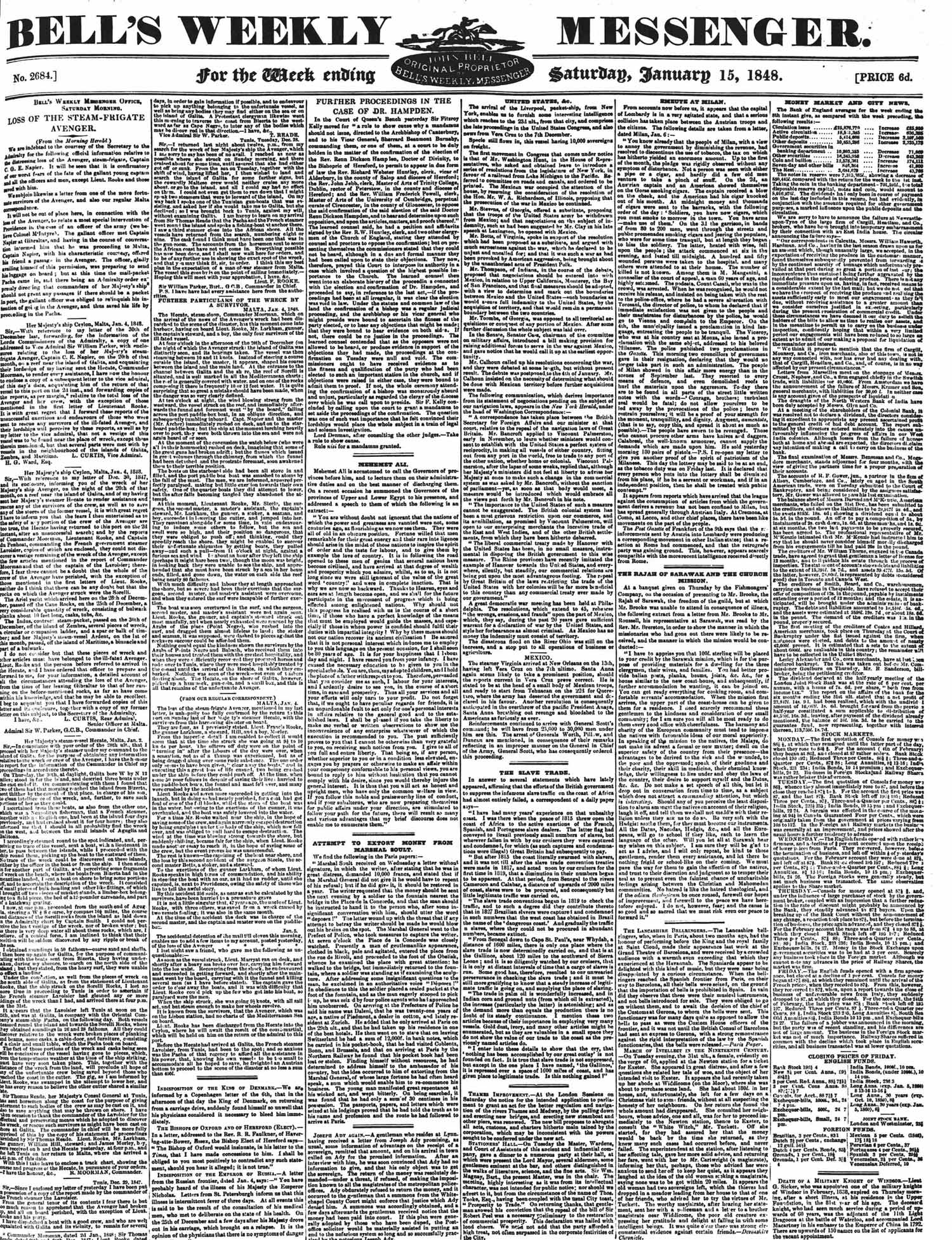
Bell’s Weekly Messenger was one of Britain’s most influential newspapers during the 19th century, providing readers with vital news on agriculture, commerce, politics, and crime. Published for exactly 100 years (1796–1896), the paper played a crucial role in keeping the British public informed, particularly those involved in farming and business. It was especially notable for its coverage of rural affairs, parliamentary reports, and shipping news.
Founding and Early Years (1796–1800s)
Founder and Origins
Bell’s Weekly Messenger was established in 1796 by John Bell, a well-known publisher and bookseller in London. Bell was a pioneer in British journalism and printing, having already founded publications such as The World and Bell’s British Theatre. His goal for Bell’s Weekly Messenger was to create a reliable, farmer-friendly newspaper that would focus on:
- Agriculture and grain prices
- Trade and shipping news
- Government policies affecting landowners
The Agricultural Focus
Unlike other newspapers of the time, which were often political, Bell’s Weekly Messenger was dedicated to practical economic concerns. It quickly became the go-to source for landowners, farmers, and merchants who wanted updates on crop yields, market prices, weather conditions, and new agricultural techniques.
Expansion and Influence (1810s–1850s)
Growth in Readership
By the early 19th century, Bell’s Weekly Messenger had established itself as one of Britain’s most respected newspapers, widely read in both rural and urban areas. Its agricultural price reports were used by traders, while its legal and political news appealed to the rising middle class.
Impact of the Industrial Revolution
During the Industrial Revolution (c. 1750–1850), Britain’s economy underwent significant transformation. The newspaper expanded its coverage to include:
- The growth of railways
- Factory conditions and worker rights
- Trade developments, both domestic and colonial
With Britain becoming a leading industrial power, Bell’s Weekly Messenger played a role in educating farmers on how they could adapt to technological changes such as mechanised ploughs, fertilisers, and crop rotation.
Mid-19th Century: Political and Social Commentary (1850s–1870s)
Crime and Legal Reporting
By the 1850s, Bell’s Weekly Messenger had diversified into crime reporting, public trials, and legal updates.
- It regularly published court cases, making it an important source for family historians looking for records of ancestors involved in legal proceedings.
- It provided detailed accounts of accidents, disasters, and bankruptcies, which were crucial for both business owners and the working class.
Crime and Transportation of Convicts
Many of the newspaper’s court cases related to convict transportation to Australia, a common punishment for criminals in the 19th century. The paper would list names, crimes, and destinations, making it an invaluable resource for those researching convict ancestry.
Coverage of the Poor Laws
With Britain undergoing social reform, Bell’s Weekly Messenger reported on workhouses, poverty relief, and changes in the Poor Law system. This was particularly important for landowners and farmers, who needed to understand how these changes impacted their workforce.
Decline and Final Years (1870s–1896)
Challenges from Other Newspapers
By the late 19th century, Britain had a growing number of mass-market newspapers that were cheaper and more politically charged.
- Papers such as The Times, The Daily Telegraph, and The Manchester Guardian attracted larger urban audiences.
- The rise of illustrated newspapers (e.g., The Illustrated London News) also reduced Bell’s Weekly Messenger’s appeal.
Shift Away from Agriculture
As Britain became more urbanised, fewer people relied on agricultural newspapers. Many farmers migrated to cities for industrial jobs, and the demand for agricultural news declined.
The End in 1896
After exactly 100 years, Bell’s Weekly Messenger ceased publication in 1896. By this time, modern journalism had overtaken its traditional format, and Britain’s newspaper industry had become dominated by mass-market, politically driven papers.
The Legacy of Bell’s Weekly Messenger
Importance for Historians
Today, Bell’s Weekly Messenger is an essential historical source for researchers studying:
- Agricultural history (prices, techniques, farming methods)
- Economic conditions (trade, railway development, taxation)
- Crime and law (trials, punishment, convict records)
- Social history (how people lived, worked, and travelled in the 19th century)
Importance for Family Historians
Genealogists and family historians find Bell’s Weekly Messenger useful for:
- Obituaries and accident reports (providing names and family details)
- Court cases and transportation records (helping trace convict ancestors)
- Business records (bankruptcies, land sales, company news)
Contributions to British Journalism
While it eventually declined, Bell’s Weekly Messenger was a pioneering publication that helped shape modern business and agricultural journalism.
In Brief
🚢 Tragic 1848 Accidents: Shipwrecks, Stagecoach Crashes & Maritime Mystery! 📰
- Barge sinks near Nore Light – a widow & 6 orphans left behind
- Fatal coach crash in Derbyshire – driver killed
- Hazard ship leaks due to mysterious chisel accident
- Louis Philippe wrecks near Nantucket – 175 survive!