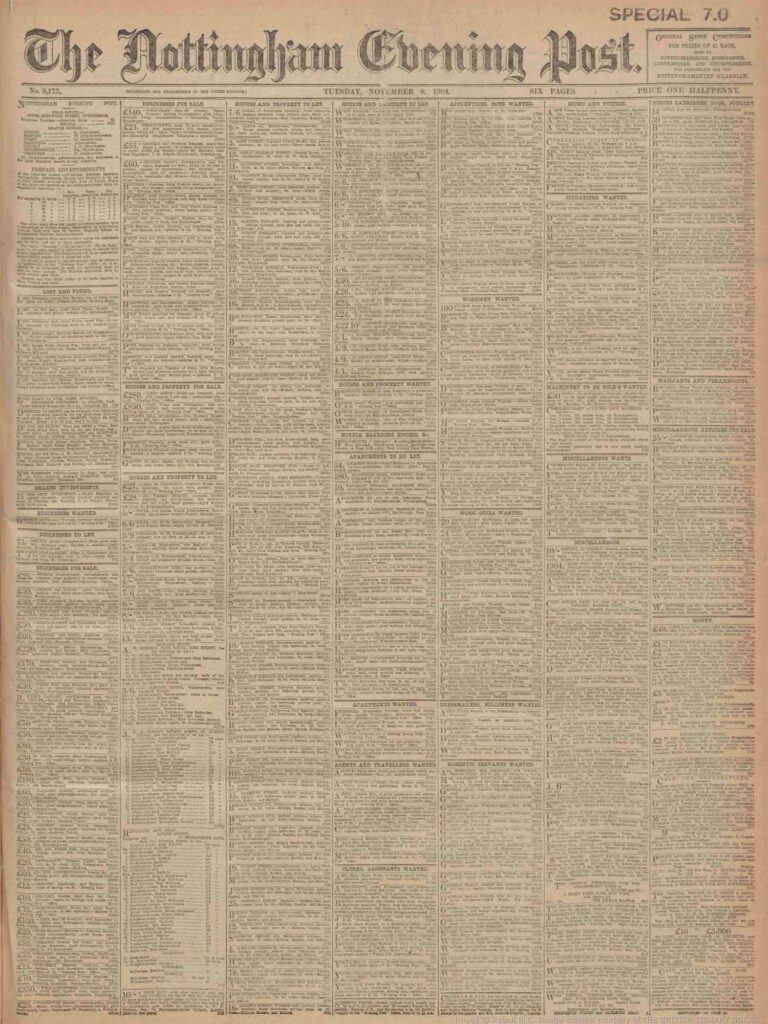
Nottingham Evening Post – Tuesday 08 November 1904
BAD CHEESE AT MANSFIELD
BURTON-ON-TRENT DEALER HEAVILY FINED.
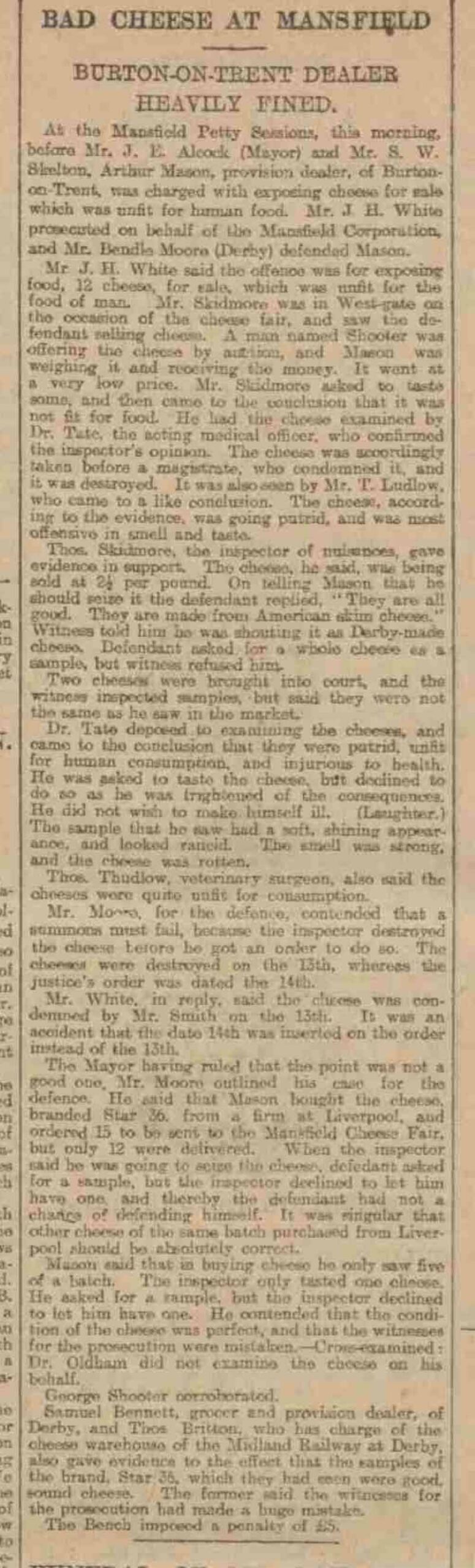
At the Mansfield Petty Sessions this morning, before Mr. J. E. Alcock (Mayor) and Mr. S. W. Skelton, Arthur Mason, provision dealer, of Burton-on-Trent, was charged with exposing cheese for sale which was unfit for human food. Mr. J. H. White prosecuted on behalf of the Mansfield Corporation, and Mr. Bendle Moore (Derby) defended Mason.
Mr. J. H. White said the offence was for exposing food, 12 cheeses, for sale, which was unfit for the food of man. Mr. Skidmore was at Westgate on the occasion when the cheeses were, and he saw a defendant selling cheese. A bargain was struck, the officer paying a sum for the cheese, and Mason stating that he was recovering from a loss, and so he wanted a very low price. Mr. Skidmore asked to see some, and then came to the conclusion that it was not fit for food. He had the cheese examined by Dr. Tate, the acting medical officer, who confirmed the inspector’s opinion. The cheese was accordingly taken before a magistrate, who condemned it, and it was destroyed. It was also seen by Mr. T. Ludlow, who came to a like conclusion. The cheese, according to the evidence, was going putrid and was most offensive in smell and taste.
Thomas Skidmore, the inspector of nuisances, gave evidence in support. The cheese, he said, was being sold at 2½ pence per pound. On telling Mason he should seize it, the defendant replied, “They are all good. They are made from American farm cheese.” Witness told him he was describing it as Derby cheese. Defendant asked for a whole cheese as a sample, but witness refused him.
One of the cheeses was brought into court, and the witness inspected samples but said they were not the same as he saw in the market.
Dr. Tate deposed that he had examined the cheeses and came to the conclusion that they were putrid, unfit for human consumption, and injurious to health. He did not want to taste the cheese sample he had because he was frightened of the consequences. He did not wish to make himself ill. (Laughter.) The sample he saw had a soft, shining appearance and looked rancid. The smell was strong, and the cheese was rotten.
Thomas Thudlow, veterinary surgeon, also said the cheeses were quite unfit for consumption.
Mr. Moore, for the defence, contended that a summons must fail because the inspector destroyed the cheese before he got an order to do so. The cheeses were destroyed on the 13th, whereas the justice’s order was dated the 14th.
Mr. White, in reply, said the cheese was condemned by Mr. Smith on the 13th. It was an accident that the date “14th” was inserted on the order instead of the 13th.
The Mayor, having ruled that this point was not a good one, Mr. Moore outlined his case for the defence. He said that Mason bought the cheese, branded Star 36, from a firm in Liverpool, and ordered 15 to be sent to the Mansfield Cheese Fair, but only 12 were delivered. When the case arose, he was going to appeal to the cheese company for a sample, but the inspector declined to let him have one, thereby depriving the defendant of a chance of defending himself. It was singular that other cheeses of the same batch purchased from Liverpool should be absolutely correct.
Mason said that in buying cheese, he only saw a few of a batch. The inspector only tasted one cheese. He asked for a sample, but the inspector declined to let him have one. He contended that the condition of the cheese was perfect and that the witnesses for the prosecution were mistaken. (Cross-examined: Dr. Oldham did not examine the cheese on his behalf.)
George Shooter corroborated.
Samuel Bennett, grocer and provision dealer, of Derby, and Thomas Britton, who has charge of the cheese warehouse at the Midland Railway at Derby, also gave evidence to the effect that the samples of the brand Star 36, which they had seen, were good cheeses. The former said the witnesses for the prosecution had made a huge mistake.
The Bench imposed a penalty of £5.
Historical Analysis & Context
Laws and Regulations on Food Safety (1904)
At the time of this case, food safety laws in Britain were evolving. The Sale of Food and Drugs Act 1875 was one of the primary legislations governing food quality, prohibiting the sale of food unfit for human consumption. Local councils had health inspectors (such as Thomas Skidmore in this case) responsible for enforcing these laws. The Public Health Act 1875 also gave municipal authorities the power to act against those selling contaminated food.
This case illustrates early enforcement of food safety laws, where a provision dealer (Arthur Mason) was penalised for selling unfit food despite defending the quality of his stock.
The People Involved
- Arthur Mason – A provision dealer from Burton-on-Trent, selling cheese at Mansfield market. His defence claimed that the cheese was from a reputable supplier.
- Thomas Skidmore – The inspector of nuisances who tested and condemned the cheese.
- Dr. Tate – Acting medical officer, whose expert opinion confirmed the cheese was unfit.
- Thomas Thudlow – Veterinary surgeon who corroborated the findings.
- Mr. J. H. White – Prosecuting solicitor for the Mansfield Corporation.
- Mr. Bendle Moore – Defence solicitor representing Mason.
- Mr. J. E. Alcock – Mayor of Mansfield, presiding over the case.
- Mr. S. W. Skelton – Magistrate hearing the case.
Occupations & Businesses
- Provision Dealer – A seller of general food items, particularly cheese in this case.
- Cheese Inspector/Warehouse Keeper – Those responsible for quality control in railway distribution hubs.
- Medical Officer of Health – Ensuring public health safety.
- Market Vendors – Important figures in local commerce, with traders sourcing goods from different parts of the country.
The Implications
- Public Health Risk – Consumption of rancid cheese could have led to food poisoning.
- Commercial Reputation – The case could damage Mason’s business and public trust in food markets.
- Legal Enforcement – Demonstrates how food safety laws were actively enforced in early 20th-century Britain.
- Food Supply Chains – Highlights the complexity of food distribution networks in 1904, with products coming from Liverpool to a local fair in Mansfield.
Use for Historians & Family Historians
- Genealogists researching family members involved in food trade, markets, or law enforcement may find connections to this case.
- Local historians studying Mansfield’s commercial history will see how food regulation shaped the market economy.
- Food historians can explore the impact of regulations on food safety practices.
- Social historians gain insight into early 20th-century consumer protections and legal proceedings.
Life in Mansfield in 1904
In 1904, Mansfield, a market town in Nottinghamshire, England, was undergoing significant changes that reflected broader industrial and social developments of the early 20th century.
Industrial Developments
The year 1904 marked the sinking of the Mansfield Colliery, also known as Crown Farm Colliery. Located approximately two miles from the town centre, this colliery began operations under the Bolsover Colliery Company. By 1909, it had become one of the largest coal-producing mines in the country, with a daily output nearing 5,000 tons. This development not only provided substantial employment opportunities but also led to the establishment of the nearby pit village of Forest Town, which included amenities such as churches, a school, and shops to support the mining community.
In addition to coal mining, Mansfield had a rich history in textile manufacturing, particularly framework knitting, which had been a common occupation since the early 18th century. By 1812, the town had 400 knitting frames in use. The introduction of wide frames in the 1770s was more widely adopted in Mansfield compared to other regions, leading to a decline in the use of narrow frames by 1845. Brewing was another significant industry, with 36 maltings recorded in the 1700s and the establishment of Mansfield Brewery in 1855.
Infrastructure and Public Amenities
The early 20th century saw Mansfield investing in public infrastructure. In 1904, Broomhill School was opened, enhancing educational facilities for the town’s children. The same year, public baths were officially inaugurated on 16 April, providing residents with improved sanitary amenities.
The Mansfield Museum, which opened in 1904, became a cultural hub for the town. Initially located beside the Palace Theatre in Leeming Street, it moved to its current site in 1938. The museum offered free entry and played a significant role in promoting arts and education within the community.
Transport and Connectivity
Although the Mansfield and District Light Railways tram system was not inaugurated until 1905, the preparations and construction activities in 1904 were pivotal in enhancing local transportation. The tramway network eventually connected Mansfield to neighbouring towns such as Berry Hill, Crown Farm, Mansfield Woodhouse, Pleasley, and Sutton-in-Ashfield, covering over 12 miles. This development improved mobility for residents and facilitated commerce in the region.
Social and Cultural Life
Mansfield’s identity as a market town with a 700-year-old market tradition continued to thrive in 1904. The market square, established after the Mansfield Improvement Act of 1823, remained a central hub for trade and social interaction. The Bentinck Memorial, erected in 1849, stood as a prominent landmark, commemorating Lord George Bentinck, a notable local figure.
The town’s commitment to education and public welfare was evident through the establishment of institutions like Broomhill School and the public baths. These facilities not only improved the quality of life but also reflected the progressive mindset of the local authorities and the community’s emphasis on health and learning.
Conclusion
In 1904, Mansfield was a town balancing its rich historical heritage with the demands of modern industrialisation. The expansion of coal mining and textile industries provided employment and spurred economic growth. Investments in public infrastructure, education, and transportation enhanced the living standards of its residents. The town’s vibrant market culture and community initiatives fostered a sense of identity and cohesion among the inhabitants, setting the foundation for Mansfield’s continued development in the 20th century.
The history of The Nottingham Evening Post

The Nottingham Evening Post, now known as the Nottingham Post, has been a cornerstone of Nottinghamshire’s media landscape since its inception in 1878. Founded by Thomas Forman, a seasoned printer originally from Lincolnshire who had been active in Nottingham’s printing industry since 1848, the newspaper was launched on 1st May 1878 as Nottingham’s first evening paper. The inaugural edition consisted of four pages and was priced at a halfpenny. Prior to establishing the Evening Post, Forman had already made his mark with the Conservative Nottingham Daily Guardian, established in 1861, and had built a substantial printing business by the 1870s. His sons were integral to the company’s operations, with Jesse Forman serving as the first editor of the Evening Post. In the maiden issue, Jesse emphasised the paper’s commitment to being a news-focused publication, stating it would be “the exclusive organ of no religious or political party”.
Throughout its history, the Nottingham Evening Post underwent several transformations. In 1902, the newspaper expanded to six pages, and by 1914, the front page transitioned from advertisements to news items, reflecting a shift towards more immediate news reporting. The Forman family’s involvement continued into the 20th century, guiding the paper through various evolutions. In 1953, T. Bailey Forman Ltd acquired the Nottingham Journal and the Nottingham Evening News, consolidating local news sources. A decade later, in 1963, the Evening News was incorporated into the Evening Post, further solidifying its position in the regional media landscape.
The newspaper also played a role in the broader context of Nottingham’s media history. For instance, in 1963, the Nottingham Guardian and the Nottingham Journal merged to form the Guardian Journal. However, during a printing dispute that began on 19th June 1973, the Guardian Journal ceased publication, leaving the Nottingham Evening Post as the sole remaining newspaper in the city. This period of industrial turmoil led some Post journalists to launch their own newspaper, receiving moral support from Brian Clough, then manager of Nottingham Forest. Increasingly covering the whole day’s news, the Evening Post was rebranded as the Nottingham Post from the beginning of July 2010.
Over the years, the Nottingham Post has been home to several notable journalists who later made significant contributions to the broader media landscape. For example, the writer Graham Greene served as a sub-editor before joining The Times and launching his career as a novelist. Similarly, J.M. Barrie worked at the Nottingham Journal from 1883 to 1884, a period that influenced his later works. Additionally, Duncan Hamilton, who spent 20 years at the Post, authored a renowned book about Brian Clough titled “Provided You Don’t Kiss Me,” which TV commentator John Motson described as “one of the best football books I’ve ever read.”
In terms of its physical presence, the Post was based at offices on Forman Street in the centre of Nottingham until 1998, when it relocated to Castle Wharf House. It moved to Tollhouse Hill in the city centre in 2012. In October 2011, printing operations moved from Derby to Birmingham. In 2012, Local World acquired the paper’s owner, Northcliffe Media, from Daily Mail and General Trust. The newspaper’s owner, Reach PLC, closed the Post’s City Gate offices in March 2022, meaning that the Nottingham Post’s remaining journalists all worked from home and the company no longer had a newsroom base in the East Midlands. A new office for the paper then opened in September 2023 on Castle Gate in the centre of Nottingham.
Today, the Nottingham Post continues to serve Nottinghamshire and parts of neighbouring counties, adapting to the digital age with its online platform, NottinghamshireLive. The newspaper maintains its commitment to delivering news without allegiance to any religious or political party, staying true to the principles laid out by its founders over a century ago.
In Brief
🚨 Bad cheese at Mansfield! A Burton-on-Trent dealer fined for selling putrid cheese in 1904. A case of early food safety enforcement! 🧀❌ #History #NottinghamEveningPost #Mansfield #FoodHistory #UKHistory #Nottingham #PublicHealth #Cheese #1904 #VictorianBritain #BurtonOnTrent #FoodSafety #LegalHistory