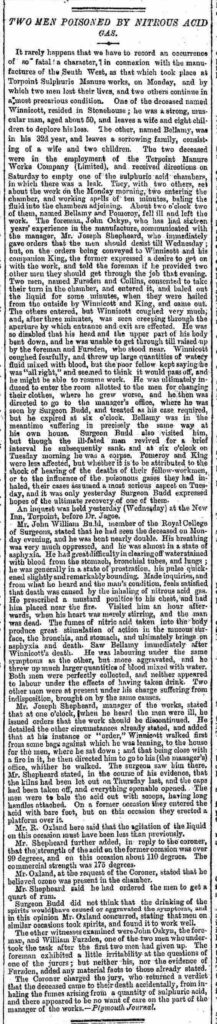
Morning Chronicle – Saturday 08 January 1859
Table of Contents
ToggleTWO MEN POISONED BY NITROUS ACID GAS.

It rarely happens that we have to record an occurrence of so fatal a character, in connection with the manufactures of the South West, as that which took place at Torpoint Sulphuric Manure works, on Monday, and by which two men lost their lives, and two others continue in a most precarious condition. One of the deceased, named Winnicott, resided in Stonehouse; he was a strong, muscular man, aged about 50, and leaves a wife and eight children to deplore his loss. The other, named Bellamy, was in his 32d year, and leaves a sorrowing family, consisting of a wife and two children. The two deceased were in the employment of the Torpoint Manure Works Company (Limited), and received directions on Saturday to empty one of the sulphuric acid chambers, in which there was a leak. They, with two others, set about the work on the Monday morning; two entering the chamber, and working spells of ten minutes, baling the fluid into the chambers adjoining. About two o’clock two of them, named Bellamy and Pomeroy, fell ill and left the work. The foreman, John Oskyn, who has had sixteen years’ experience in the manufacture, communicated with the manager, Mr. Joseph Shepheard, who immediately gave orders that the men should desist till Wednesday; but, on the orders being conveyed to Winnicott and his companion King, the former expressed a desire to get on with the work, and told the foreman if he provided two other men they should get through the job that evening.
Two men, named Fursden and Collins, consented to take their turn in the chamber, and entered it, and baled out the liquid for some minutes, when they were hailed from the outside by Winnicott and King, and came out. The others entered, but Winnicott coughed very much; and, after three minutes, was seen creeping through the aperture by which entrance and exit are effected. He was so disabled that his head and the upper part of his body bent down, and he was unable to get through till raised up by the foreman and Fursden, who stood near. Winnicott coughed fearfully, and threw up large quantities of watery fluid mixed with blood, but the poor fellow kept saying he was “all right,” and seemed to think it would pass off, and he might be able to resume work. He was ultimately induced to enter the room allotted to the men for changing their clothes, where he grew worse, and he then was directed to go to the manager’s office, where he was seen by Surgeon Budd, and treated as his case required, but he expired at six o’clock.
Bellamy was in the meantime suffering in precisely the same way at his own house. Surgeon Budd also visited him, but though the ill-fated man revived for a brief interval he subsequently sank, and at six o’clock on Tuesday morning he was a corpse. Pomeroy and King were less affected, but whether it is to be attributed to the shock of hearing of the deaths of their fellow-workmen, or to the influence of the poisonous gases they had inhaled, their cases assumed a most serious aspect on Tuesday, and it was only yesterday Surgeon Budd expressed hopes of the ultimate recovery of one of them.
An inquest was held yesterday (Wednesday) at the New Inn, Torpoint, before Dr. Jagoe.
Mr. John William Budd, member of the Royal College of Surgeons, stated that he had seen the deceased on Monday evening, and he was bent nearly double. His breathing was very much oppressed, and he was almost in a state of asphyxia. He had great difficulty in clearing off water stained with blood from the stomach, bronchial tubes, and lungs; he was generally in a state of prostration, his pulse quickened slightly and remarkably bounding. Made inquiries, and from what he heard and the man’s condition, feels satisfied that death was caused by the inhaling of nitrous acid gas. He prescribed a mustard poultice to his chest, and had him placed near the fire. Visited him an hour afterwards, when his heart was merely stirring, and the man was dead. The fumes of nitric acid taken into the body produce great stimulation of action in the mucous surface, the bronchia, and stomach, and ultimately brings on asphyxia and death. Saw Bellamy immediately after Winnicott’s death. He was labouring under the same symptoms as the other, but more aggravated, and he threw up much larger quantities of blood mixed with water. Both men were perfectly collected, and neither appeared to labour under the effects of having taken drink. Two other men were at present under his charge suffering from indisposition, brought on by the same causes.
Mr. Joseph Shepheard, manager of the works, stated that at one o’clock, when he heard the men were ill, he issued orders that the work should be discontinued. He detailed the other circumstances already stated, and added that at his instance or order, Winnicott walked first from some bags against which he was leaning, to the house for the men, where he sat down; and that being close with a fire in it, he then directed him to go to his (the manager’s) office, whither he walked. The surgeon saw him there.
Mr. Shepheard stated, in the course of his evidence, that the kilns had been let out on Thursday last, and the caps had been taken off, and everything openable opened. The men were to bale the acid out with scoops, having long handles attached. On a former occasion they entered the acid with bare feet, but on this occasion they erected a platform over it.
Mr. R. Oxland here said that the agitation of the liquid on this occasion must have been less than previously.
Mr. Shepheard further added, in reply to the coroner, that the strength of the acid on the former occasion was over 99 degrees, and on this occasion about 110 degrees. The commercial strength was 175 degrees.
Mr. Oxland, at the request of the Coroner, stated that he believed ozone was present in the chamber.
Mr. Shepheard said he had ordered the men to get a quart of rum.
Surgeon Budd did not think that the drinking of the spirits would have caused or aggravated the symptoms, and in this opinion Mr. Oxland concurred, stating that men on similar occasions took spirits, and found it to work well.
The other witnesses examined were John Oskyn, the foreman, and William Fursden, one of the two men who undertook the task after the first two men had given up. The foreman exhibited a little irritability at the questions of one of the jurors; but neither his, nor the evidence of Fursden, added any material facts to those already stated.
The Coroner charged the jury, who returned a verdict that the deceased came to their death accidentally, from inhaling the fumes arising from a quantity of sulphuric acid, and there appeared to be no want of care on the part of the manager of the works. — Plymouth Journal.
Analysis & Explanation of the Article
The article recounts a tragic industrial accident at the Torpoint Sulphuric Manure Works in Cornwall, where two men, Winnicott and Bellamy, died after inhaling nitrous acid gas while emptying a sulphuric acid chamber. Two other workers, Pomeroy and King, suffered serious illness but survived. The inquest, led by Dr. Jagoe, confirmed their deaths were accidental.
Key Points and Breakdown
-
Industrial Workplace Dangers (19th Century)
- The victims were employed in a fertiliser factory, which used sulphuric acid in its processes. Such industries were hazardous due to exposure to toxic chemicals.
- The men were tasked with emptying a chamber leaking sulphuric acid, an inherently dangerous job requiring protective measures that were not fully available at the time.
-
Failure to Heed Safety Warnings
- The manager, Joseph Shepheard, had ordered the work to stop until Wednesday, but Winnicott and King insisted on continuing. This highlights:
- Worker desperation – likely due to financial insecurity, forcing them to ignore safety warnings.
- Lack of strict enforcement of workplace safety regulations.
- The presence of Fursden and Collins, two additional men brought in to help, suggests the work was physically demanding and required shifts.
- The manager, Joseph Shepheard, had ordered the work to stop until Wednesday, but Winnicott and King insisted on continuing. This highlights:
-
Medical Aspects of Poisoning
- The primary cause of death was inhalation of nitrous acid gas, which severely affected the lungs, leading to asphyxiation.
- Symptoms included:
- Severe coughing.
- Vomiting of blood-stained fluid (suggesting internal damage).
- Laboured breathing.
- Surgeon Budd’s intervention: Applied mustard poultices, a common 19th-century treatment to stimulate blood circulation, but ultimately ineffective.
-
Safety Practices and Work Conditions
- The article mentions rum was ordered for the workers, suggesting alcohol was used as a crude “protective” measure against inhaling fumes—a common, yet ineffective, belief at the time.
- The working conditions involved handling sulphuric acid with long-handled scoops, sometimes barefoot (on previous occasions). This indicates a severe lack of protective gear.
- The use of a platform over the acid, instead of direct contact, was an improvement but still insufficient in preventing toxic fume inhalation.
-
Legal and Industrial Implications
- The verdict: Accidental death, with no negligence from the management.
- This reflects the early state of workplace safety laws:
- The Factories Act of 1833 regulated textile mills but did not cover chemical industries.
- The Factories Act of 1844 introduced safety regulations, but enforcement remained weak.
- Not until The 1864 Alkali Act (five years later) did the government start regulating chemical emissions, prompted by growing public awareness of industrial pollution and workplace deaths.
-
Coroner’s Inquest and Testimonies
- Key witnesses:
- Joseph Shepheard (manager) – Claimed all precautions were taken.
- John Oskyn (foreman) – Appeared irritated during questioning, suggesting potential workplace tensions.
- Surgeon Budd – Provided a detailed medical account of symptoms and death.
- Verdict: The jury found no managerial negligence, though modern standards would likely hold the company responsible.
- Key witnesses:
Historical Context
Life in 1859 Torpoint, Cornwall
-
Industrial Landscape:
- Torpoint was a small but significant industrial centre, benefiting from its proximity to the Royal Navy dockyards in Devonport.
- The fertiliser industry was booming due to demand for agricultural improvements.
- Industrial accidents were common due to a lack of regulation.
-
Social & Economic Conditions:
- Working-class men had little choice but to accept dangerous jobs.
- Large families (Winnicott had eight children, Bellamy had two) depended on single incomes, making job refusal almost impossible.
- Limited medical knowledge meant effective treatment for chemical poisoning was unavailable.
-
Broader Legal Trends:
- 1850s Britain was slowly moving towards labour protection laws.
- This case, like many others, highlighted the need for stronger safety measures, which would later shape occupational health laws.
Use for Historians & Family Historians
Professional Historians
- Provides a primary source on industrial accidents in 19th-century Britain.
- Offers insight into workplace safety (or lack thereof) before industrial regulations were formalised.
- Shows the medical understanding of chemical poisoning in 1859.
Family Historians
- If researching ancestors in Torpoint, Cornwall, or those working in the fertiliser/chemical industry, this article gives valuable insight into their working conditions.
- Surnames: If related to Winnicott, Bellamy, Pomeroy, King, Oskyn, Fursden, Shepheard, or Budd, this article may be of direct ancestral relevance.
Research & Storytelling
Narrative of the Event
The tragic deaths at the Torpoint Sulphuric Manure Works illustrate the dangers of industrial employment in the mid-19th century. Two men, determined to complete their work despite orders to stop, entered a sulphuric acid chamber. Within minutes, they succumbed to the toxic fumes. One collapsed as he tried to escape, while another suffered at home, dying overnight. Their co-workers survived, but only barely, and the case went to an inquest. The jury found no fault with the management, despite unsafe working conditions.
This incident sheds light on the bravery, desperation, and vulnerability of industrial workers, who often risked their lives for meagre wages in an era when workplace deaths were common and largely unpunished.
The History of The Morning Chronicle
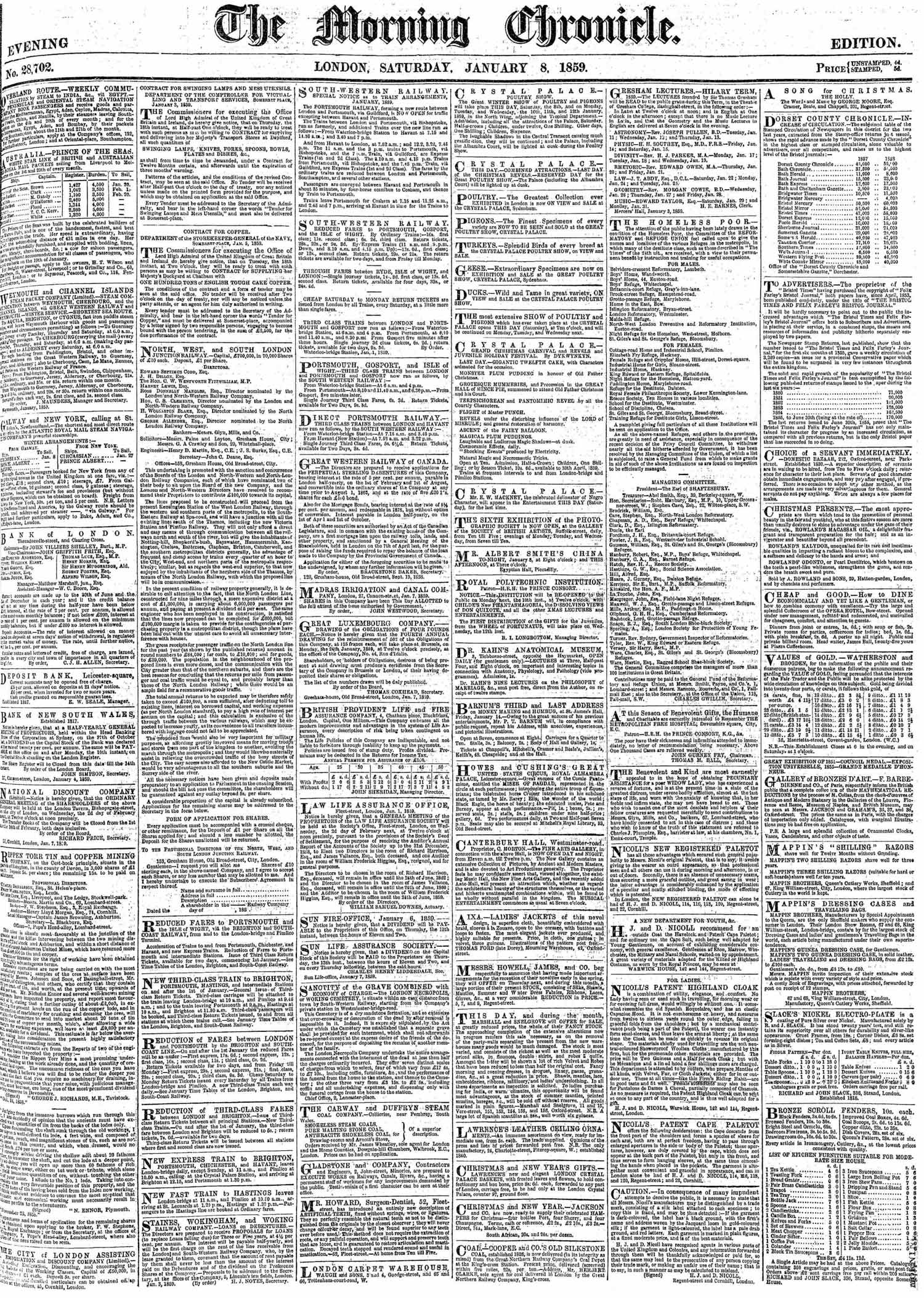
The Morning Chronicle was a prominent London newspaper that played a significant role in British journalism from its inception in 1769 until its decline in the mid-19th century. Founded by William Woodfall, the paper became renowned for its comprehensive parliamentary reporting and association with influential literary figures.
Founding and Early Years
Established as The Morning Chronicle and London Advertiser in 1769 by William Woodfall, the newspaper distinguished itself by providing detailed accounts of parliamentary debates—a notable achievement given that official note-taking was prohibited at the time. Woodfall’s remarkable memory allowed him to reconstruct debates accurately, earning the paper a reputation for reliable political reporting.
James Perry’s Ownership
In 1789, James Perry acquired the Morning Chronicle, aligning it with Whig politics and transforming it into a leading liberal voice. Under Perry’s direction, the newspaper flourished, attracting contributions from prominent radicals and reformists such as Richard Sheridan and Henry Brougham. Perry’s commitment to parliamentary reform occasionally led to legal challenges, including charges of seditious libel in 1793, from which he was acquitted.
Notable Contributors
The Morning Chronicle served as a platform for several distinguished writers:
-
William Hazlitt: Joined as a parliamentary reporter in 1813, later contributing political articles and theatre reviews.
-
Charles Dickens: Began his journalistic career with the paper in 1834, reporting on various events and publishing his early literary sketches under the pseudonym “Boz.”
-
Henry Mayhew: In 1849, Mayhew’s investigative series on London’s working class, later compiled into London Labour and the London Poor, were first published in the Morning Chronicle.
-
Eliza Lynn Linton: In 1849, she became the first salaried female journalist in Britain while working for the Morning Chronicle.
Technological Innovations
The Morning Chronicle was at the forefront of adopting new technologies in journalism. In May 1845, it became the first newspaper to transmit a message via telegraph, using the London and South Western Railway Company’s line from Portsmouth to London.
Decline and Closure
Despite its earlier prominence, the Morning Chronicle faced financial difficulties in the mid-19th century. Publication was suspended on 21 December 1862, with brief resumptions on 9 January 1864 and 2 March 1865, before ceasing entirely.
Legacy
The Morning Chronicle is remembered for its significant contributions to political journalism and literature. Its commitment to detailed parliamentary reporting and its role as a platform for emerging literary talents have cemented its place in the history of British media.
In Brief
📜 Industrial Tragedy in 1859: Fatal Chemical Exposure at Torpoint Factory
In 1859, two men died after inhaling toxic nitrous acid fumes at a fertiliser factory in Cornwall. A stark reminder of industrial dangers before safety laws. #History #Cornwall #IndustrialRevolution #WorkplaceSafety #Genealogy #19thCentury