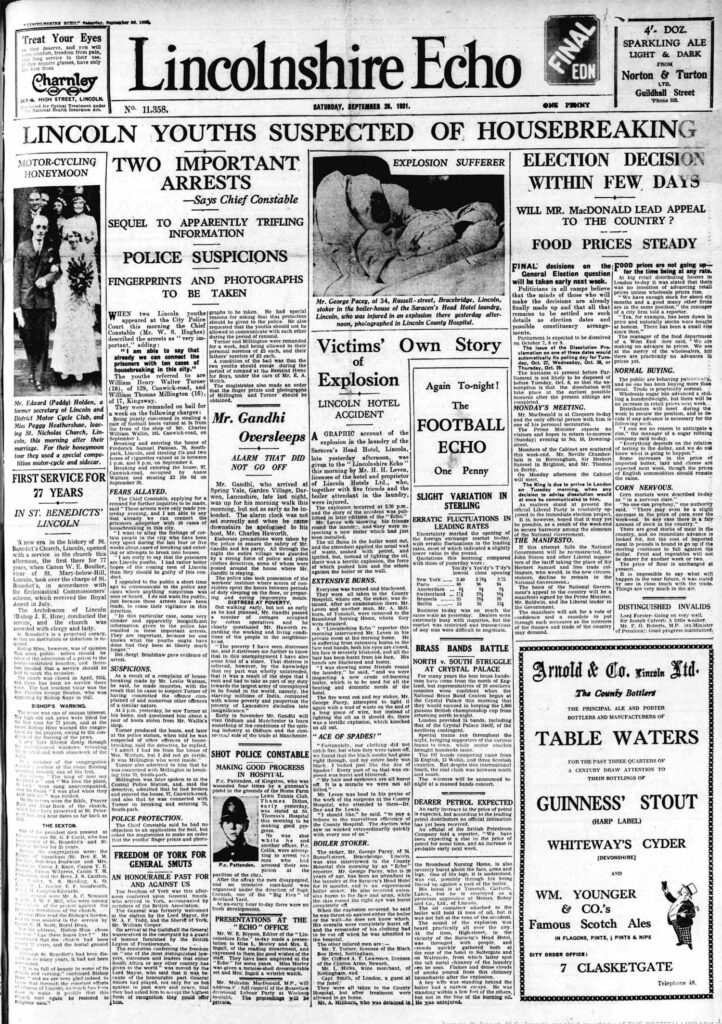
The Lincolnshire Echo – Saturday 26 September 1931
LINCOLN YOUTHS SUSPECTED OF HOUSEBREAKING
TWO IMPORTANT ARRESTS — Says Chief Constable
SEQUEL TO APPARENTLY TRIFLING INFORMATION
POLICE SUSPICIONS
FINGERPRINTS AND PHOTOGRAPHS TO BE TAKEN
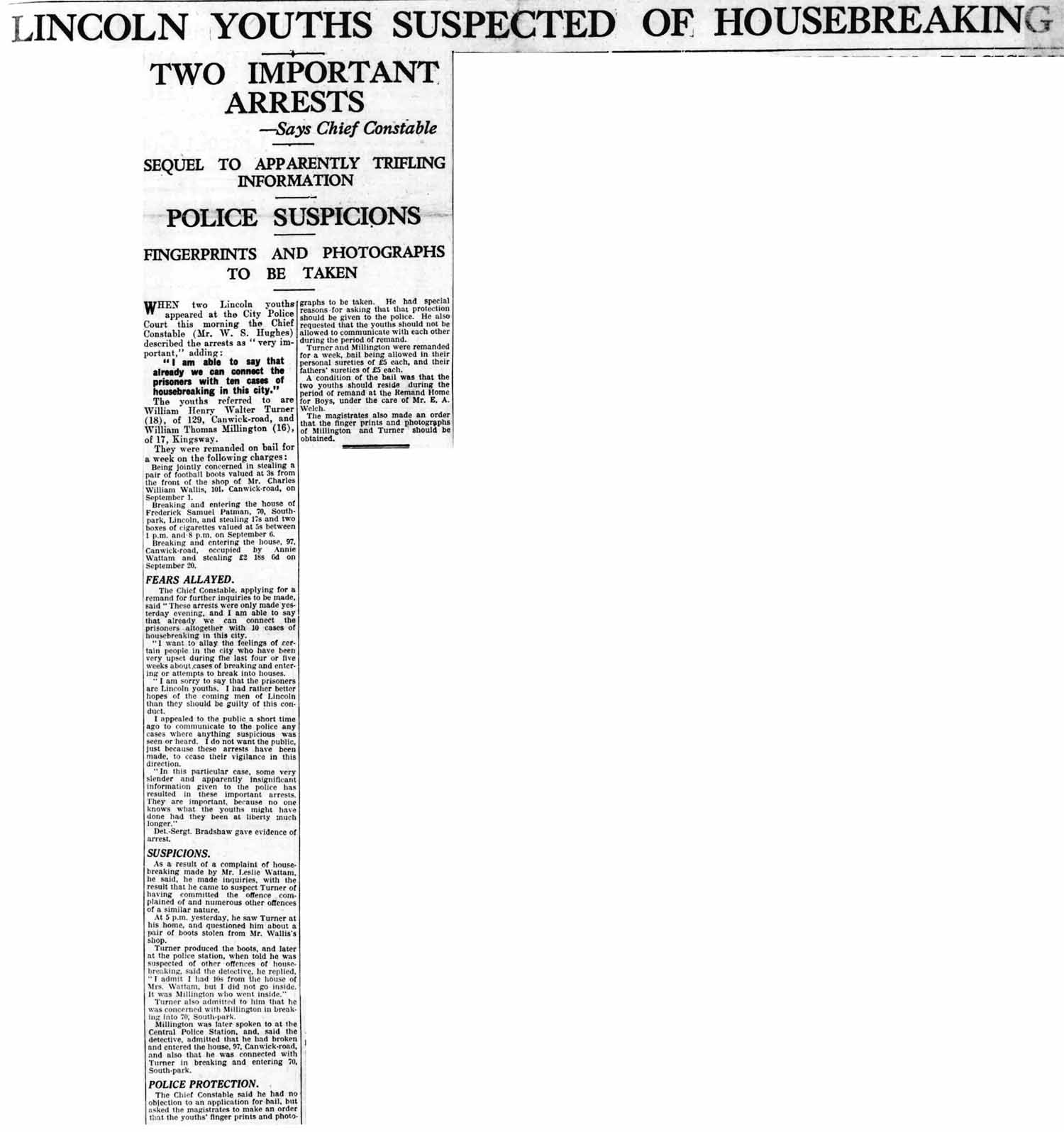
When two Lincoln youths appeared at the City Police Court this morning, the Chief Constable, Mr. W. S. Hughes, described the arrests as “very important,” adding, “already we can connect the prisoners with other housebreaking in this city.”
The youths referred to were William Henry Walter Turner, aged 18, of 129 Canwick Road, and William Thomas Millington, aged 16, of 17 Kingsway. They were remanded on bail for a week on the following charges:
- Being jointly concerned in stealing a pair of football boots valued at 3 shillings from the front of the shop of Mr. Charles William Wallis of 10 Canwick Road.
- Stealing cigarettes valued at 18 shillings between 3 p.m. and 5 p.m.
- Breaking and entering the house at 97 Canwick Road, occupied by Annie Wattam, and stealing £2 18s 6d on 20 September.
FEARS ALLAYED
The Chief Constable applied for a remand to allow further inquiries. He explained, “These arrests were only made yesterday evening, and already we can connect the prisoners with 10 cases of housebreaking in this city.” He sought to reassure the public, acknowledging that recent break-ins had caused distress: “I want to allay the feelings of certain people in the city who have been very upset during the last four or five cases of housebreaking.”
He emphasised the role of public vigilance: “In this particular case, some very slender and apparently insignificant information given to the police has resulted in these important arrests. They are important, because no one knows what the youths might have done had they remained at liberty any longer.”
SUSPICIONS
Sergeant Bradshaw gave evidence that the police’s suspicions were aroused following a complaint by Mr. Lester Wattam regarding housebreaking. Subsequent inquiries led to the suspicion of Turner. Upon questioning, Turner produced a pair of boots identified as stolen from Mr. Wallis’s shop. He was later taken to the police station, where he was informed that he was suspected of further offences. Turner admitted to breaking into 70 South Park with Millington.
Millington was also questioned at the Central Police Station, where he admitted to breaking into the house at 97 Canwick Road and confirmed his involvement in other break-ins with Turner.
POLICE PROTECTION
The Chief Constable raised concerns about potential intimidation and requested that police protection be extended to witnesses who had come forward with information. He also asked the magistrates to permit the taking of fingerprints and photographs of the youths for further investigations.
Historical and Legal Context
In 1931, Britain was experiencing economic hardship due to the Great Depression, and youth crime, often linked to social and economic factors, was of significant concern. Housebreaking was treated as a serious offence under British law, with courts often imposing strict penalties to deter others.
The detailed reporting of crimes like these, including the names, ages, and addresses of suspects, was standard practice, reflecting a belief in transparency and deterrence through public awareness. For family historians, cases such as this provide valuable insight into the social conditions and policing practices of the era, illustrating the challenges faced by communities and law enforcement alike in maintaining order during difficult times.
History of The Lincolnshire Echo
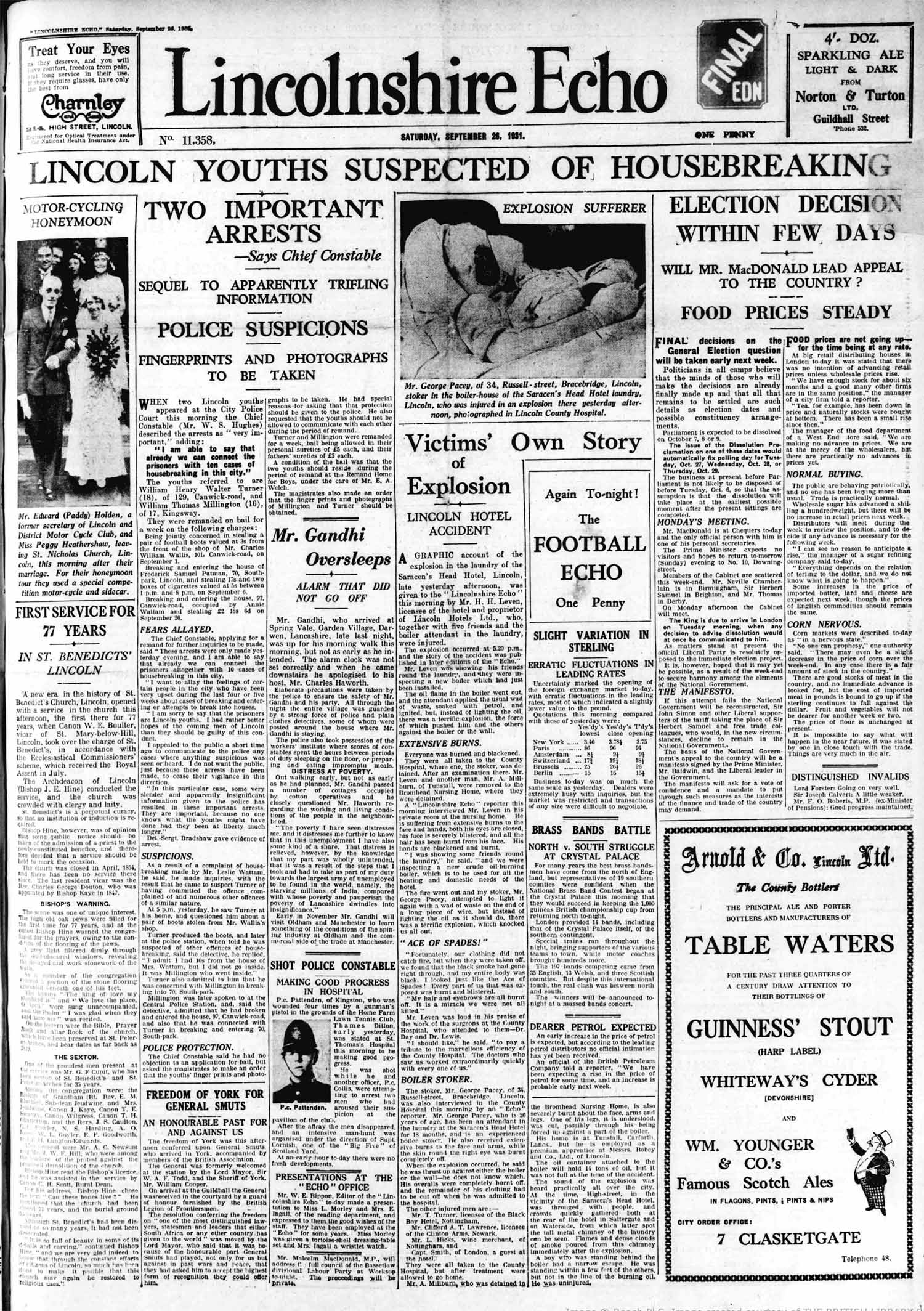
The Lincolnshire Echo holds a significant place in the history of local journalism, being the first daily evening newspaper to serve the county of Lincolnshire. The newspaper was founded in 1893 through the collaborative efforts of William Cottam, a skilled letterpress printer, and Samuel Burrows, an experienced journalist. Both men hailed from Liverpool but saw the potential for a daily publication to serve the growing needs of Lincoln and its surrounding areas.
Recognising the importance of securing financial stability for their ambitious venture, Cottam and Burrows sought investment from local businessmen. Their efforts were successful, and they established The Lincolnshire Publishing Company, a limited company that would manage the production and distribution of the newspaper. The company’s first chairman was Joseph Ruston, a prominent figure in the community, known for his role as a manufacturer and his political service as a former Liberal Member of Parliament for Lincoln.
The inaugural edition of the Lincolnshire Echo was published in 1893 as a broadsheet newspaper. It consisted of four pages, with the front page predominantly featuring advertisements rather than news articles. This layout was characteristic of newspapers at the time, where advertisements provided essential funding for the publication. The Echo quickly gained popularity among the local population, who appreciated its commitment to reporting on local news, events, and issues relevant to the community.
William Cottam served as the newspaper’s first editor, bringing his expertise in printing and his eye for detail to ensure the publication maintained high standards of production. Meanwhile, Samuel Burrows took on the role of business manager, overseeing the operational aspects of the newspaper and working to expand its readership. Together, their complementary skills laid a solid foundation for the newspaper’s success.
The Lincolnshire Echo retained its traditional broadsheet format for nearly a century, continuing to present its front page as a platform for advertisements well into the 20th century. It wasn’t until 1991 that the newspaper underwent a significant transformation, adopting a more compact tabloid format. This change reflected broader trends within the newspaper industry, as publications sought to make their content more accessible and appealing to modern readers.
Throughout its history, the Lincolnshire Echo has remained a trusted source of news and information for the people of Lincolnshire, chronicling the events that have shaped the county over the decades. From its modest beginnings with a four-page broadsheet to its later evolution into a tabloid, the newspaper stands as a testament to the vision of its founders and the enduring value of local journalism.
Two Lincoln youths arrested for multiple housebreaking offences. Chief Constable calls it a “very important” case. 👮♂️ #LincolnshireHistory #TrueCrime #1930sCrime #FamilyHistory #NewspaperArchive 📰