Hertford Mercury and Reformer – Saturday 18 October 1879
SECOND COURT.
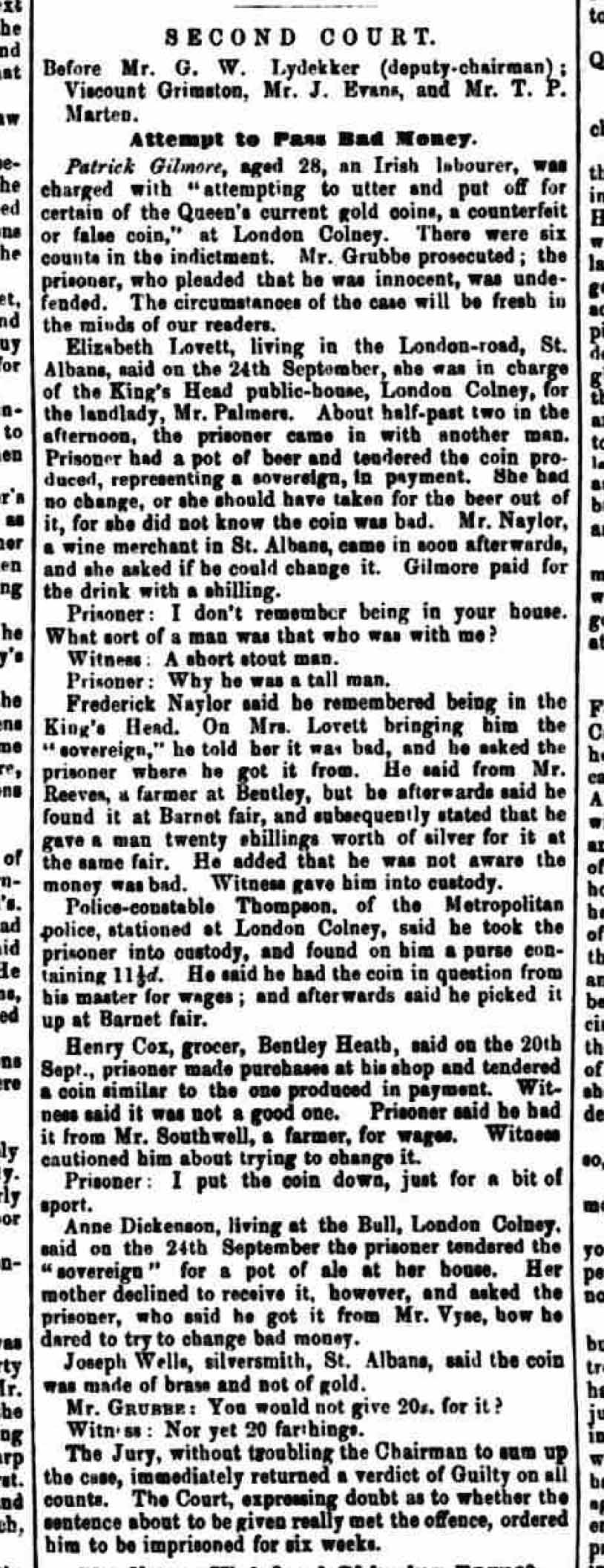
Before Mr. G. W. Lydekker (deputy-chairman); Viscount Grimston, Mr. J. Evans, and Mr. T. P. Marten.
Attempt to Pass Bad Money.
Patrick Gilmore, aged 28, an Irish labourer, was charged with “attempting to utter and put off for certain of the Queen’s current gold coins, a counterfeit or false coin,” at London Colney. There were six counts in the indictment. Mr. Grubbe prosecuted; the prisoner, who pleaded that he was innocent, was undefended. The circumstances of the case will be fresh in the minds of our readers.
Elizabeth Lovett, living in the London-road, St. Albans, said on the 24th September, she was in charge of the King’s Head public-house, London Colney, for the landlady, Mrs. Palmer. About half-past two in the afternoon, the prisoner came in with another man. The prisoner had a pot of beer and tendered the coin produced, representing a sovereign, in payment. She had no change, or she should have taken for the beer out of it, for she did not know the coin was bad.
Mr. Naylor, a wine merchant in St. Albans, came in soon afterwards, and she asked if he could change it. Gilmore paid for the drink with a shilling.
Prisoner: I don’t remember being in your house. What sort of man was that who was with me?
Witness: A short stout man.
Prisoner: Why he was a tall man.
Frederick Naylor said he remembered being in the King’s Head. On Mrs. Lovett bringing him the “sovereign,” he told her it was bad, and he asked the prisoner where he got it from. He said from Mr. Reeves, a farmer at Bentley, but he afterwards said he found it at Barnet fair, and subsequently stated that he gave a man twenty shillings worth of silver for it at the same fair. He added that he was not aware the money was bad. Witness gave him into custody.
Police-constable Thompson, of the Metropolitan police, stationed at London Colney, said he took the prisoner into custody and found on him a purse containing 11½d. He said he had the coin in question from his master for wages; and afterwards said he picked it up at Barnet fair.
Henry Cox, grocer, Bentley Heath, said on the 20th September, the prisoner made purchases at his shop and tendered a coin similar to the one produced in payment. Witness said it was not a good one. Prisoner said he had it from Mr. Southwell, a farmer, for wages. Witness cautioned him about trying to change it.
Prisoner: I put the coin down, just for a bit of sport.
Anne Dickenson, living at the Bull, London Colney, said on the 24th September the prisoner tendered the “sovereign” for a pot of ale at her house. Her mother declined to receive it, however, and asked the prisoner, who said he got it from Mr. Vyse, how he dared to try to change bad money.
Joseph Wells, silversmith, St. Albans, said the coin was made of brass and not of gold.
Mr. Grubbe: You would not give 20s. for it?
Witness: Nor yet 20 farthings.
The Jury, without troubling the Chairman to sum up the case, immediately returned a verdict of Guilty on all counts. The Court, expressing doubt as to whether the sentence about to be given really met the offence, ordered him to be imprisoned for six weeks.
Analysis of the Article
1. The Crime and Charges:
The crime involved uttering counterfeit coin, a serious offence in Victorian England, as it undermined the currency and the economy. Patrick Gilmore, an Irish labourer, was charged with presenting fake sovereign coins at multiple establishments.
- Nature of Crime: Fraud (passing counterfeit currency)
- Outcome: Guilty on all counts
- Sentence: Six weeks’ imprisonment
Despite his claims of innocence and multiple conflicting stories about the coin’s origin (claiming it came from employers or from a fair), the jury swiftly reached a verdict of guilty.
2. People and Their Occupations:
The case involves individuals from various social classes and occupations, reflecting life in a market town like Hertford in 1879:
- Patrick Gilmore (Prisoner): Irish labourer, highlighting the common presence of Irish migrant workers in England at the time.
- Elizabeth Lovett: Public house manager (The King’s Head, London Colney)
- Frederick Naylor: Wine merchant (St. Albans)
- Henry Cox: Grocer (Bentley Heath)
- Anne Dickenson: Innkeeper (The Bull, London Colney)
- Joseph Wells: Silversmith (St. Albans), an expert in identifying counterfeit coins.
- Police-constable Thompson: Metropolitan Police officer (London Colney)
The case provides insight into the importance of pubs and local shops as community hubs where such crimes were often detected.
3. Law and Justice in 1879:
- Court System: Local courts were presided over by notable figures such as Mr. G. W. Lydekker (Deputy-Chairman) and local gentry (Viscount Grimston).
- Jury Trial: Common in criminal cases, and here the jury’s swift decision reflects their confidence in the witnesses’ testimonies.
- Sentencing: Six weeks’ imprisonment seems relatively lenient, possibly due to doubt from the Court about the severity of the crime and the conflicting stories from the prisoner.
4. Life in Hertford and Surrounding Areas in 1879:
- Community Hubs: Pubs like the King’s Head and The Bull served as both social and commercial centres.
- Fairs and Markets: Barnet Fair, a major event in Hertfordshire, was a place for commerce but also for crime and deception.
- Occupational Diversity: A range of professions, from labourers to merchants and farmers, highlights the economic diversity of the region.
- Police Presence: The presence of a Metropolitan Police constable indicates organised law enforcement even in semi-rural areas like London Colney.
- Currency and Trade: Awareness of counterfeit coins was high among merchants and publicans, reflecting the importance of cash transactions in daily life.
Conclusion:
This case from the Hertford Mercury and Reformer (1879) offers a glimpse into Victorian criminal justice, local society, and the challenges faced by business owners in identifying fraudulent activities. It also reflects the era’s swift justice system and the social fabric of Hertfordshire, where pubs, fairs, and markets were key community centres.
History of The Hertford Mercury and Reformer
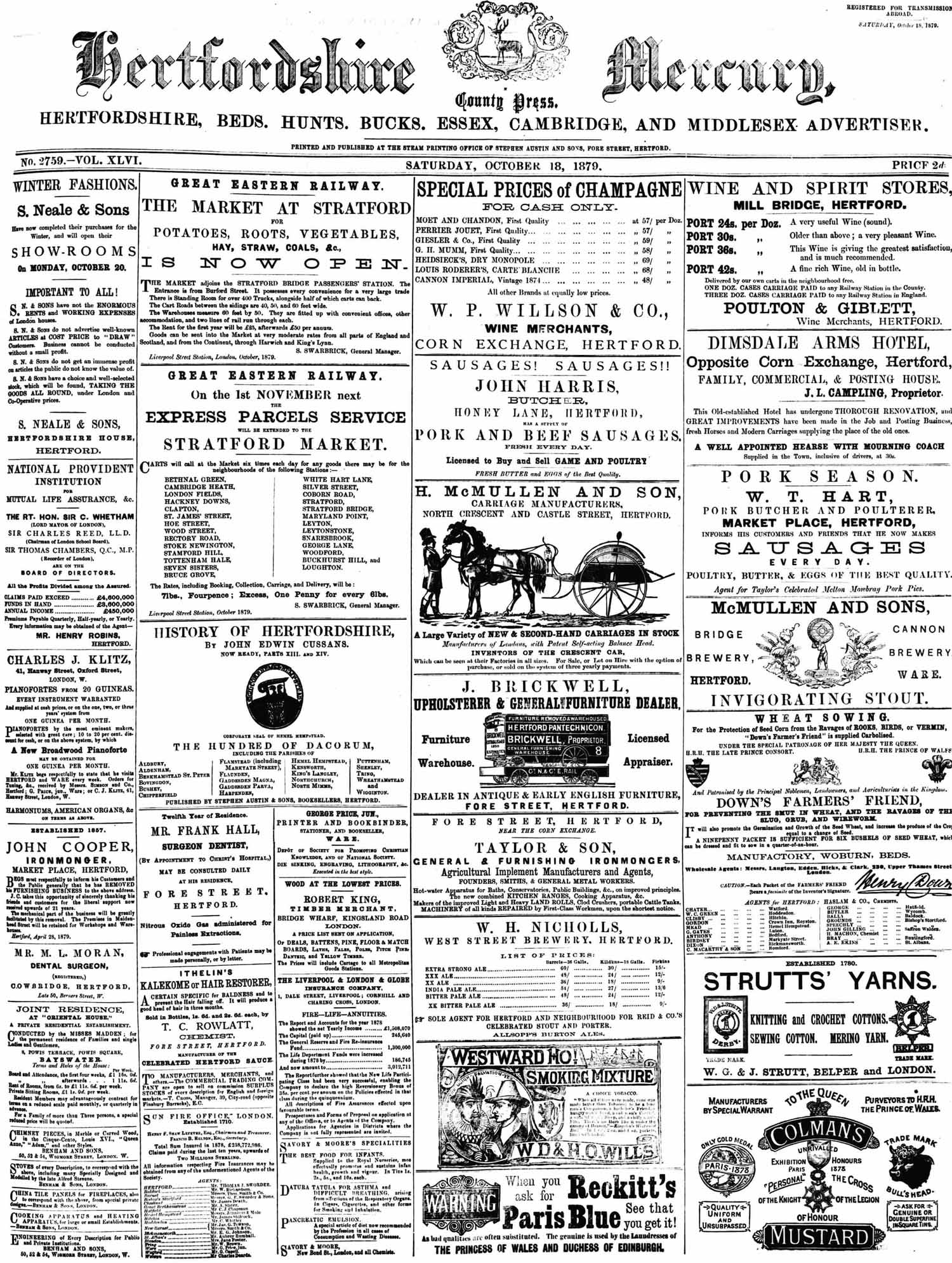
The Hertford Mercury and Reformer is a distinguished British newspaper with a rich history dating back to the 18th century.
Origins and Early History:
-
1772: The newspaper was first published as the Hertfordshire Mercury.
-
1834: A separate publication, the Reformer, began circulation in Hertford.
Merger and Evolution:
- 1834-1868: The Hertford Mercury and Reformer was published during this period, indicating a merger of the two titles.
Publishing and Editorial Leadership:
- Stephen Austin, a notable figure in Hertford, was the publisher of the Hertfordshire Mercury during the mid-19th century. Kelly’s Post Office Directory for 1869 describes him as a ‘Printer, Bookseller, and Stationer’
Archival Records:
- The Hertfordshire Mercury has an extensive archive, with over 125,586 searchable pages available, providing a valuable resource for historical research
Throughout its history, the Hertford Mercury and Reformer has played a significant role in reporting local news and events, contributing to the rich tapestry of Hertfordshire’s journalistic heritage.
In Brief
Labourer Sentenced for Attempting to Pass Counterfeit Sovereigns in Hertfordshire #VictorianCrime #HertfordshireHistory #CounterfeitCurrency #LegalHistory #HertfordMercury1879