Sidmouth Journal and Directory – Wednesday 01 June 1870
THE LOCAL BOARD.
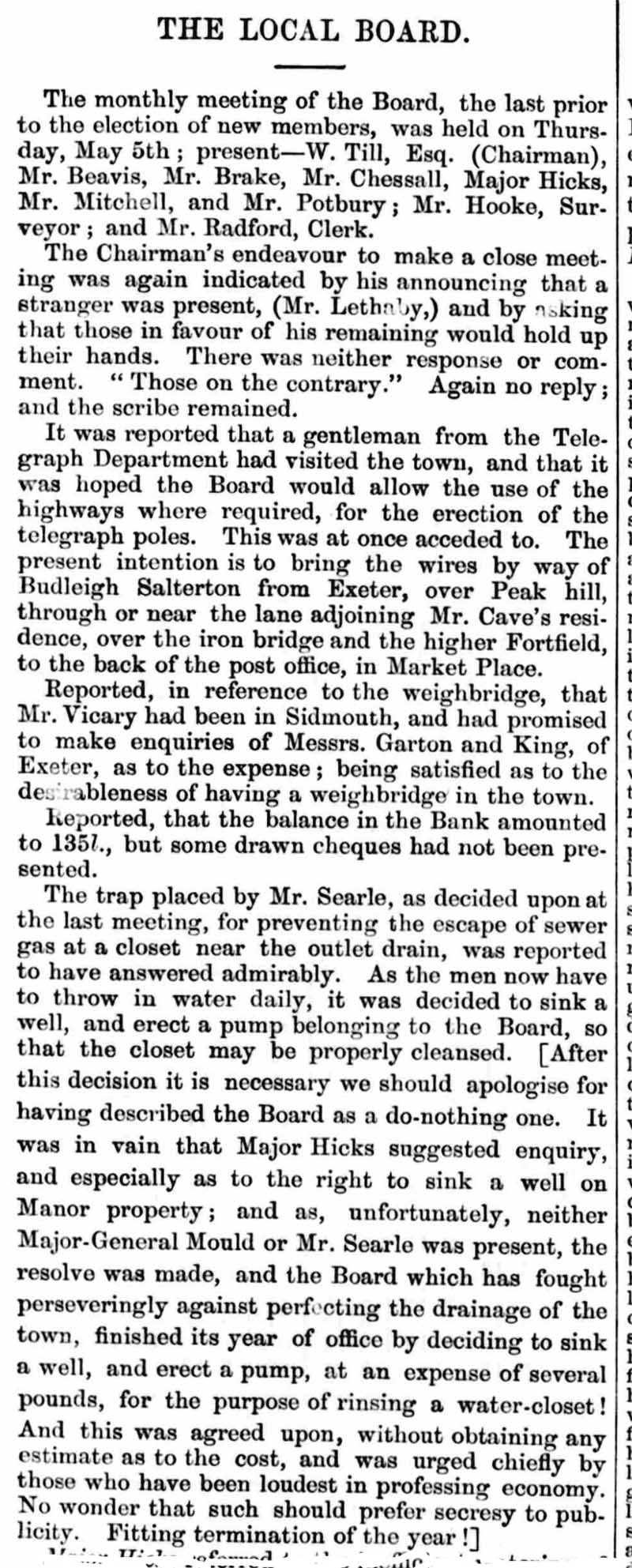
The monthly meeting of the Board, the last prior to the election of new members, was held on Thursday, May 5th; present—W. Till, Esq. (Chairman), Mr. Beavis, Mr. Brake, Mr. Chessall, Major Hicks, Mr. Mitchell, and Mr. Potbury; Mr. Hooke, Surveyor; and Mr. Radford, Clerk.
The Chairman’s endeavour to make a close meeting was again indicated by his announcing that a stranger was present, (Mr. Lethaby,) and by asking that those in favour of his remaining would hold up their hands. There was neither response nor comment. “Those on the contrary.” Again no reply; and the scribe remained.
It was reported that a gentleman from the Telegraph Department had visited the town, and that it was hoped the Board would allow the use of the highways where required, for the erection of the telegraph poles. This was at once acceded to. The present intention is to bring the wires by way of Budleigh Salterton from Exeter, over Peak Hill, through or near the lane adjoining Mr. Cave’s residence, over the iron bridge and the higher Fortfield, to the back of the post office, in Market Place.
Reported, in reference to the weighbridge, that Mr. Vicary had been in Sidmouth, and had promised to make enquiries of Messrs. Garton and King, of Exeter, as to the expense; being satisfied as to the desirableness of having a weighbridge in the town.
Reported, that the balance in the Bank amounted to 135l., but some drawn cheques had not been presented.
The trap placed by Mr. Searle, as decided upon at the last meeting, for preventing the escape of sewer gas at a closet near the outlet drain, was reported to have answered admirably. As the men now have to throw in water daily, it was decided to sink a well, and erect a pump belonging to the Board, so that the closet may be properly cleansed. [After this decision it is necessary we should apologise for having described the Board as a do-nothing one. It was in vain that Major Hicks suggested enquiry, and especially as to the right to sink a well on Manor property; and as, unfortunately, neither Major-General Mould nor Mr. Searle was present, the resolve was made, and the Board which has fought perseveringly against perfecting the drainage of the town, finished its year of office by deciding to sink a well, and erect a pump, at an expense of several pounds, for the purpose of rinsing a water-closet! And this was agreed upon, without obtaining any estimate as to the cost, and was urged chiefly by those who have been loudest in professing economy. No wonder that such should prefer secrecy to publicity. Fitting termination of the year!]
Context and Analysis
This article details the proceedings of a meeting of the Sidmouth Local Board, which was responsible for managing public works and local governance in the town. The Board discussed various administrative matters, including:
- Telegraph Infrastructure: The Board approved the installation of telegraph poles, which were to connect Sidmouth to Exeter via Budleigh Salterton.
- Weighbridge Proposal: A member of the Board was tasked with investigating the cost of installing a weighbridge, which would have been used for weighing goods, likely for trade and commerce.
- Sewer Management: The Board decided to construct a well and install a pump to improve sanitation, although this decision was criticised as being made hastily and without proper cost estimates.
- Financial Matters: The Board noted that the town’s bank balance stood at £135, though some cheques had not yet been cashed.
Use for Family Historians
For family historians researching ancestors in Sidmouth or the surrounding area, this document provides valuable insights:
- Local Governance and Civic Engagement: If an ancestor served on the Local Board or was involved in municipal affairs, their role might be referenced in similar reports.
- Public Health and Sanitation: The discussions on sewer gas and drainage reflect the broader Victorian concerns about public health. If an ancestor was a builder, labourer, or engineer, they might have been involved in such projects.
- Telegraph Expansion: If researching ancestors involved in the postal or telegraph service, this article provides details of when the infrastructure reached Sidmouth.
- Trades and Commerce: The mention of the weighbridge highlights the town’s economic activity, relevant for those researching ancestors in trade, agriculture, or transport.
Relief and Local Governance in 1870
In 1870, local boards were the precursors to modern councils and were responsible for public health, road maintenance, and sanitation.
- Workhouse System: Though not directly mentioned in this article, the concerns about sanitation and the weighbridge relate to the broader public welfare efforts in Victorian England. The Poor Law, which governed relief for the destitute, was still in place, and those unable to work often had to seek assistance from the workhouse.
- Public Health Act 1872: This article predates the 1872 Act, which established local authorities to enforce sanitation and disease prevention measures. The Board’s actions show an early attempt at managing sanitation, even if criticised for inefficiency.
- Poverty and Welfare: Decisions about public spending, like installing a well for rinsing a closet, show that even small expenses were scrutinised, reflecting economic pressures in the town.
Sidmouth in 1870: Life, Social Classes, and the Workhouse System
In 1870, Sidmouth was a small but well-regarded seaside town in Devon, known for its genteel character and a mix of residents from different social backgrounds. The town had a reputation as a health retreat for the upper and middle classes, but like many places in Victorian England, it also had a working-class population and a poor relief system that included the workhouse.
Below is a detailed exploration of life in Sidmouth in 1870, focusing on the upper, middle, and lower classes, the workhouse system, and environmental conditions.
Upper Class in Sidmouth (Gentry and Wealthy Residents)
The upper class in Sidmouth consisted mainly of wealthy landowners, retired military officers, professionals, and those with inherited wealth. Many of them lived in large, well-built homes along the seafront or in more secluded areas such as Fortfield Terrace or Peak Hill, which were considered prestigious addresses. These individuals often had London or Exeter connections and came to Sidmouth for its coastal air, which was believed to have health benefits.
Connections to Local Governance
- The Local Board, as seen in the newspaper article, was largely controlled by wealthier residents, including professionals and business owners.
- Many had political influence in the town’s affairs, such as sanitation projects, road improvements, and new infrastructure (e.g., the telegraph poles being installed).
- They were also patrons of charitable institutions, including churches and schools, though their direct interaction with the working class was often minimal.
Lifestyle
- They enjoyed horse-drawn carriage rides along the Esplanade, visits to Exeter for shopping, and leisure pursuits such as seafront promenades.
- Social gatherings, dinners, and cultural events were common, often held in their own homes or at exclusive clubs.
- Many had domestic servants—cooks, maids, and governesses—to run their households.
Relationship with the Workhouse
- The upper class often saw the workhouse system as a necessary deterrent to idleness. Victorian morality dictated that the poor should only receive assistance if they were truly destitute.
- While some wealthy Sidmouth residents contributed charitable donations, they generally supported the strict workhouse regime as a way of discouraging “laziness.”
Middle Class in Sidmouth (Traders, Professionals, and Skilled Workers)
Sidmouth’s middle class was growing in influence in the 1870s. This group included shopkeepers, schoolmasters, doctors, innkeepers, small business owners, and skilled artisans.
Role in the Town
- The middle class provided essential goods and services to both the wealthy and working classes.
- Many of them were involved in local administration, including the Local Board meetings, where they debated public works, sanitation, and civic improvements.
- Some, such as merchants and innkeepers, benefited from the town’s tourism, particularly from wealthier visitors seeking relaxation by the sea.
Living Conditions
- Middle-class homes were often two-storey terraced houses, well-maintained but without the grandeur of upper-class residences.
- Many had a small number of servants, usually one or two maids, to assist with domestic work.
- Unlike the upper class, they worked for a living, though they aimed to maintain respectability and financial independence.
Concerns About Public Health and the Environment
- The middle class was increasingly aware of sanitation issues, as seen in the Local Board’s discussions on drainage and sewage control.
- Many backed public health initiatives but did not want to pay excessive local rates to fund improvements.
- They were at risk of diseases like typhoid and cholera, which still occurred due to poor water supply and waste disposal.
Attitude Towards the Workhouse
- Some middle-class people feared falling into poverty and ending up in the workhouse.
- They generally supported strict workhouse rules, believing that only the deserving poor (widows, orphans, and the disabled) should receive assistance.
- Many middle-class women engaged in charity work, providing food or clothing to struggling families.
Lower Class in Sidmouth (Labourers, Fishermen, and Domestic Servants)
The lower class in Sidmouth formed the backbone of the town’s workforce, with many employed in fishing, agriculture, construction, domestic service, and labouring jobs. Others worked in Sidmouth’s small businesses, as bakers, blacksmiths, or seamstresses.
Living Conditions
- Housing was cramped, often consisting of one or two rooms per family, with shared outdoor toilets and wells.
- Poorer families lived in alleyways or cottages off the main streets, particularly near the marketplace or close to the river, where flooding was a risk.
- Many families struggled with high rents and seasonal employment, making their financial situation unstable.
Health and Hardship
- Many suffered from malnutrition, as their diet consisted mainly of bread, potatoes, and occasional fish or meat.
- Sanitation was a major problem, with open drains and unclean water leading to frequent outbreaks of diseases.
- Work was physically demanding and often dangerous, especially for fishermen or labourers on construction projects.
The Workhouse in Sidmouth
- The Sidmouth workhouse was the last resort for those who could not support themselves.
- Families were often separated upon entry, with men, women, and children placed in different sections.
- Conditions were strict and harsh—food was basic (bread, porridge, gruel), and inmates had to perform hard labour, such as breaking stones or picking oakum (separating fibres from old rope).
- Many of Sidmouth’s poorest avoided the workhouse at all costs, relying instead on charity or seasonal work.
Outdoor Relief and Community Support
- Instead of entering the workhouse, some received “outdoor relief”, small allowances provided to the very poor without institutionalisation.
- The church played a role in helping the poor, with clothing distributions and occasional free meals.
- The lower classes relied heavily on mutual aid, with family members and neighbours supporting each other when possible.
Environmental Conditions and Public Health
In 1870, Sidmouth was grappling with the challenges of urban sanitation. The Local Board’s debates about drainage, sewer gas, and well water highlight the town’s struggles with:
- Limited clean water supply – Wells were often contaminated.
- Poor waste disposal – Open drains and cesspits spread disease.
- Overcrowding in poorer areas – Increased the spread of typhoid and cholera.
- Limited medical care – Doctors were expensive, and many lower-class families could not afford treatment.
The workhouse infirmary provided some medical assistance, but conditions were basic and far from ideal.
Conclusion
Sidmouth in 1870 was a town of sharp social contrasts, where the upper classes lived in comfort, the middle class aspired to financial security, and the lower classes struggled for survival. The workhouse loomed as a feared institution, a last resort for those without means, while sanitation and public health were growing concerns.
For family historians, understanding these conditions provides vital context for researching ancestors from Sidmouth. Whether they were governing from the Local Board, running a shop, working as a servant, or struggling in poverty, their daily lives were shaped by class, work, and the environment.
The history of The Sidmouth Journal and Directory
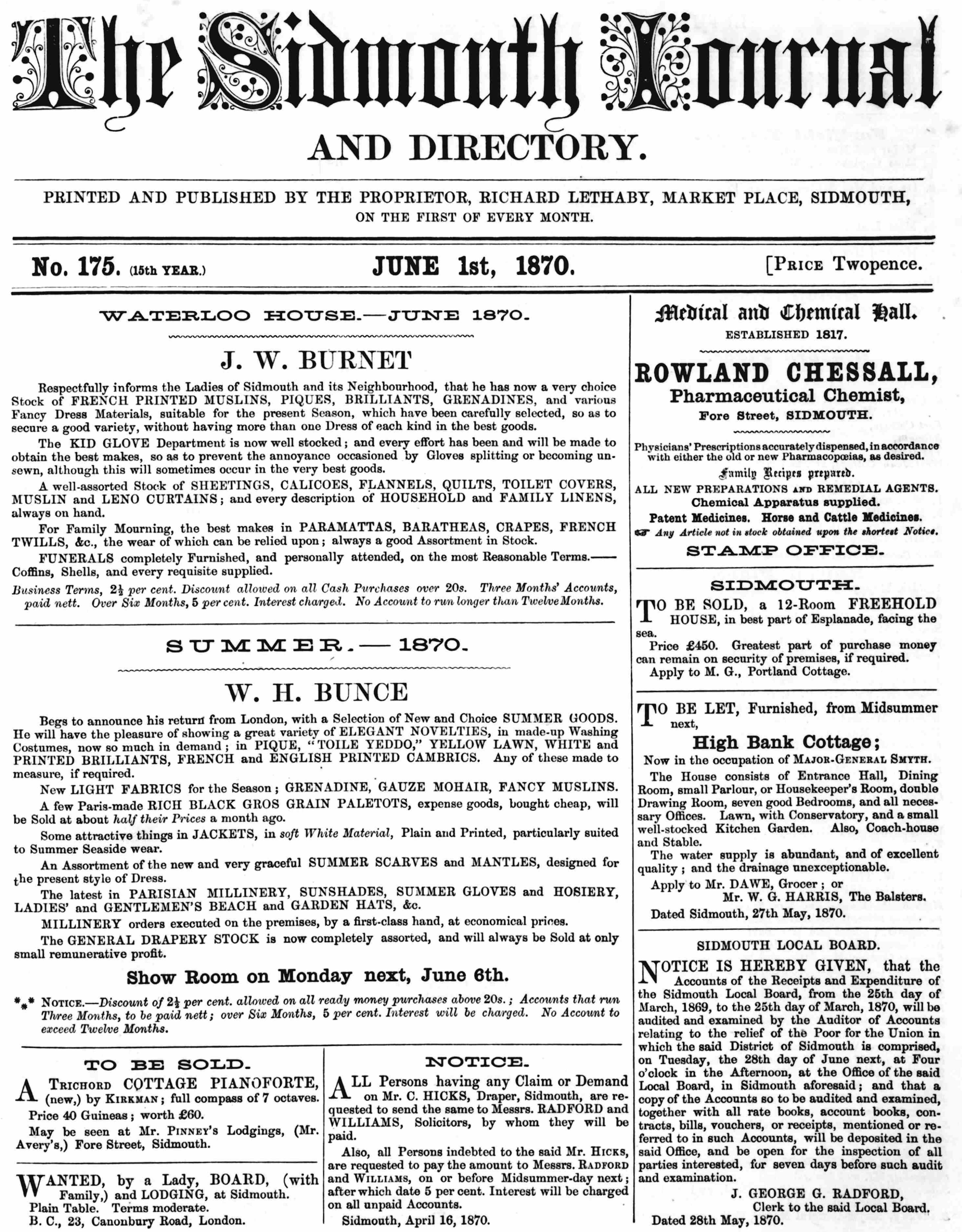 The Sidmouth Journal and Directory was a local publication serving the town of Sidmouth, Devon, during the 19th century. While specific details about its founding and operational years are limited, records indicate that it was active at least between 1862 and 1873. During this period, the publication covered various local events, including inquests into suspicious or unexplained deaths, providing valuable insights into the community’s social and legal affairs.
The Sidmouth Journal and Directory played a crucial role in documenting the town’s development, societal issues, and daily life, making it an invaluable resource for historians and genealogists researching the area. Its articles offer contemporary accounts of local governance, public health concerns, and community events, reflecting the social dynamics of Sidmouth during the Victorian era.
For those interested in exploring the history of Sidmouth further, the Sid Vale Association provides extensive resources and publications on local history.
Additionally, the diaries and sketches of Peter Orlando Hutchinson, a prominent 19th-century resident, offer detailed observations of the town during that period.
Overall, the Sidmouth Journal and Directory stands as a testament to the town’s rich history, offering a window into the lives of its past inhabitants and the evolution of the community.
🚨 Sidmouth Local Board, 1870 🚨
🔹 Approval for telegraph poles 📡
🔹 Debate over a weighbridge ⚖️
🔹 Public health: Sewer gas & a controversial well 🚰
💬 Victorian governance, sanitation & economy in action!
#Sidmouth #History #VictorianEra #LocalBoard #DevonHistory #Workhouse #Sanitation