Chester Chronicle – Saturday 30 January 1869
BROXTON PETTY SESSIONS.
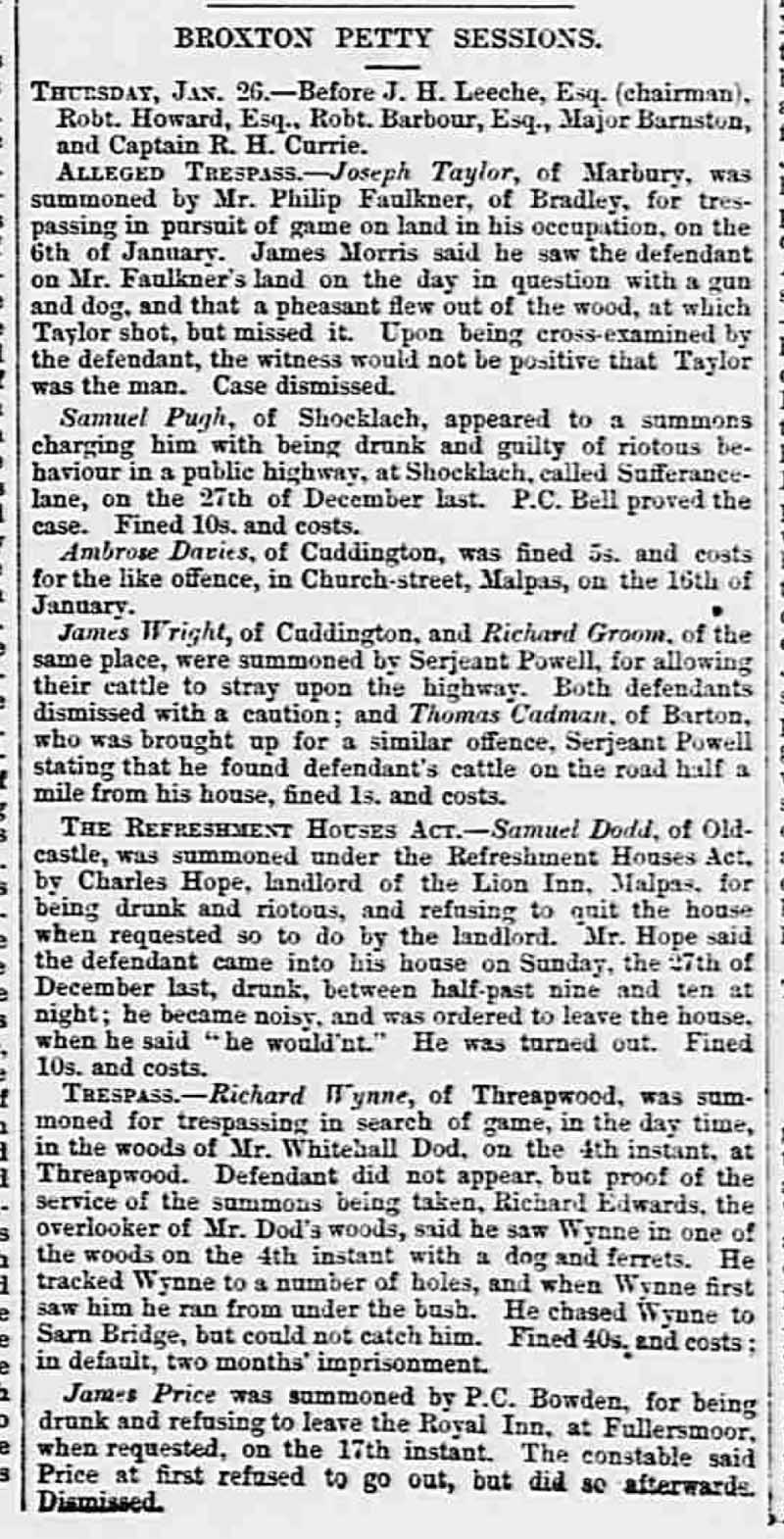
Thursday, Jan. 26. — Before J. H. Leeche, Esq. (chairman), Robt. Howard, Esq., Robt. Barbour, Esq., Major Barnston, and Captain R. H. Currie.
Alleged Trespass. — Joseph Taylor, of Marbury, was summoned by Mr. Philip Faulkner, of Bradley, for trespassing in pursuit of game on land in his occupation, on the 6th of January. James Morris said he saw the defendant on Mr. Faulkner’s land on the day in question with a gun and dog, and that a pheasant flew out of the wood, at which Taylor shot, but missed it. Upon being cross-examined by the defendant, the witness would not be positive that Taylor was the man. Case dismissed.
Samuel Pugh, of Shocklach, appeared to a summons charging him with being drunk and guilty of riotous behaviour in a public highway, at Shocklach, called Sufferance-lane, on the 27th of December last. P.C. Bell proved the case. Fined 10s. and costs.
Ambrose Davies, of Cuddington, was fined 5s. and costs for the like offence, in Church-street, Malpas, on the 18th of January.
James Wright, of Cuddington, and Richard Groom, of the same place, were summoned by Sergeant Powell, for allowing their cattle to stray upon the highway. Both defendants dismissed with a caution; and Thomas Cadman, of Barton, who was brought up for a similar offence, Sergeant Powell stating that he found defendant’s cattle on the road half a mile from his house, fined 1s. and costs.
The Refreshment Houses Act.
Samuel Dodd, of Oldcastle, was summoned under the Refreshment Houses Act by Charles Hope, landlord of the Lion Inn, Malpas, for being drunk and riotous, and refusing to quit the house when requested to do so by the landlord. Mr. Hope said the defendant came into his house on Sunday, the 17th of December last, drunk, between half-past nine and ten at night; he became noisy, and was ordered to leave the house. When he said “he wouldn’t,” he was turned out. Fined 10s. and costs.
Trespass.
Richard Wynne, of Threapwood, was summoned for trespassing in search of game, in the daytime, in the woods of Mr. Whitehall Dod, on the 4th instant, at Threapwood. Defendant did not appear, but proof of the service of the summons being taken, Richard Edwards, the overlooker of Mr. Dod’s woods, said he saw Wynne in one of the woods on the 4th instant with a dog and ferrets. He tracked Wynne to a number of holes, and when Wynne first saw him, he ran from under the bush. He chased Wynne to Sarn Bridge, but could not catch him. Fined 40s. and costs; in default, two months’ imprisonment.
James Price was summoned by P.C. Bowden, for being drunk and refusing to leave the Royal Inn, at Fullersmoor, when requested, on the 17th instant. The constable said Price at first refused to go out, but did so afterwards. Dismissed.
Analysis & Historical Context:
1. The People Mentioned:
- J. H. Leeche, Esq. (Chairman) – A magistrate overseeing the Broxton Petty Sessions, likely a landowner or legal professional.
- Robt. Howard, Robt. Barbour, Major Barnston, and Captain R. H. Currie – Local justices or magistrates, suggesting they were of some social standing, possibly landowners or former military officers.
- Joseph Taylor – Accused of game trespassing, a common charge against poachers in rural England at the time.
- Philip Faulkner – Landowner or tenant of Bradley, enforcing hunting rights on his land.
- James Morris – Witness in the case, potentially a farm labourer or gamekeeper.
- Samuel Pugh & Ambrose Davies – Charged with drunken disorderly conduct, suggesting they were either farm labourers or tradesmen with access to alcohol and public spaces.
- James Wright, Richard Groom, Thomas Cadman – Farmers or smallholders fined for allowing cattle to stray, implying rural occupations.
- Samuel Dodd – A frequent pub-goer, his refusal to leave a pub suggests tensions between landlords and customers in regulating drinking.
- Richard Wynne – A known poacher, actively avoiding capture, suggesting he may have been involved in illicit hunting to supplement his income.
- James Price – Similar case of public drunkenness, though he avoided a fine.
2. Employment & Social Status:
- Gamekeepers & Landowners – Mr. Philip Faulkner and Richard Edwards (woodland overlooker) were likely responsible for managing land and preventing poaching.
- Farmers & Labourers – Many defendants were involved in rural work, either as independent smallholders or farmhands.
- Public House Workers – Charles Hope, landlord of the Lion Inn, represents the tensions between pub owners and rowdy customers.
- Law Enforcement – P.C. Bell and Sergeant Powell were local policemen, possibly working under the new county constabulary system that emerged in the 19th century.
3. The Crimes & Punishments:
- Game Trespass (Poaching) – A significant issue in the 19th century as game laws heavily favoured landowners. Wynne’s case reflects the common struggle of poorer individuals resorting to poaching.
- Drunkenness & Public Disorder – Reflects a time when alcohol consumption was high, particularly among working-class men. Authorities were clamping down on public disturbances.
- Stray Cattle Offences – Indicative of rural England, where livestock management was essential, and loose animals could cause significant damage.
4. Historical Context:
- Petty Sessions – A lower-level court dealing with minor offences, a key part of the Victorian justice system.
- Poaching Laws – Enforced under strict game laws, as hunting was reserved for landowners. Many working-class men risked imprisonment or fines for illegal hunting.
- Alcohol Regulation – The Refreshment Houses Act was part of increasing attempts to regulate alcohol consumption in public spaces.
- Policing & Law Enforcement – Local constables, like P.C. Bell, were tasked with maintaining order, a relatively new development in rural policing.
5. What We Learn from This Article:
- Rural England in 1869 was heavily regulated by magistrates, with strict enforcement of laws related to hunting, livestock management, and public order.
- Poaching remained a significant problem, suggesting economic hardship among the working class.
- Alcohol-related offences were prevalent, indicating the social importance of pubs and drinking culture.
- The magistrates were typically local landowners, military officers, or members of the gentry, reinforcing the class divide in Victorian England.
- The punishments, including fines and imprisonment, show a system designed to deter lower-class transgressions while protecting landowners’ interests.
Further Detail
1. Magistrates Presiding Over Broxton Petty Sessions:
- J. H. Leeche, Esq. (Chairman): While specific details about J. H. Leeche are scarce, chairing the Broxton Petty Sessions indicates he was a person of considerable local influence, likely a landowner or someone involved in local governance.
- Robert Howard, Esq.: Similarly, Robert Howard’s exact background isn’t detailed in available records, but his position as a magistrate suggests he was a respected figure in the community.
- Robert Barbour, Esq.: No specific information is readily available about Robert Barbour. His role as a magistrate implies he was a person of standing in the area.
- Major Barnston: The title “Major” indicates military service. The Barnston family has historical ties to Cheshire, suggesting he was a member of this family and held a significant position locally.
- Captain R. H. Currie: Holding the rank of Captain denotes military involvement. The Currie family was prominent in Cheshire, and R. H. Currie was likely a member of this family, contributing to local affairs.
2. Individuals Involved in Cases:
- Joseph Taylor of Marbury: Accused of trespassing in pursuit of game on Mr. Philip Faulkner’s land. Marbury is a village in Cheshire, and during this period, many residents were engaged in agriculture or related rural occupations.
- Mr. Philip Faulkner of Bradley: The complainant in the trespassing case. Bradley is a locality in Cheshire, and Mr. Faulkner was likely a landowner or tenant farmer concerned with protecting his property rights.
- James Morris: Served as a witness in the trespassing case. His role suggests he might have been a gamekeeper or farm worker employed to monitor the land.
- Samuel Pugh of Shocklach: Charged with being drunk and riotous on a public highway. Shocklach is a village in Cheshire, and such offenses were common among laborers during this era.
- Ambrose Davies of Cuddington: Fined for drunken behavior in Malpas. Cuddington is another Cheshire village, and public intoxication was a frequent issue in rural communities.
- James Wright and Richard Groom of Cuddington: Summoned for allowing their cattle to stray on the highway. This indicates they were likely farmers or livestock owners.
- Thomas Cadman of Barton: Also charged with allowing cattle to stray, suggesting involvement in farming activities.
- Samuel Dodd of Oldcastle: Summoned under the Refreshment Houses Act for being drunk and riotous and refusing to leave the Lion Inn in Malpas. Oldcastle is a locality in Cheshire, and such incidents highlight the challenges publicans faced in maintaining order.
- Richard Wynne of Threapwood: Summoned for trespassing in search of game in Mr. Whitehall Dod’s woods. Threapwood is a village on the Cheshire-Shropshire border, and poaching was a common issue due to economic hardships.
- James Price: Charged with being drunk and refusing to leave the Royal Inn at Fullersmoor. This reflects the prevalent issues of public drunkenness and the enforcement of public house regulations.
3. Locations Mentioned:
- Marbury: A village in Cheshire, known for its agricultural activities during the 19th century.
- Bradley: A locality in Cheshire, likely comprising farmland and rural estates.
- Shocklach: A village in Cheshire with a predominantly farming community.
- Cuddington: Another Cheshire village, where agriculture was the mainstay of the local economy.
- Malpas: A larger village in Cheshire, serving as a local market center during this period.
- Barton: A village in Cheshire, with a community engaged in farming.
- Oldcastle: A locality in Cheshire, possibly comprising small farms and cottages.
- Threapwood: A village on the Cheshire-Shropshire border, with a history of agricultural activities.
- Fullersmoor: A locality in Cheshire, likely rural in nature during the 19th century.
4. Historical Context:
The Broxton Petty Sessions were local courts in Cheshire that dealt with minor offenses, both civil and criminal. Established in the early 19th century, they replaced earlier informal meetings of justices and were a fundamental part of local governance. The records from these sessions provide valuable insights into the social history of the area, reflecting the everyday concerns and issues faced by the community.
The cases reported in the Chester Chronicle highlight common issues of the time, such as poaching, public drunkenness, and the management of livestock. These incidents shed light on the social dynamics, economic challenges, and legal frameworks of 19th-century rural Cheshire.
For those interested in exploring these records further, the Cheshire Archives and Local Studies hold extensive collections of Petty Sessions records, including those from Broxton. These archives offer a window into the past, providing detailed accounts of local governance and community life.
The History of the Chester Chronicle

The Chester Chronicle is one of the oldest newspapers in Britain, with a long and distinguished history dating back to the 18th century. It has played a crucial role in reporting local, national, and international events to the people of Chester and the wider Cheshire region.
Early History and Founding (18th Century)
The Chester Chronicle was founded in 1775, during a time of significant social and political change in Britain. It was established to provide Chester and the surrounding region with regular news coverage, focusing on both local affairs and wider national events.
In the 18th century, newspapers were becoming an essential means of spreading information, and the growth of literacy among the population increased demand for reliable sources of news. The Chester Chronicle emerged as one of the key newspapers in the northwest of England.
19th Century: Growth and Influence
By the 19th century, the Chester Chronicle had firmly established itself as a leading regional newspaper. It covered:
- Local governance, including reports from the Broxton Petty Sessions, Quarter Sessions, and Chester courts.
- Economic and agricultural news, particularly relevant to Cheshire, a county known for farming and dairy production.
- Political developments, including Parliamentary affairs and elections.
- Crime and justice, with detailed reports on trials, convictions, and sentences.
During this period, newspapers were printed using letterpress printing, and copies were distributed widely throughout Chester and nearby towns.
The Chester Chronicle competed with other local papers, such as the Cheshire Observer (founded in 1854), but remained a dominant voice in the region.
20th Century: Technological Advancements and Expansion
In the 20th century, the newspaper adapted to new printing technologies, such as linotype machines and later offset printing, which improved efficiency and allowed for greater circulation.
It continued to report on key events, including:
- Both World Wars, providing news on local men serving in the armed forces and how the wars affected life in Cheshire.
- The decline of traditional industries in the mid-20th century, such as shipbuilding on the River Dee and changes in agriculture.
- The expansion of Chester as a commercial and residential hub.
The newspaper remained family-owned for much of its history but was later acquired by larger media groups.
21st Century: Digital Age and Challenges
With the rise of the internet and digital media in the 21st century, the Chester Chronicle adapted by launching an online presence, offering news articles via its website. Like many print newspapers, it faced challenges due to declining print circulation and increased competition from online news sources.
In 2018, the newspaper was rebranded as the Cheshire Live website, although the Chester Chronicle name continued to be used for its weekly print edition.
Today, Cheshire Live continues to serve the Chester and Cheshire community, covering local news, events, business, and sports.
Legacy and Importance
The Chester Chronicle remains an important part of Cheshire’s historical record, with its archives providing a valuable resource for historians, genealogists, and researchers.
The British Newspaper Archive holds many historical editions, and the Cheshire Archives and Local Studies also preserve copies, offering insight into life in Chester over the past 250 years.
BROXTON PETTY SESSIONS
#ChesterChronicle
#BroxtonPettySessions
#VictorianJustice
#CheshireHistory
#LegalHistory
#PoachingLaws
#19thCenturyCrime
#VictorianEngland
#PublicDisorder
#HistoricalNewspapers
#ChesterHistory
#RuralCrime
#GameLaws
#OldBritishNews