Bromsgrove & Droitwich Messenger – Saturday 06 April 1872
PETTY SESSIONS.
WEDNESDAY, APRIL 3.
(Before H. MILWARD, E. W. HAYWOOD, E. HOLYOAKE, and J. SMITH, Esqs.)
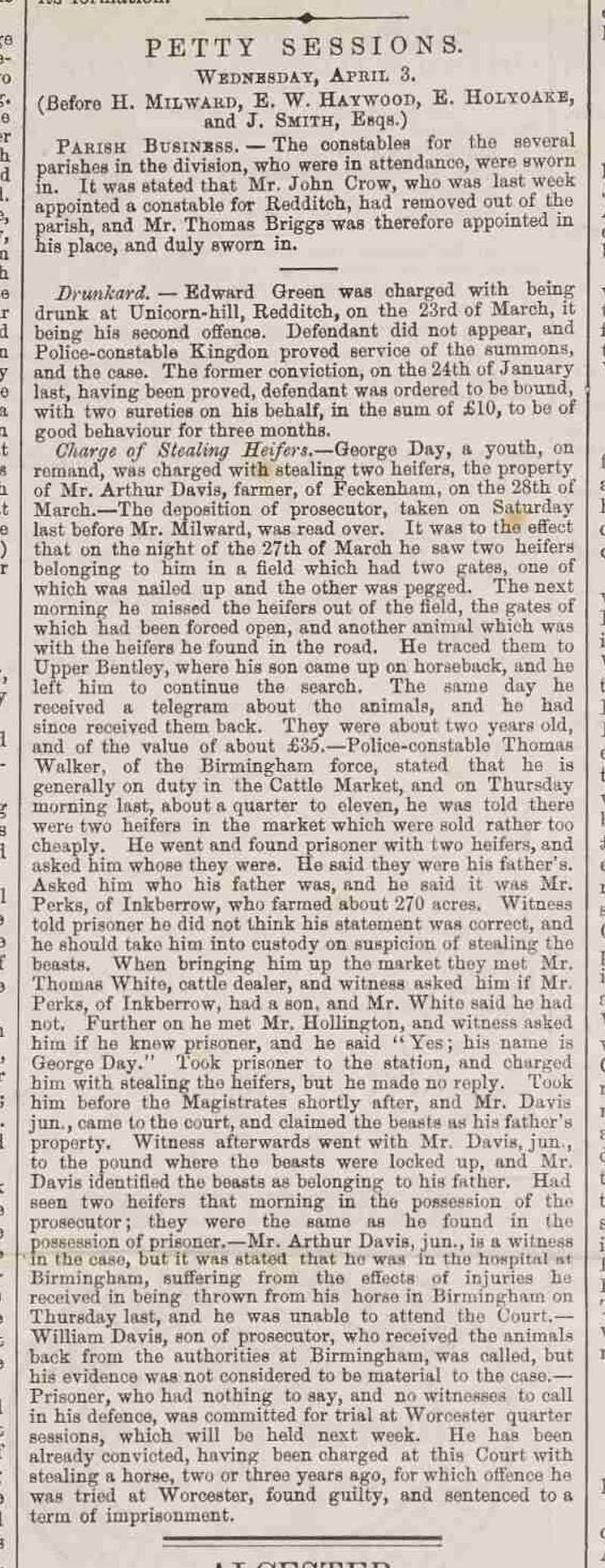
Parish Business. – The constables for the several parishes in the division, who were in attendance, were sworn in. It was stated that Mr. John Crow, who was last week appointed a constable for Redditch, had removed out of the parish, and Mr. Thomas Briggs was therefore appointed in his place, and duly sworn in.
Drunkard. – Edward Green was charged with being drunk at Unicorn-hill, Redditch, on the 23rd of March, it being his second offence. Defendant did not appear, and Police-constable Kingdon proved service of the summons, and the case. The former conviction, on the 24th of January last, having been proved, defendant was ordered to be bound, with two sureties on his behalf, in the sum of £10, to be of good behaviour for three months.
Charge of Stealing Heifers. – George Day, a youth, on remand, was charged with stealing two heifers, the property of Mr. Arthur Davis, farmer, of Feckenham, on the 28th of March. – The deposition of prosecutor, taken on Saturday last before Mr. Milward, was read over. It was to the effect that on the night of the 27th of March he saw two heifers belonging to him in a field which had two gates, one of which was nailed up and the other was snagged. The next morning he missed the heifers out of the field, the gates of which had been forced open, and another animal which was with the heifers he found in the road. He traced them to Upper Bentley, where his son came up on horseback and left him to continue the search. The same day he received a telegram about the animals, and he had since received them back. They were about two years old, and of the value of about £35. – Police-constable Thomas Walker, of the Birmingham Force, stated that he is generally on duty in the Cattle Market, and on Thursday morning last, about a quarter to eleven, he was told there were heifers in the market which were sold rather too cheaply. He went and found prisoner with two heifers, and asked him whose they were. He said they were his father’s. Asked him who his father was, and he said it was Mr. Perks, of Inkberrow, who farmed about 270 acres. Witness told prisoner he did not think his statement was correct, and he should take him into custody on suspicion of stealing the beasts. When bringing him up the market they met Mr. Thomas White, cattle dealer, and witness asked him if Mr. Perks, of Inkberrow, had a son, and Mr. White said he had not. Further on he met Mr. Hollington, and witness asked him if he knew prisoner, and he said “Yes; his name is George Day.” Took prisoner to the station, and charged him with stealing the heifers, but he made no reply. Took him before the Magistrates shortly after, and Mr. Davis jun., came to the court, and claimed the beasts as his father’s property. Witness afterwards went with Mr. Davis, jun., to the pound where the beasts were locked up, and Mr. Davis identified the beasts as belonging to his father. Had seen two heifers that morning in the possession of the prosecutor; they were the same as he found in the possession of prisoner. – Mr. Arthur Davis, jun., is a witness in the case, but it was stated that he was in the hospital in Birmingham, suffering from the effects of injuries received in being thrown from his horse in Birmingham on Thursday last, and he was unable to attend the Court. – William Davis, son of prosecutor, who received the animals back from the authorities at Birmingham, was called, but his evidence was not considered to be material to the case. – Prisoner, who had nothing to say, and no witnesses to call in his defence, was committed for trial at Worcester quarter sessions, which will be held next week. He has been already convicted, having been charged at this Court with stealing a horse, two or three years ago, for which offence he was tried at Worcester, found guilty, and sentenced to a term of imprisonment.
Explanation and Analysis
This excerpt from the Bromsgrove & Droitwich Messenger (6 April 1872) reports on the proceedings of a petty session, a type of local magistrates’ court dealing with minor legal matters. The cases include swearing in of constables, a habitual drunkard’s penalty, and a charge of livestock theft.
Law in 1872
- Petty Sessions: These were lower courts handling minor criminal cases, licensing issues, and local disputes. Magistrates, often local landowners or officials, presided over them.
- Drunkenness: At the time, being publicly drunk was considered a public order offence. The punishment for Edward Green was not imprisonment but being bound to good behaviour with financial sureties. This means he had to provide a bond (£10) and find two guarantors to ensure he remained sober and law-abiding for three months.
- Livestock Theft: A serious offence in agrarian communities, livestock theft was punishable by imprisonment. The accused, George Day, was already a convicted horse thief, which likely influenced the magistrates’ decision to commit him for trial.
Crime Patterns
- Drunkenness: Public drunkenness was a frequent offence in 19th-century Britain, often associated with labourers and the working class.
- Livestock Theft: Common in rural areas, where cattle and horses were valuable assets. The emergence of railways and markets made it easier for thieves to transport and sell stolen animals.
- Repeat Offenders: The fact that George Day had a prior conviction for stealing a horse suggests that habitual criminals were a concern, and authorities kept records of previous offences.
Job Roles
- Constables: Local law enforcement officers, sworn in to serve their parishes. Their duties included enforcing public order, investigating crimes, and presenting evidence in court.
- Magistrates (Justices of the Peace): Unpaid officials, usually landowners or businessmen, who presided over petty sessions and determined minor cases.
- Police Constables: Uniformed officers, often assigned specific duties (e.g., Cattle Market patrol in this case). Their role was to apprehend suspects, gather evidence, and present it in court.
- Farmers: Landowners and employers of agricultural labourers, responsible for large amounts of livestock and produce.
- Cattle Dealers: Traders who bought and sold livestock, making them key witnesses in identifying stolen animals.
- Labourers: Many of the accused in such cases were agricultural or manual labourers, sometimes resorting to theft due to poverty.
Conclusion
This court record highlights key aspects of law enforcement and rural crime in 19th-century England. While minor offences like drunkenness resulted in fines and behavioural bonds, serious crimes such as livestock theft led to imprisonment, particularly for repeat offenders. The role of magistrates, police constables, and community witnesses was crucial in maintaining law and order, reflecting the structured yet evolving nature of British justice in the Victorian era.
The history of The Bromsgrove & Droitwich Messenger
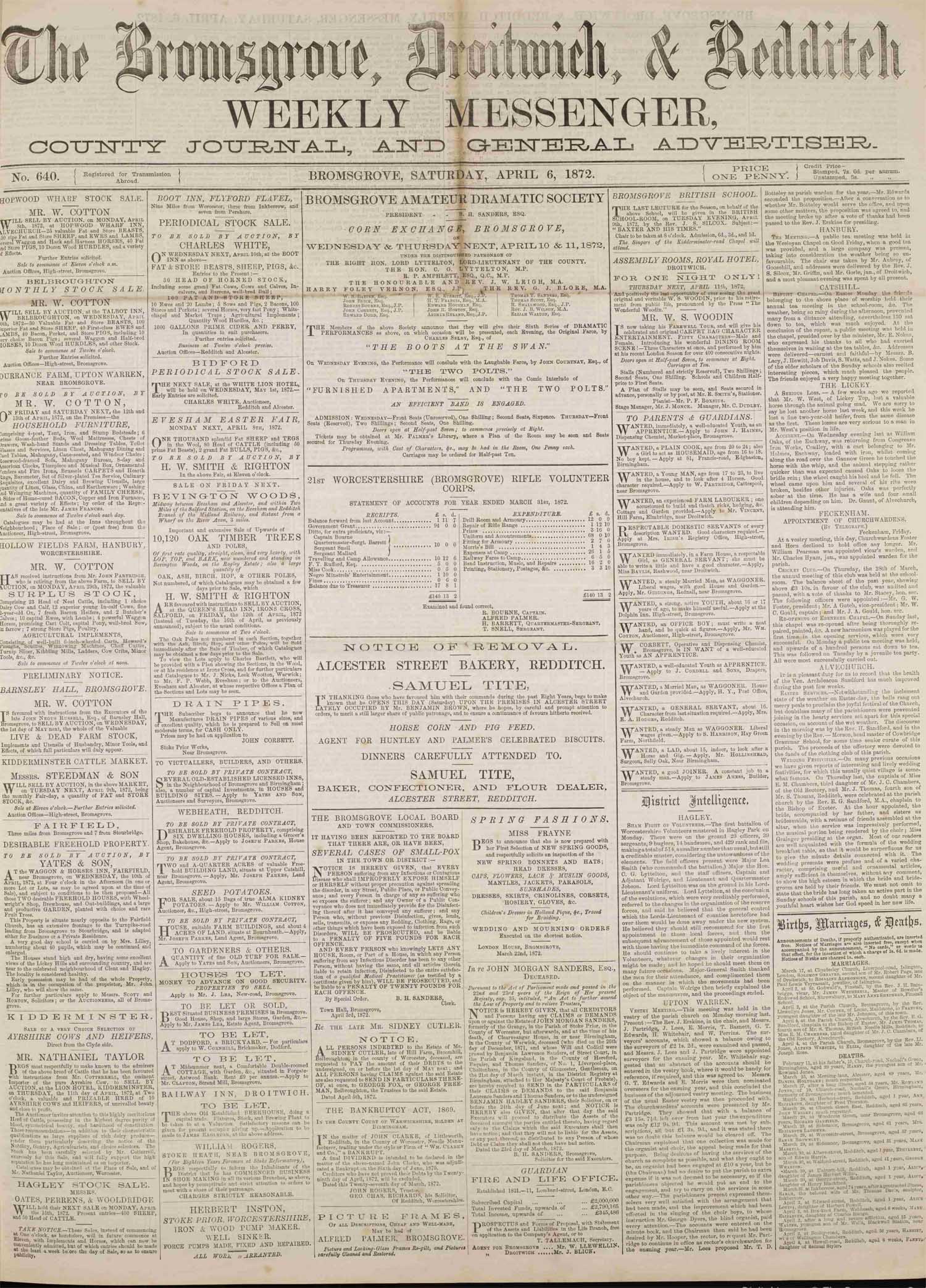
The Bromsgrove & Droitwich Messenger was a well-known local newspaper covering the Worcestershire towns of Bromsgrove, Droitwich, and later Redditch. It was first published on 7 January 1860 under the title The Bromsgrove and Droitwich Weekly Messenger, Local Intelligencer, and General Advertiser. In 1866, the paper expanded its coverage to Redditch, prompting a title change to The Bromsgrove, Droitwich & Redditch Weekly Messenger, County Journal, and General Advertiser, a name it retained until 1921.
The newspaper featured a broad mix of content, including national and international news, local events, petty session reports, Worcestershire news, trade advertisements, auctions, and family announcements. It served as a vital resource for residents seeking both local and wider news.
In 1963, it rebranded as the Bromsgrove Messenger, continuing its role as a primary news source for the region. Today, historic editions of the Bromsgrove & Droitwich Messenger have been digitised and can be accessed via the British Newspaper Archive, with available issues ranging from 1860 to 1917.
Additionally, the Bromsgrove branch of the Birmingham & Midland Society for Genealogy & Heraldry has digitised 67 years of the paper, covering 1860 to 1937. These editions are freely available online, providing an invaluable resource for historians and genealogists.
The Bromsgrove & Droitwich Messenger remains an important historical record, documenting the social, economic, and political landscape of Worcestershire for generations.
Petty Sessions: Drunkenness and Livestock Theft in Redditch and Feckenham #VictorianJustice #PettySessions #BromsgroveCourt #DroitwichHistory #CrimeAndPunishment #WorcestershireLaw #HistoricalCrime #DrunkennessLaws #LivestockTheft #19thCenturyCourt