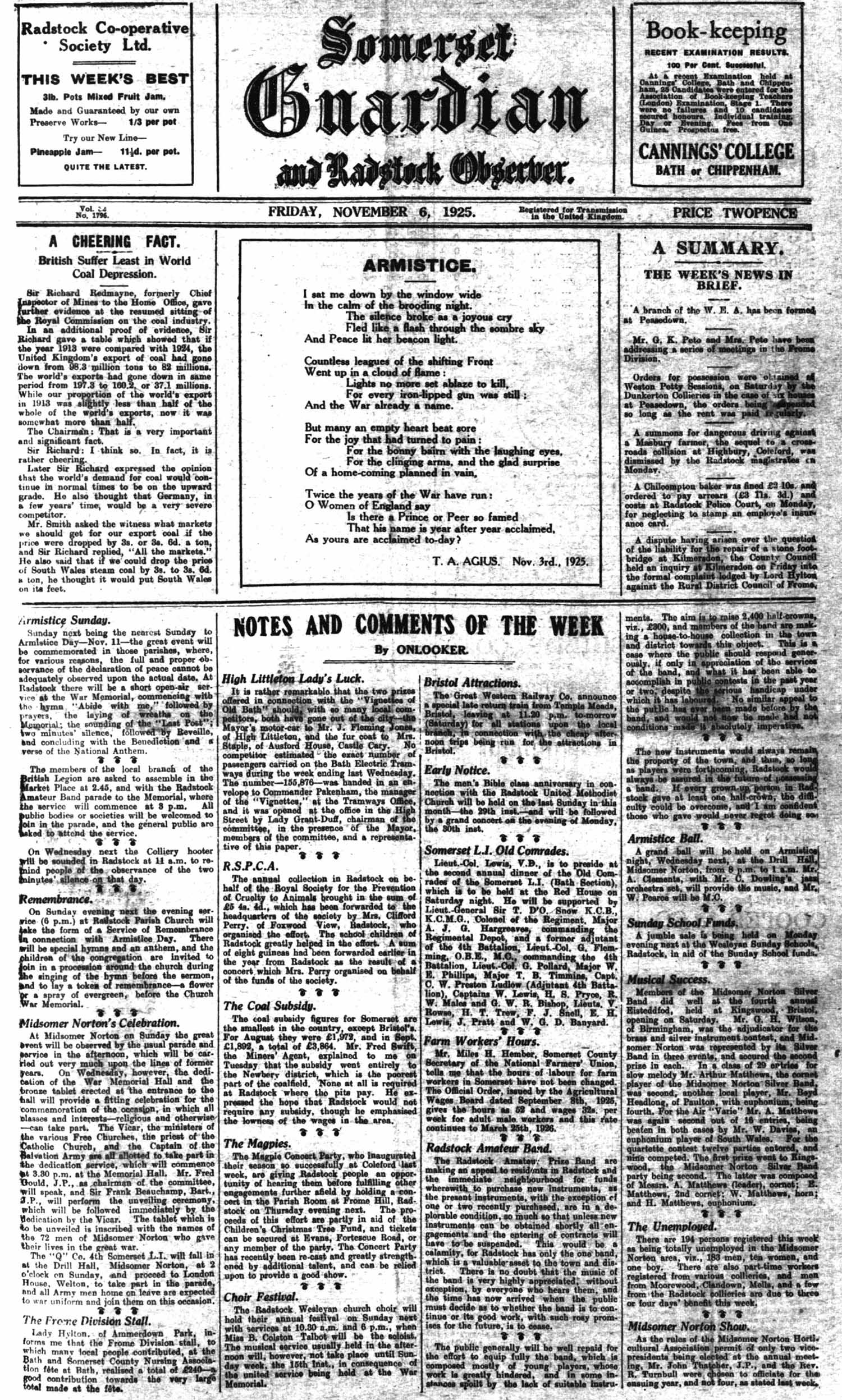
Somerset Guardian and Radstock Observer – Friday 06 November 1925
LIGHTING OFFENCES.
Tuesday, before Lieut.-Col. the Hon. Edward Strachey (in the chair), and Messrs. J. G. Norman, M. James, J. H. Tovey and S. W. Warrell.
CINEMATOGRAPH LICENSE.
On the application of the Rev. Maxwell Fisher (Rector), the Bench granted for one year a cinematograph license in respect to the Village Hall, Compton Martin.
LICENSE TRANSFERRED.
On the application of Mr. T. W. Biggs, for the George’s Breweries Co., the license of the Old Market Tavern, High Littleton, was transferred to the widow of the late Mr. Woodhouse (former licensee).
LIGHTING OFFENCES.
John Augustus Exton, motor driver, of Bristol, was summoned for driving a motor car without a red rear light, at 9.25 p.m. at Paulston, on October 3rd. Defendant was further summoned for failing to illuminate the index mark and number at the rear of the car at the same time and place. Defendant pleaded guilty to both offences, and upon the evidence of P.C. Curtis, a fine of 5s. was inflicted in each case.
Frederick Lippiatt, a dispenser, of Bristol, was summoned for riding a bicycle without a light at 12 o’clock midnight at Farrington Gurney on October 3rd. Defendant pleaded guilty, and the facts having been stated by P.C. Curtis, a fine of 5s. was imposed.
CARRIER SUMMONED.
Fred Mullins, carrier, of Timsbury, was summoned for allowing the engine of a motor charabanc to run, whilst being absent, at Timsbury, on October 15th.
Defendant, pleading guilty, informed the Bench that his accumulator had gone wrong, and he had been forced to keep his engine running to prevent the lights burning. He was only absent for a short time from his garage.
P.C. Lovell stated the facts, and under the circumstances the Bench dismissed the case.
Fred Mullins (defendant in the previous case) was also summoned for driving a motor charabanc without a red rear light at 8 p.m. at Timsbury, on October 15th, and there was a further summons against the defendant for failing to illuminate the index mark and number at the same time and place. Defendant pleaded guilty in each case, and the facts having been stated by P.C. Lovell, a fine of 5s. was imposed in each case.
TIMBER WAGON LIGHTS.
Henry Giles, timber merchant, of Bath, was summoned for driving a timber carriage without a red rear light, the timber projecting more than 6ft. beyond the hindmost wheels, at Farrington, on October 15th. Defendant failed to appear, and upon the evidence of P.C. Barber, a fine of 15s. was inflicted.
LOCO ON A BRIDGE.
David Bryant, engine driver, of Shepton Mallet, was summoned for allowing his locomotive to remain stationary on a county bridge at High Littleton, on October 15th. Defendant pleaded not guilty, but upon the evidence of P.C. Woodhouse, the Bench convicted, and imposed a fine of 6d.
Clifford McDonald Piggott, an engine driver, of Bristol, was summoned for a similar offence at High Littleton on October 23rd. Defendant did not appear, and upon the evidence of P.C. Woodhouse, a fine of 10s. was imposed.
AFTER THE APPLES.
Charles Carrott (23) and Robert Carrott (12), brothers, of Hinton Blewitt, were charged with an alleged theft of a quantity of apples, to the value of 6d., the property of Francis R. Whitefield, of Hinton Blewitt, on October 24th. Both elected to be dealt with summarily and pleaded guilty.
Minnie Louise James, of Hinton Blewitt, gave evidence of having seen the two defendants on the afternoon of the day in question at Mr. Whitefield’s orchard, where they were picking apples and putting them in their pockets. She and another witness had seen the two defendants in the orchard.
Prosecutor gave evidence that a lot of pilfering had been going on, although he had not himself actually seen any persons taking apples from the orchard.
P.C. Woodhouse gave evidence of having visited the home of defendants, where the elder one admitted having taken the apples.
The Bench dismissed the case against the boy, and ordered the elder defendant, Charles Carrott, to pay a fine of 7s. 6d.
Analysis of the Legal Context in 1925:
The cases presented in this court session reflect various minor legal infractions in early 20th-century England, many of which relate to transport, licensing, and petty theft.
1. Lighting Offences & Transport Laws
Many of the cases involve motor vehicles and bicycles failing to display proper lighting. In 1925, roads were largely unlit, and lighting requirements for vehicles were crucial to road safety. Laws at the time required:
Motor vehicles to have rear red lights and illuminated number plates.
Bicycles to have a front and rear light after dark.
Timber wagons carrying long loads to have sufficient lighting to alert other road users.
These laws were designed to prevent accidents in an era where motor transport was still developing. The enforcement of lighting laws illustrates the increasing regulation of road safety as motor traffic grew.
2. Stationary Locomotives on Bridges
Laws at the time prohibited locomotives from blocking bridges due to concerns about traffic congestion and structural strain. The small fines (6d and 10s) suggest this was a minor but regulated offence.
3. Licensing Laws
The granting of a cinematograph license for the village hall in Compton Martin reflects the spread of public entertainment venues in rural areas. Such licenses were required to ensure that film screenings complied with moral and safety regulations.
Similarly, the transfer of a pub license to the widow of the former licensee shows how alcohol licensing laws functioned at the time. Women could take over a deceased husband’s business, provided they were deemed fit to hold the license.
4. Petty Theft
The case of the Carrott brothers reflects the strict approach to theft, even for minor items like apples. The elder brother was fined, while the younger was dismissed, likely due to his age. This case illustrates:
The importance placed on property rights.
The community’s concern over theft from orchards, which suggests food pilfering was a common issue.
A degree of leniency toward juveniles in the justice system.
Implications for Historians:
Social History: The strict enforcement of lighting laws and licensing rules highlights the increasing regulation of public and private life as Britain modernised.
Economic Context: Fines for small infractions suggest a relatively low cost of legal penalties, reflecting the economic conditions of the working and lower-middle classes.
Crime & Punishment: The cases reveal a legal system focused on order and deterrence through small but enforceable penalties.
Transport Evolution: The transition from horse-drawn transport to motor vehicles and concerns about safety regulations are evident.
Gender & Work: The granting of a pub license to a widow shows that women could take over certain business roles, though only in a limited capacity.
This newspaper article offers a fascinating snapshot of daily life, law enforcement, and community concerns in 1925 Somerset.
The history of The Somerset Guardian and Radstock Observer
Somerset Guardian and Radstock Observer – Friday 06 November 1925
The Somerset Guardian and Radstock Observer was a weekly newspaper published in Radstock, Somerset, England. According to the British Newspaper Archive, it was in circulation from 1899 to 1962.
The paper primarily served the local communities of Somerset, covering news, events, and issues pertinent to the area.
The newspaper’s archives are held by the Somerset Heritage Centre, managed by the South West Heritage Trust. These archives provide valuable insights into the local history of Somerset during the late 19th and early 20th centuries.
The Somerset Guardian and Radstock Observer ceased publication in 1962, but its legacy continues through these archives, offering a window into the past for historians and the public alike.
Somerset Justice: Lighting Offences, Stalled Locomotives, and Apple Thieves in Court #SomersetHistory #1925Justice #PoliceCourt #LightingLaws #OldBritishNews #TransportRegulations #LocalCrime #HistoricalNewspapers #RadstockObserver #LegalHistory
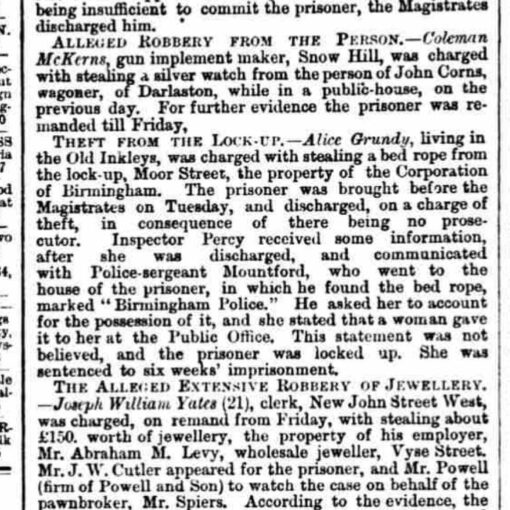
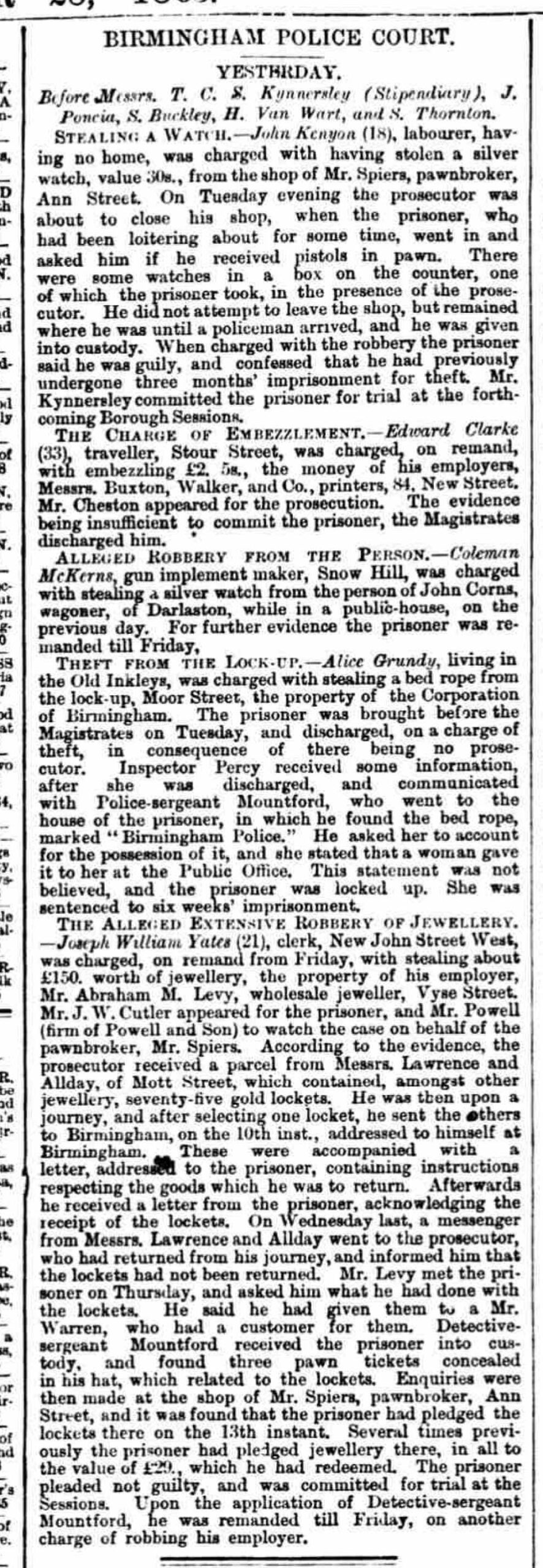
Birmingham Daily Post – Thursday 28 December 1865 BIRMINGHAM POLICE COURT YESTERDAY Before Messrs. T.C.S. Kynnersley (Stipendiary), J. Poncia, S. Buckley, H. […]