Berkshire Chronicle – Saturday 06 June 1835
HENLEY.
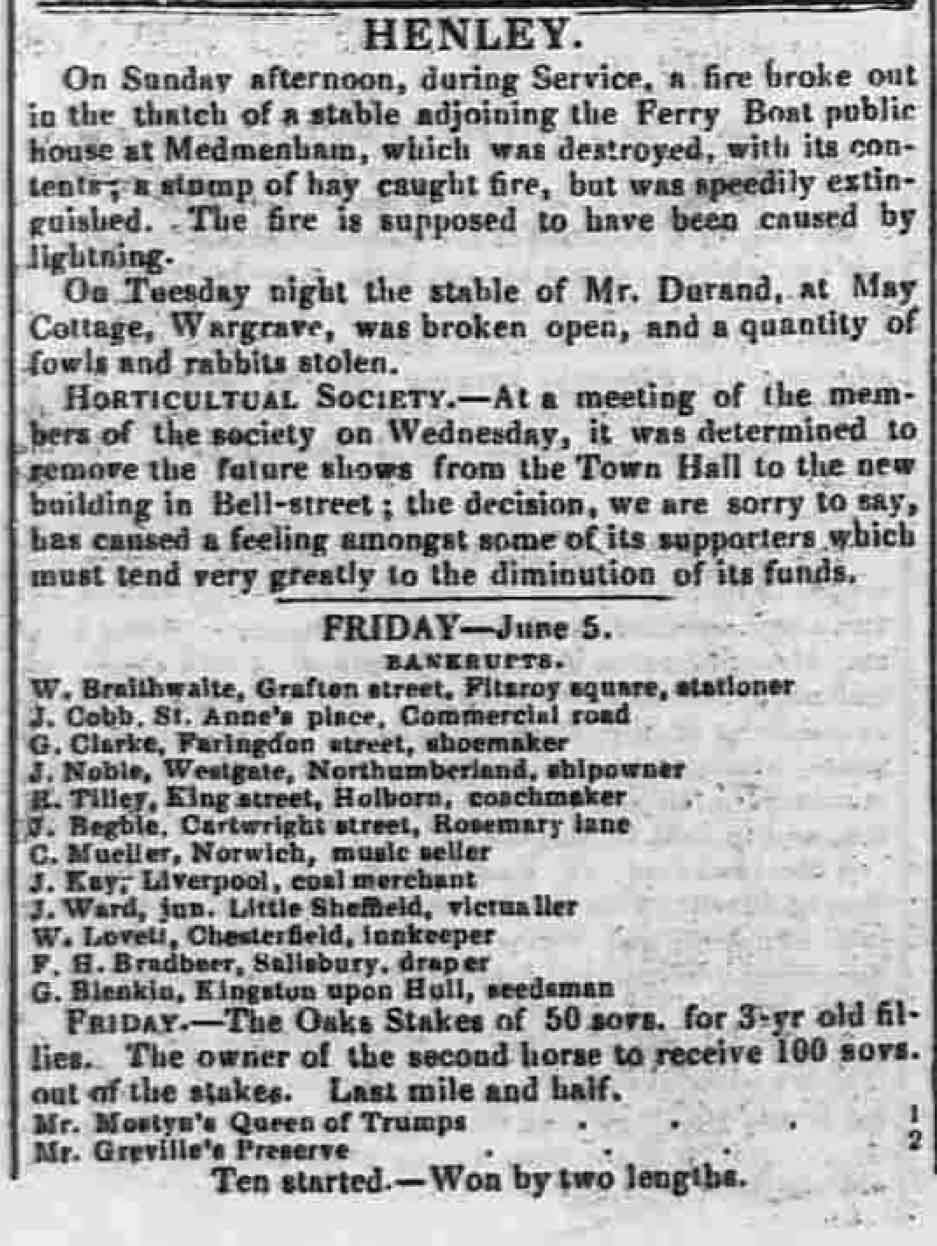
On Sunday afternoon, during Service, a fire broke out in the thatch of a stable adjoining the Ferry Boat public-house at Medmenham, which was destroyed, with its contents—a stump of hay caught fire, but was speedily extinguished. The fire is supposed to have been caused by lightning.
On Tuesday night the stable of Mr. Durand, at May Cottage, Wargrave, was broken open, and a quantity of fowls and rabbits stolen.
HORTICULTURAL SOCIETY.—At a meeting of the members of the society on Wednesday, it was determined to remove the future shows from the Town Hall to the new building in Bell-street; the decision, we are sorry to say, has caused a feeling amongst some of its supporters, which must tend very greatly to the diminution of its funds.
FRIDAY—June 5.
BANKRUPTS.
-
W. Braithwaite, Grafton street, Fitzroy square, stationer
-
J. Cobb, St. Anne’s place, Commercial road
-
G. Clarke, Farringdon street, shoemaker
-
G. Noble, Westgate, Northumberland, shipowner
-
R. Tiller, King street, Holborn, coachmaker
-
J. Begbie, Cartwright street, Rosemary lane
-
C. Mueller, Norwich, music seller
-
J. Kay, Liverpool, coal merchant
-
A. Ward, jun. Little Sheffield, victualler
-
W. Lovell, Chesterfield, innkeeper
-
E. H. Bradbeer, Salisbury, draper
-
G. Blenkins, Kingston upon Hull, seedsman
FRIDAY.—The Oaks Stakes of 50 sovs. for 3-yr old fillies. The owner of the second horse to receive 100 sovs. out of the stakes. Last mile and half.
-
Mr. Mostyn’s Queen of Trumps – 1
-
Mr. Greville’s Preserve – 2
Ten started.—Won by two lengths.
Detailed Analysis & Historical Context
📜 Laws and Implications (1835)
In 1835, Britain was in the midst of substantial legal and political reform. That year saw the passing of the Municipal Corporations Act 1835, reforming local government structures in boroughs across England and Wales. The bankruptcy list reflects the Bankruptcy Act 1825, which allowed traders (but not private individuals) to be declared bankrupt. Those declared bankrupt would often have all their assets liquidated to repay debts and were subject to public scrutiny—hence their names published in newspapers.
The theft at Wargrave (fowls and rabbits stolen) would have been considered larceny under the Larceny Act 1827—a criminal offence that could carry harsh penalties including imprisonment or even transportation to penal colonies.
The fire at Medmenham, assumed to be caused by lightning, would be an act of God and not subject to criminal liability unless arson were suspected. However, it reminds us how vulnerable thatched buildings were.
Occupations & Lives of the People
We see a vivid cross-section of early Victorian society and trade:
-
Stationers, shoemakers, coachmakers, and drapers represent the tradespeople reliant on urban commerce.
-
Shipowners, coal merchants, and seedsmen were part of the expanding industrial and agricultural economy.
-
Victuallers and innkeepers catered to both travellers and local communities—a staple of British social life.
-
Music sellers show the domestic cultural life—music was an important part of middle-class entertainment.
All of them declared bankrupt suggests the volatility of trade and economic hardship many faced, particularly as Britain entered the Victorian industrial boom. Bankruptcy was public and often humiliating, and many lost not only their business but social standing.
Community and Societies
The Horticultural Society reflects local efforts to bring scientific agriculture, botany, and beautification into community life. The debate about moving the venue shows how civic pride and local politics intertwined with funding and public engagement.
The dispute over venue could reflect class tensions—supporters preferring the traditional Town Hall over a new, possibly less central, building in Bell Street. Such decisions could seriously impact public support and funds.
Horse Racing – The Oaks Stakes
The Oaks Stakes, a prestigious horse race, shows the enduring cultural importance of racing among both aristocracy and public alike. The monetary prizes (in guineas or sovereigns) suggest significant betting and financial stakes.
-
Queen of Trumps, the winning horse, was in fact a real thoroughbred who won The Oaks in 1835 and later became a broodmare.
-
Mr. Mostyn and Mr. Greville were members of the gentry or nobility—landed elite who owned racing stables, showing how intertwined sport and status were.
Life in Berkshire in 1835
Henley-on-Thames, Wargrave, and surrounding towns were transitioning from rural agrarian societies into increasingly industrialised and commuter-linked towns. While agriculture remained central (evident in the fowl and rabbit theft and the horticultural society), the emergence of organised societies, large races, and new buildings point to modernisation and middle-class influence.
Local events (like church services interrupted by fire) also show how integrated religious and community life remained. At the same time, incidents of rural crime hint at growing concerns over law, order, and economic disparity.
Historical Value for Historians & Family Historians
-
Genealogists may find the bankruptcy lists invaluable, as these list names, occupations, and addresses—vital details for tracking ancestors.
-
The societal changes are evident in shifts like the relocation of public exhibitions—useful for historians studying social change, civic engagement, or urban development.
-
Events like the fire and theft offer micro-histories—insights into everyday risks, responses to disaster, and crime reporting.
-
The horse racing result, with specific horses and owners named, can assist historians of British sport, leisure, and aristocratic society.
Life in Henley-on-Thames in 1835
In the year 1835, Henley-on-Thames was a small but thriving market town nestled on the borders of Oxfordshire and Berkshire, famed for its picturesque position on the River Thames, its timber-framed buildings, and a community steeped in agriculture, river trade, and genteel society.
The River: Heart of Henley Life
The River Thames was both a literal and metaphorical lifeline for the town. It supported barge traffic, transporting goods such as timber, coal, hay, flour, and malt between Oxford and London. The Ferry Boat Inn, referenced in the Berkshire Chronicle article, was one of several public houses catering to river folk and townspeople alike. River traffic was slowing in favour of the emerging railway system, but in 1835, the Thames wharves remained busy.
The river was also a source of leisure and pride. Henley’s long association with rowing and regattas was taking root, and although the Henley Royal Regatta would not formally begin until 1839, amateur rowing contests and river outings were already part of the town’s social scene.
Occupations and Society
Henley in 1835 had a population of around 3,000. The majority were involved in:
-
Agriculture (labourers, shepherds, dairy workers)
-
Craft trades (blacksmiths, wheelwrights, coopers, shoemakers, tailors)
-
Retail (butchers, grocers, drapers)
-
Hospitality (innkeepers, ostlers, and domestic servants)
The town also supported gentry and professionals—solicitors, clergymen, physicians, and schoolmasters—who formed a growing middle class, influenced by national reforms and Evangelical Christianity.
Henley had several large estates and country houses in the surrounding area, owned by landowners and titled families. These estates provided employment to many, as well as a market for luxury goods.
Town Structure and Buildings
Henley’s town centre was focused around Hart Street and the Market Place, lined with Georgian and older timber-framed buildings. The Town Hall was a focal point for civic life, meetings, and elections. There were coaching inns such as the Red Lion, which hosted travellers journeying between London and Oxford.
Bell Street, mentioned in the Horticultural Society report, was a key thoroughfare—home to shops, chapels, and newly built meeting places reflecting the town’s expansion.
Many dwellings were still thatched—as noted in the newspaper’s report of a stable fire caused by lightning. Chimney fires and lightning strikes were a constant hazard in these years.
Religion and Morality
1835 was a time of deep religious feeling, particularly following the reforms of the Church of England and the rise of Nonconformist chapels. Henley’s residents largely attended St. Mary’s Church, the ancient parish church with its striking tower, although Methodist and Baptist chapels were also active.
Church was central to town life. The fire at Medmenham occurred during a Sunday service, highlighting both the importance of worship and the vulnerability of unattended property.
Crime and Policing
Crime in Henley was relatively low but persistent, as illustrated by the theft of fowls and rabbits from Mr. Durand’s property in nearby Wargrave. Poultry theft was common, and the punishment—depending on the value—could include imprisonment or transportation to Australia, under the Larceny Act 1827.
Henley had a local magistrate and petty sessions, often reported in the Reading Mercury or Berkshire Chronicle. These courts dealt with minor crimes, drunkenness, family disputes, and wage issues.
Leisure and Societies
The Henley Horticultural Society, mentioned in the 1835 newspaper article, shows the growing middle-class interest in botany, improvement, and public exhibitions. Moving the society’s shows from the Town Hall to Bell Street caused division—highlighting how even seemingly simple decisions could stir civic pride and tension.
Markets were held weekly, where local farmers sold produce and livestock. There were also annual fairs, drawing traders and entertainers from surrounding counties.
Reading of novels, music, and Sunday walks were among genteel pastimes. Card games, drinking, and betting were popular among working men. The town also had a subscription library and reading room for the educated elite.
Governance and Reform
1835 was a year of political change. The Municipal Corporations Act, passed that year, sought to reform local governance, rooting out corruption and making town councils more representative. Although Henley was not a large borough, such changes began to ripple through market towns, affecting everything from road maintenance to poor relief.
The Poor Law Amendment Act (1834) had just come into force, leading to the creation of workhouses and more centralised welfare. This was a source of resentment among the poor, who had previously relied on parish support.
Daily Life and Domestic Realities
-
Water came from public pumps or wells
-
Lighting was by oil lamp or candle—there was no gas lighting in smaller homes
-
Clothes were mostly homemade or mended, with Sunday-best outfits kept for worship
-
Children worked from an early age, often helping in shops, farms, or as domestic servants
-
Food was seasonal and local—bread, root vegetables, mutton, pies, and river fish
-
Medical care was basic, and epidemics (such as cholera or typhoid) were common
Summary: A Town in Transition
Henley in 1835 was neither wholly rural nor industrial, but a bridging community—genteel yet practical, rooted in farming but conscious of modern commerce and reform. It was a place where:
-
The gentry mixed with artisans and tradesmen
-
Fires and thefts could shake quiet Sundays
-
A decision about a horticultural show venue could split a town
-
And where the slow current of the Thames mirrored the steady rhythm of daily life
History of The Berkshire Chronicle
An Influential Voice in Provincial England (1825–20th Century)
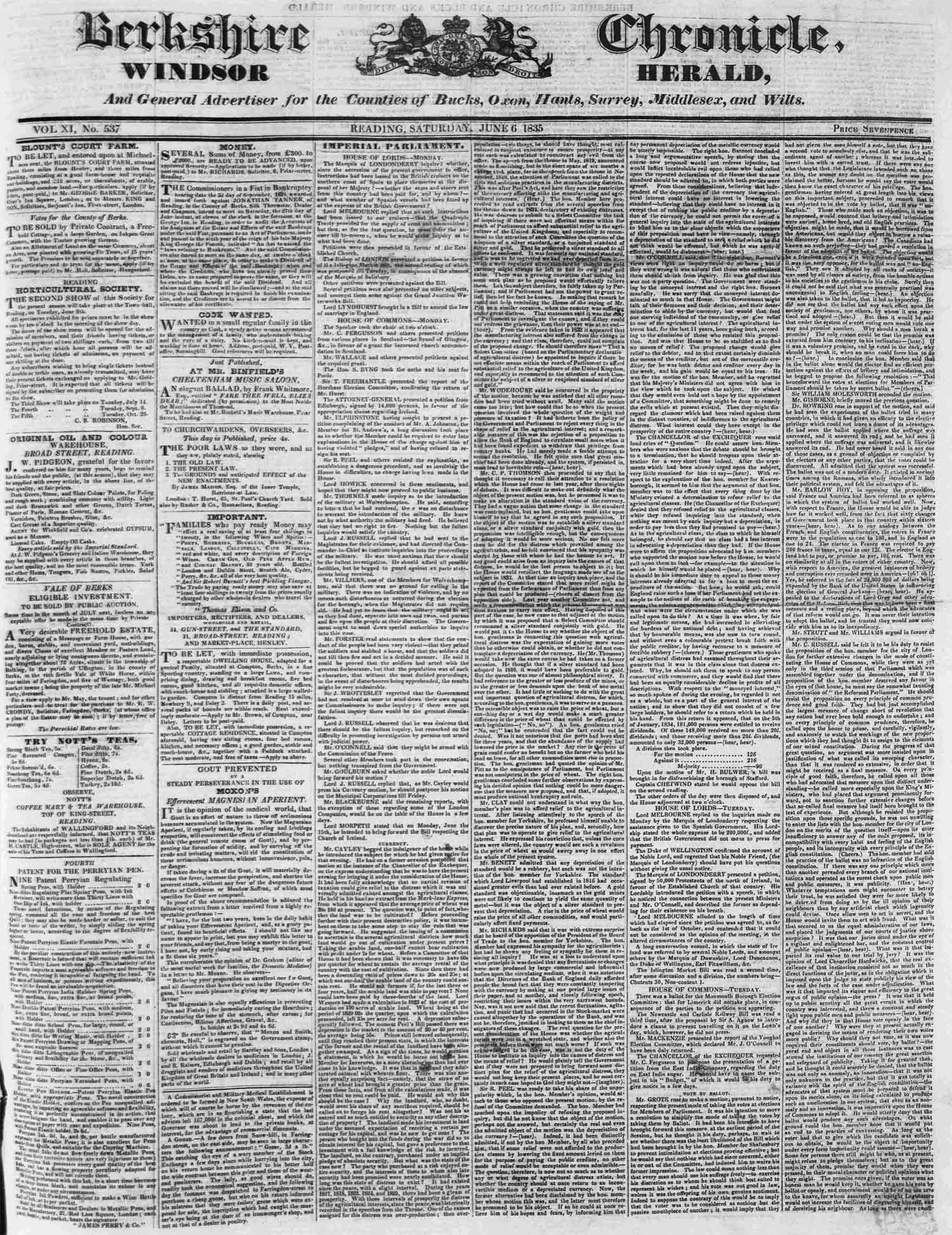
The Berkshire Chronicle was one of the most enduring and respected provincial newspapers in 19th-century England. First published in 1825, it served as a primary source of news, opinion, commercial intelligence, and community information for the county of Berkshire and its surrounding districts, including Reading, Newbury, Henley, Wallingford, and Windsor.
At a time when local newspapers were rising in influence following the relaxation of press taxation laws and the spread of literacy, the Berkshire Chronicle emerged as a moderate, reform-minded publication catering to the region’s growing middle class.
Founding and Early Years
Founded in Reading, the county town of Berkshire, the Chronicle was initially published weekly, reflecting the rhythms of both local life and national events. It reported on:
-
Parliamentary and council decisions
-
Local court and petty sessions
-
Agricultural and market news
-
Crime reports
-
Public meetings, lectures, and social events
-
Shipping intelligence and horse racing results
The early decades were shaped by great political and social reform, including the Catholic Emancipation Act (1829) and the Reform Act (1832)—events it covered with depth and local context.
Political Leanings and Editorial Character
While avoiding the extremes of radical or reactionary rhetoric, the Berkshire Chronicle leaned liberal-conservative, supporting measured reform, free trade, and strong civic institutions. Its editorial tone was informed but respectable, often appealing to clergy, professional men, merchants, and educated tradesmen.
It was part of the emerging “fourth estate” that held public figures to account, printing details of corruption, bankruptcies, and court proceedings, all of which served as valuable checks on power.
Role in the Community
The Chronicle became essential reading for those wishing to keep abreast of:
-
Legal affairs (such as bankruptcies, wills, and public notices)
-
Commercial interests, including property for sale, apprenticeships, and transport services
-
Cultural life, through coverage of local societies (horticultural, philosophical, temperance), fairs, concerts, and church affairs
It also played a role in community memory, recording fires, disasters, floods, crimes, and celebrations—effectively documenting the life and soul of Berkshire.
Content Style and Format
A typical edition of the Berkshire Chronicle in the 1830s–1850s might include:
-
Front page of classified ads—a tradition in the early newspaper press
-
Middle pages of news, split between national political affairs and regional matters
-
Law and police reports, naming individuals and providing precise descriptions
-
Market prices for grain, livestock, coal, and wool
-
Shipping lists and railway developments in the industrial age
Its language was formal but accessible, and its structure closely mirrored that of The Times, but on a more localised scale.
Technological Change and the Newspaper Boom
As printing technologies improved with the introduction of steam-powered presses and stereotyping, the Chronicle could increase both its size and frequency. By the mid to late 19th century, it may have evolved into a bi-weekly or even tri-weekly publication, especially during times of national crisis or local political excitement.
It likely adopted woodcut illustrations, and later photographic engravings, as these became affordable. Circulation grew with railway distribution, allowing copies to reach distant villages and market towns by morning.
Decline and Absorption
By the early 20th century, many local newspapers faced growing pressure from mass-market national titles and corporate newspaper groups. The Berkshire Chronicle, though still respected, struggled to maintain independence.
It was eventually merged or absorbed into other local publications—possibly into the Reading Mercury or others that later contributed to the foundation of what became the Reading Chronicle in the 20th century.
Its archives today survive in part, preserved on microfilm and digital format, available through the British Newspaper Archive, the British Library, and regional heritage centres.
Historical and Genealogical Value
For historians and family historians alike, the Berkshire Chronicle is a rich seam of primary source material:
-
Birth, marriage, and death notices provide essential family history clues
-
Court reports and bankruptcies offer insight into social status, occupations, and adversity
-
Reports of daily life give vivid colour to Victorian and Edwardian Berkshire
-
Political and religious coverage reflects the beliefs, debates, and institutions shaping the county
Because it was highly localised, it often includes names and places not recorded elsewhere—making it invaluable for tracing lesser-known ancestors, tradespeople, and small farmers.
Conclusion
The Berkshire Chronicle was not just a newspaper; it was a mirror of a county in transition. From the post-Napoleonic period through to the dawn of modern democracy, its pages captured the voices, scandals, tragedies, celebrations, and transformations of Berkshire’s people.
Its legacy lives on—not in headlines, but in the meticulous weekly chronicles of everyday life that, nearly two centuries later, still speak volumes to researchers, historians, and families alike.
In Brief
FIRE, THEFT & BANKRUPTS IN 1835 HENLEY
From lightning-struck stables to stolen rabbits and bankrupt shoemakers — a vivid window into rural Berkshire life in the 1830s from the Berkshire Chronicle, 6 June 1835.
#History #Berkshire #Henley #1835 #Genealogy #BritishNewspapers #LocalHistory #VictorianLife #HorseRacing #Archives #Horticulture #FamilyHistory #CrimeHistory