Chelmsford Chronicle – Friday 31 August 1832
UTTERERS OF COUNTERFEIT COIN.
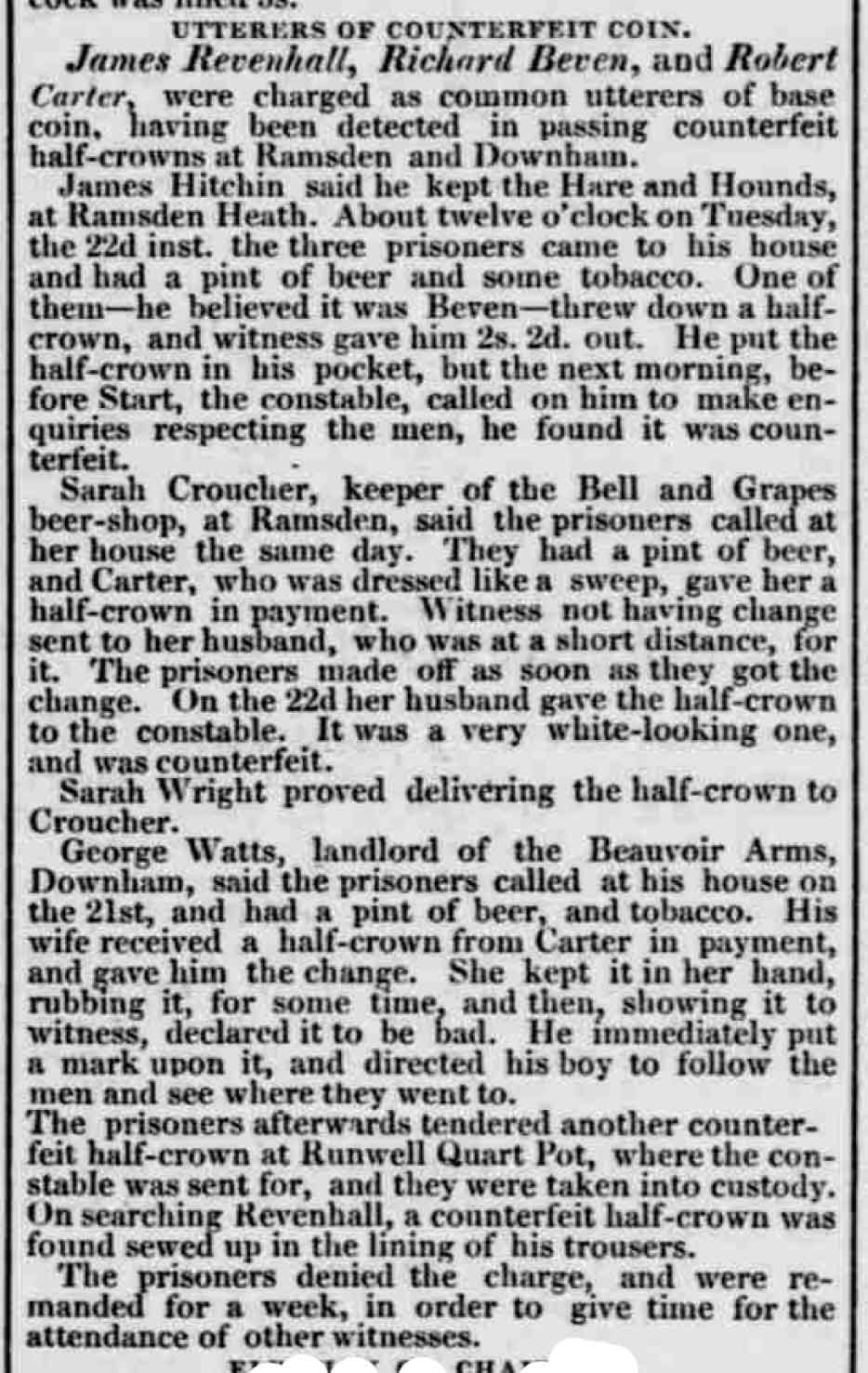
James Revenhall, Richard Beven, and Robert Carter, were charged as common utterers of base coin, having been detected in passing counterfeit half-crowns at Ramsden and Downham.
James Hitchin said he kept the Hare and Hounds, at Ramsden Heath. About twelve o’clock on Tuesday, the 22d inst., the three prisoners came to his house and had a pint of beer and some tobacco. One of them—he believed it was Beven—threw down a half-crown, and witness gave him 2s. 2d. out. He put the half-crown in his pocket, but the next morning, before Start, the constable, called on him to make enquiries respecting the men, he found it was counterfeit.
Sarah Croucher, keeper of the Bell and Grapes beer-shop, at Ramsden, said the prisoners called at her house the same day. They had a pint of beer, and Carter, who was dressed like a sweep, gave her a half-crown in payment. Witness not having change sent to her husband, who was at a short distance, for it. The prisoners made off as soon as they got the change. On the 22d her husband gave the half-crown to the constable. It was a very white-looking one, and was counterfeit.
Sarah Wright proved delivering the half-crown to Croucher.
George Watts, landlord of the Beauvoir Arms, Downham, said the prisoners called at his house on the 21st, and had a pint of beer, and tobacco. His wife received a half-crown from Carter in payment, and gave him the change. She kept it in her hand, rubbing it, for some time, and then, showing it to witness, declared it to be bad. He immediately put a mark upon it, and directed his boy to follow the men and see where they went to.
The prisoners afterwards tendered another counterfeit half-crown at Runwell Quart Pot, where the constable was sent for, and they were taken into custody. On searching Revenhall, a counterfeit half-crown was found sewed up in the lining of his trousers.
The prisoners denied the charge, and were remanded for a week, in order to give time for the attendance of other witnesses.
Legal and Social Analysis (1832 England)
Legal Context: Counterfeit Coining in 1832
In 1832, “uttering base coin” (i.e., knowingly passing counterfeit money) was a criminal offence under English law, punishable by imprisonment, hard labour, or even transportation for repeat or serious offenders.
Under:
-
The Counterfeit Coin Act of 1805, and later consolidated in the Offences Against the Coinage Act, penalties were severe.
-
The term “common utterers” implied repeat offences or an organised intent.
The judicial system treated coin forgery seriously due to its threat to public trust and the economy. This case, involving multiple instances across pubs in Essex villages, was a clear example of travelling coiners—a known phenomenon in the early 19th century.
Pubs as Economic Hubs
-
All incidents occurred in rural pubs, where beer and tobacco were commonly purchased with silver coin.
-
Publicans acted as gatekeepers of local trust—they could detect fraud, report offenders, and protect their patrons.
-
Sarah Croucher (Bell & Grapes), James Hitchin (Hare and Hounds), and George Watts (Beauvoir Arms) all demonstrated a high level of vigilance.
Tactics of the Offenders
-
Use of disguise: Carter was “dressed like a sweep”, possibly to attract less suspicion or to present himself as a working-class labourer.
-
Strategic movements: The group visited several locations in rapid succession, staying only long enough to pass coins and collect change.
-
Concealing false coins (e.g. sewing one into trousers) suggests premeditation and intent.
Implications for Social Historians and Family Historians
-
Named individuals: This report offers valuable surname mentions (Revenhall, Beven, Carter, Croucher, Watts, Wright, Hitchin), occupations (landlord, beer-shop keeper), and places of residence or business.
-
Insight into rural justice: Local constables, cooperation among publicans, and swift community response show how law enforcement relied on the vigilance of ordinary people.
-
The accused were likely transient or itinerant men, a group frequently viewed with suspicion and more vulnerable to harsh penalties.
What We Learn About Life in 1832 Essex
-
Pubs were vital not just for social life but for commerce, communication, and local justice.
-
Cash transactions were routine but risky—change-giving was a vulnerability exploited by criminals.
-
Communities in places like Ramsden Heath and Downham were tightly knit, with locals acting quickly when suspicions were raised.
-
The criminal justice system operated on a local scale—charges, remands, and witness gathering were community-driven.
-
Dress (e.g., “dressed like a sweep”) could influence perception and suspicions.
Historical Context of 1832
The year 1832 was significant in British history, marked by the passing of the Reform Act 1832, which restructured the electoral system of England and Wales. This act addressed issues of parliamentary representation, eliminating “rotten boroughs” and granting seats to emerging industrial towns. It also extended voting rights to a broader segment of the male population, though universal suffrage was still distant. Discussions and debates surrounding this act would have prominently featured in local publications like the Chelmsford Chronicle.
Local Implications in Chelmsford
In 1832, Chelmsford was a burgeoning market town with a population approaching 3,800. The town was experiencing the early stages of the Industrial Revolution, leading to shifts in occupations and the establishment of new businesses. Traditional roles in agriculture were complemented by emerging opportunities in engineering and manufacturing. The arrival of the railway in 1843 would later bolster this industrial growth, but even in 1832, the seeds of change were evident.
The Chelmsford Chronicle likely covered local events such as markets, fairs, and public gatherings. Notably, Chelmsford suffered a cholera outbreak in 1832, reflecting the broader public health challenges of the era. The newspaper would have reported on such health crises, offering insights into the living conditions and medical understanding of the time.
Occupations and Social Structure
The social fabric of Chelmsford in 1832 was a tapestry of traditional and emerging occupations. While many residents were engaged in agriculture, others found employment in trades such as blacksmithing, carpentry, and brewing. The presence of inns and public houses, like the notable Black Boy Inn, indicated a thriving hospitality sector catering to travelers and locals alike. The Chelmsford Chronicle would have featured advertisements and announcements related to these businesses, providing a window into the commercial life of the town.
Legal Framework and Public Institutions
The legal landscape of the time was characterized by reforms and the establishment of institutions aimed at addressing social issues. For instance, the Poor Law system was in place, with workhouses serving as a means to support the destitute. Chelmsford had its own workhouse, reflecting the nationwide approach to poverty alleviation. The Chelmsford Chronicle might have reported on the conditions within these institutions, shedding light on societal attitudes towards poverty and welfare.
Value for Historians and Family Researchers
For historians and genealogists, editions of the Chelmsford Chronicle from 1832 are invaluable. They offer firsthand accounts of daily life, societal norms, and local responses to national events. Family historians can glean information about ancestors through announcements of births, marriages, deaths, and advertisements for local businesses. Such details help construct a vivid picture of individual lives within the broader historical context.
Insights into Chelmsford’s 1832 Lifestyle
Life in Chelmsford during 1832 was a blend of tradition and transition. The town maintained its market roots while gradually embracing industrial advancements. Public health challenges, like the cholera outbreak, underscored the need for infrastructural improvements, which would come in subsequent decades. The Chelmsford Chronicle served as a mirror to these times, capturing the essence of a community navigating the currents of change.
History of the Chelmsford Chronicle
Origins and Founding (1764)
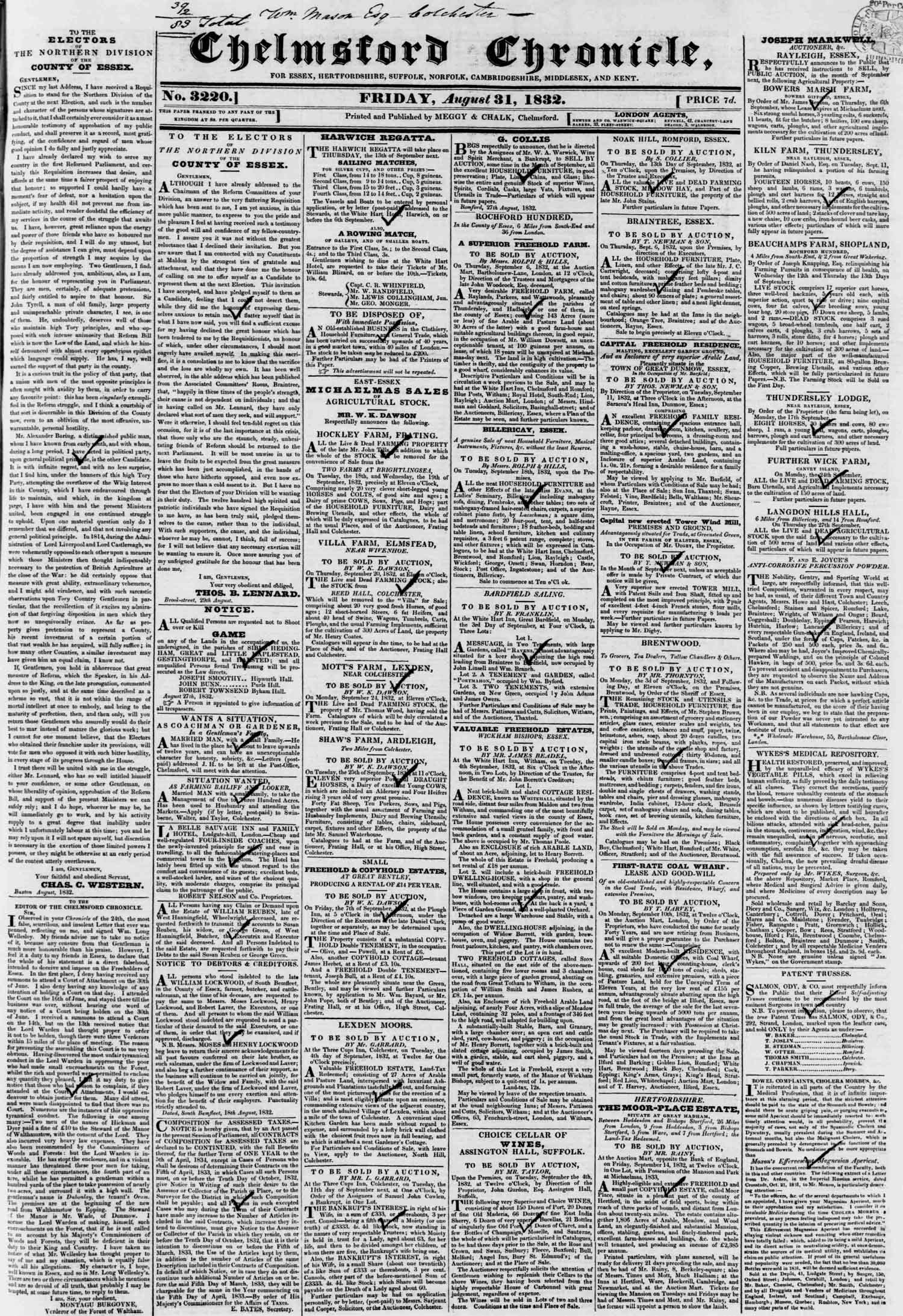
The Chelmsford Chronicle was first published in 1764, during the reign of King George III. It was founded by John Meggy, a Chelmsford printer and bookseller, who ran his press from premises in the town centre. The newspaper began as a weekly broadsheet, distributed locally and sold for threepence per copy (equivalent to roughly £1.50 today).
At the time, provincial newspapers were few and far between. London titles dominated national discourse, but rural and regional communities were increasingly seeking local news, advertisements, and public notices relevant to their own affairs. The Chelmsford Chronicle stepped in to meet that need in Essex, particularly for the mid-Essex area around Chelmsford.
The full title of the newspaper in its earliest years was often rendered as:
The Chelmsford Chronicle, or Essex Weekly Advertiser
It combined news reports, political updates, parliamentary summaries, court cases, shipping news, poetry, and advertisements.
18th and Early 19th Century Development
In its first few decades, the newspaper was closely aligned with the Whig political interests and frequently published material sympathetic to the Reform movement. It also printed reports from abroad, including dispatches from wars in Europe and the Americas. Local news focused on:
-
Market prices for agricultural goods
-
Public hangings and assizes at Chelmsford Gaol
-
Births, marriages, and deaths
-
Notices of missing persons, debtors, and auctions
It was also used as a vehicle for the dissemination of official government proclamations, particularly during the Napoleonic Wars and the early 19th century.
Family Ownership and Continuity
The newspaper remained under the Meggy family for generations. After John Meggy’s death, his descendants and business partners continued the enterprise. In 1832 (the date of the issue you’re interested in), the paper was being published by Meggy and Chalk, a firm of printers and publishers in Chelmsford.
This continuity of family ownership gave the Chronicle stability and a strong reputation for local accuracy. It remained fiercely independent, even when covering controversial topics such as the 1832 Reform Act and later, Chartism.
Mid-Victorian Expansion and Innovations
In the 1850s–1880s, the paper began to broaden its appeal. Key developments included:
-
More classified advertisements, particularly for employment and property
-
Regular railway timetables, reflecting the increasing mobility of the local population
-
Dedicated sections on crime, education, agriculture, and religion
-
Improved printing quality due to steam-powered presses
The Chronicle was an essential tool for estate agents, auctioneers, clergy, and schoolmasters across the county.
Late 19th and Early 20th Century: Transition and Transformation
By the 1890s, the paper had a growing rival in the Essex County Standard, based in Colchester. However, the Chronicle continued to be the principal news source in mid-Essex, due in part to:
-
Its long-standing reputation
-
Strong ties with county council and court records
-
Detailed reporting on Chelmsford Borough Council
It adopted new layout techniques, included illustrations, and added correspondents in rural parishes.
During the First World War (1914–1918), the paper was filled with:
-
Casualty lists
-
Patriotic appeals
-
War bond advertisements
-
Letters from soldiers
Interwar and WWII Years
The paper played an essential role during the Second World War, publishing information on:
-
Evacuation orders
-
Rationing updates
-
Civil Defence notices
-
Reports of bomb damage, particularly after the Chelmsford Blitz of 1943
Despite paper shortages and censorship, it remained in regular weekly publication throughout the conflict.
Post-War to Modern Times
Following the war, the newspaper gradually moved from traditional broadsheet to tabloid format and modernised its printing techniques.
In 1969, recognising its wider circulation beyond Chelmsford, the paper was officially renamed the Essex Chronicle. Despite the change, many locals continued to refer to it by its historic name.
In the 1990s, the paper was acquired by Northcliffe Media, part of the Daily Mail & General Trust group. In 2012, ownership passed to Local World, and eventually to Reach plc, the UK’s largest local newspaper publisher.
Digital Era
Today, the paper operates in both print and digital formats. The website EssexLive serves as its online platform, offering real-time news updates, local stories, and multimedia content.
The archives of the Chelmsford Chronicle are digitally preserved, with issues from 1764 to the 20th century available via:
-
The British Newspaper Archive (BNA)
-
Essex Record Office
-
Local history societies and family history resources
Historical Significance
For Historians
-
A primary source for 18th and 19th century Essex life.
-
Provides insight into rural political change, especially regarding the Reform Acts.
-
Details social issues like public health, sanitation, education, and crime.
-
Records changes in language, editorial style, and public opinion over time.
For Family Historians
-
Births, marriages, and deaths often published in full.
-
Court records and inquests list full names, occupations, and addresses.
-
Estate sales, employment notices, and missing persons all provide genealogical clues.
-
Coverage of village and parish affairs that aren’t found elsewhere.
Life in Chelmsford Through the Chronicle’s Lens
The paper shows Chelmsford as:
-
A bustling market town evolving into a commuter hub.
-
A centre for military and industrial innovation, especially in later years with Marconi’s radio factory and Hoffmann’s ball bearing works.
-
A population shifting from agrarian roots to urban complexity, with constant references to social tension, migration, and changing values.
Legacy of the Chelmsford Chronicle
-
One of Britain’s longest-running provincial newspapers.
-
A continuous record of 260+ years of local life.
-
Now part of a digital age while preserving deep print traditions.
Conclusion
The Chelmsford Chronicle of 31 August 1832 offers a snapshot of a town at the crossroads of tradition and modernity. Through its pages, readers gain access to the lives, challenges, and aspirations of Chelmsford’s residents during a pivotal era in British history. For those interested in the intricate tapestry of local heritage, this newspaper remains an indispensable resource.
In Brief
Headline: “Exploring Chelmsford’s Past: Insights from the 1832 Chelmsford Chronicle“ChelmsfordHistory #1832Chronicles #EssexHeritage #HistoricalNewspapers #ChelmsfordChronicle