St James’s Gazette – Tuesday 23 June 1885
OUTRAGE IN IRELAND.
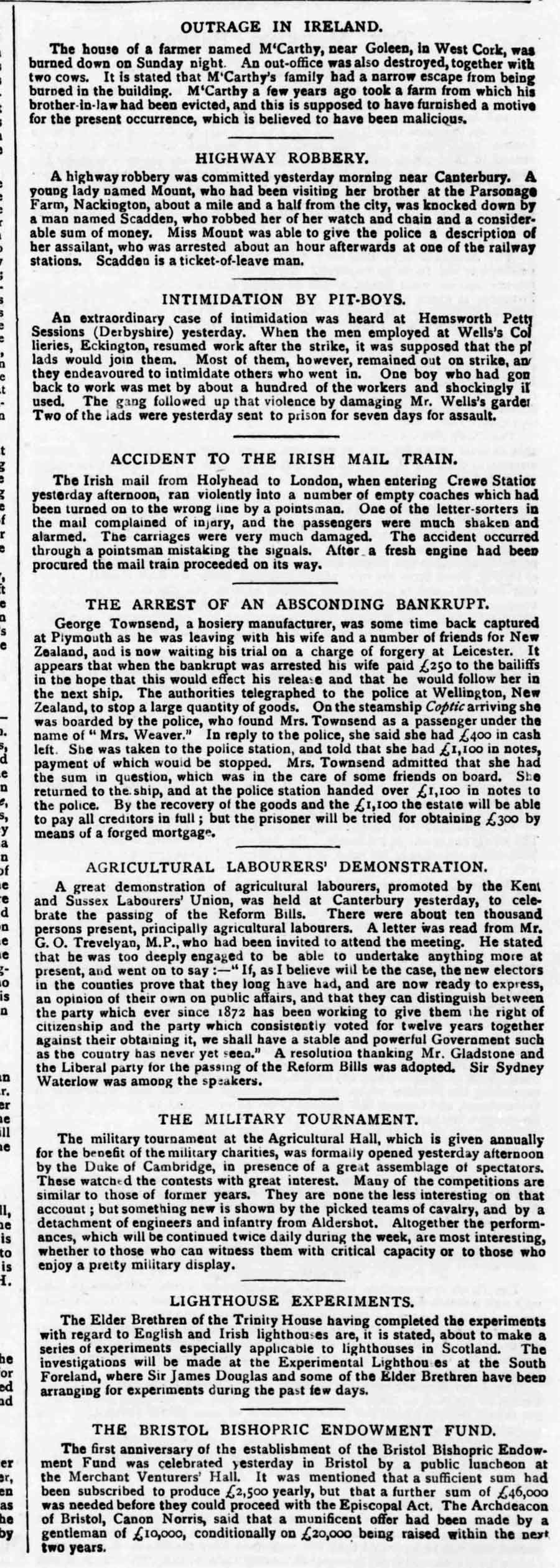
The house of a farmer named M‘Carthy, near Goleen, in West Cork, was burned down on Sunday night. An out-office was also destroyed, together with two cows. It is stated that M‘Carthy’s family had a narrow escape from being burned in the building. M‘Carthy a few years ago took a farm from which his brother-in-law had been evicted, and this is supposed to have furnished a motive for the present occurrence, which is believed to have been malicious.
HIGHWAY ROBBERY.
A highway robbery was committed yesterday morning near Canterbury. A young lady named Mount, who had been visiting her brother at the Parsonage Farm, Nackington, about a mile and a half from the city, was knocked down by a man named Scadden, who robbed her of her watch and chain and a considerable sum of money. Miss Mount was able to give the police a description of her assailant, who was arrested about an hour afterwards at one of the railway stations. Scadden is a ticket-of-leave man.
INTIMIDATION BY PIT-BOYS.
An extraordinary case of intimidation was heard at Hemsworth Petty Sessions (Derbyshire) yesterday. When the men employed at Wells’s Collieries, Eckington, resumed work after the strike, it was supposed that the pit lads would follow them. Most of them, however, remained out on strike, and they endeavoured to intimidate those who went in. One boy who had gone to the works was met by about a hundred of the workers and knocked down and kicked by two lads, and stones were thrown and sticks and other weapons used. The gang followed up that violence by damaging Mr. Wells’s garden. Two of the lads were yesterday sent to prison for seven days for assault.
ACCIDENT TO THE IRISH MAIL TRAIN.
The Irish mail from Holyhead to London, when entering Crewe Station yesterday afternoon, ran violently into a number of empty coaches which had been turned on to the wrong line by a pointsman. One of the letter-sorters in the mail complained of injury, and the passengers were much shaken and alarmed. The carriages were very much damaged. The accident occurred through a pointsman mistaking the signals. After a fresh engine had been procured the mail train proceeded on its way.
THE ARREST OF AN ABSCONDING BANKRUPT.
George Townsend, a hosiery manufacturer, was some time back captured at Plymouth as he was leaving with his wife and a number of friends for New Zealand, and is now waiting his trial on a charge of forgery at Leicester. It appears that when the bankrupt was arrested his wife paid £250 to the bailiffs in the hope that this would effect his release: and that he would follow her in the next ship. The authorities telegraphed to the police at Wellington, New Zealand, to stop a large quantity of goods. On the steamship Coptic arriving she was boarded by the police, who found Mrs. Townsend as a passenger under the name of “Mrs. Weaver.” In reply to the police, she said she had £400 in cash left. She was taken to the police station, and told that she had £1,100 in notes, the payment of which would be stopped. Mrs. Townsend admitted that she had returned to the ship, and at the police station handed over £1,100 in notes to the police. By the recovery of the goods and the £1,100 the estate will be able to pay all creditors in full; but the prisoner will be tried for obtaining £300 by means of a forged mortgage.
AGRICULTURAL LABOURERS’ DEMONSTRATION.
A great demonstration of agricultural labourers, promoted by the Kent and Sussex Labourers’ Union, was held at Canterbury yesterday, to celebrate the passing of the Reform Bills. There were about ten thousand persons present, principally agricultural labourers. A letter was read from Mr. G.O. Trevelyan, M.P., who had been invited to attend the meeting. He stated that he was too deeply engaged to be able to undertake anything more at present, and went on to say:—“If, as I believe will be the case, the new electors in the counties prove that they long have had, and are now ready to express, an opinion of their own on public affairs, and that they can distinguish between the party which ever since 1872 has been working to give them the right of citizenship and the party which consistently voted for twelve years together against their obtaining it, we shall have a stable and powerful Government such as the country has never yet seen.” A resolution thanking Mr. Gladstone and the Liberal party for the passing of the Reform Bills was adopted. Sir Sydney Waterlow was among the speakers.
THE MILITARY TOURNAMENT.
The military tournament at the Agricultural Hall, which is given annually for the benefit of the military charities, was formally opened yesterday afternoon by the Duke of Cambridge, in presence of a great assemblage of spectators. These watched the contests with great interest. Many of the competitions are similar to those of former years. They are none the less interesting on that account; but something new is shown by the picked teams of cavalry, and by a detachment of engineers and infantry from Aldershot. Altogether the performances, which will be continued twice daily during the week, are most interesting, whether to those who can witness them with critical capacity or to those who enjoy a pretty military display.
LIGHTHOUSE EXPERIMENTS.
The Elder Brethren of the Trinity House having completed the experiments with regard to English and Irish lighthouses are, it is stated, about to make a series of experiments especially applicable to lighthouses in Scotland. The investigations will be made at the Experimental Lighthouse at the South Foreland, where Sir James Douglas and some of the Elder Brethren have been arranging for experiments during the past few days.
THE BRISTOL BISHOPRIC ENDOWMENT FUND.
The first anniversary of the establishment of the Bristol Bishopric Endowment Fund was celebrated yesterday in Bristol by a public luncheon at the Merchant Venturers’ Hall. It was mentioned that a sufficient sum had been subscribed to produce £2,500 yearly, but that a further sum of £4,600 was needed before they could proceed with the Episcopal Act. The Archdeacon of Bristol, Canon Norris, said that a munificent offer had been made by a gentleman of £10,000, conditionally on £20,000 being raised within the next two years.
HISTORICAL ANALYSIS
Legal Context (1885)
-
Ticket-of-leave: A form of conditional release from prison in Victorian England, akin to modern parole. The Penal Servitude Acts regulated this.
-
Forgery: A felony under the Forgery Act 1861, and severely punished. George Townsend’s £300 forgery was significant; punishment could include penal servitude.
-
Assault and Public Order: The Offences Against the Person Act 1861 covered assault, while public disorder and intimidation during strikes were treated seriously, with prison sentences like those given to the pit-boys.
People and Occupations
-
George Townsend: Hosiery manufacturer, implying the importance of textile trades in the Midlands (Leicester in particular).
-
Mrs. Townsend (“Mrs. Weaver”): Her deception and possession of large cash sums suggest financial literacy and boldness, rare for women of the time.
-
Agricultural Labourers: Often poorly paid and disenfranchised. Their gathering reflects increased political awakening post-Reform Act.
-
Miss Mount: A woman of means (jewellery and cash) but vulnerable travelling alone.
-
G.O. Trevelyan and Sir Sydney Waterlow: Politicians supporting reform, reflecting Liberal ideology expansion.
-
Engineers and soldiers from Aldershot: Represent the disciplined professionalisation of Britain’s military.
Employers and Businesses
-
Wells’s Collieries: Derbyshire-based mining firm; illustrates labour tensions in the mining industry.
-
Merchant Venturers’ Hall: Influential Bristol institution dating to 16th century, supporting economic and religious expansion.
-
Trinity House: Longstanding authority overseeing maritime safety, lighthouses, and pilotage in England.
Life in England, 1885
-
Violence and unrest were common, especially linked to Irish politics, industrial disputes, and criminality.
-
Women’s roles were changing, visible in stories like Mrs. Townsend’s financial autonomy and Miss Mount’s independence.
-
Railways and communication were vulnerable to human error but vital to national logistics.
-
Politics and reform: The 1884-5 Reform Acts dramatically widened the electorate. This marked a pivotal step in working-class political power.
-
Charity and religion: The Bristol Bishopric Fund shows continued civic religiosity and reliance on philanthropy.
The History of The St James’s Gazette
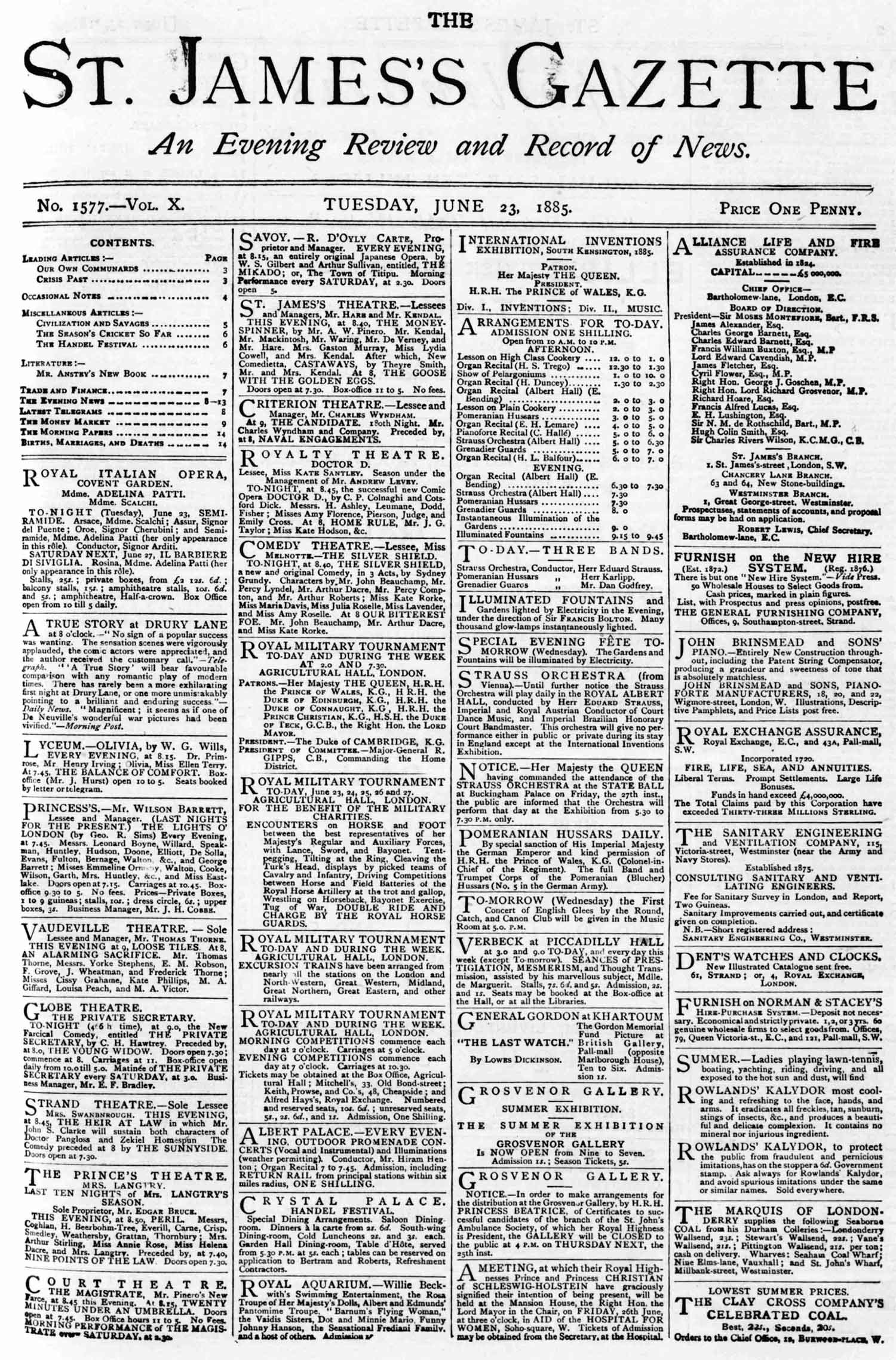
The St James’s Gazette was a London-based Conservative evening newspaper, published between 1880 and 1905. It emerged in an age when print journalism was a dominant force in shaping public opinion, and its editorial policy, contributors, and readership placed it among the more influential periodicals of the late Victorian and Edwardian eras. Though not the longest-lived of newspapers, its intellectual tone and political alignment left a lasting mark on British journalism.
Origins and Founding
The St James’s Gazette was launched on 31 May 1880 as the spiritual successor to the Pall Mall Gazette, which had shifted from a Conservative to a Liberal editorial stance under W. T. Stead and its new owner George Newnes. This alienated its traditional readers, creating a market gap. Into that gap stepped Henry Yates Thompson, former editor and owner of the Pall Mall Gazette, who used his experience and connections to establish the new title.
Though the name St James’s Gazette suggested a continuation of the West End’s genteel newspaper tradition, it aimed to combine political commentary, arts coverage, and news reporting, but with a more distinctly Conservative viewpoint. It was named after the prestigious St James’s district of London, associated with clubs, high society, and government.
Editorial Direction and Tone
The St James’s Gazette was intellectually serious, often described as having a “high-minded” tone. It deliberately avoided sensationalism, distinguishing itself from mass-circulation tabloids like The Star or The Evening News. Its pages focused on:
-
Political analysis from a Conservative and often imperialist standpoint
-
Literary criticism and reviews
-
Short news summaries, often with dry wit and sarcasm
-
Commentary on public affairs, including social reforms, military matters, and foreign policy
While some contemporaries found its content too cerebral for the average reader, others praised it for its integrity, concision, and refusal to pander.
The editorial leadership included figures such as:
-
Frederick Greenwood, its first editor, who had previously edited the Pall Mall Gazette
-
Sidney Low, editor in the 1890s, a respected historian and journalist
-
Ronald McNeill (later 1st Baron Cushendun), who edited the paper in its final years
Contributors and Literary Influence
Although it was not primarily a literary magazine, the St James’s Gazette attracted many prominent writers, poets, and essayists, including:
-
Oscar Wilde, who contributed reviews early in his career
-
Rudyard Kipling, whose imperial themes aligned with the paper’s values
-
Max Beerbohm, cartoonist and essayist
-
Andrew Lang, classicist and folklorist
-
E. W. Hornung, creator of the gentleman thief Raffles
Its literary criticism was regarded as serious, if sometimes conservative, and it was seen as a venue for refined literary discussion, in contrast to more populist papers.
Political and Social Positioning
Politically, the paper was Conservative, often pro-empire, pro-military, and traditionalist. It supported:
-
The Unionist stance in Ireland
-
The Conservative governments of Lord Salisbury
-
The British Empire, advocating for colonial unity and military strength
However, it was also known for its editorial independence. While it generally aligned with the Tory party, it did not hesitate to criticise Conservative ministers if it saw them as compromising on core principles.
Socially, the paper represented the professional, educated, and club-going classes of London. It was popular among civil servants, clergy, scholars, military officers, and legal professionals—those seeking informed, restrained, and civilised reportage.
Circulation and Audience
The St James’s Gazette was never a mass-market paper. Its circulation figures were modest compared to the rising tide of halfpenny newspapers. However, its readership was highly influential. It was read in:
-
Gentlemen’s clubs
-
Government offices
-
University common rooms
-
Law courts and chambers
Its reputation was akin to a “paper of record” for elite circles, and it was frequently quoted or referenced in parliamentary debate and political discussion.
Decline and Closure
By the early 20th century, the St James’s Gazette struggled to maintain its relevance. The media landscape was changing, with:
-
The rise of mass-circulation dailies (Daily Mail, Daily Express)
-
Growing demand for illustrated content
-
Shifts in political culture with the rise of New Liberalism and Labour politics
-
An increasing appetite for sensationalism and human-interest stories
In 1905, the St James’s Gazette was merged with the Evening Standard, ending its 25-year run. The Evening Standard incorporated some of its editorial traditions but pursued a broader readership strategy.
Legacy
Though relatively short-lived, the St James’s Gazette is remembered for:
-
Its high editorial standards
-
Its role in Conservative intellectual circles
-
Its literary contributions
-
Its influence on opinion formation among the educated elite of Victorian and Edwardian Britain
Today, researchers and historians value the Gazette as a primary source on:
-
The tone and content of elite political discourse
-
Conservative responses to Liberal reforms and Irish nationalism
-
Daily events with minimal sensationalism
-
Literary culture of late 19th-century Britain
It is cited in studies on the history of journalism, British political thought, imperial culture, and gender roles, particularly as it offered insight into the values of the professional and ruling classes.
Bibliography & Sources for Further Study
-
Brake, Laurel, and Marysa Demoor (eds.), Dictionary of Nineteenth-Century Journalism (2009)
-
Lee, Alan J., The Origins of the Popular Press in England, 1855–1914
-
Brown, Lucy, Victorian News and Newspapers
-
The British Newspaper Archive (numerous scans of St James’s Gazette)
-
Bodleian Library and British Library newspaper collections
-
Hansard Parliamentary Debates (citing the Gazette)
- Here at Old British News
VALUE FOR HISTORIANS & GENEALOGISTS
This article is a goldmine for:
-
Criminologists and legal historians (ticket-of-leave system, forgery cases)
-
Social historians (labour movements, gender roles, class relations)
-
Transport historians (mail train accident)
-
Family historians (names like George Townsend, Miss Mount, M‘Carthy, and employers like Wells’s Collieries or Trinity House)
-
Irish history researchers (Land War context and rural violence)
-
Political historians (impact of Reform Bills and voter rights)
In Brief
From Irish arson to Canterbury highway robbery, a runaway bankrupt, and an 1885 miners’ strike — gripping tales from Victorian England via the St James’s Gazette.
#VictorianHistory #OnThisDay #FamilyHistory #BritishHistory #StJamesGazette #Ireland #RailwayAccident #LabourHistory #1885News #Genealogy