Lynn Advertiser – Saturday 02 December 1876
WINTER ASSIZE AT NORWICH.
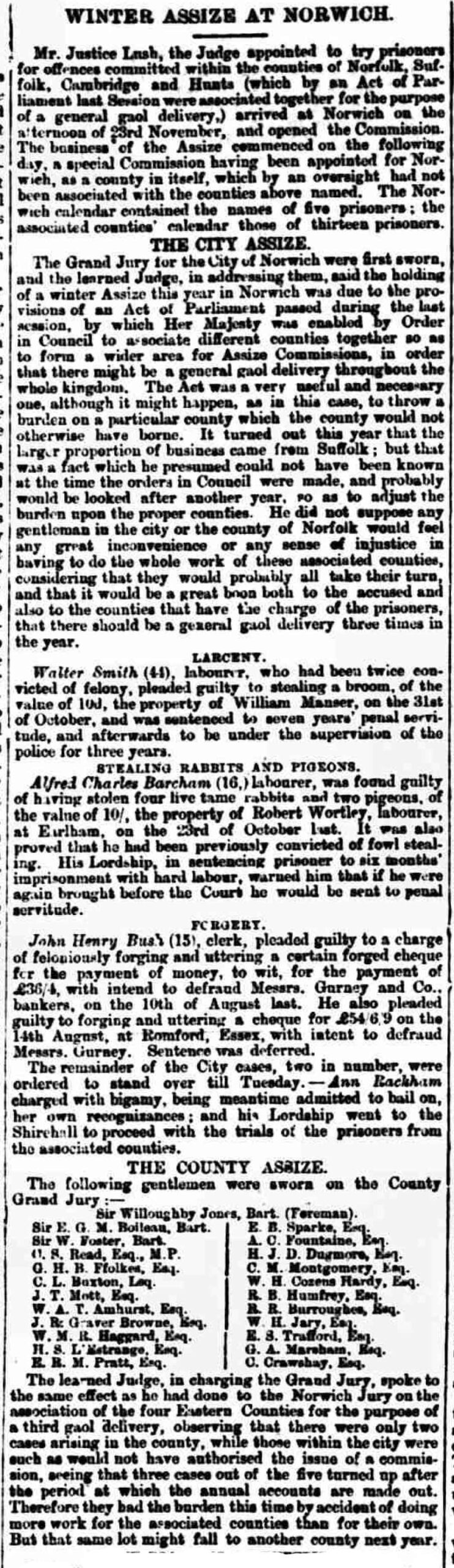
Mr. Justice Lush, the Judge appointed to try prisoners for offences committed within the counties of Norfolk, Suffolk, Cambridge and Hunts (which by an Act of Parliament last Session were associated together for the purpose of a general gaol delivery), arrived at Norwich on the afternoon of 23rd November, and opened the Commission. The business of the Assize commenced on the following day, a special Commission having been appointed for Norwich, as a county in itself, which by an oversight had not been associated with the counties above named. The Norwich calendar contained the names of five prisoners; the associated counties’ calendar those of thirteen prisoners.
THE CITY ASSIZE.
The Grand Jury for the City of Norwich were first sworn, and the learned Judge, in addressing them, alluded to the holding of a winter Assize in Norwich as due to the provisions of an Act of Parliament passed during the last Session, by which Her Majesty was enabled by Order in Council to associate the different counties together and to form a wider area for Assize Commissions, in order that there might be a general gaol delivery throughout the one, although it might happen, as in this case, to throw a burden on a particular county which the county would not otherwise have borne. It turned out this year that the larger proportion of business came from Suffolk; but that was a fact which he presumed could not have been known at the time the orders in Council were made, and probably would be looked after another year, so as to adjust the burden upon the proper counties. He did not suppose any gentleman in the city or the county of Norfolk would feel any great inconvenience or any sense of injustice in having to do the whole work of these associated counties, considering that they would probably all take their turn, and that it would be a great boon both to the accused and also the counties that have the charge of the prisoners, that there should be a general gaol delivery three times in the year.
LARCENY.
Walter Smith (44), labourer, who had been twice convicted of felony, pleaded guilty to stealing a broom, the value of 10d., the property of William Manser, on the 31st of October, and was sentenced to seven years’ penal servitude, and afterwards to be under the supervision of the police for three years.
STEALING RABBITS AND PIGEONS.
Alfred Charles Read (16), labourer, was found guilty of having stolen four live tame rabbits and two pigeons, the value of 10/-, the property of Robert Wortley, labourer, at Earlham, on the 23rd of October last. It was also proved that he had been previously convicted of fowl stealing. His Lordship, in sentencing prisoner to six months’ imprisonment with hard labour, warned him that if again brought before the Court he would be sent to penal servitude.
FORGERY.
John Henry Bush (15), clerk, pleaded guilty to a charge of feloniously forging and uttering a certain forged cheque for the payment of money, to wit, for the payment of £36/4, with intent to defraud Messrs. Gurney and Co., bankers, on the 10th of August last. He also pleaded guilty to forging and uttering a cheque for £54/6/9 on the 14th August, at Romford, Essex, with intent to defraud Messrs. Gurney. Sentence was deferred.
The remainder of the City cases, two in number, were ordered to stand over till Tuesday. — Ann Rackham, charged with bigamy, being meantime admitted to bail on her own recognisances; and his Lordship went to the Shirehall to proceed with the trials of the prisoners from the associated counties.
THE COUNTY ASSIZE.
The following gentlemen were sworn on the County Grand Jury: —
-
Sir Willoughby Jones, Bart. (Foreman)
-
G. M. Boileau, Bart.
-
Sir W. Foster, Bart.
-
G. S. Read, Esq., M.P.
-
G. H. R. Folkes, Esq.
-
C. L. Buxton, Esq.
-
T. Mett, Esq.
-
W. T. Amhurst, Esq.
-
J. R. Gayer Browne, Esq.
-
W. M. R. Haggard, Esq.
-
S. L’Estrange, Esq.
-
R. M. Pratt, Esq.
-
E. B. Sparke, Esq.
-
E. W. Foster, Esq.
-
H. C. Sparke, Esq.
-
J. D. Dagnose, Esq.
-
C. M. Montgomery, Esq.
-
W. H. Cozens Hardy, Esq.
-
H. B. Hansley, Esq.
-
R. R. Burroughes, Esq.
-
E. Trafford, Esq.
-
G. A. Marsham, Esq.
-
C. Crershaw, Esq.
The learned Judge, in charging the Grand Jury, spoke to the same effect as he had done to the Norwich Jury on the association of the four Eastern Counties for the purpose of a third gaol delivery, observing that there were only two cases arising in the county, while those within the city were such as would not have authorised the issue of a commission, seeing that three cases out of the five turned up after the period at which the annual sessions are made out. Therefore the shift and the burden this time by accident of doing more work for the associated counties than their own. But that same lot might fall to another county next year.
Analysis for Historians and Family Historians
Laws and Judicial System
-
The article highlights changes from a recent Act of Parliament, enabling multiple counties to share Assize Commissions, an efficiency reform to reduce delays in trials.
-
General gaol delivery refers to the practice of clearing prisoners awaiting trial; this reform introduced three such deliveries a year.
-
Penalties for repeat offences were extremely harsh (e.g. Walter Smith got 7 years for stealing a broom due to prior convictions).
-
Juvenile justice was in its infancy. A 15-year-old clerk, John Henry Bush, faced heavy charges for forgery—a serious offence, especially against a bank.
-
The term “penal servitude” meant hard labour in prison, often in distant penal colonies or harsh workhouses.
Occupations and Social Structure
-
The accused were largely labourers—manual, low-paid workers.
-
Their victims included William Manser, a likely householder; Robert Wortley, a fellow labourer and small animal keeper.
-
The Grand Jury members listed are of high status—baronets, Members of Parliament, and landed gentry—revealing the hierarchical class system in legal administration.
-
Some men, like Sir Willoughby Jones, were both magistrates and Members of the County Grand Jury.
Businesses and Institutions
-
The bank Messrs. Gurney and Co., defrauded in the forgery case, was a prestigious Norwich banking family, later absorbed into Barclays Bank—showing local businesses’ vulnerability and importance.
-
The Shirehall was the location of county court proceedings.
Norfolk Life in 1876
-
Crime levels were modest, with only five City prisoners and thirteen from the associated counties.
-
There was still a strong rural element—e.g., thefts of rabbits and pigeons—indicating how valuable even small livestock were.
-
Labourers lived precariously: repeat offences for minor thefts could mean years in penal servitude.
-
The law did not spare youth; young people were tried and punished with almost the same severity as adults.
-
The role of the Assizes was vital in maintaining social order, especially when local magistrates or petty sessions were insufficient.
The Lynn Advertiser: History
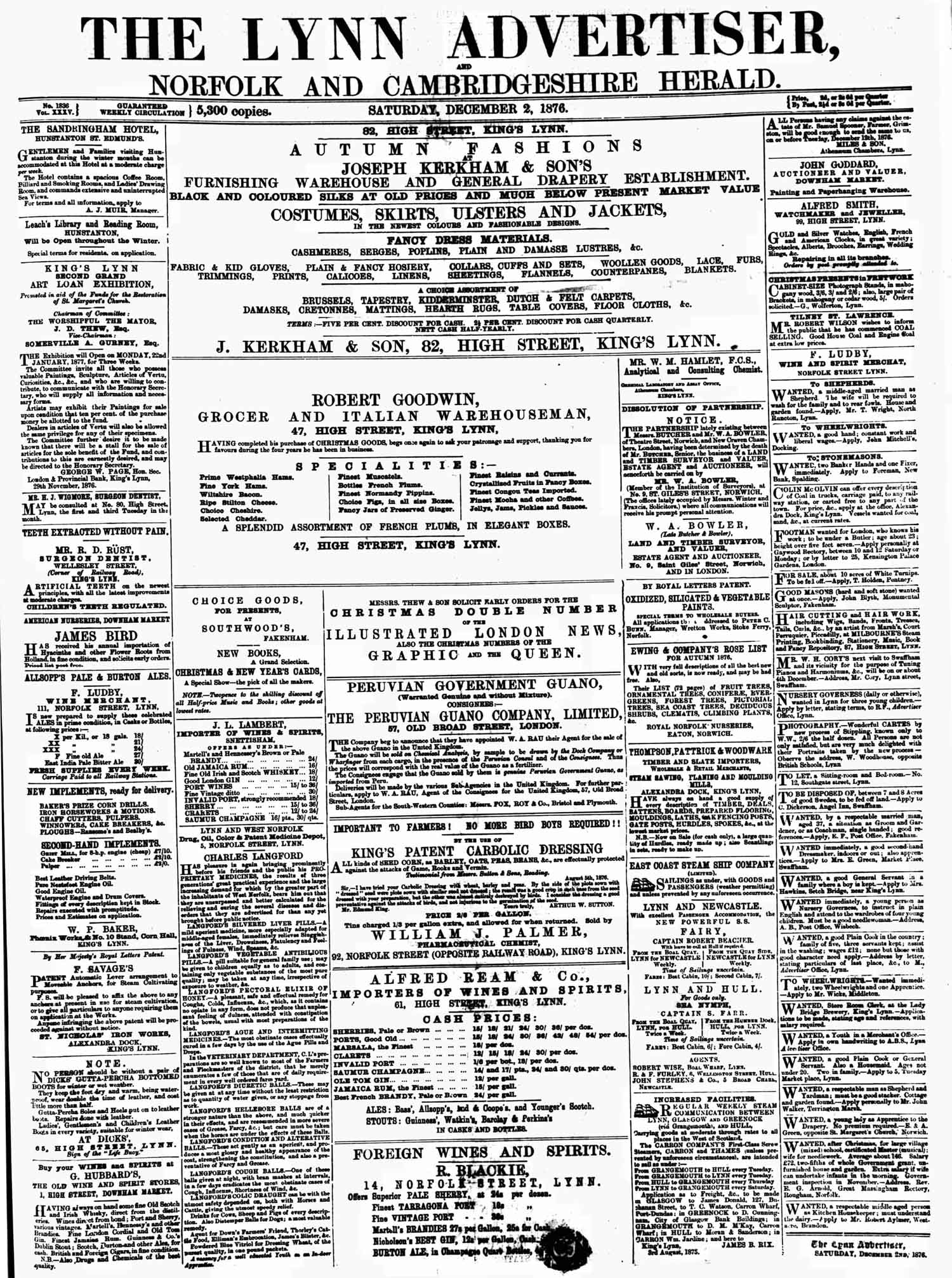
The Lynn Advertiser is one of the oldest surviving newspapers in Norfolk, England, with a heritage that stretches back to the early Victorian period. Founded in 1841, it played a vital role in the public, political, and cultural life of King’s Lynn and the surrounding counties for well over a century.
Origins (1841–1850s): The Victorian Birth of a Regional Paper
The Lynn Advertiser was first published on July 18, 1841, under the name The Lynn Advertiser, and West Norfolk Herald. It was launched in response to a growing demand for reliable, regular printed news in the wake of reforms to the stamp duty laws and increasing literacy among the middle and working classes.
King’s Lynn, a historic port town on the Wash, was a bustling market centre. The paper catered to both urban and rural readerships, covering:
-
Town Council affairs
-
Agricultural news and prices
-
Local business developments
-
Church events and dissenting meetings
-
Shipping movements from the port
-
Court reports and Assizes
-
Advertisements for local tradesmen, auctions, and employment
It quickly became essential reading for farmers, landowners, merchants, and an emerging class of politically aware working men.
Political Alignment and Editorial Tone
In its early years, the Lynn Advertiser leaned toward Whig and Liberal politics, supporting parliamentary reform, religious tolerance, and free trade, while maintaining a moderate and respectful editorial tone. It competed with conservative publications in the region, such as the Norfolk Chronicle, leading to a healthy press rivalry that invigorated political debate in West Norfolk.
By the mid-Victorian era, it had become one of the most influential Liberal newspapers in Norfolk, strongly supporting Gladstone’s policies, local Liberal MPs, and social reform campaigns such as those for education and temperance.
Content and Coverage
By the 1850s and 1860s, the Lynn Advertiser regularly ran:
-
Full court reports, including petty sessions, coroner’s inquests, and Assizes
-
Reports of railway development and industrial changes
-
Coverage of public health issues, such as cholera outbreaks
-
Proceedings of friendly societies, local charities, and agricultural unions
-
Letters to the Editor from readers — often lively and well-informed
It was a weekly publication, typically published on Saturdays, and had a strong emphasis on localism and moral standards.
Growth, Expansion, and Competition (1870s–1900s)
By the 1870s, the Lynn Advertiser had firmly cemented its place as the premier paper of West Norfolk. Its reach extended beyond King’s Lynn to Downham Market, Hunstanton, Swaffham, and the Fens. Its success spurred several local competitors, including the Lynn News and West Norfolk Examiner, but the Advertiser maintained its edge through editorial quality, depth of reporting, and printing standards.
In the 1890s, it modernised its layout, increased its column space, and introduced illustrated advertisements, a rare feature for provincial newspapers at the time. It was published by The Lynn Advertiser Company, a locally owned and operated enterprise with printing works in the town centre.
20th Century: War, Merger, and Modernisation
The Lynn Advertiser remained in publication through both World Wars, providing valuable coverage of recruitment efforts, war memorials, rationing, and local casualty lists. By the mid-20th century, increasing production costs and consolidation within the regional press led to its merger with the Lynn News in 1944, forming the Lynn News & Advertiser.
This unified title continued the legacy of the Advertiser, combining its detailed historical record with the broader format of the News. Eventually, the name Lynn Advertiser faded from the masthead, but its archives remain a priceless resource.
Legacy and Use for Historians and Family Researchers
The Lynn Advertiser is today considered a primary source of local history for Norfolk, Cambridgeshire, and parts of Lincolnshire. Its surviving issues (many now digitised or on microfilm) are used by:
-
Family historians tracing ancestors in court records, birth/death notices, and public events
-
Academic historians exploring local reactions to national events like the Reform Acts, the Corn Laws, or WWI
-
Students of media studying the evolution of press freedoms and editorial bias
-
Social historians examining working-class life, rural crime, charity, and community values
Its detailed court coverage (like the 1876 Assize report I provided), obituary notices, parish meetings, and public announcements provide a vivid picture of life in 19th and early 20th-century Norfolk.
In Brief
🗞️ 1876: Brooms, Bunnies & Bank Fraud – Norfolk’s Assize Trials Reveal Rural Justice & Harsh Penalties 🏛️ #NorfolkHistory #Assizes #VictorianJustice #Genealogy #LynnAdvertiser #CrimeAndPunishment #OldBailey #UKLegalHistory #FamilyHistory #Norfolk