Liverpool Echo – Saturday 30 June 1917
POISONED.
MINER’S DEATH AFTER EATING MEAT PIE.
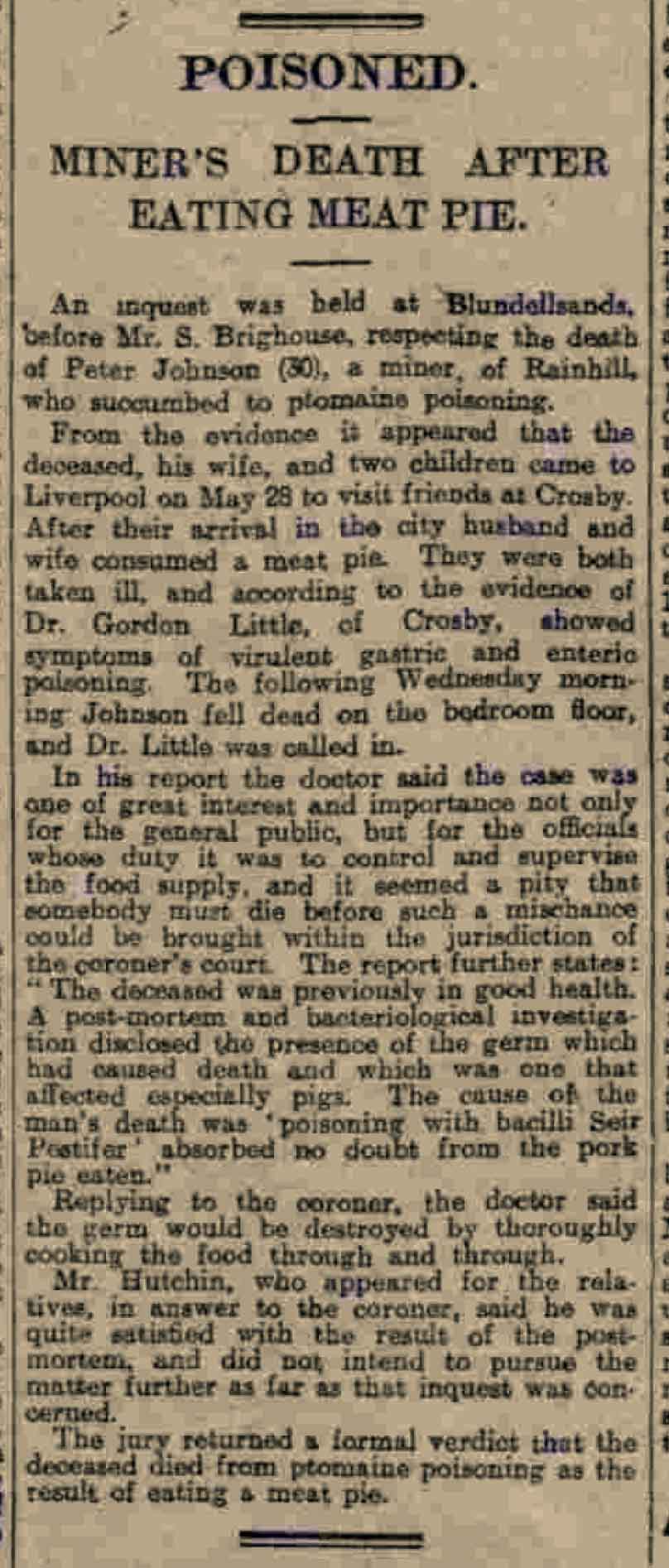
An inquest was held at Blundellsands, before Mr. S. Brighouse, respecting the death of Peter Johnson (30), a miner, of Rainhill, who succumbed to ptomaine poisoning.
From the evidence it appeared that the deceased, his wife, and two children came to Liverpool on May 28 to visit friends at Crosby. After their arrival in the city husband and wife consumed a meat pie. They were both taken ill, and according to the evidence of Dr. Gordon Little, of Crosby, showed symptoms of virulent gastric and enteric poisoning. The following Wednesday morning Johnson fell dead on the bedroom floor, and Dr. Little was called in.
In his report the doctor said the case was one of great interest and importance not only for the general public, but for the officials whose duty it was to control and supervise the food supply, and it seemed a pity that somebody must die before such a mischance could be brought within the jurisdiction of the coroner’s court. The report further stated: “The deceased was previously in good health. A post-mortem and bacteriological investigation disclosed the presence of the germ which had caused death and which was one that affected especially pigs.” The cause of the man’s death was “poisoning with bacilli Seir Pestifer, absorbed no doubt from the pork pie eaten.”
Replying to the coroner, the doctor said the germ would be destroyed by thoroughly cooking the food through and through.
Mr. Hutchin, who appeared for the relatives, in answer to the coroner, said he was quite satisfied with the result of the post-mortem, and did not intend to pursue the matter further as far as that inquest was concerned.
The jury returned a formal verdict that the deceased died from ptomaine poisoning as the result of eating a meat pie.
🧭 Detailed Historical Analysis
⚖️ Laws and Public Health in 1917
In 1917, Britain was in the midst of World War I. Food regulation fell under the Public Health Acts and the Sale of Food and Drugs Act 1875, which aimed to prevent food adulteration and enforce sanitary food handling. However, enforcement was inconsistent, especially during wartime when resources were stretched.
The case drew attention to the lack of strict food inspection, especially for processed items like pies. The coroner and doctor both implicitly criticised the state of food hygiene oversight, suggesting that someone had to die before authorities took action.
👤 People and Occupations
-
Peter Johnson: A 30-year-old miner from Rainhill, a working-class occupation fundamental to wartime industry.
-
Dr Gordon Little: A local doctor from Crosby who diagnosed the cause and presented medical evidence at the inquest.
-
Mr. S. Brighouse: Coroner for the area, presiding over the inquiry.
-
Mr. Hutchin: Represented the family during the inquest, possibly a solicitor or family advocate.
🏢 Businesses and Food Safety
Though unnamed, the supplier of the pork pie would likely have been a local bakery, butcher, or grocer. The doctor’s comment that the food was not properly cooked implies commercial negligence or unsafe preparation. During the war, food preservation and quality control were a growing concern due to rationing and substitutions.
🧑🤝🧑 Life in Rainhill in 1917
Rainhill, located in Lancashire (now Merseyside), was a small industrial community known for its connection to railway history. In 1917, many residents were engaged in:
-
Mining
-
Railway work
-
Agricultural or food production
-
War-related industry (munitions, textiles)
Wartime conditions led to:
-
Rationing
-
Limited access to fresh food
-
Overcrowded homes
-
High mortality from infectious diseases
Travelling to Liverpool for social visits, even during wartime, shows the importance of maintaining family connections, and how urban centres offered both opportunity and danger (as seen in this tragic event).
📜 Value for Historians and Family Historians
This article is a rich source for:
-
Medical historians: Understanding causes of foodborne illness pre-antibiotics.
-
Legal historians: Public health oversight and inquest processes in wartime.
-
Social historians: Class, diet, domestic travel, and risk in working-class families.
-
Family historians: Clear mention of names, place (Rainhill), family structure, and cause of death.
It demonstrates how a simple meal could be fatal, and highlights the lack of awareness around food safety, especially during a time of national crisis.
📰 History of the Liverpool Echo
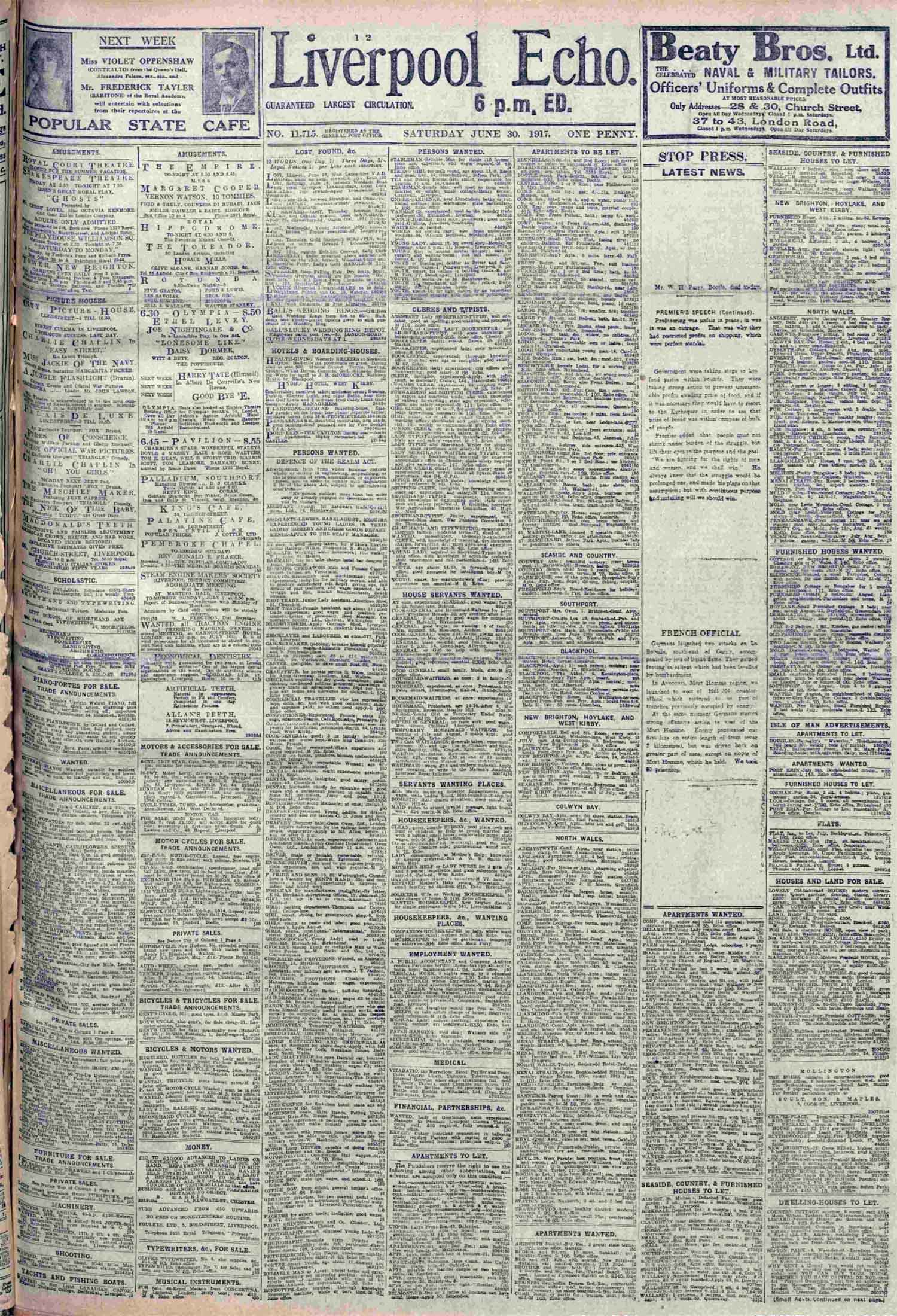
The Liverpool Echo is one of Britain’s most enduring and influential regional newspapers. Founded in the late 19th century, it has served the people of Liverpool and surrounding areas for nearly a century and a half. Over its long and storied existence, the Echo has evolved from a bustling evening broadsheet to a modern multimedia news outlet, reflecting both the changing face of Merseyside and the broader shifts in journalism.
🗞️ Foundation and Early Years (1879–1900)
The Liverpool Echo was first published on October 13, 1879, as an evening paper, by Alfred Holt, under the ownership of the Liverpool Daily Post & Echo Ltd. It was intended to provide working-class readers with affordable, accessible news, particularly after the working day. Costing only a halfpenny, it quickly gained popularity for its lively tone, local focus, and digestible content.
In these early years, it was designed to complement the more formal Liverpool Daily Post, offering:
-
Crime reports and inquests
-
Shipping news
-
Entertainment listings
-
Local government and civic coverage
-
Humorous columns and illustrations
By the end of the 19th century, The Liverpool Echo was a staple of life for many Liverpudlians.
🪖 Echo Through War and Change (1900–1945)
During World War I, the Echo became a crucial source of information for families with men at the Front. It published:
-
Lists of the wounded or killed
-
Updates on war loans and patriotic campaigns
-
Food rationing advice
-
Public health warnings (like the 1917 meat pie poisoning article)
During World War II, despite the challenges of the Blitz and severe paper shortages, the Echo continued publication without interruption, a feat not all regional newspapers managed. The paper became a vital morale-boosting force, printing community solidarity stories, bomb damage updates, and civil defence advice.
🏙️ Post-War Growth and Peak Circulation (1945–1970s)
The post-war decades marked the golden age of the Echo. As Liverpool boomed as a commercial and shipping city, the Echo’s readership exploded.
By the 1950s and 1960s:
-
It was selling over 250,000 copies daily.
-
Editions were printed throughout the day (early, late, final).
-
It offered in-depth coverage of local football (especially Liverpool FC and Everton FC).
-
It featured children’s pages, comics, classifieds, and competitions.
In this period, the Echo’s editorial offices were based at the iconic Daily Post & Echo Building on Victoria Street, a hub of bustling newsroom life.
📺 Challenges and Adaptation (1980s–2000s)
Like many regional newspapers, the Echo faced:
-
Declining print sales due to television and later internet competition
-
The closure of Liverpool’s docks and industry, reducing local advertising revenue
-
Changing demographics and suburbanisation
To survive, the Echo:
-
Modernised its layout
-
Moved to tabloid format in the 1980s
-
Introduced a Saturday edition
-
Expanded sports and celebrity content
-
Focused increasingly on local news, justice campaigns, and community issues
In 1985, the Echo separated from the Daily Post in terms of editorial direction, becoming more populist, and took a stronger campaigning tone on issues such as:
-
Housing injustices
-
Police accountability
-
Local unemployment
-
The Hillsborough Disaster and its aftermath
🧾 Ownership and Corporate Changes
Originally owned by Liverpool Daily Post & Echo Ltd, the Echo became part of Trinity Holdings, and later, the Trinity Mirror Group. In 2018, Trinity Mirror rebranded as Reach plc, which now owns over 150 local and national titles across the UK.
Under Reach plc, the Echo has remained a flagship regional brand, although it has faced:
-
Staff cutbacks
-
Office downsizing (leaving Old Hall Street HQ)
-
A shift toward digital-first publishing
🌐 The Digital Age (2010–Present)
Today, liverpoolecho.co.uk is one of the UK’s most-read regional news websites, reaching millions each month. It features:
-
Breaking news
-
Crime updates
-
Political commentary
-
Culture and history
-
Multimedia content (video, social, podcast)
Despite the fall in print circulation (down to around 25,000 by 2020), the Echo remains influential. Its journalism is regularly cited nationally, particularly in stories of injustice and civic scandal.
The Echo has a significant presence on social media, and its newsroom has embraced community-driven, real-time journalism, ensuring its survival in a competitive media landscape.
⚖️ Notable Campaigns and Legacy
Hillsborough Justice Campaign
The Echo played a critical role in the long campaign for justice following the Hillsborough Disaster (1989), where 97 Liverpool FC fans died. While national papers like The Sun were condemned for their misleading reporting, the Echo gave a voice to victims’ families and led calls for accountability.
Public Health and Civic Journalism
From the 1917 food poisoning case to COVID-19 updates, the Echo has a proud tradition of raising awareness of public health issues, holding local authorities to account.
Representation of Working-Class Voices
Historically and now, the Echo has reflected the lives, struggles, and pride of Liverpool’s working class. It has long championed:
-
Council tenants
-
Trade unionists
-
Football fans
-
Local creatives and musicians
🧠 Why the Echo Matters for Historians and Genealogists
-
🧾 Inquests, births, marriages, deaths: Ideal for family history research.
-
🕵️♀️ Crime reports and court cases: Deep insight into justice, morality, and class.
-
🛠️ Industrial history: A record of dockers, miners, builders, railwaymen.
-
⚓ Migration and wartime records: Including evacuees, servicemen, ship departures.
-
🏘️ Local life: Neighbourhoods, changing street names, demolitions, and planning.
-
🎙️ Public voice: Through letters to the editor, readers’ columns, and campaigns.
📅 Timeline of Key Dates
| Year | Event |
|---|---|
| 1879 | First edition of The Liverpool Echo published |
| 1900s | Gains mass readership as Liverpool booms |
| 1914–1918 | Key war information source |
| 1940s | Continues printing during WWII blitz |
| 1950s | Peak circulation, multiple daily editions |
| 1980s | Moves to tabloid format |
| 1989 | Reports sensitively on Hillsborough Disaster |
| 2010s | Transitions to digital-first operations |
| 2018 | Parent company becomes Reach plc |
| 2020s | Digital site attracts millions of readers |
In Brief
📰 1917: Miner Dies After Eating Pork Pie – Ptomaine Poisoning Tragedy
“A Rainhill miner’s visit to Crosby ends in sudden death after a contaminated meat pie. Coroner calls for better food safety oversight.”
#WW1History #LiverpoolEcho #PublicHealth #Rainhill #FamilyHistory #Inquest #1917News #PorkPie #FoodSafety #LiverpoolHistory