Gloucester Journal – Saturday 16 June 1928
Road Accident.
TWO GIRL CYCLISTS KILLED.
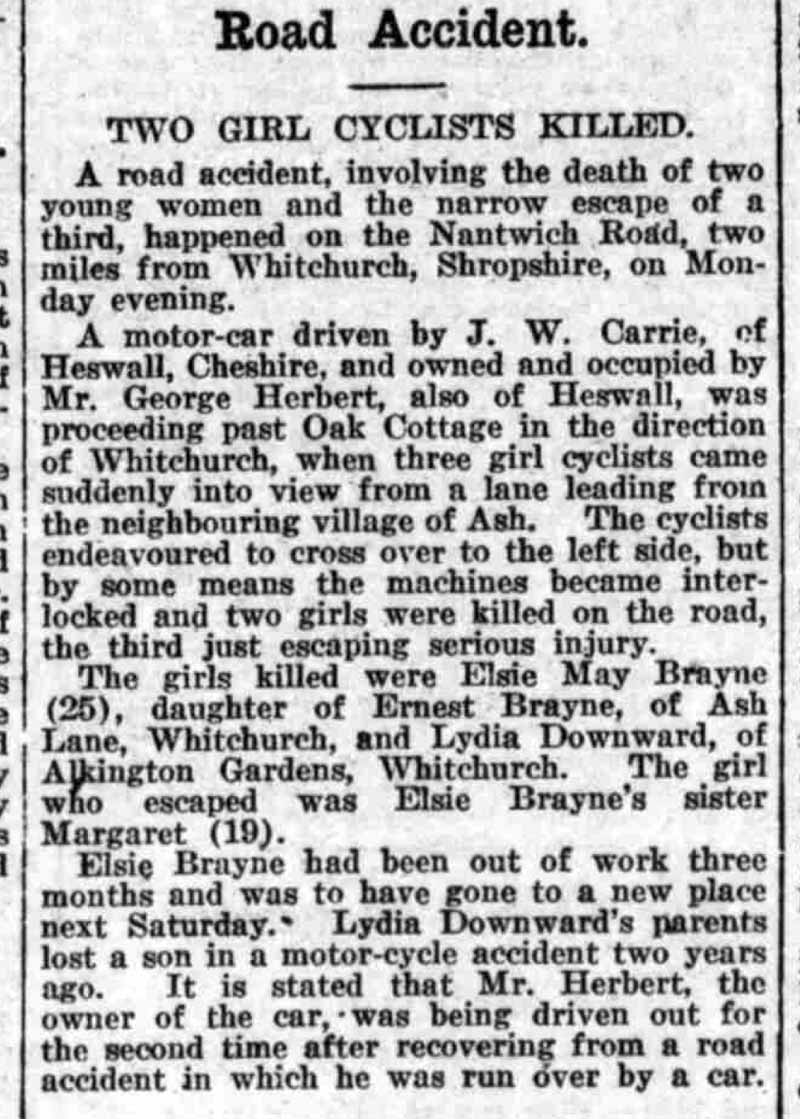
A road accident, involving the death of two young women and the narrow escape of a third, happened on the Nantwich Road, two miles from Whitchurch, Shropshire, on Monday evening.
A motor-car driven by J. W. Carrie, of Heswall, Cheshire, and owned and occupied by Mr. George Herbert, also of Heswall, was proceeding past Oak Cottage in the direction of Whitchurch, when three girl cyclists came suddenly into view from a lane leading from the neighbouring village of Ash. The cyclists endeavoured to cross over to the left side, but by some means the machines became interlocked and two girls were killed on the road, the third just escaping serious injury.
The girls killed were Elsie May Brayne (25), daughter of Ernest Brayne, of Ash Lane, Whitchurch, and Lydia Downward, of Akington Gardens, Whitchurch. The girl who escaped was Elsie Brayne’s sister Margaret (19).
Elsie Brayne had been out of work three months and was to have gone to a new place next Saturday. Lydia Downward’s parents lost a son in a motor-cycle accident two years ago. It is stated that Mr. Herbert, the owner of the car, was being driven out for the second time after recovering from a road accident in which he was run over by a car.
Detailed Analysis:
1. The Events & Their Context
This tragic accident occurred on Nantwich Road, near Whitchurch, Shropshire, in June 1928. Three young women were cycling from Ash, a small neighbouring village. The description suggests they were either merging onto the main road or crossing when their bicycles became entangled, causing them to be hit by a car.
- The car was driven by J. W. Carrie, but owned by George Herbert, both of Heswall, Cheshire.
- Two of the cyclists (Elsie May Brayne, 25, and Lydia Downward) died, while Margaret Brayne (19), Elsie’s sister, survived.
- The incident was particularly tragic for Lydia Downward’s family, as her brother had died in a motorcycle accident two years prior.
The mention that Mr. Herbert was recovering from being run over in a previous accident adds an eerie twist to the story.
2. Legal Implications at the Time (1928)
In 1928, British road traffic laws were in a transitional phase:
- No compulsory driving tests or licences – Driving tests were only introduced in 1935.
- No roadworthiness checks – There were no MOT tests (introduced in 1960).
- No speed limits for private cars – These had been abolished in 1903, with new regulations coming in the 1930s.
- Negligence law & inquests – If the driver was found to have been negligent, a coroner’s jury could return a verdict of “manslaughter by dangerous driving.”
At this stage, it is unclear whether J. W. Carrie was at fault. Given the cyclists’ movements and the interlocking of their machines, an inquest would likely have investigated whether the driver could have avoided the accident.
3. The People Involved:
- Elsie May Brayne (25) – Lived in Ash Lane, Whitchurch. Had been unemployed for three months and was due to start a new job that Saturday.
- Margaret Brayne (19) – Survived the accident. Likely deeply affected by losing her sister.
- Lydia Downward – Lived in Akington Gardens, Whitchurch. Her family had suffered another loss two years prior when her brother died in a motorcycle accident.
- Ernest Brayne – Father of Elsie and Margaret.
- J. W. Carrie – Driver of the car.
- George Herbert – Owner of the car. Recently recovered from a serious road accident.
These details help genealogists and historians trace family histories and understand social and economic conditions of the time.
4. Occupational & Social Context:
- Cycling was a primary mode of transport – Women in particular used bicycles as an independent and affordable form of mobility.
- Job instability – Elsie had been unemployed for three months, reflecting economic struggles in post-WWI Britain.
- Motor vehicles were increasing – The 1920s saw rapid growth in car ownership, often leading to more accidents due to unregulated driving conditions.
5. Use for Historians & Family Historians:
- Family research – This article provides full names, ages, addresses, and some family history, particularly helpful for genealogists.
- Transport history – It offers insight into road safety in 1928, particularly regarding cyclists.
- Social history – The struggles of working-class women and the dangers of early motoring are highlighted.
- Legal history – Understanding how road deaths were investigated pre-1930s.
The History of The Gloucester Journal
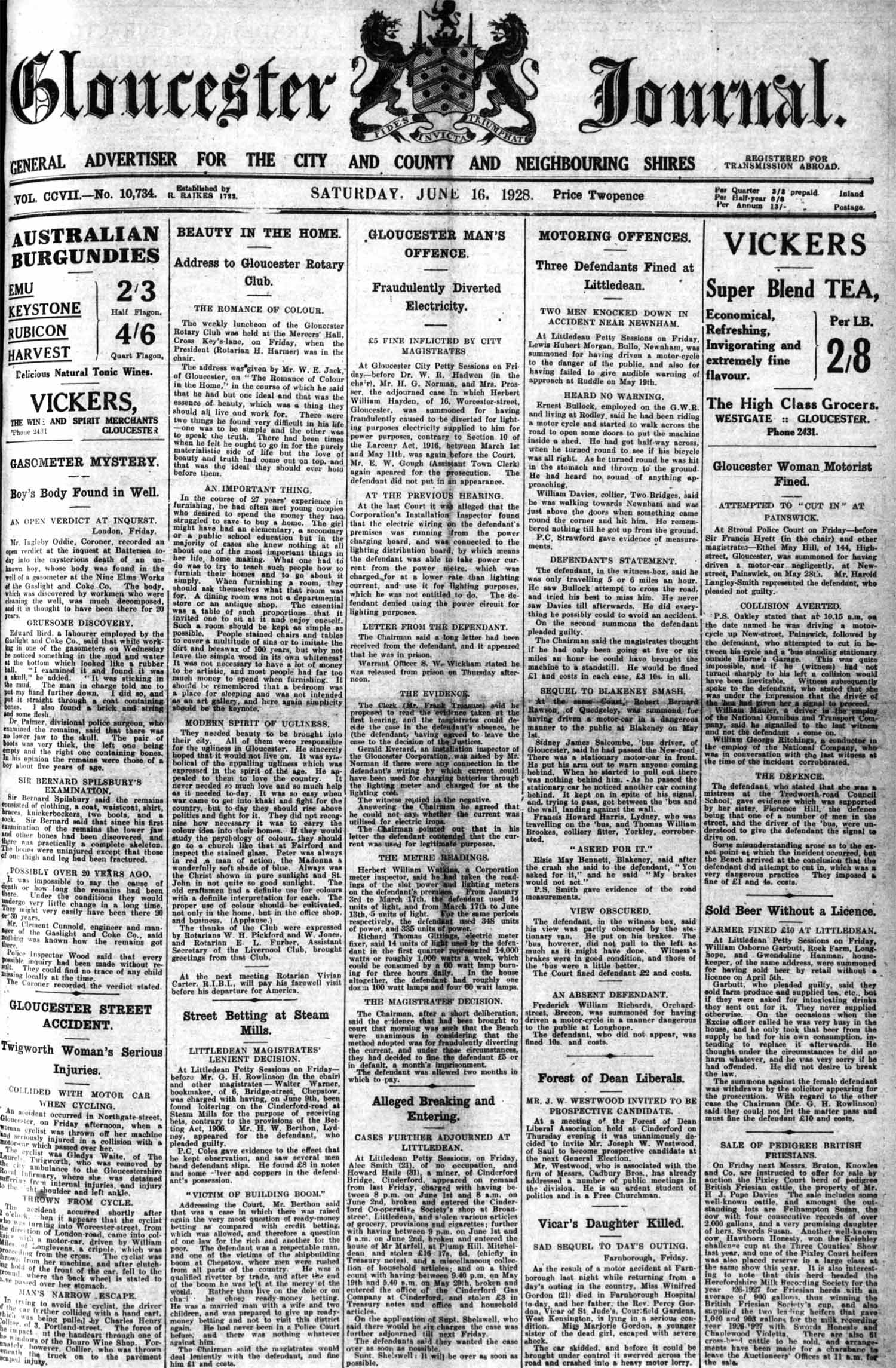
The Gloucester Journal holds a significant place in British journalism history as one of the earliest provincial newspapers. Founded in 1722, it chronicled over two centuries of local and national events, reflecting the evolving landscape of media and society in Gloucestershire and beyond.
Founding and Early Years (1722–1802):
On 9 April 1722, Robert Raikes the Elder and William Dicey established The Gloucester Journal. Prior to this, the duo had launched the Northampton Mercury in 1720. The inaugural issue of The Gloucester Journal was priced at three halfpence and, like many early newspapers, primarily featured national and international news, supplemented by local advertisements. Raikes was a pioneer among provincial publishers, notably reporting on Parliamentary proceedings—a practice that led to censure on two occasions for breaching Parliamentary privilege. He also experimented with a series of essays titled “Country Common Sense,” but reader preference for news led him to discontinue the feature.
In 1725, Raikes and Dicey amicably ended their partnership. Dicey retained control of the Northampton Mercury, while Raikes became the sole proprietor of The Gloucester Journal. Under his leadership, the newspaper expanded in size in 1742, adapting to the growing demand for news and information.
Transition and Philanthropy (1802–1871):
Upon Robert Raikes the Elder’s death, his son, Robert Raikes the Younger, assumed control of the newspaper. Beyond his role as a publisher, the younger Raikes was a noted philanthropist, deeply involved in prison reform and widely recognised for establishing Sunday schools aimed at educating underprivileged children. In 1802, he sold The Gloucester Journal to David Walker from Hereford. The Walker family maintained ownership until 1871, ensuring the newspaper’s continued influence in the region.
Expansion and Dominance (1871–1928):
In 1871, Birmingham journalist Thomas Henry Chance acquired The Gloucester Journal. By 1879, Chance had partnered with Samuel Bland, owner of the Citizen. This collaboration led to the acquisition of another local Liberal newspaper, the Gloucester Mercury, in 1884. The consolidation of these publications under Chance & Bland established a dominant media presence in Gloucester, which lasted until 1928.
Modern Developments and Legacy:
In 1928, the business transitioned to Gloucestershire Newspapers Ltd, a subsidiary of Northcliffe Newspapers Group Ltd. Reflecting advancements in media, 1925 saw the introduction of a glossy supplement, the Journal Pictorial. By March 1932, photographs began to feature prominently on the front page, marking a shift towards more visual journalism.
Over its extensive publication history, The Gloucester Journal produced approximately 76,707 pages across 10,361 issues, spanning the years 1730 to 1992. These archives serve as a valuable resource for historians and researchers, offering insights into the socio-political and cultural developments of the region. Today, the legacy of The Gloucester Journal continues, with its archives accessiblef ensuring that its rich history remains available for future generations.
In Brief
🚴♀️ Tragic 1928 cycling accident near Whitchurch, Shropshire: Two young women killed, one survivor. Driver had survived a previous crash. Road safety laws were still in their infancy. #History #RoadSafety#OnThisDay #History #Cycling #UKHistory #Shropshire #Genealogy #LocalHistory #RoadSafety #1920s