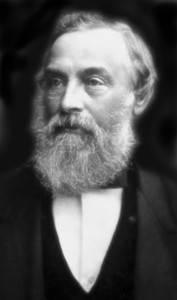
 There is no doubt that some Victorians were a tad mad, unquestionably overzealous and downright eccentric. Few epitomise this more than Henry Tracey Coxwell (1819–1900), the Victorian aeronaut (born 2 March 1819, Wouldham, Kent – died 5 January 1900, Lewes, Sussex), an English aeronaut whose obsession with ballooning knew no bounds. By Victorian standards he boldly went where no other man had ventured, often pushing himself and his passengers to the very edge of survival.
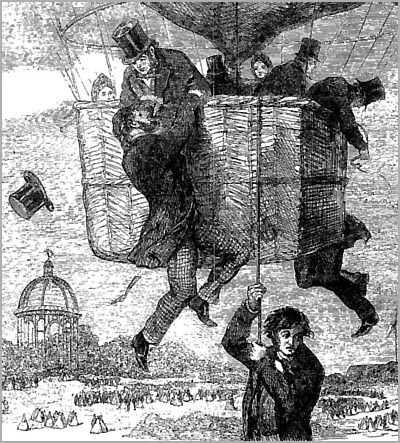
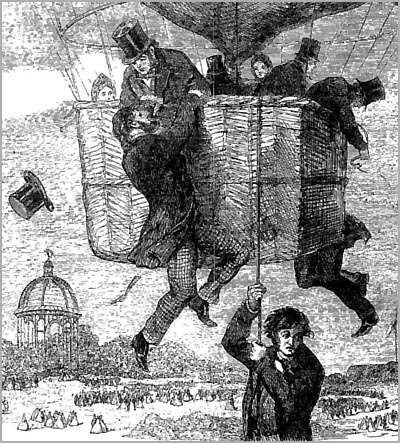
The illustration here shows contemporary newspaper accounts of a terrifying incident at the Crystal Palace in 1862, when one of Coxwell’s balloon ascents almost ended in tragedy.
Early Life and First Flights
Henry was the son of a naval officer. Though originally educated for the army, he pursued dentistry as a profession. From boyhood, however, his fascination with ballooning – still an experimental novelty – captured his imagination. His first ascent in 1844 marked the beginning of a lifelong devotion.
By 1848, Coxwell had abandoned dentistry altogether and become a professional aeronaut, travelling across Europe to perform public ascents in Paris, Berlin, Vienna, and other major continental cities. These early demonstrations were as much theatre as science, thrilling audiences with daring displays of aerial navigation.
Ballooning Spectacles in London
On his return to England, Coxwell became a familiar figure at Cremorne Gardens in Chelsea and the Surrey Zoological Gardens, both popular venues for Victorian entertainment. Balloon ascents were major attractions, combining spectacle, risk, and the promise of new scientific knowledge.
By 1861, Coxwell had already made over 400 ascents, earning a reputation as one of Britain’s foremost aeronauts.
The Historic Flight with James Glaisher, 1862 – Coxwell the Victorian Aeronaut
Coxwell’s most famous exploit came in September 1862, when he partnered with the distinguished meteorologist Dr James Glaisher. Their goal was to investigate the atmosphere at unprecedented heights.
On this flight, they reached an estimated 11,887 m (39,000 ft) – higher than any human being had ever ascended without artificial aid. At such altitudes, oxygen deprivation set in: Glaisher lost consciousness, while Coxwell, suffering from frostbite so severe he could not use his hands, managed to release the balloon’s gas valve by gripping the cord with his teeth. His quick thinking and sheer determination brought the balloon safely back to earth.
This dramatic episode not only entered the annals of adventure but also laid the groundwork for modern meteorology. The data collected by Coxwell and Glaisher revolutionised understanding of the upper atmosphere, temperatures, and air pressure, proving ballooning’s scientific value.
Military Ballooning and Later Career
Coxwell became a tireless advocate for the use of balloons in warfare, particularly for reconnaissance and communication. His campaigns foreshadowed their successful deployment during the Franco-Prussian War (1870–71) and later conflicts.
He also established a balloon factory in Richmond Road, Seaford, Sussex, producing equipment for both entertainment and experimental purposes.
Coxwell continued flying into his sixties, making his final ascent in 1885 after a career spanning over four decades.
A Victorian Narrow Escape
The dangers of ballooning were never far away. The Nottinghamshire Guardian, reporting on Friday 19 September 1862, recounted one such perilous episode:
The article describes how Coxwell narrowly avoided disaster when a sudden shift in the wind threatened both balloon and passengers. Such stories were not uncommon, but they cemented his reputation as a fearless, if eccentric, pioneer.
THE LATE SCIENTIFIC BALLOON ASCENT.
NARROW ESCAPE OF THE ÆRONAUTS.
The following is Mr. Glaisher’s report of the recent balloon ascent:—
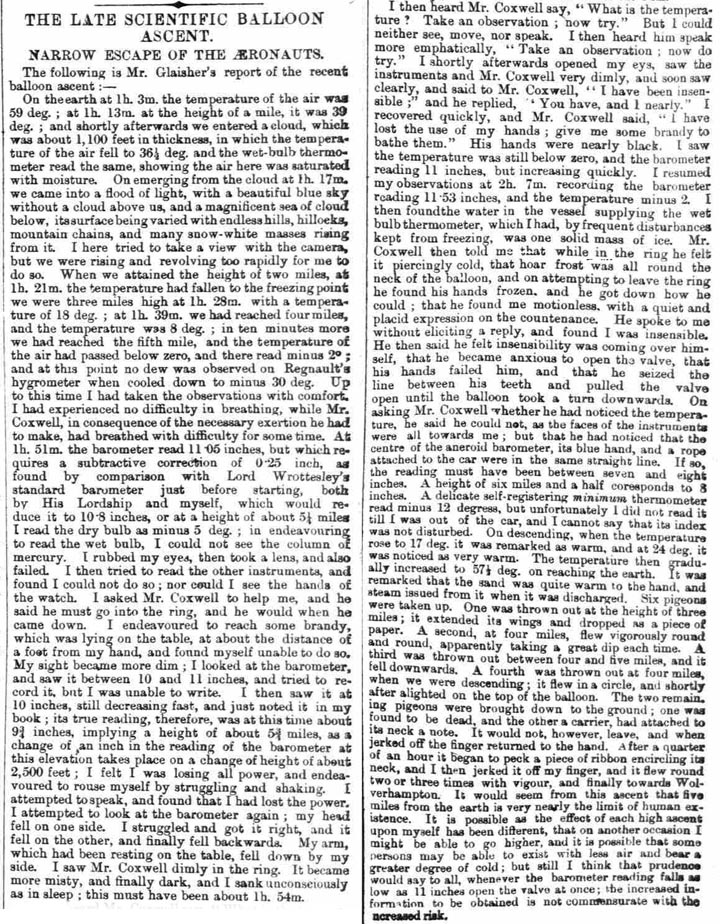
On the earth at 1h. 3m. the temperature of the air was 59 deg.; at 1h. 13m. at the height of a mile, it was 39 deg.; and shortly afterwards we entered a cloud, which was about 1,100 feet in thickness, in which the temperature of the air fell to 36½ deg. and the wet-bulb thermometer read the same, showing the air here was saturated with moisture. On emerging from the cloud at 1h. 17m. we came into a flood of light, with a beautiful blue sky without a cloud above us, and a magnificent sea of cloud below, its surface being varied with endless hills, hillocks, mountain chains, and many snow-white masses rising from it. I here tried to take a view with the camera, but we were rising and revolving too rapidly for me to do so. When we attained the height of two miles, at 1h. 21m. the temperature had fallen to 31 deg., the freezing point; we were three miles high at 1h. 23m. with a temperature of 15 deg.; at 1h. 39m. we had reached four miles high, the temperature was 8 deg.; at 1h. 48m. we were 5 miles high, and the temperature was 2 deg.; at 1h. 52m. we were 6 miles high, and the temperature minus 5 deg.; at 2h. 2m. 7 miles high, temperature minus 8 deg.; at 2h. 6m. 8 miles high, temperature minus 12 deg.; at 2h. 11m. 9 miles high, temperature minus 16 deg.; at 2h. 16m. 10 miles high, temperature minus 20 deg. At this time Mr. Coxwell having to leave the valve-line, the balloon rapidly rose past the 10 miles; at 2h. 17m. we had attained 10 miles and a half high, the temperature was minus 22 deg. and still falling fast. At 2h. 18m. we were 11 miles high, the temperature minus 24 deg.
At this height I found great difficulty in reading my instruments, for my hands were quite benumbed, but I still continued to observe, until at length I could not see the column of mercury in the wet-bulb thermometer. Mr. Coxwell, in consequence of the necessary exertion he had to make, had breathed with difficulty for some time. At 1h. 51m. the barometer read 11·05 inches, but which requires a subtractive correction of 0·25 inch, as found by comparison with Lord Wrottesley’s standard barometer just before starting, both by his Lordship and myself, which would reduce it to 10·8 inches, or at a height of about 5½ miles. I read the dry bulb as minus 5 deg.; in endeavouring to read the wet bulb, I could not see the column of mercury. I rubbed my eyes, then took a lens, and also failed. I then tried to read the other instruments, and found I could not do so; nor could I see the hands of the watch. I asked Mr. Coxwell to help me, and he said he must go into the ring, and he would when he came down. I endeavoured to reach some brandy, which was lying on the table, at about the distance of a foot from my hand, and found myself unable to do so. By this time I became motionless, as far as my hands, and as if without life, and lost all power of moving. I then saw Mr. Coxwell dimly, and could just see him moving; then observed that our descent had commenced; and that the valve-line was twisted round his hand. I began to recover power, but could not get my hand to the valve-line, and my arm fell powerless by my side. Mr. Coxwell then came down into the car, and immediately I began to revive. It became more misty, and I finally darkened, and I sank unconscious in sleep; this may have been about 1h. 54m.
I then heard Mr. Coxwell say, “What is the temperature? Take an observation; now try.” But I could neither see, move, nor speak. I then heard him speak more emphatically, “Take an observation; now do try.” I shortly afterwards opened my eyes, saw the instruments and Mr. Coxwell very dimly, and soon saw clearly, and said to Mr. Coxwell, “I have been insensible;” and he replied, “You have, and I nearly.” I recovered quickly, and Mr. Coxwell said, “I have lost the use of my hands; give me some brandy to bathe them.” His hands were nearly black. I saw the temperature was still below zero, and the barometer reading 11 inches, but increasing quickly. I resumed my observations at 2h. 2m. recording the barometer reading 11·53 inches, and the temperature minus 2 deg. I then found the water in the vessel supplying the wet-bulb thermometer, which I had previously thought had kept from freezing, was one solid mass of ice. Mr. Coxwell then told me that when at the height of 5 miles it piercedly cold, and that frost was all round the neck of the balloon. In attempting to leave the car to reach the valve, he became insensible, but was aroused by the shaking of the car, due to the motions of the valve-line, and at once knew that he must be doing something, and forthwith with his teeth he seized the valve-line and pulled the valve, and the balloon immediately descended.
After we had been descending some minutes, and I had recovered my power to move, I took a bird out of the bag, and threw it; it fell like a stone. I threw out two more; they likewise fell downwards. Mr. Coxwell then said, “We are safe now.” The descent then became very rapid, and I feared we might fall in the sea, and I threw away sand. At 2h. 16m. we were 5 miles high, temperature minus 12 deg., barometer 10·8 inches. A height of six miles and a half corresponds to 8 inches. A definite self-registering minimum thermometer read minus 12 degrees, but unfortunately I did not read it till I was out of the car, and I cannot say that its index was disturbed. On reaching the earth the reading was 10 or 17 deg. A remarkable warm, and at 24 deg. it was noticed it was very warm. The temperature then gradually increased to 57 deg. on reaching the earth. It was remarked that the sand was quite warm to the hand, and steam issued from it on being disturbed. Six pigeons were taken up. One was thrown out at the height of three miles; it extended its wings and dropped like a piece of paper. A second was thrown out at the same height, and found apparently taking a great gasp of breath, and flew vigorously about between four and five miles, and at this height one was thrown out, which fell four miles, when we were descending; it flew about, and strongly. On descending it flew with vigour. At two miles high pigeons were brought down to the ground; one was thrown out and descended like a carrier, stretched out its wings, and went downwards. A fourth pigeon was jerked off the finger but did not fly. After arriving at the ground one pigeon was released, and it flew round two or three times in front of my finger, and then downwards.
The experiments have thus clearly proved that no life can exist at the height of seven miles, and that animal life ceases entirely at that height. The expansion of air-bags at six miles high, as also the bursting of the bladder at 5½ miles high, shews that there is no mistake as to the height we attained. The descent was at first very rapid, then lessened to about 1,000 feet per minute, and finally towards two miles from the earth was more moderate.
The lessons taught by this ascent are that the dangers to life are such that no future attempt should be made to reach such an altitude without suitable provision against the great cold and the want of air; and that the scientific knowledge to be obtained is not commensurate with the increased risk.
Legacy
Henry Tracey Coxwell died in 1900, remembered as a Victorian adventurer who risked life and limb in the pursuit of both spectacle and science. Though ballooning has since been eclipsed by aeroplanes and spacecraft, his partnership with James Glaisher remains legendary – a moment when human curiosity literally reached new heights.
Today, his name survives not only in meteorological history but also in local heritage around Seaford, where his factory once stood. In an age of invention and eccentricity, Coxwell was among the boldest.