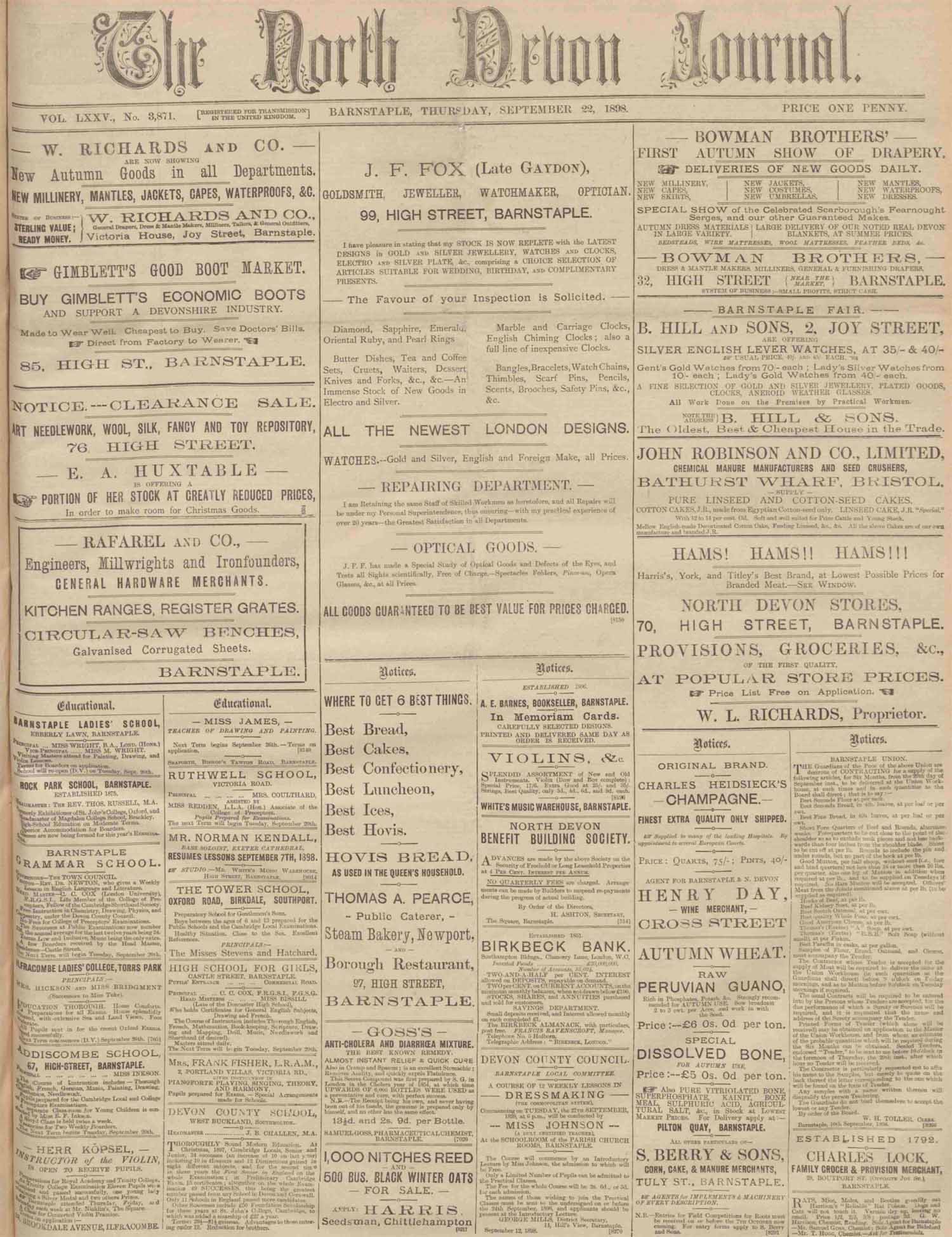
Lincolnshire Chronicle – Friday 13 February 1863
Friday, 13 February 1863
COURT OF PROBATE
NEW RULES AND ORDERS AS TO PRACTICE.
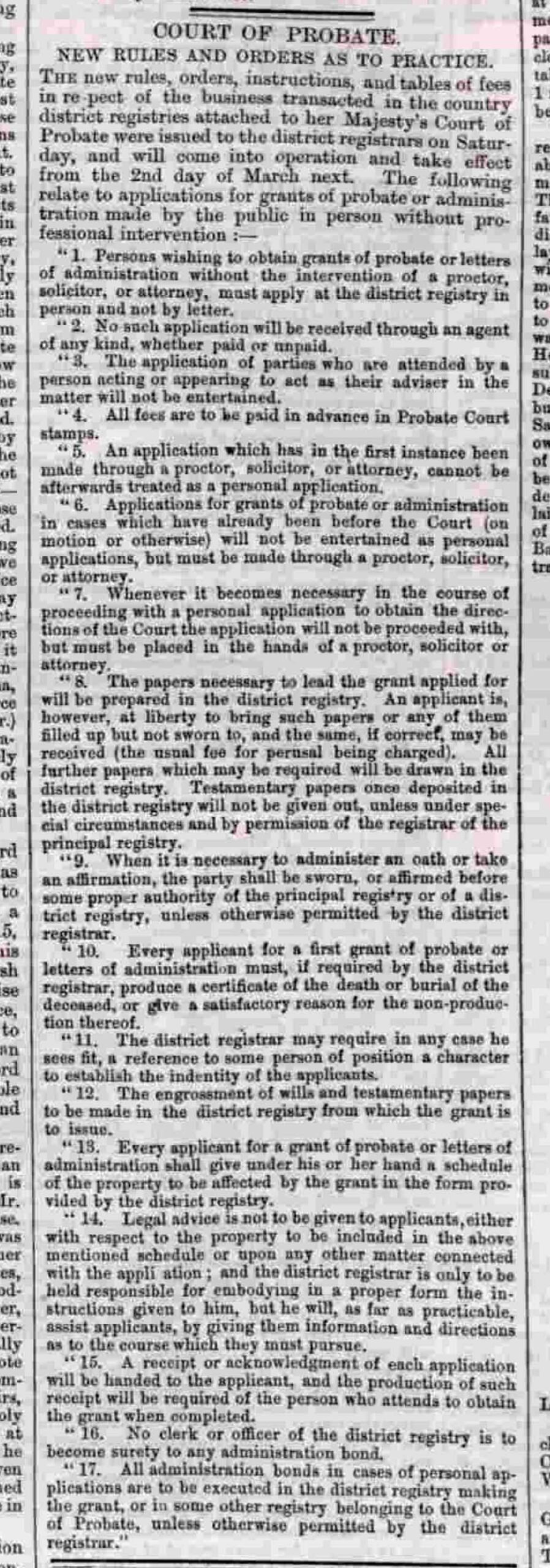
The new rules, orders, instructions, and tables of fees in respect of the business transacted in the country district registries attached to Her Majesty’s Court of Probate were issued to the district registrars on Saturday, and will come into operation and take effect from the 2nd day of March next. The following relate to applications for grants of probate or administration made by the public in person without professional intervention:
-
Persons wishing to obtain grants of probate or letters of administration without the intervention of a proctor, solicitor, or attorney, must apply at the district registry in person and not by letter.
-
No such application will be received through an agent of any kind, whether paid or unpaid.
-
The application of parties who are attended by a person acting or appearing to act as their adviser in the matter will not be entertained.
-
All fees are to be paid in advance in Probate Court stamps.
-
An application which has in the first instance been made through a proctor, solicitor, or attorney, cannot be afterwards treated as a personal application.
-
Applications for grants of probate or administration in cases which have already been before the Court (on motion or otherwise) will not be entertained as personal applications, but must be made through a proctor, solicitor, or attorney.
-
Whenever it becomes necessary in the course of proceeding with a personal application to obtain the directions of the Court, the application will not be proceeded with, but must be placed in the hands of a proctor, solicitor or attorney.
-
The papers necessary to lead the grant applied for will be prepared in the district registry. An applicant is, however, at liberty to bring such papers, or any of them filled up but not sworn to, and the same, if correct, may be received (the usual fee for perusal being charged). All further papers which may be required will be drawn in the district registry. Testamentary papers once deposited in the district registry will not be given out, unless under special circumstances and by permission of the registrar of the principal registry.
-
When it is necessary to administer an oath or take an affirmation, the party shall be sworn, or affirmed before some proper authority of the principal registry or of a district registry, unless otherwise permitted by the district registrar.
-
Every applicant for a first grant of probate or letters of administration must, if required by the district registrar, produce a certificate of the death or burial of the deceased, or give a satisfactory reason for the non-production thereof.
-
The district registrar may require in any case he sees fit, a reference to some person of position or character to establish the identity of the applicant.
-
The engrossment of wills and testamentary papers is to be made in the district registry from which the grant is to issue.
-
Every applicant for a grant of probate or letters of administration shall give under his or her hand a schedule of the property to be affected by the grant in the form provided by the district registry.
-
Legal advice is not to be given to applicants, either with respect to the property to be included in the above mentioned schedule or upon any other matter connected with the application; and the district registrar is only to be held responsible for embodying in a proper form the instructions given to him, but he will, as far as practicable, assist applicants, by giving them information and directions as to the course which they must pursue.
-
A receipt or acknowledgment of each application will be handed to the applicant, and the production of such receipt will be required of the person who attends to obtain the grant when completed.
-
No clerk or officer of the district registry is to become surety to any administration bond.
-
All administration bonds in cases of personal applications are to be executed in the district registry making the grant or in some other registry belonging to the Court of Probate, unless otherwise permitted by the district registrar.
Detailed Analysis for Historians and Family Historians:
Context and Legal Implications:
In 1863, the Court of Probate was responsible for legal matters concerning the administration of deceased persons’ estates, including grants of probate and letters of administration. This article outlines new standardised procedures across the country district registries, to take effect from 2 March 1863.
The rules mark a shift toward formalising and restricting personal (non-professional) applications, reflecting a broader trend in Victorian bureaucracy towards control, order, and the professionalisation of legal processes. It essentially discouraged laypeople from managing these legal matters without solicitors or proctors, thus protecting legal standards but also preserving the legal profession’s influence.
Implications for Individuals and Occupations:
-
Solicitors, proctors, and attorneys were formally reinstated as the default route for most probate applications, ensuring continued employment and prestige for these professions.
-
Clerks and registry officers were instructed not to act as legal advisers, limiting informal access to legal help and reinforcing the need for professional services.
-
Applicants (ordinary citizens) were subjected to stricter rules, documentation, identity verification, and fee payment in advance — possibly burdensome for poorer or rural individuals.
Businesses and Employers:
Legal firms likely saw increased activity and revenue due to the curtailing of DIY probate applications. It formalised their central role in probate, administration, and testamentary processes, likely creating a higher barrier to entry for those wishing to avoid legal fees.
Life in 1863 Lincolnshire:
-
In rural Lincolnshire, many residents were agricultural labourers or tradespeople with limited literacy. These new rules would make probate navigation challenging without legal support, especially where travel to a registry was involved.
-
In urban centres like Lincoln, access to legal help may have been easier, but the costs and bureaucracy still affected working families dealing with a death in the family.
-
The need to provide death certificates and sworn oaths suggests that Victorian society placed significant trust in formal documentation, which might have been hard to access promptly in rural parishes.
-
The article illustrates how legal processes were centralised and standardised in the 19th century, part of a wider Victorian push toward institutional authority and structure.
History of The Lincolnshire Chronicle:
“A voice for the county since 1833”
Overview:
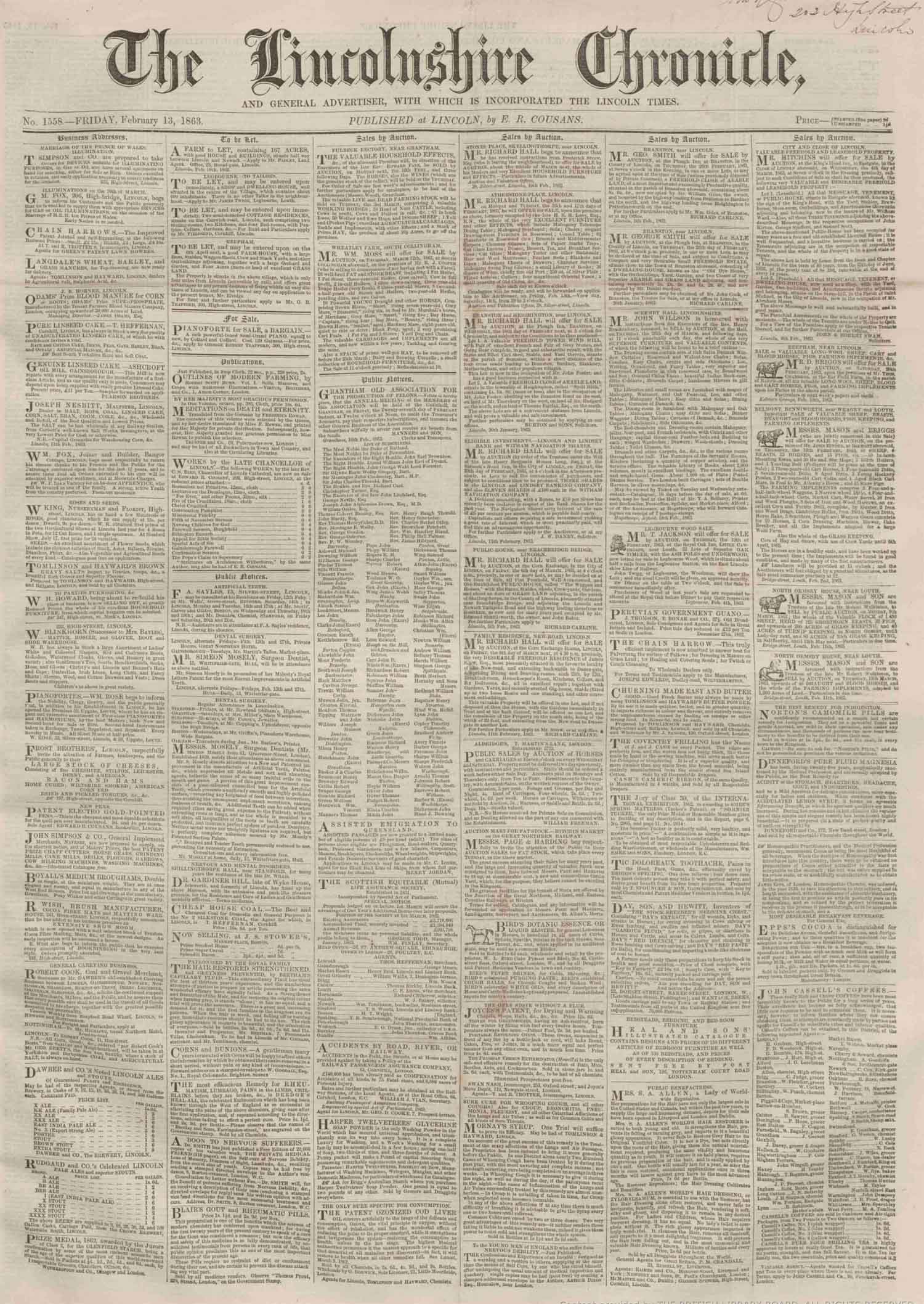
The Lincolnshire Chronicle was one of the most enduring and influential provincial newspapers in 19th- and early 20th-century England. Established in 1833, it provided an essential platform for news, public notices, advertisements, and commentary, especially for those living in the predominantly rural county of Lincolnshire. It was more than just a newspaper — it was a reflection of the times, offering valuable insight into the changing social, political, agricultural, and legal landscapes of the region.
Origins and Early Years (1833–1850s)
Founded during a period of immense national transformation — with the Reform Act of 1832 having just expanded the electorate — The Lincolnshire Chronicle emerged to serve a county in flux. Its readership included yeoman farmers, landed gentry, clergy, merchants, and the increasingly literate artisan class.
-
Format and Distribution:
The Chronicle was a weekly broadsheet, typically published on Fridays. It was printed in Lincoln but circulated widely across the county, reaching places like Boston, Grantham, Gainsborough, Spalding, and Market Rasen. By the 1840s, its circulation extended beyond the county, as Lincolnshire folk living in London or the Midlands sought news from home. -
Content Focus:
The newspaper gave extensive coverage to:-
Local and national politics
-
Agricultural market reports
-
Court and legal proceedings
-
Ecclesiastical news
-
Shipping movements (especially relevant to Boston and Grimsby)
-
Advertisements for land, auctions, jobs, and apprenticeships
-
The Role of the Press in Rural Society
In a largely agricultural county like Lincolnshire, newspapers served as the main form of connection to the wider world. The Lincolnshire Chronicle was instrumental in informing farmers of corn prices, weather predictions, poor law decisions, and seasonal wages.
It also helped enforce moral and legal order — by publishing reports from the assizes and petty sessions — often with strong editorial commentary.
The Church of England and local landowners often had close relationships with the Chronicle’s editorial stance, which leaned toward moderate conservatism but evolved with the times.
Technological & Editorial Development (1850s–1890s)
The newspaper industry saw immense change in the second half of the 19th century:
-
Steam-powered printing presses and improved railways meant faster production and wider distribution.
-
Reduction of newspaper stamp duties in the 1850s made papers more affordable.
-
Journalistic professionalism increased, with correspondents in market towns providing regular dispatches.
During this time, the Lincolnshire Chronicle expanded its coverage and began printing serial fiction, letters to the editor, and women’s columns, appealing to a broader audience.
By the 1860s–70s, it was one of the principal newspapers in the East Midlands, often cited by national papers and used by lawyers, clergy, and genealogists as a record of public notices.
The Chronicle and Victorian Legal Culture
Notices like the Court of Probate orders (as seen in the 1863 issue) were typical. The Chronicle served as:
-
A quasi-official legal record, often used for verifying probate, bankruptcy, and local government affairs.
-
A public notice board, especially for the announcement of property sales, deaths, marriages, tenders, and civic duties.
-
An essential tool for family historians today — enabling reconstruction of lineages, social mobility, occupational changes, and local events affecting ancestors.
Twentieth Century and Decline
By the early 20th century, The Lincolnshire Chronicle was part of a crowded provincial newspaper landscape. Other titles, such as the Lincolnshire Echo (founded 1893), began to outpace it in terms of modernity, daily publication, and urban relevance.
The Chronicle began to struggle with:
-
Rising costs
-
Competition from radio and later, television
-
Decline of rural readership, especially after the two World Wars
It eventually merged with or was absorbed into other regional papers, with publication likely ceasing as an independent title by the mid-20th century.
Legacy and Importance Today
Despite no longer being in print, the Lincolnshire Chronicle lives on:
-
Digitised editions are available via the British Newspaper Archive and local record offices.
-
It is frequently cited in academic and genealogical research.
-
It provides an unparalleled window into Victorian and Edwardian rural life — covering everything from smallpox outbreaks to school prize-givings.
It holds special value for:
-
Historians interested in provincial England, rural politics, press history, and social change.
-
Family historians seeking marriage banns, obituaries, criminal proceedings, or land transfers.
-
Cultural researchers studying dialect, gender roles, advertising, or education in the 1800s.
Conclusion: A Chronicle of the County
From its establishment in 1833 until its decline, The Lincolnshire Chronicle was a pillar of civic life. It informed, connected, educated, and sometimes entertained the people of Lincolnshire. As a historical source, it remains invaluable, offering us intimate glimpses into the daily realities of life in rural and urban Lincolnshire — a county shaped by both tradition and transformation.
What Can Be Learned from This Article?
-
The increasing complexity of estate and death-related legal processes in Victorian England.
-
The limitations faced by non-professionals in legal proceedings.
-
The importance of documentation, identity verification, and formal legal procedure.
-
Social stratification reflected in access to legal services.
-
The growth of state and bureaucratic control over personal affairs.
In Brief
📜 New 1863 Probate Rules: DIY applications now restricted! The Lincolnshire Chronicle explains how Victorians had to navigate death, law & bureaucracy without a solicitor. Vital reading for #FamilyHistory & #LegalHistory buffs!
📰 #Lincolnshire #VictorianEra #Genealogy #Probate #HistoryUK #1863 #LincolnshireChronicle #Historians #FamilyTree #LocalHistory #CourtOfProbate #Ancestry