Holloway Press – Friday 29 January 1943
When Is Bigamy Not Bigamy?

When is bigamy not bigamy? This question was discussed at the Old Bailey when George Livingstone, a soldier in the R.A.S.C., pleaded guilty to bigamously marrying Phyllis Dorothy May Sandy, of Luard-street, Caledonian-road, N.1, last year.
Before any evidence was given, the Recorder, Sir Gerald Dodson, said he noticed that when the accused married this girl it was just over seven years since he parted from his legal wife—seven years and one month, in fact. As the prosecution would not be able to prove that Livingstone had heard of his wife in that time, he did not think that any evidence should be offered against the prisoner in this case.
Prosecuting counsel said it was only a month more than seven years since Livingstone last saw his wife and it was not likely that she would die during those four weeks.
The Recorder: “You have got to draw the line somewhere. The law says seven years. In these days it doesn’t take a month to die.” Turning to the accused, he said: “I think you had better withdraw your plea of guilty.”
The Recorder then directed the jury to return a formal verdict of not guilty, saying, “This is a question of ‘When is bigamy not bigamy?’ The accused man has pleaded guilty to bigamy. Probably this man has pleaded under a misapprehension of the law, because, where a husband has been absent for seven years, and where the prosecution were unable to prove that the accused knew that the espoused was living, the second marriage was not covered by the law relating to bigamy. The seventh year expired one month before this bigamous marriage took place. It follows that there is really no case against this man.”
Livingstone was then discharged.
Description and Context
The article describes a case heard at the Old Bailey in London involving George Livingstone, a soldier in the Royal Army Service Corps (R.A.S.C.), who was charged with bigamy after marrying Phyllis Dorothy May Sandy while still being legally married to his first wife. However, the court discharged him after discovering that more than seven years had passed since he had last seen his legal wife.
The judge, Recorder Sir Gerald Dodson, ruled that Livingstone’s second marriage did not constitute bigamy because he had been separated from his wife for more than seven years, with no evidence that he had heard from or about her in that time.
Legal Explanation (UK Law in 1943)
Under British law in 1943, bigamy was defined as marrying someone while already legally married to another person. However, Section 22 of the Offences Against the Person Act 1861 contained a crucial exception: if a person had been separated from their spouse for seven years without knowing if they were alive, a subsequent marriage would not be considered bigamy.
The principle here was rooted in the assumption that a spouse absent for seven years with no known contact was presumed dead unless evidence suggested otherwise. This presumption aimed to protect individuals who genuinely believed their spouse had died after prolonged separation.
Analysis
The Recorder’s intervention highlights a nuanced application of the law. Livingstone had pleaded guilty, likely misunderstanding that his absence from his wife for seven years meant he was legally allowed to remarry. The court found that:
- Seven-Year Absence Rule: Livingstone had been separated from his wife for seven years and one month, satisfying the requirement.
- No Knowledge of Life: There was no evidence he knew his wife was still alive.
- Misapprehension of the Law: His guilty plea reflected a lack of understanding of this legal protection, not a genuine admission of bigamy.
This case illustrates the balance between strict legal definitions and judicial discretion. The law allowed for remarriage after seven years without contact, ensuring fairness for individuals abandoned or otherwise left without knowledge of their spouse’s whereabouts.
Historical Implications
For historians, this case provides insight into mid-20th-century family law in Britain, including assumptions about marriage permanence and how the legal system managed ambiguous marital situations. It also demonstrates the impact of military service, wartime disruptions, and societal norms around relationships during World War II.
Moreover, the Recorder’s somewhat sardonic comment—”In these days it doesn’t take a month to die”—suggests a wartime context in which death and disappearance were unfortunately common. Such cases likely increased during wartime due to forced separations and communication difficulties.
The history of The Holloway Press
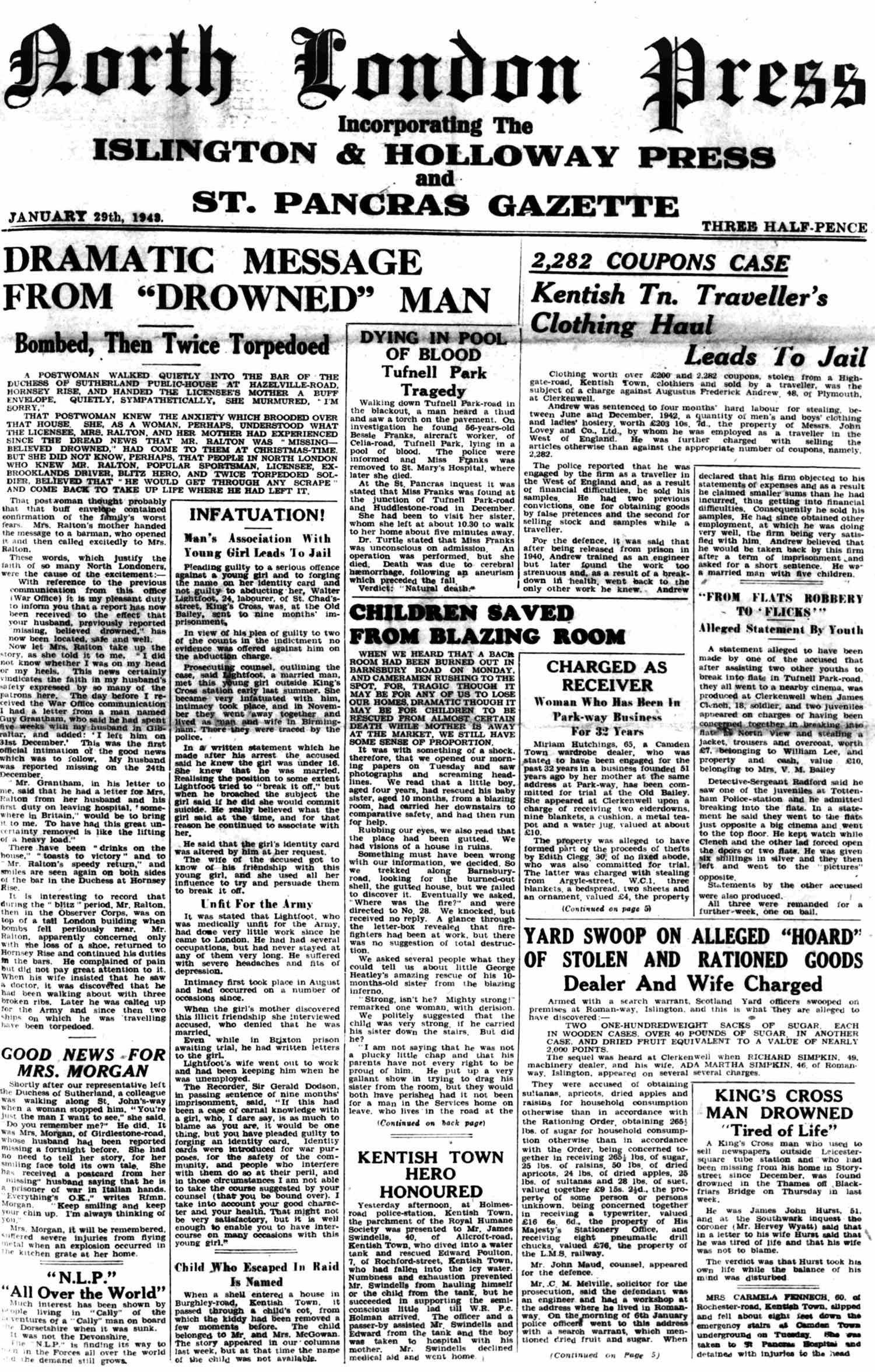
The Holloway Press was a local newspaper serving the Holloway area in North London. Its publication history reflects the evolving landscape of local journalism in London over nearly a century.
Publication Timeline:
-
1872: The newspaper was first published as The Holloway Press.
-
1875: It was renamed The North Metropolitan and Holloway Press.
-
1880: The title reverted to The Holloway Press.
-
1923: The newspaper became the Islington and Holloway Press, reflecting a broader focus that included the neighbouring Islington area.
-
1942: It was renamed the North London Press, indicating an expansion to cover a wider region of North London.
-
1964: Separate editions were published for Islington and Camden, two prominent boroughs in North London.
-
February 1971: The publications split into the Holloway & Islington Journal and the Camden Journal.
-
1974: The Holloway & Islington Journal was discontinued.
Throughout its existence, the Holloway Press and its successor titles chronicled local news, events, and issues pertinent to the communities of Holloway, Islington, and the broader North London area. The newspaper’s evolution in title and coverage area reflects the dynamic nature of local journalism and its response to the changing demographics and interests of its readership.
📜 “When Is Bigamy Not Bigamy?” – Old Bailey, 1943 🏛️
A soldier marries again after seven years apart from his wife—was it bigamy or legal remarriage? Discover how the law drew the line.
#HistoryMysteries #OldBailey #BigamyCase #1940sLaw #HollowayPress #LegalCuriosities #BritishHistory