North Cumberland Reformer – Saturday 24 December 1898
THE HEXHAM MURDER.
THE ACCUSED MAN ACQUITTED.
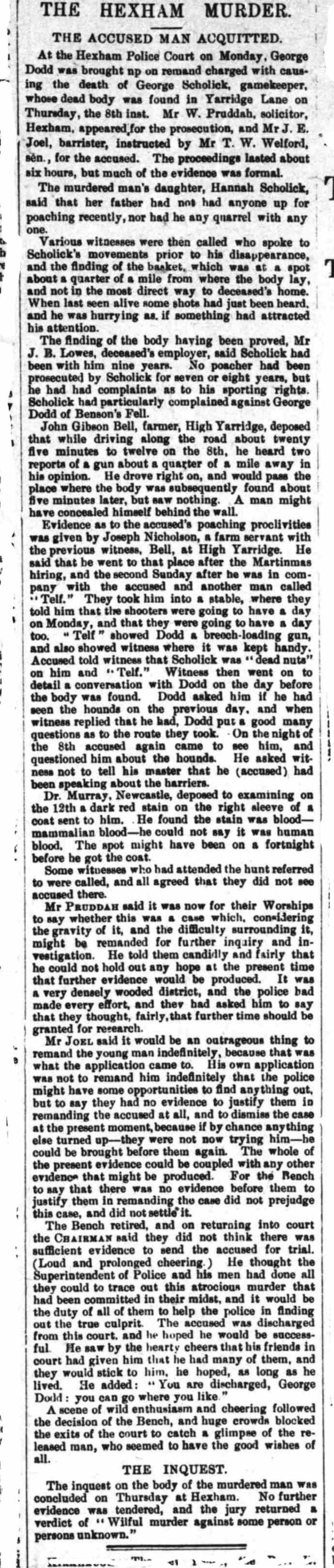
At the Hexham Police Court on Monday, George Dodd was brought up on remand charged with causing the death of George Schollick, gamekeeper, whose dead body was found in Yarridge Lane on Thursday, the 8th inst. Mr W. Pruddah, solicitor, Hexham, appeared for the prosecution, and Mr J. E. Joel, barrister, instructed by Mr T. W. Welford, sén., for the accused. The proceedings lasted about six hours, but much of the evidence was formal.
The murdered man’s daughter, Hannah Schollick, said that her father had not had anyone up for poaching recently, nor had he any quarrel with any one.
Various witnesses were then called who spoke to Schollick’s movements prior to his disappearance, and the finding of the basket, which was at a spot about a quarter of a mile from where the body lay, and set in the most direct way to the deceased’s home. When last seen he took some shots just had been heard. He was hurrying as if something had attracted his attention.
The finding of the body having been proved, Mr J. B. Lowes, deceased’s employer, said Schollick had been employed in the capacity of gamekeeper at the time of his death for seven or eight years. Schollick had particularly complained against George Dodd of Blenkinsopp Fell.
John Gibson Bell, farmer, High Yarridge, deposed that while driving along the road about twenty-five minutes to twelve on the 8th, he heard two reports of a gun about a quarter of a mile away in his opinion. He drove right on, and would pass the place where the body was subsequently found about five minutes later, but saw nothing. A man might have concealed himself behind the wall.
Evidence as to the accused’s poaching proclivities was given by Joseph Nicholson, a farm servant with the previous witness, Bell, at High Yarridge. He said that he went to that place after the Martinmas hiring, and the second Sunday after he was in company with the accused and another man called “Telf.” They took him into a stable, where they told him that the shooting was going to have a day on Monday, and that they were going to have a day.
“Telf” showed Dodd a breech-loading gun, and also showed witness where it was kept handy. An old witness that Schollick was “dead nuts” on him and “Telf.” Witness then went on to hold a conversation with Dodd on the day before the body was found. Dodd asked him if he had been at the house on the previous day, and when witness replied that he had, Dodd put a good many questions as to the route he had gone. On the night of the 8th accused again came to see witness, and witness then told his master that he (accused) had been speaking about the business.
Dr. Murray, Newcastle, deposed to examining on the 12th a dark red stain on the right sleeve of a coat sent to him. He found the stain was blood—mammalian blood—he could not say it was human blood. The spot might have been on a fortnight before he got coat.
Some witnesses who had attended the hunt referred to were called, and all agreed that they did not see accused there.
MR PRUDDAH said it was now for their Worships to say whether this was a case which, considering the gravity of it, and the difficulty surrounding it, might be remanded for further inquiry and investigation. He told them candidly and fairly that he could not hold out any hope at the present time that further evidence would be produced. It was a very densely wooded district, and the police had made every effort, and they had asked him to say that they thought, fairly, that further time should be granted for research.
MR JOEL said it would be an outrageous thing to remand the young man indefinitely, because that was what the application came to. His own application was that they should immediately find that the police might have had some opportunities to bring things out, but in regard to any evidence to justify their putting the man back at all, and to dismiss the case unless further commenced, he should take the case up at once.
The Bench retired, and on returning into court the CHAIRMAN said they did not think there was sufficient evidence to send the accused for trial. [Loud and prolonged cheering.] He thought the Superintendent of Police and his men had done their best to trace out this atrocious murder that had been committed in their midst, and it would be the duty of all of them to help the police in finding out the guilty spirit. The accused was discharged from this court, and he hoped he would be successful. He also pointed out to the accused that his friends in court had given him that he had many of them, and they would stick to him if he need, as long as he lived. He added: “You are discharged, George Dodd: you can go where you like.”
A scene of wild enthusiasm and cheering followed the decision of the Bench, and huge crowds blocked the exits of the court to catch a glimpse of the released man, who seemed to have the good wishes of all.
THE INQUEST.
The inquest on the body of the murdered man was concluded on Thursday at Hexham. No further evidence was tendered, and the jury returned a verdict of “Wilful murder against some person or persons unknown.”
Table of Contents
Toggle[Breaking Down the Phrase:
-
-
“Wilful Murder”
- This was a formal term used in English common law to describe intentional and unlawful homicide—what we now call murder.
- “Wilful” (the older spelling of willful) meant that the killing was deliberate, premeditated, or intentional.
- It distinguished murder from manslaughter, which involved unintentional or provoked killings.
-
“Against Some Person or Persons Unknown”
- This phrase was used when there was no known or identifiable suspect at the time of the inquest.
- It acknowledged that a crime had been committed, but the authorities lacked evidence to name a perpetrator.
- It was commonly used when there was no witness to the crime, no confession, and insufficient forensic evidence (forensics were still in their infancy in the 1890s).
-
Legal and Procedural Implications in the 1890s
-
- The coroner’s inquest was responsible for determining the cause of death. If a jury found “Wilful Murder,” it meant they believed a crime had occurred rather than a natural or accidental death.
- However, by adding “against some person or persons unknown,” it indicated that no specific individual could yet be charged.
- This verdict allowed the police investigation to continue, and if new evidence emerged, an arrest and formal trial could take place later.
- In practice, many unsolved murders remained in this legal limbo, as forensic science was primitive and convictions relied heavily on eyewitness testimony.
Comparison with Modern Terminology
Today, a similar phrase used in British legal terminology would be “Unlawful killing by person(s) unknown”, or simply ruling a death as homicide without a named suspect.
Examples of Cases with Similar Verdicts in the 19th Century
-
- Jack the Ripper murders (1888): Many of the inquests ruled “Wilful murder by some person or persons unknown” as the police never conclusively identified the killer.
- Rural murders (like the Hexham case): When bodies were found with evidence of violence but no clear suspect, inquest juries often reached the same verdict.
Conclusion
In Victorian England, “Wilful murder against some person or persons unknown” was a formal legal finding that:
✔ Confirmed the death was a deliberate murder
✔ Acknowledged the perpetrator was unidentified
✔ Allowed the police to continue their investigation
✔ Often resulted in cold cases due to lack of forensic evidence]
Historical Analysis of The Hexham Murder Case (1898)
1. Legal Context in 1898
During the late 19th century, British law followed the Offences Against the Person Act 1861, under which murder was a capital offence, punishable by hanging if the accused was found guilty. For a case to proceed to trial, sufficient evidence was needed, typically including witness testimony, forensic evidence, and motive.
- Burden of Proof: The prosecution had to establish guilt beyond a reasonable doubt. The lack of direct evidence against George Dodd meant the magistrates at Hexham Police Court felt there was no basis to proceed to trial.
- Forensic Science in 1898: Blood analysis was in its infancy. Dr. Murray’s testimony that the stain was “mammalian blood” but not necessarily human shows the limitations of forensic techniques at the time.
- Coronial Inquest: The role of the inquest jury was to determine the cause of death. Their verdict of “wilful murder against some person or persons unknown” suggests they were convinced a murder occurred, but the perpetrator remained unidentified.
2. Key Figures in the Case
- George Schollick (Deceased) – A gamekeeper (responsible for protecting land from poachers). His employer was J. B. Lowes, who stated Schollick had been in his role for seven to eight years.
- Hannah Schollick – Daughter of the deceased, provided evidence about her father’s character and disputes.
- George Dodd (Accused) – A suspected poacher, previously warned or confronted by Schollick.
- Joseph Nicholson & John Gibson Bell – Farmworkers who provided evidence about poaching activities.
- Dr. Murray (Newcastle) – Provided forensic evidence on the coat stain.
- The Bench (Magistrates) & Mr. Pruddah (Solicitor for the Prosecution) – Recognised the difficulty in gathering further evidence in a densely wooded rural area.
- Mr. J. E. Joel (Defence Barrister) – Argued against an indefinite remand due to lack of evidence.
3. Implications of the Verdict
- For George Dodd: He was acquitted due to insufficient evidence, but the inquest jury’s verdict meant suspicion remained. The public reaction (cheering and crowd support) suggests he had local sympathy, likely due to tensions between gamekeepers and rural working-class people (often poachers).
- For Law Enforcement: Despite efforts by the Superintendent of Police, the case remained unsolved. This was common in rural Victorian England, where investigative techniques were limited, and local silence (protecting a fellow working man) often obstructed justice.
4. Social & Economic Background
- Gamekeepers vs. Poachers: The 19th century saw increasing tensions between landowners, gamekeepers, and working-class poachers. Gamekeepers were employed to protect landowners’ hunting rights, often clashing violently with those who poached game for food or profit.
- Blenkinsopp Fell (Where George Dodd Lived) – A rural area known for mining and agriculture, making poaching a common crime among lower-class workers struggling for food.
- Employment in the Area:
- Gamekeepers (like Schollick) worked for landowners.
- Farmers (like John Gibson Bell) hired seasonal labourers at the Martinmas Hiring Fair (a key event for agricultural employment).
- Hunters & Landowners (unnamed but important figures) had the legal right to game, which they often protected aggressively.
5. Historical Significance for Historians & Genealogists
- Family History:
- If descendants of George Schollick or George Dodd exist, this case provides insights into their ancestors’ lives, occupations, and potential conflicts.
- The Martinmas Hiring Fair reference suggests employment patterns in Northumberland. If your ancestors were farmworkers, they likely moved for work.
- Local Crime History:
- This case is part of 19th-century rural crime trends, particularly poaching-related violence.
- The lack of forensic advancement highlights why many Victorian-era murder cases went unsolved.
- The Role of Inquests:
- Coroners’ inquests were a critical legal procedure, often more public than criminal trials.
- In many cases, inquests were the only form of legal judgment if evidence was insufficient for trial.
- Impact on the Justice System:
- This case reflects Victorian attitudes toward working-class crime. While gamekeepers were seen as law enforcers, poachers had public support (as seen in the cheering for Dodd).
- The reliance on circumstantial evidence and limited forensic science often meant suspects were acquitted due to lack of definitive proof.
Conclusion: Lessons from this Case
- Victorian-era justice relied heavily on eyewitness testimony. Lack of modern forensic science made murder convictions difficult.
- Social class tensions shaped public perception of crime. The accused (Dodd) was a suspected poacher, yet the crowd cheered his release, showing public distrust of landowners & gamekeepers.
- Newspapers played a vital role in shaping narratives. The North Cumberland Reformer likely influenced public opinion, and modern researchers can use such articles to understand regional history, crime trends, and employment patterns.
Life in Hexham in the 1890s
In the 1890s, Hexham—a historic market town in Northumberland—experienced notable developments that shaped its social, cultural, and economic landscape.
Religious and Social Institutions
The town’s religious life was vibrant, with various denominations actively contributing to community cohesion:
-
Methodist Community: In 1890, the United Methodists relocated to Tanners Row, reflecting the dynamic nature of religious affiliations during this period. hexhamhistorian.org
-
Presbyterian Leadership: John McVitie’s appointment as minister to the Presbyterian Church in 1890 marked a significant era, with his tenure extending until 1925. hexhamhistorian.org+1hexhamhistorian.org+1
Cultural and Recreational Developments
The 1890s saw Hexham enhancing its cultural and recreational facilities:
-
Hexham Racecourse: Established in 1890, the racecourse became a prominent venue for National Hunt racing. The inaugural event on 23 April 1890 featured six races with 31 participants, laying the foundation for a longstanding equestrian tradition.
-
Tynedale Open Tournament: Revived in 1890, this grass-court tennis tournament attracted local and regional players, fostering a competitive sporting spirit.
Military Presence
The establishment of military facilities underscored Hexham’s strategic importance:
- Hencotes Drill Hall: Completed around 1891, this building served as the headquarters for the 1st Volunteer Battalion, The Northumberland Fusiliers. It played a pivotal role in local military organisation, especially during the mobilisation in August 1914.
Industrial and Economic Activities
While Hexham maintained its traditional industries, the 1890s also brought infrastructural advancements:
- Hexham and Allendale Railway: Although opened earlier, this railway continued to influence Hexham’s economy by facilitating the transport of minerals and goods, thereby integrating the town more closely with regional industrial activities.
Notable Events
The decade was marked by significant occurrences that impacted the community:
- Death of Wentworth Canning Blackett Beaumont: His passing led to Wentworth Henry Canning Beaumont inheriting the title of 2nd Viscount Allendale on 6 August 1890, influencing local landownership and politics. hexhamabbey.org.uk
In summary, the 1890s were a transformative period for Hexham, characterised by infrastructural developments, cultural enrichment, and evolving social institutions. These changes collectively contributed to the town’s rich historical tapestry, reflecting a community adapting to the broader currents of the late Victorian era.
History of The North Cumberland Reformer
The North Cumberland Reformer: A Historical Overview
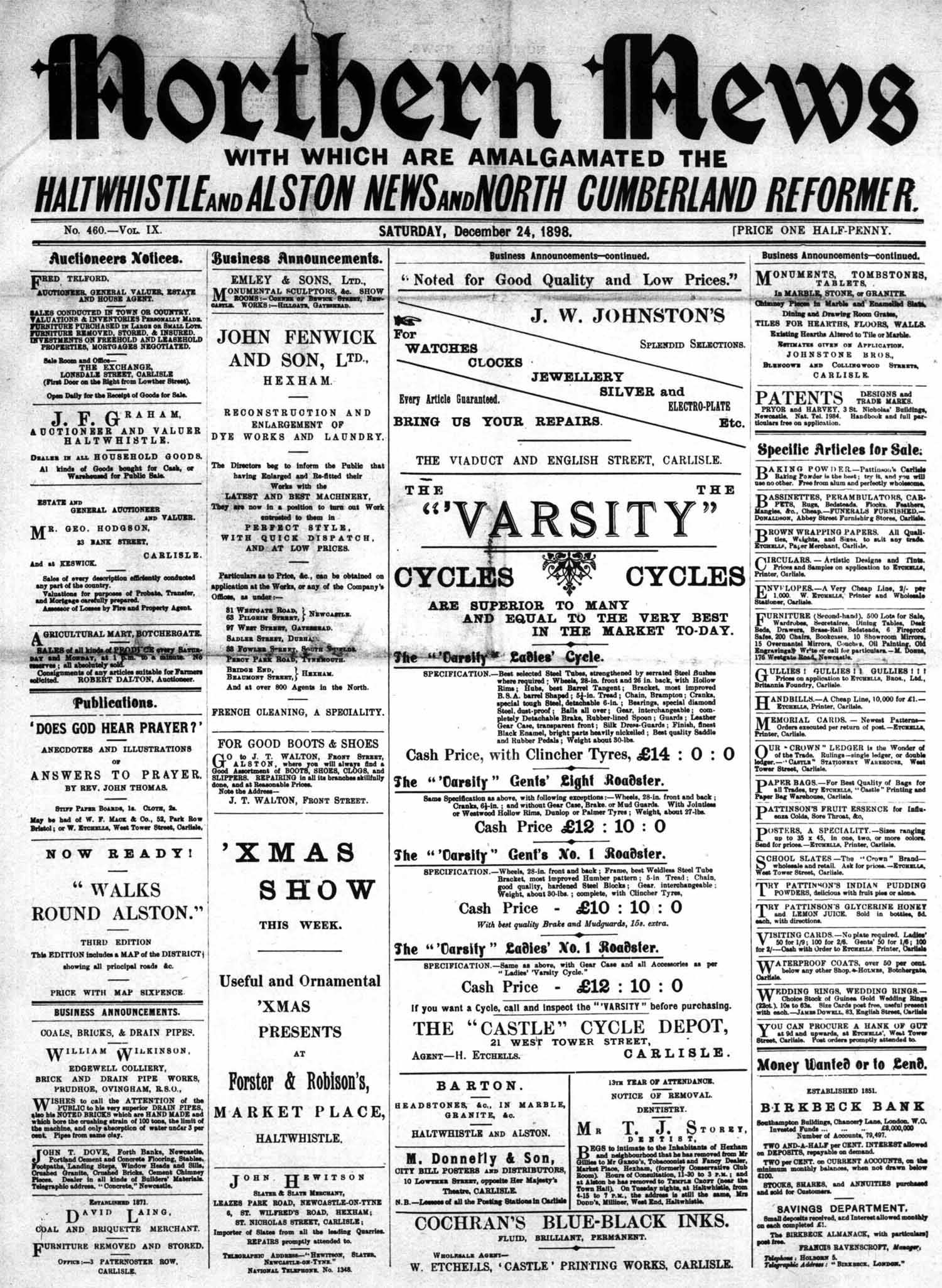
The North Cumberland Reformer was a regional newspaper that served the northern regions of Cumberland, England, during the late 19th century. Its publication spanned from 1890 until 1898, providing readers with local and international news, opinions, and various features.
Publication Period and Coverage
The newspaper operated for approximately eight years.
Content and Focus
As a regional publication, The North Cumberland Reformer likely focused on issues pertinent to the local community, including:
-
Local News: Reporting on events, developments, and stories within the northern Cumberland area.
-
Social and Political Commentary: Providing opinions and analyses on social reforms and political matters affecting the region.
-
Community Events: Highlighting local gatherings, cultural events, and societal happenings.
Archival Access
For researchers and historians interested in exploring the content of The North Cumberland Reformer, the Carlisle Library’s local studies section holds microfilm copies of the newspaper, covering its entire publication run from 1890 to 1898. Cumberland Council
Significance for Research
The newspaper serves as a valuable resource for understanding the historical landscape of northern Cumberland during the late 19th century. It provides contemporary accounts of local events, societal norms, and public opinion of the time, making it a significant tool for historians and genealogists alike.Cumberland Council
In Brief
📜 “Murder in Hexham, 1898. Gamekeeper George Schollick found dead, poacher George Dodd acquitted—case unsolved. Public cheered Dodd’s release, but the inquest declared ‘Wilful murder’! What happened? #TrueCrime #History #Northumberland #VictorianCrime #UnsolvedMurder #Poaching #Hexham #Northumberland #Gamekeepers #ForensicHistory #LegalHistory