The Aftermath of the Charlotte Winsor Baby Farming Case
This page is a curated collection of archival news extracts, providing a sobering retrospective on the aftermath of the Charlotte Winsor case — one of the earliest and most notorious examples of so-called “baby farming” in Victorian England. Drawing from several regional and national newspapers between 1870 and 1894, the page situates Winsor’s long incarceration within the broader public discourse about child neglect, moral panic, and the evolving criminal justice system.
At its heart, the page explores two interwoven themes: the horror of baby farming as a social phenomenon and the endurance of Charlotte Winsor’s punishment long after the public had forgotten her name. It opens with an article from The Exeter and Plymouth Gazette (1870) discussing the exposure of another baby farmer — Mrs. Waters — at the Lambeth Police Court. That article is not about Winsor herself, but is included as context to show that such cases continued to appear even after Winsor’s conviction, with public outcry growing ever more intense. The tone is one of outrage and moral condemnation, particularly towards institutions (both secular and religious) that allowed or concealed the mistreatment and death of infants. The rhetoric is deeply Victorian — moralistic, judgmental, and often religiously charged — calling for stronger laws and invoking phrases like “demonicism” and “infanticidal wickedness.”
This leads directly into the more reflective coverage of Charlotte Winsor’s fate. The rest of the page comprises a series of newspaper reports from 1886 and 1894 describing Winsor’s continued incarceration in Woking Female Convict Prison. Each report adds layers of detail and tone, showing how society viewed her over time: once a figure of public horror, later a forgotten woman serving a life sentence in near-total obscurity.
These later articles — from sources like The Northampton Mercury, Sheffield Independent, The Star, and Western Times — paint a poignant picture of an ageing convict who, by the late 1880s, had become the longest-serving female prisoner in the country. She was described as a quiet, elderly woman engaged in light prison labour, living out a sentence that had begun in 1865 after her conviction for child murder near Torquay. Multiple reports confirm that although she had confessed, her execution was ultimately commuted due to legal ambiguities and growing public unease over the hanging of women. Despite this, successive Home Secretaries refused to recommend clemency, citing the severity of her crime.
The consistent phrase across the later reports — “confinement does not seem to trouble her much” — becomes a haunting refrain. It suggests that Winsor had resigned herself to prison life, and that her punishment had become not just a sentence but a permanent state of being. She is referred to as the “doyenne” of female prisoners, her case long since buried in public memory, yet still a symbol of one of the era’s darkest social scandals.
Conclusion
In essence, this page serves as both a micro-history of a forgotten woman and a wider commentary on the treatment of female criminals in Victorian Britain. By presenting multiple historical sources together, the page enables readers to witness how a figure like Charlotte Winsor — once vilified in headlines — was gradually recast by the press as a tragic relic of a past outrage. It also documents how the baby farming panic, and the associated moral revulsion, continued to influence British attitudes toward justice, gender, motherhood, and incarceration well into the late 19th century.

The “Baby Farming” case at the Lambeth Police Court is one of the most revolting revelations it is possible to conceive. By the aid of newspaper advertisements, a woman who is reputedly under the name of Mrs. Waters, but who has called herself “Mrs. Oliver” and various other names, appears to have made what may be a trade with persons for the adoption of children at a low rate. When a police officer visited her house he found five infants, two of whom were all but in the last extremities of death. There was very little chance of the others living with such food as she foisted upon them, and she was under the influence of drink. The only conclusion, led to by this discovery of the finale of so large a system, must be of the most horrible nature. As keeping the dead, you see, is no more than has been done at Lambeth during the past few weeks. They were in baskets, boxes, and in the fireplace, and so packed and closed. As a witness in the case against Mrs. Waters said: “You may say what you like of a mother’s wish and duty, but I bring mine up myself and see after them.” And judging Mrs. Waters, we may say that, like all these fiends, in whom respectable Christian women will see the very blackest of blackest DEMONIACISM that ever disguised itself in woman’s shape, she had the self-same and specific defence—they were not of the price, and under the limitations she agreed for. It is quite time that a more rigorous law should exist for the supervision of institutions of this class. From statements in the CATHOLIC WORLD, it is evident that in the sister island there are, if anything, more such foul sinks of INFANTICIDAL WICKEDNESS than in England. Many are removed by Lourdes, and others are taken to institutions that never send up children again. Were these facts known, not only would Protestant Christians shudder horrified, but many of those Romanists themselves, whose female kin, the mercy of Heaven visit their conscience, would close them as abased pagan establishments and ordinances.

AN OLD CONVICT.
A friend, privileged to visit one of Her Majesty’s convict prisons, came the other day upon an old woman, apparently 70 years of age, engaged upon some light labour. He asked who it was, and heard a name that has not passed the public lips for nearly a generation. It was Charlotte Windsor, the child murderess, whom everybody, if they thought of her at all, doubtless believed was dead. More than twenty years she has dwelt in this living tomb, and seems likely to live for years to come. She was 46, in the prime of life, when sentenced to penal servitude for life, and is now in her 67th year, having, in last July, attained what may be well called her majority as a convict. She is the doyenne of women in penal servitude. She has had a long interval of monotony, not a very bad quarter of a century. It was in March, 1865 that she was arraigned at the Exeter Assizes on a charge of murder. The jury not being able to come to an agreement she was sent back to gaol and committed to take her trial at the following July assizes on the same indictment. In the meantime she made a full confession, and Charlotte Windsor was found guilty and sentenced to death. Lord Westbury’s Act not being then in force against anyone being tried twice for the same offence, she was liable, notwithstanding her full judicial confession, to be again tried on the same charge. The wretched woman being sufficiently represented pending the trial to plead her revulsion, it was stated that otherwise the public would have seen yet another woman hung, and accordingly she was sentenced to penal servitude for life.
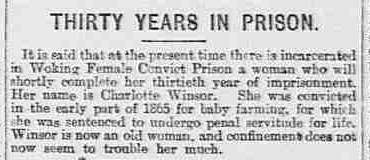
THIRTY YEARS IN PRISON.
It is said that at the present time there is incarcerated in Woking Female Convict Prison a woman who will shortly complete her thirtieth year of imprisonment.
Her name is Charlotte Winsor. She was convicted in the early part of 1865 for baby farming, for which she was sentenced to undergo penal servitude for life.
Winsor is now an old woman, and confinement does not now seem to trouble her much.
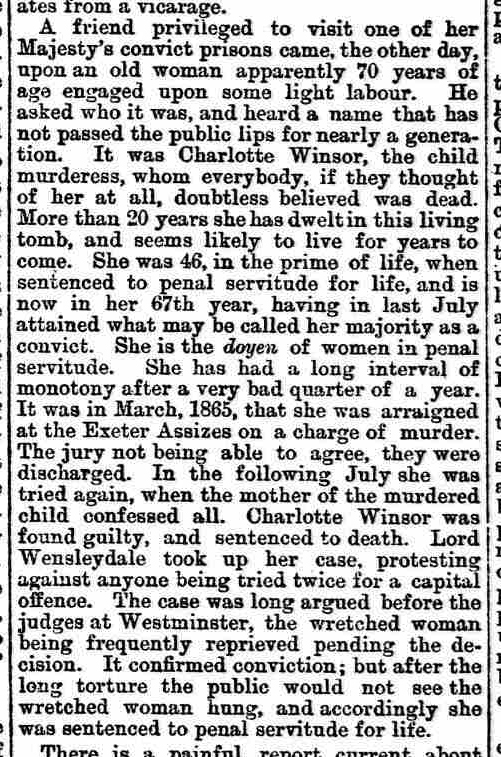
A friend privileged to visit one of her Majesty’s convict prisons came, the other day, upon an old woman apparently 70 years of age engaged upon some light labour. He asked who it was, and heard a name that has not passed the public lips for nearly a generation. It was Charlotte Winsor, the child murderess, whom everybody, if they thought of her at all, doubtless believed was dead. More than 20 years she has dwelt in this living tomb, and seems likely to live for years to come. She was 46, in the prime of life, when sentenced to penal servitude for life, and is now in her 67th year, having in last July attained what may be called her majority as a convict. She is the doyenne of women in penal servitude. She has had a long interval of monotony after a very bad quarter of a year. It was in March, 1865, that she was arraigned at the Exeter Assizes on a charge of murder. The jury not being able to agree, she was remanded and committed to take her trial at the following July assizes, when the mother of the murdered child confessed all. Charlotte Winsor was found guilty and sentenced to death. Lord Westbury’s Act not being then in force against anyone being tried twice for the same offence, notwithstanding her full confession she was liable to be tried for a capital crime. The case was long argued before the then Attorney-General, the wretched woman being sufficiently represented, whereupon the indictment was eventually registered, pending new decision. It continued overlooked; but after the long torture the public would not have seen yet another woman hung, and accordingly she was sentenced to penal servitude for life.
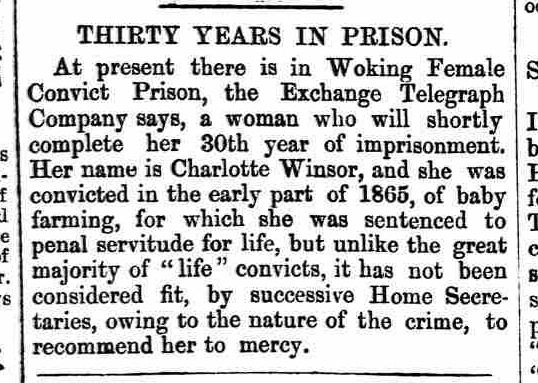
THIRTY YEARS IN PRISON.
At present there is in Woking Female Convict Prison, the Exchange Telegraph Company says, a woman who will shortly complete her 30th year of imprisonment.
Her name is Charlotte Winsor, and she was convicted in the early part of 1865, of baby farming, for which she was sentenced to penal servitude for life, but unlike the great majority of “life” convicts, it has not been considered fit, by successive Home Secretaries, owing to the nature of the crime, to recommend her to mercy.
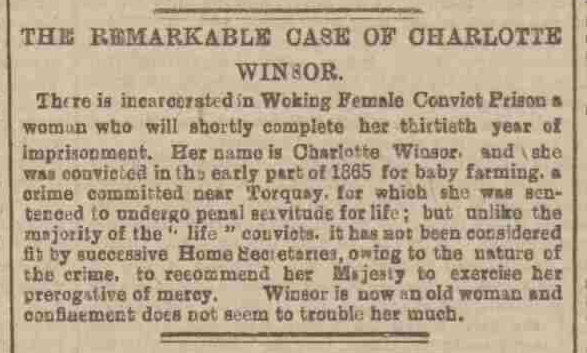
THE REMARKABLE CASE OF CHARLOTTE WINSOR.
There is incarcerated in Woking Female Convict Prison a woman who will shortly complete her thirtieth year of imprisonment. Her name is Charlotte Winsor, and she was convicted in the early part of 1865 for baby farming, a crime committed near Torquay, for which she was sentenced to undergo penal servitude for life; but unlike the majority of the “life” convicts, it has not been considered fit by successive Home Secretaries, owing to the nature of the crime, to recommend her Majesty to exercise her prerogative of mercy. Winsor is now an old woman and confinement does not seem to trouble her much.